
并购六条

Search documents
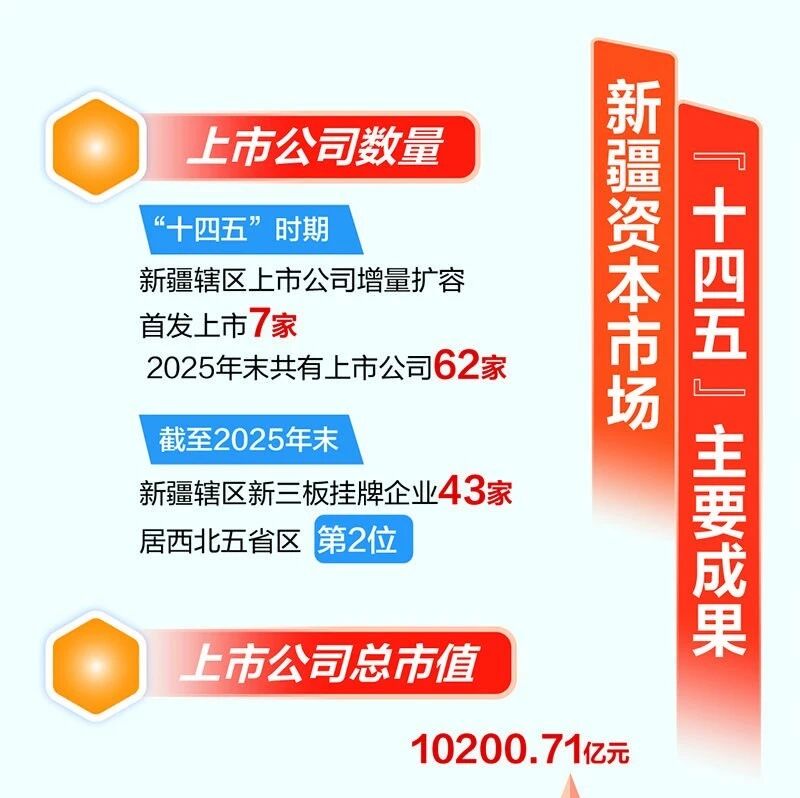
资本向“新”更好发挥枢纽作用 金融向“实”提升新疆发展势能丨决胜“十四五” 擘画“十五五”·地方资本市场高质量发展之新疆篇
证券时报· 2026-02-06 04:29
Core Viewpoint - The article discusses the significant growth and development of listed companies in Xinjiang during the "14th Five-Year Plan" period, highlighting the increase in market capitalization, revenue, and investment returns, as well as improvements in corporate governance and risk management [3][7][8]. Group 1: Market Expansion and Financial Growth - Xinjiang's listed companies increased from 7 to 62 by the end of 2025, with total market capitalization rising from 606.28 billion to 1,020.07 billion, a growth of 68.25% [3]. - Total revenue of listed companies is projected to grow from 533.31 billion in 2020 to 709.78 billion in 2024, an increase of 33.09% [7]. - Cumulative cash dividends paid by listed companies reached 88.33 billion, up 162.33% from the previous period [7]. Group 2: Financing and Investment - Direct financing through various instruments such as stocks, bonds, ABS, and REITs reached 364.76 billion [4]. - By 2025, Xinjiang's companies are expected to raise 59.26 billion through capital market financing [10]. - The region has seen a significant increase in the number of REITs, with new projects contributing to financing of 2.15 billion [14]. Group 3: Corporate Governance and Risk Management - The regulatory framework has been enhanced, with 39 cases of market violations addressed, resulting in penalties exceeding 100 million [8]. - A comprehensive system for preventing financial fraud has been established, improving corporate governance and internal controls [8]. - The implementation of tailored risk management strategies for individual companies has strengthened overall market stability [8]. Group 4: Future Development and Strategic Goals - The "15th Five-Year Plan" aims to leverage Xinjiang's unique resources and improve the business environment to support high-quality economic development [16][17]. - The focus will be on enhancing the capital market's role in supporting local industries and fostering innovation [16]. - The region plans to continue expanding its multi-tiered capital market, with an emphasis on supporting small and medium-sized enterprises [13][14].

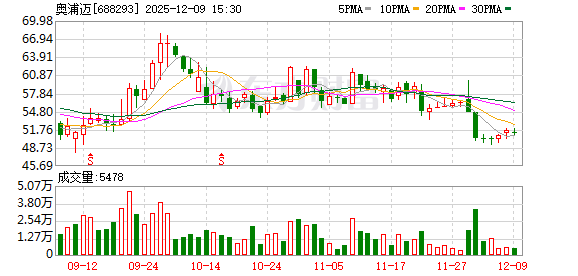
审核通过!奥浦迈或成“并购六条”首单分期股权支付重组
2 1 Shi Ji Jing Ji Bao Dao· 2025-12-10 06:37
Core Viewpoint - Aopu Mai's asset acquisition plan has been approved by the Shanghai Stock Exchange's M&A Committee, marking it as the first case in the A-share market to utilize a "staged payment mechanism" for share consideration since the release of the "Six M&A Rules" [1][2] Group 1: Company Overview - Aopu Mai, listed on the Sci-Tech Innovation Board in 2022, focuses on the research and production of cell culture media and provides contract development and manufacturing organization (CDMO) services [1] - The target company, Pengli Bio, specializes in drug and medical device research and preclinical research services (CRO), recognized as a national-level specialized and innovative small giant and a high-tech enterprise [1] Group 2: Strategic Rationale - Both companies operate within the pharmaceutical research and production service sector, indicating significant synergy and complementary industrial advantages [1] - The merger aims to create an integrated service platform combining "culture media + CRO + CDMO," which is expected to meet clients' needs from early research to commercial production, enhancing one-stop service capabilities and integrated competitive levels [1] Group 3: Financial Data - As of the end of 2024, Aopu Mai's total assets are 2.272 billion yuan, with annual revenue and net profit attributable to shareholders at 297 million yuan and 21.0523 million yuan, respectively [2] - Pengli Bio's total assets are 1.216 billion yuan, exceeding Aopu Mai's total assets by 50%, with annual revenue and net profit at 330 million yuan and 45.15 million yuan, respectively, both surpassing Aopu Mai's figures [2] Group 4: Regulatory Context - The asset restructuring plan was likely to be classified as a "restructuring listing" prior to the release of the "Six M&A Rules," which would have subjected it to stricter scrutiny and a slower process [2] - The approval of Aopu Mai's restructuring project is seen as a typical case of implementing the "Six M&A Rules," aligning with the need for new productive forces and enhancing the resource allocation function of mergers and acquisitions [2]


“双首单”重组项目过会 提升支付灵活性降低并购风险
Zheng Quan Shi Bao· 2025-12-09 17:44
Core Viewpoint - The approval of Aopumai's restructuring project exemplifies the implementation of the "Six Merger Guidelines," highlighting the policy direction to enhance the resource allocation function of mergers and acquisitions in the capital market [1][3]. Group 1: Restructuring Mechanism - The installment payment mechanism for share consideration enhances payment flexibility and better protects the interests of listed companies [1]. - Listed companies will pay the controlling shareholders and management team of the target company in installments based on the subsequent operating conditions of the target company, with the number of shares adjusted according to performance completion [1]. - This flexible payment method for mergers and acquisitions helps align the long-term interests of the core team of the target company with those of the listed company, strengthening collaborative development [1]. Group 2: Market Significance - On December 8, Aopumai's application for issuing shares to purchase assets was approved by the Shanghai Stock Exchange's M&A Committee, marking the first project in the A-share market to adopt the installment payment mechanism since the release of the "Six Merger Guidelines" [3]. - It is also the first project to apply the policy linking the investment period of private equity funds with the lock-up period for shares obtained through restructuring [3].
A股首单重组股份对价分期支付、“反向挂钩”项目通过上交所重组委审议
Xin Hua Cai Jing· 2025-12-09 13:26
Core Viewpoint - Aopu Mai's asset acquisition through share issuance has been approved by the Shanghai Stock Exchange's M&A Committee, marking the first use of a phased payment mechanism for share consideration in the A-share market since the introduction of the "Six M&A Guidelines" [2] Group 1: Aopu Mai's Acquisition - Aopu Mai (688293.SH), listed on the Sci-Tech Innovation Board in 2022, focuses on cell culture medium R&D and biopharmaceutical contract development and manufacturing services (CDMO) [2] - The target company, Pengli Bio, specializes in drug and device R&D clinical research services (CRO) and is recognized as a national-level specialized and innovative small giant [2] - Post-transaction, the target company will become a wholly-owned subsidiary of Aopu Mai, enhancing the company's profitability and core competitiveness through synergistic effects [2] Group 2: Phased Payment Mechanism - The phased payment mechanism for share consideration significantly enhances payment flexibility, safeguarding the interests of the listed company [3] - The listed company will pay the target company's controlling shareholders and management team in installments based on the target's future operational performance, allowing for adjustments in share quantity based on performance completion [3] - This mechanism binds the core team of the target company to the long-term interests of the listed company, promoting collaborative development [3] Group 3: Reverse Linkage Policy - The "reverse linkage" policy encourages private equity funds to participate in M&A by linking the investment period with the lock-up period for shares acquired through the restructuring [3] - Private equity funds holding shares of the target company for over 48 months prior to the restructuring will have a 6-month lock-up period for shares obtained through this transaction [3] - This policy fosters "patient capital" and promotes a healthy cycle of fundraising, investment, management, and exit [3] Group 4: "Six M&A Guidelines" Impact - The "Six M&A Guidelines" introduce a comprehensive set of reform measures aimed at invigorating the M&A market, enhancing regulatory inclusiveness, and improving payment flexibility and review efficiency [4] - Since the implementation of these guidelines, various policies such as inter-company mergers, phased payment mechanisms, and the reverse linkage for private equity funds have been successfully executed [4] - These measures are expected to strengthen the role of capital markets in corporate M&A, supporting economic transformation and high-quality development [4]
“双首单”重组项目,过会!
Shang Hai Zheng Quan Bao· 2025-12-09 12:15
Group 1 - The core viewpoint of the news is that Aopu Mai's asset acquisition through share issuance has been approved, marking a significant step in the implementation of the "Six Merger Guidelines" aimed at enhancing the value of listed companies by injecting quality assets [1] - Aopu Mai's restructuring project is the first in the A-share market to adopt a phased payment mechanism for share consideration since the release of the "Six Merger Guidelines" [1] - The target company, Pengli Bio, specializes in preclinical research services for drugs and devices and is recognized as a national-level "little giant" enterprise, which will enhance Aopu Mai's profitability and core competitiveness post-acquisition [1] Group 2 - The phased payment mechanism for share consideration enhances payment flexibility and better protects the interests of the listed company, allowing for adjustments based on the target company's future performance [2] - The "reverse linkage" mechanism encourages private equity funds to participate in mergers and acquisitions by linking the investment period with the lock-up period of shares obtained through the restructuring [2] - The implementation of the "Six Merger Guidelines" has led to a series of reforms aimed at invigorating the merger and acquisition market, improving regulatory tolerance, and supporting industrial integration [3]
提升支付灵活性 A股首单股份对价分期支付重组项目过会
Zheng Quan Shi Bao Wang· 2025-12-09 11:01
Core Viewpoint - Aopu Mai's asset acquisition application has been approved by the Shanghai Stock Exchange's M&A Committee, marking the first A-share market project to utilize a phased payment mechanism for share-based acquisitions since the introduction of the "Six Merger Guidelines" [1] Group 1: Transaction Details - Aopu Mai is primarily engaged in the research and production of cell culture media and provides CDMO services, while the target company, Pengli Bio, focuses on preclinical research services in drug and device development [1] - Upon completion of the transaction, the target company will become a wholly-owned subsidiary of the listed company, enhancing profitability and core competitiveness through synergistic effects [1] Group 2: Policy Implications - The approval of Aopu Mai's restructuring project exemplifies the implementation of the "Six Merger Guidelines" and highlights the policy direction to strengthen the resource allocation function of mergers and acquisitions [1] - The phased payment mechanism for share-based acquisitions enhances payment flexibility and better safeguards the interests of the listed company, allowing for adjustments in share payments based on the target company's operational performance [1] Group 3: Private Equity Involvement - The "reverse linkage" mechanism encourages private equity funds to participate in mergers and acquisitions by linking the investment period with the lock-up period for shares acquired through restructuring [2] - Private equity funds that have held shares in the target company for over 48 months will have a lock-up period of 6 months for shares obtained through this restructuring, promoting a "patient capital" approach [2] - The implementation of the "Six Merger Guidelines" and related policies has led to various measures such as mergers and acquisitions among peer companies and phased payment mechanisms, further supporting economic transformation and high-quality development [2]
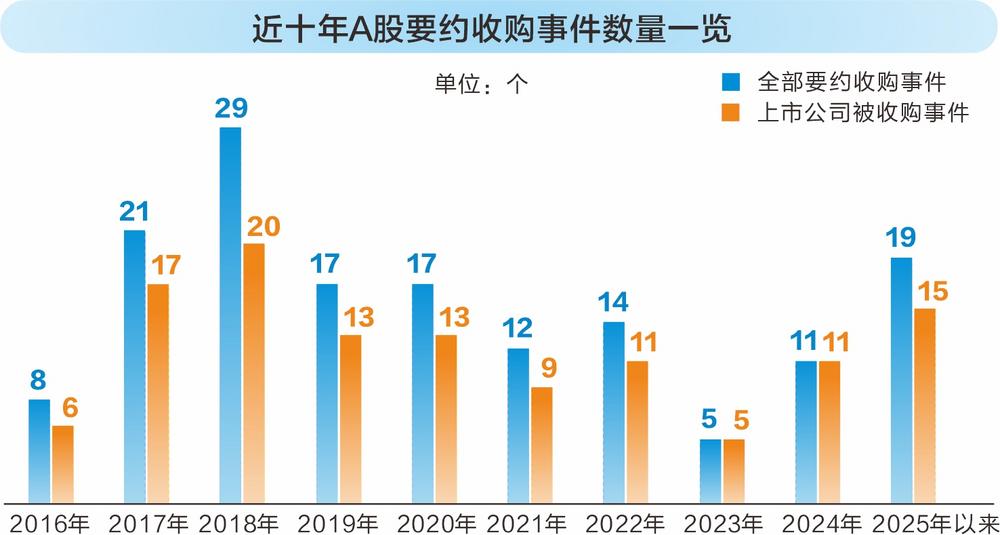
年内要约收购数量创七年新高 四大特征凸显
Zheng Quan Shi Bao· 2025-11-26 18:33
Core Viewpoint - The A-share market has seen a significant increase in tender offers, with 19 cases reported in 2023, marking the highest number since 2019, indicating a recovery in the M&A market and new characteristics emerging in the tender offer landscape [8][9]. Group 1: Tender Offer Statistics - The total number of tender offers in the A-share market has reached 19 in 2023, with 15 cases involving listed companies as target parties, both figures being the highest since 2019 [9]. - The proportion of cases where the acquisition price is not less than the weighted average price of the first 30 trading days before the announcement has increased, with 69.23% in 2023 [1]. Group 2: Financial Indicators Before and After Acquisition - For completed cases, the average net cash flow increased from 5.40 billion to 6.19 billion yuan, while for failed cases, it decreased from 10.72 billion to 8.15 billion yuan [3]. - The average net profit for completed cases rose from 2.35 billion to 3.26 billion yuan, whereas for failed cases, it fell from 5.49 billion to 3.05 billion yuan [3]. - The average asset-liability ratio for completed cases decreased from 48.35% to 40.75%, while for failed cases, it dropped from 43.78% to 39.73% [3]. Group 3: Characteristics of Recent Tender Offers - The distribution of industries involved in tender offers has broadened, with companies from 14 different industries participating in 2023, a record since 2019 [12]. - The first reverse acquisition of a B-share company acquiring an A-share company occurred in April 2023, showcasing innovative transaction structures [12][13]. - There is a notable increase in the focus on industrial integration, with many acquisitions aimed at enhancing control over listed companies and aligning with the "merger six guidelines" [13]. Group 4: Market Performance and Shareholder Impact - Tender offers have shown a significant positive impact on stock prices, with an average increase of over 3.5% on the announcement day, compared to less than 0.1% for the CSI 300 index [15]. - The average market capitalization of target companies increased from approximately 8.8 billion yuan at the announcement to over 11.7 billion yuan, reflecting a growth of over 30% [16]. - The average net profit of target companies rose by nearly 40% post-acquisition, indicating improved financial health [16].
政策红利窗口已打开,A股并购潮加速“引入”国际资本
Hua Xia Shi Bao· 2025-11-17 03:36
Core Insights - The A-share merger and acquisition (M&A) wave is attracting increasing international capital to the Chinese capital market, with a focus on leveraging the "M&A Six Guidelines" policy to enhance industrial development [2][3] - The A-share M&A market has entered a new active cycle, reflecting a shift in China's economic growth from factor-driven to innovation-driven [2][3] - International investors see significant growth opportunities in China's unique demand-supply ecosystem, which is fostering the emergence of world-class leading enterprises [2][3] M&A Market Dynamics - Since the introduction of the "M&A Six Guidelines" in September last year, over 1,000 M&A transactions have been disclosed by companies in the Shanghai Stock Exchange, with significant asset restructurings increasing by 138% year-on-year [3] - Half of the major asset restructurings are in the technology sector, which has seen a 287% increase, indicating a strong focus on emerging and future industries [3] - Traditional industries are also seeking transformation through M&A, aiming to enhance their competitive edge and find new growth avenues [3][6] Role of International Capital - International capital is increasingly viewing the M&A market as a vital window into China's economic landscape, with a focus on sectors like healthcare and consumer goods [8][9] - The M&A fund sector is becoming crucial, providing not only capital but also professional investment and management services to enhance enterprise value [4][9] - The integration of domestic and international markets through M&A is seen as a key strategy for driving industry upgrades and optimizing resource allocation [4][9] Future Trends - The technology sector, particularly in semiconductors, is experiencing a surge in M&A activity, with significant transactions representing over 20% of the market [5] - Traditional industries are expected to accelerate their transformation efforts, reshaping the valuation landscape of A-shares [6] - The demand for M&A is anticipated to grow as China's economy continues to develop and its industrial structure evolves [9][10] Policy and Market Environment - The current policy environment is viewed as supportive of M&A activities, with ample cash reserves among A-share listed companies and encouragement for restructuring [9][10] - International capital leaders are advocating for further policy enhancements to eliminate regional protectionism and industry barriers, which could facilitate a more unified market for M&A [10]

国家金融与发展实验室理事长李扬:投资者偏好转变,权益类及主题类理财产品正受青睐
Mei Ri Jing Ji Xin Wen· 2025-11-14 11:17
Group 1: Mergers and Acquisitions Market - The mergers and acquisitions (M&A) market is showing significant new development trends, becoming a core engine for economic structural adjustment [3][4] - Companies are increasingly using M&A to build complete industrial value ecosystems, aiming for listing standards and seeking strategic partners for mutual benefits [3] - M&A has become an effective means for companies to acquire cutting-edge technologies, with methods like backdoor listings and stock swaps broadening listing pathways [3][4] Group 2: Policy Reforms and Market Environment - The "Six Guidelines" for M&A, released by the China Securities Regulatory Commission, aim to restore market-oriented and rule-of-law principles, allowing cross-industry and cross-field mergers [4][5] - The new policies simplify procedures and enhance efficiency, significantly shortening the M&A cycle and reducing time costs for companies [5] - The regulatory framework is becoming more tolerant of innovative and exploratory M&A projects, encouraging companies to take the lead in trial initiatives [5] Group 3: Wealth Management Market - The wealth management market in China is projected to reach CNY 29.95 trillion in 2024, with expectations to exceed CNY 32 trillion in 2025 and potentially reach CNY 45 trillion by 2026 [7] - Investors are shifting their preferences from traditional fixed-income products to diversified, non-standardized, and higher-yield asset allocations, indicating a change in risk appetite [7][8] - Asset management companies are encouraged to maintain a fiduciary role, focusing on service provision rather than profit from interest rate spreads, and to engage in sectors like technology innovation and green finance [8]
定向可转债支付走俏 科技企业并购“得心应手”
Zheng Quan Shi Bao· 2025-10-21 17:23
Core Viewpoint - The adoption of targeted convertible bonds for mergers and acquisitions (M&A) is gaining popularity among listed companies due to their dual characteristics of equity and debt, providing flexibility and reducing financial pressure compared to traditional cash payments [1][3]. Group 1: Adoption of Targeted Convertible Bonds - Since the introduction of targeted convertible bonds for restructuring projects, 16 A-share listed companies have announced plans to use this method for M&A, alongside issuing shares and cash payments [1][2]. - Companies like Changhong High-Tech and Huahai Chengke are actively pursuing M&A using targeted convertible bonds, indicating a trend among tech firms [2][4]. - Targeted convertible bonds allow companies to issue bonds that can be converted into shares under certain conditions, providing a flexible payment structure for M&A transactions [2][3]. Group 2: Benefits for Technology Companies - Over 60% of the companies utilizing targeted convertible bonds for asset purchases are from the Sci-Tech Innovation Board and the Growth Enterprise Market, primarily targeting technology firms [4][5]. - The characteristics of technology companies, such as being asset-light and having high R&D investments, make targeted convertible bonds a suitable financing option, allowing for differentiated pricing and supporting valuation stability [5][6]. - The mechanism of targeted convertible bonds provides capital support flexibility for tech firms while allowing investors to mitigate risks and share in future growth [5][6]. Group 3: Enhancing M&A Efficiency - The use of targeted convertible bonds, along with other innovative tools, has significantly improved the efficiency of M&A transactions, reducing costs and risks associated with traditional methods [6]. - The flexible design and lower financing costs of targeted convertible bonds enhance market activity and promote resource integration and industrial collaboration [6]. - However, complexities in the terms of targeted convertible bonds may introduce challenges in understanding and negotiation, alongside potential credit and market valuation risks [6].
