
成本上升

Search documents
TrendForce:2026 全球手机产量恐衰退10%至11.35 亿台
Huan Qiu Wang· 2026-02-12 05:45
Core Insights - The smartphone industry is facing significant challenges due to a sharp increase in memory prices, which is expected to lead to a notable decline in global smartphone production by 2026 [1] Group 1: Production Forecast - Global smartphone production is projected to decrease by 10% in 2026, reaching approximately 1.135 billion units [1] - If memory prices continue to rise, the production decline could extend to 15% or more, with annual capacity potentially dropping to a minimum of 1.061 billion units [1] Group 2: Cost Impact - The surge in memory prices has directly increased the manufacturing costs of smartphones [1] - For instance, the estimated contract price for a mainstream configuration of 8GB RAM and 256GB storage has risen by nearly 200% compared to the same period in 2025 [1] - The share of memory costs in the overall smartphone production costs has escalated from the previous range of 10%-15% to now 30%-40% [1] Group 3: Manufacturer Strategies - The significant rise in costs has compelled smartphone manufacturers to adjust their production and operational strategies [1] - Manufacturers are responding by raising the prices of end products, restructuring product mix, or optimizing hardware configurations to cope with cost pressures [1]
受成本上升等影响,中微半导、国科微宣布芯片产品大幅涨价
Sou Hu Cai Jing· 2026-01-27 11:33
Group 1 - Zhongwei Semiconductor announced a price increase for MCU and Norflash products due to industry-wide chip supply shortages and rising costs, with price adjustments ranging from 15% to 50% [1] - Guokewi also issued a price increase notice, indicating that the supply gap for KGD chips is expected to widen, with price hikes of 40% for 512Mb KGD, 60% for 1Gb KGD, and 80% for 2Gb KGD products starting January 2026 [4] - Guokewi plans to adjust prices in the second quarter of 2026 based on market fluctuations of KGD prices, with specific strategies to be announced later [5] Group 2 - Zhongwei Semiconductor is a leading provider of intelligent control solutions in China, focusing on the research and design of microcontrollers (MCUs) and offering high-performance, low-power, and highly integrated chip products for various smart terminal devices [9] - Guokewi is dedicated to the development of large-scale integrated circuits and solutions in fields such as smart ultra-high definition, smart vision, artificial intelligence, and automotive electronics, with a range of proprietary chips including satellite HD chips and AI vision processing chips [9]



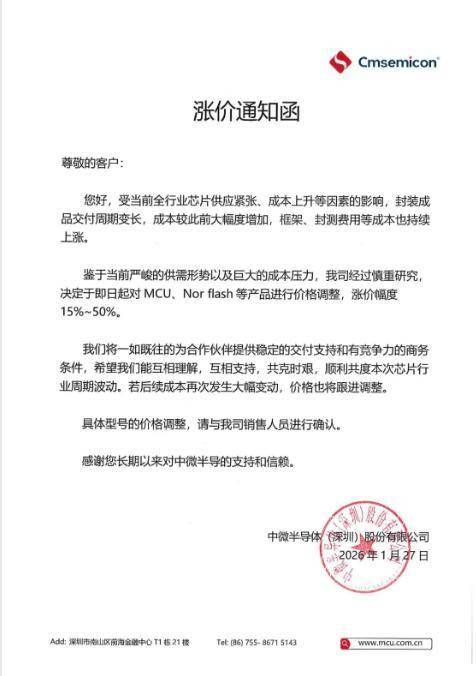
中微半导发布涨价通知函:即日起调整MCU、Nor flash等产品价格,涨价幅度15%~50%
3 6 Ke· 2026-01-27 11:09
Core Viewpoint - The company Zhongwei Semiconductor has announced a price increase for its products due to industry-wide chip supply shortages and rising costs, with price adjustments ranging from 15% to 50% [1] Group 1: Company Actions - Zhongwei Semiconductor issued a price adjustment notice citing significant increases in delivery cycles and costs for packaged products [1] - The company has decided to raise prices for MCU and Nor flash products in response to the current supply-demand situation and cost pressures [1] Group 2: Industry Context - The semiconductor industry is experiencing tight supply conditions, leading to prolonged delivery times and increased costs across various components, including packaging and testing fees [1] - The overall cost pressures in the industry are prompting companies to reconsider pricing strategies to maintain profitability [1]
塑料花盆全球第一 环球园艺谋港上市
BambooWorks· 2025-12-29 15:04
Core Viewpoint - The company, Global Horticulture Limited, is facing a decline in both revenue and net profit in the first half of the year, despite its strong market position in the decorative plastic pot industry and a focus on the U.S. market, which is not affected by tariffs [1][6]. Group 1: Company Overview - Global Horticulture Limited, founded in 2004 by Chairman and CEO Lu Jingzhang, is the world's largest manufacturer of decorative plastic pots, with a significant portion of its production based in Shenzhen since 2006 [2]. - The company’s product range includes outdoor and indoor decorative plastic pots, contributing 65.3% and 21% to its revenue respectively in the first half of the year [2]. Group 2: Market Position and Strategy - The majority of the company's revenue comes from the U.S. market, accounting for over 90% of total revenue from 2022 to the first half of 2025, with established long-term partnerships with major retailers like Lowe's, Walmart, Costco, and Home Depot [4]. - The U.S. gardening market is robust, with over 55% of households owning gardens, and the retail sales of decorative gardening pots reaching $1.5 billion, expected to grow at a compound annual growth rate of 6.1% from 2024 to 2029 [5]. Group 3: Financial Performance - In the first half of 2025, the company's revenue decreased by 4.1% to 186 million yuan, attributed to cautious customer behavior, particularly for larger outdoor products, although automation improvements helped increase gross profit margin by 3.5 percentage points to 60% [5][6]. - Despite an increase in gross profit, net profit fell by 15.7% to 33.88 million yuan due to rising administrative expenses and a 22.6% increase in sales and distribution costs, primarily from higher transportation costs and new SKU launches [6]. Group 4: Valuation and Future Prospects - Global Horticulture operates in a traditional manufacturing sector with a primary focus on exports, and its expected price-to-earnings ratio is lower compared to other Hong Kong-listed export stocks, making a high valuation at IPO unlikely [7]. - Future valuation expansion may depend on addressing rising costs and potential acquisitions, as the top five manufacturers in the decorative plastic pot market hold only 19% market share, indicating significant room for growth [7].

多家知名仪器外企官宣调价
仪器信息网· 2025-12-18 09:02
Core Viewpoint - Multiple scientific instrument manufacturers are announcing price adjustments in response to rising costs of raw materials, labor, and supply chain pressures, which are impacting production and operations [4][6][20]. Group 1: Thermo Fisher - Thermo Fisher has stated that due to macroeconomic factors, the costs of raw materials and intermediate processes for chromatography consumables are increasing, leading to production and operational pressures. As a result, they will adjust their product catalog prices starting January 1, 2026 [4][6]. Group 2: Danaher - Abcam - Danaher has completed a review of its entire product line and will implement necessary price adjustments due to rising costs in key areas. The new prices will take effect on January 1, 2026, with variations depending on the product line [8][11]. Group 3: Phenomenex - Phenomenex has decided to adjust market pricing for its products in China due to challenges posed by the global economic environment and supply chain issues. The price adjustments will vary by product line and will be effective from December 22, 2025 [15][16]. Group 4: PerkinElmer - PerkinElmer has indicated that due to multiple factors, including significant increases in core procurement costs due to tariffs, they will adjust prices for consumables starting January 1, 2026. The adjustments will vary by product [20][22]. Group 5: Jena - Jena has announced that due to macroeconomic influences leading to rising production costs, they will adjust prices for both main instruments and consumables starting January 1, 2026 [25]. Group 6: ATAGO - ATAGO has communicated that due to ongoing global economic instability and rapid increases in industry costs, they will raise prices on certain products effective December 1, 2025. Specific details can be obtained from regional sales representatives [29][32].



14亿人口消费者都带不动,2025年生意如何越来越难做?4个原因很现实
Sou Hu Cai Jing· 2025-12-13 19:07
Core Insights - The business environment in China is becoming increasingly challenging, with a significant decline in profitability and consumer spending expected in 2025 compared to previous years [1][9]. Group 1: Economic Trends - The total retail sales of consumer goods in China for 2024 are projected to be 48.79 trillion yuan, reflecting a growth rate of only 3.5%, which is historically low [1]. - Consumer spending growth is expected to slow to 2.3% in 2025, indicating a shift towards more cautious and purpose-driven consumption [7]. Group 2: Cost Pressures - Industry foundational costs are on the rise, with increasing prices for raw materials, logistics, and administrative expenses, leading to a compression of profit margins for businesses [3][9]. - Labor costs are expected to increase by over 5% in 2025 due to a diminishing labor pool and competitive market conditions, making it harder for businesses to maintain profitability [4][5]. - Rental costs remain high, particularly in first and second-tier cities, with some commercial properties commanding monthly rents in the tens of thousands, further straining business operations [4][5]. Group 3: Consumer Financial Constraints - Mortgage debt is significantly impacting consumer spending power, as many households are locked into long-term repayment plans, limiting their disposable income for other expenditures [5][9]. - Even with a decrease in mortgage interest rates, the overall financial burden remains substantial, constraining consumer spending and affecting sectors reliant on discretionary purchases [6][9]. Group 4: Banking and Financial Environment - The decline in bank interest rates, while seemingly beneficial, reflects underlying economic weaknesses and has led to reduced profitability for banks, which may tighten lending standards [8][9]. - The net interest margin for commercial banks fell to a historic low of 1.43% in early 2025, indicating pressure on banks to maintain profitability, which could adversely affect small businesses seeking loans [8].

美国制造业11月萎缩幅度创四个月新高 支付价格指数五个月来首次回升
智通财经网· 2025-12-01 16:06
Core Insights - The US manufacturing sector shows signs of continued weakness in November, with the manufacturing index falling to 48.2, marking the largest contraction in four months and remaining below the neutral level of 50 for nine consecutive months [1][2] Group 1: Manufacturing Index and Economic Conditions - The ISM manufacturing index decreased by 0.5 points to 48.2, indicating ongoing challenges in the sector due to weak demand and cost pressures [1] - The "prices paid index" rose for the first time in five months, indicating a resurgence in raw material cost pressures, up approximately 8 points year-over-year [1] - New orders index experienced its fastest contraction since July, while backlog orders saw the largest decline in seven months [1] Group 2: Employment and Labor Market - About 25% of manufacturing firms reported job reductions in November, the highest proportion since mid-2020 [1] - Although the production index rebounded to its fastest expansion in four months, overall output remains volatile, unable to offset the pressures from declining orders and employment [1] Group 3: Industry Performance - In November, 11 manufacturing industries contracted, including apparel, wood, paper products, and textiles, while only four industries, such as computers and electronics, experienced growth, marking the lowest number in nearly a year [2] - The machinery sector reported extended import transportation times and customer demands for earlier deliveries due to tariff impacts [2] - The transportation equipment sector is undergoing structural adjustments, including layoffs and shifts to overseas production, in response to the tariff environment [2] Group 4: Supply Chain and Inventory - Supplier delivery times accelerated for the first time in four months, indicating some relief in supply chain pressures [2] - Manufacturers and customers continue to reduce inventory levels, although the rate of decline has slowed compared to October [2] - Overall, the US manufacturing sector is facing a "triple pressure" of weak demand, rising costs, and policy uncertainty, making a substantial turnaround unlikely in the short term [2]
玻璃:产销出现回落继续弱势看待
Chang Jiang Qi Huo· 2025-11-17 03:49
Report Industry Investment Rating - The investment strategy for the glass industry is to expect a weak and volatile trend [3] Core Viewpoints - Last week, the glass futures showed a weak performance, and the main contract's open interest reached a new high. With insufficient expectations for macro - policies, the market was more in line with the fundamentals, showing a downward trend. The end - of - year demand is likely to weaken further, and there is delivery pressure in the near - term contracts. Technically, the moving averages are in a weak arrangement, and the short - side power is dominant and strengthening [3] Summary by Directory 01 Investment Strategy - The investment strategy is to expect a weak and volatile trend. The main logic is that the glass futures were weak last week, the supply side remained stable with no changes in production lines and constant daily melting volume, and the demand side weakened with manufacturers' production - sales ratio declining. The downstream was pessimistic, and processing factory orders deteriorated. For soda ash, although the cost increased due to rising coal prices, it was still considered from a short - selling perspective. The outlook is that the end - of - year demand may weaken, and there is delivery pressure in the near - term contracts. It is recommended to hold out - of - the - money call options on the glass 01 contract until expiration and continue to hold short positions on the 01 futures contract, with attention on the range of 990 - 1000 [3] 02 - 03 Market Review - **Spot and Futures Prices**: As of November 14, the 5mm float glass market price was 1110 yuan/ton (-20) in North China, 1140 yuan/ton (0) in Central China, and 1230 yuan/ton (-10) in East China. The glass 01 contract closed at 1032 yuan/ton last Friday, down 59 yuan for the week. The soda ash - glass price difference was 194 yuan/ton (+75), the glass 01 contract basis was 68 yuan/ton (+19), and the 01 - 05 contract spread was - 128 yuan/ton (+6) [10][11][13] 04 Profit - **Production Process Profits**: For the natural gas production process, the cost was 1574 yuan/ton (0), and the gross profit was - 344 yuan/ton (-10); for the coal - gas production process, the cost was 1210 yuan/ton (-2), and the gross profit was - 100 yuan/ton (-18); for the petroleum coke production process, the cost was 1092 yuan/ton (0), and the gross profit was 48 yuan/ton (0) [16] 05 Supply - The daily melting volume of glass was 157,505 tons per day (unchanged), and there were currently 222 production lines in operation. There have been multiple production line changes including cold - repairs, restarts, new ignitions, and product conversions [18][20] 06 Inventory - As of November 14, the total inventory of 80 glass sample manufacturers nationwide was 6,324.7 million weight boxes. The inventory in North China was 1112.2 million weight boxes (+30.7), in Central China was 710 million weight boxes (+8.3), in East China was 1333.3 million weight boxes (-11.4), in South China was 932.8 million weight boxes (-15.8), in Southwest China was 1301.5 million weight boxes (+7.6), the inventory in Shahe factories was 390 million weight boxes (-26), and in Hubei factories was 507 million weight boxes (-4) [22] 07 Deep - processing - On November 13, the comprehensive production - sales ratio of float glass was 88% (-26%). On November 14, the operating rate of LOW - E glass was 46.5% (+1.7%). At the beginning of November, the available order days for glass deep - processing were 10.8 days (+0.4) [26] 08 - 09 Demand - **Automobile Industry**: In October, China's automobile production was 3.359 million vehicles, a month - on - month increase of 83,000 and a year - on - year increase of 363,000; sales were 3.322 million vehicles, a month - on - month increase of 96,000 and a year - on - year increase of 269,000. The retail sales of new - energy passenger vehicles were 1.282 million, with a penetration rate of 57.2% [37] - **Real Estate Industry**: In September, China's real estate completion area was 34.3534 million square meters (0% year - on - year), new construction area was 55.9831 million square meters (-15% year - on - year), construction area was 54.7081 million square meters (-16% year - on - year), and commercial housing sales area was 85.3087 million square meters (-12% year - on - year). From November 15 to November 14, the total commercial housing transaction area in 30 large - and medium - sized cities was 1.61 million square meters, a month - on - month decrease of 20% and a year - on - year decrease of 31%. In October, real estate development investment was 585.729 billion yuan, a year - on - year decrease of 23% [44] 10 - 13 Cost - side Soda Ash - **Spot and Futures Prices**: As of last weekend, the mainstream market prices of heavy soda ash were 1325 yuan/ton (0) in North China, 1250 yuan/ton (0) in East China, 1300 yuan/ton (0) in Central China, and 1450 yuan/ton (0) in South China. The soda ash 2601 contract closed at 1226 yuan/ton (+16) last Friday, and the basis of soda ash Huazhong 09 was 74 yuan/ton (-16) [47][51] - **Profit and Cost**: As of last Friday, the cost of the ammonia - soda process for soda ash enterprises was 1392 yuan/ton (+33), with a gross profit of - 24 yuan/ton (+20); the cost of the co - production process was 1871 yuan/ton (+80), with a gross profit of - 182 yuan/ton (-8). The market price of synthetic ammonia in Hubei was 2423 yuan/ton (+173), and the ex - factory price of wet ammonium chloride from Xuzhou Fengcheng was 300 yuan/ton (0) [53][54][55] - **Inventory**: As of November 14, the national in - factory inventory of soda ash was 170.73 million tons (a month - on - month decrease of 0.69 million tons), including 90.71 million tons of heavy soda ash (a month - on - month increase of 0.75 million tons) and 80.02 million tons of light soda ash (a month - on - month decrease of 1.44 million tons). The exchange soda ash warehouse receipts were 5454 (a month - on - month decrease of 2860) [62][67] - **Apparent Consumption and Production - sales Ratio**: Last week, the apparent consumption of heavy soda ash was 40.34 million tons, a week - on - week increase of 0.18 million tons; the apparent consumption of light soda ash was 34.27 million tons, a week - on - week increase of 0.97 million tons. The production - sales ratio of soda ash was 100.93%, a week - on - week increase of 2.57% [71][77]
美国10月裁员环比飙升183%!AI渗透与消费疲软叠加 劳动力市场正被改写
Di Yi Cai Jing· 2025-11-07 00:36
Group 1 - The core point of the article highlights that the acceleration of AI integration, weak consumer spending, and rising costs are driving companies to cut expenditures and adjust their workforce structures, leading to significant layoffs in the U.S. job market [1][4][5] - In October, U.S. companies announced layoffs of 153,000 employees, a staggering increase of 183% month-over-month, marking the highest monthly total since 2003 and a 175% increase compared to the same month last year [1][3] - Year-to-date, approximately 1.1 million layoffs have been announced, representing a 65% increase from the previous year, making it the largest year for layoffs since the pandemic began [1][3] Group 2 - The technology sector is identified as the most affected industry, with 33,300 layoffs in October, nearly six times the number in September, primarily due to the impact of AI integration and automation [3][4] - Other sectors experiencing layoffs include consumer goods, with 3,400 layoffs, and non-profit organizations, which have seen a staggering 419% increase in layoffs this year due to government shutdowns [3] - The five industries with the highest cumulative layoffs this year are government, technology, warehousing, retail, and services, collectively accounting for over 70% of total layoffs [3] Group 3 - The report indicates that the current wave of layoffs is closely linked to the accelerated application of AI technology, which is reshaping workforce demand, particularly in the technology and media sectors [4][5] - The labor market is experiencing a longer re-employment cycle for laid-off workers, with reduced job supply and extended job search periods, indicating a weakening momentum for job growth [3][5] - Analysts suggest that the combination of AI penetration, cooling consumer demand, and fiscal uncertainties is prompting companies to adopt defensive measures, potentially delaying economic recovery [5]
涨价200元/吨!纸企纷纷上调白卡纸价格
Zhong Guo Jing Ying Bao· 2025-10-24 15:43
Core Viewpoint - The domestic white cardboard market is experiencing a new round of price increases, with several paper companies announcing a price hike of 200 yuan/ton effective November 1, 2025, driven by rising costs, seasonal demand, and delayed new capacity releases [1][2]. Group 1: Price Increase Announcement - Multiple paper companies, including Bohui Paper and Nine Dragons Paper, have issued price increase notices, raising the price of white cardboard products by 200 yuan/ton [1][2]. - APP (China) also announced a price increase for all products produced by its subsidiaries, indicating a widespread trend among paper manufacturers [2]. Group 2: Factors Driving Price Increases - The price hike is primarily driven by three factors: continuous cost increases nearing the breakeven point for companies, the arrival of the traditional demand peak season ("Golden September and Silver October"), and delays in the release of new production capacity [1][2]. - Rising prices of raw materials such as waste paper and coal have significantly increased operational costs, leading to a divergence between current product prices and their actual value [2]. Group 3: Market Trends and Price Movements - The average market price for white cardboard in Q3 was 3981.78 yuan/ton, reflecting a 3.56% decrease from the previous quarter and a 9.32% year-on-year decline [3]. - The lowest market price was recorded at 3930 yuan/ton in late August, with a recovery to 3999 yuan/ton by the end of September, and a further increase to 4054 yuan/ton by October 23, marking a 1.38% rise since the end of September [3]. Group 4: Seasonal Demand and Supply Adjustments - The traditional consumption peak in September and October has led to a rigid increase in orders, particularly in the packaging sector, driven by the Mid-Autumn and National Day holidays [4]. - The overall inventory in the industry has decreased to a low level, and demand is expected to grow by 5.80% in Q4 [4]. - New production capacity releases have been adjusted, with a significant line in South China successfully launched, while another planned line by Nine Dragons Paper has faced delays, easing supply pressure [4]. Group 5: Future Market Outlook - The price of white cardboard is expected to rise further in October, with an overall average price forecasted to reach 4182 yuan/ton in Q4, representing a 5.02% increase [4].
