
新能源车出海

Search documents
2月新能源车销量跟踪:淡季回落,出海与技术主线凸显
Haitong Securities International· 2026-03-03 11:00
[Table_Title] 研究报告 Research Report 3 Mar 2026 香港汽车 Hong Kong Autos 2 月新能源车销量跟踪:淡季回落,出海与技术主线凸显 February NEV Sales Tracker: Seasonal Slowdown, Overseas Expansion and Technology Take Center Stage 王沈昱 Oscar Wang, CFA 王凯 Kai Wang, CFA sy.wang@htisec.com k.wang@htisec.com [Table_yemei1] 热点速评 Flash Analysis [Table_summary] (Please see APPENDIX 1 for English summary) 事件 各大车企已披露 2 月销量数据,受春节假期与消费节奏调整影响,车市阶段性"降温"特征明显,多数车企环比出现 双位数下滑。价格竞争热度边际回落,市场重心逐步转向技术与产品周期博弈,我们预计 2026 年汽车市场将在短期 波动与中期格局重塑中承压前行,等待 3–4 月需求修复与新品催化带来的结构性 ...



交银国际_汽车行业2026年展望:穿越周期的新动能智驾商用、储能共振与机器人量产_
2025-12-15 02:13
Summary of the Conference Call Industry Overview - **Industry**: Automotive Industry - **Date**: December 5, 2025 - **Rating**: Leading - **2026 Outlook**: New driving forces through cycles - smart driving commercial use, energy storage resonance, and mass production of robots [1] Key Points Automotive Market Trends - **Passenger Vehicles**: - After stimulus, the market is entering a high-level consolidation phase. - Expected retail sales for 2026 are projected to increase by 0.3% year-on-year to 24.45 million units, with a penetration rate of new energy vehicles (NEV) exceeding 60% [5][19]. - Growth is driven by product iterations and cost advantages from domestic brands in hybrid and pure electric technologies [5][20]. - **Exports**: - Total overseas sales are expected to reach 7.5-8 million units in 2026, with a shift towards localized manufacturing to address trade uncertainties [5][10]. - In the first ten months of 2025, cumulative exports reached 6.51 million units, a year-on-year increase of 23.3%, with NEVs accounting for nearly 40% of exports [10][36]. Heavy-Duty Trucks - **Market Growth**: - Anticipated sales for heavy-duty trucks in 2026 are around 1.1 million units, a 5% increase year-on-year, with better performance expected in the second half of the year [5][10]. - The market is benefiting from policy incentives and accelerated penetration of new energy vehicles [5][10]. Smart Driving - **L3 Commercialization**: - 2026 is expected to be the year of large-scale commercialization for L3 autonomous driving, with several manufacturers accelerating development [9][11]. - The penetration rate for L2 and above smart driving systems reached 87% in the first eight months of 2025 [9]. Robotics - **Market Development**: - The robotics sector is transitioning from "technological breakthroughs" to "commercial realization," with significant advancements expected in 2026 [13][14]. - The sector is entering a consolidation phase, focusing on actual delivery capabilities and performance realization [14]. Lithium Battery Sector - **Demand Growth**: - Global lithium battery demand is projected to grow by approximately 22% in 2026, with energy storage demand expected to grow faster than power batteries [15][16]. - The industry is experiencing a recovery in profitability, but caution is advised regarding the price of lithium carbonate and supply chain uncertainties [16][17]. Investment Recommendations - **Short-term (H1 2026)**: - Market adjustments may occur post-policy withdrawal, but structural opportunities will emerge, particularly in high-level smart driving [11]. - **Mid-term (H2 2026)**: - The entry of L3 into mass production will drive product iterations and new purchasing momentum [11]. - **Long-term (2027 and beyond)**: - Focus on the sustainability of embodied intelligence and the Robotaxi/AI ecosystem [11]. Additional Insights - **Market Dynamics**: - The automotive market is shifting from a growth-driven model to one focused on replacement demand, with significant implications for market structure and competition [19][20]. - **Technological Advancements**: - The integration of advanced technologies in vehicles is reshaping consumer preferences and driving demand for new energy vehicles [27][29]. This summary encapsulates the key insights and projections from the conference call, highlighting the automotive industry's evolving landscape and investment opportunities.




新能源产业链资讯
数说新能源· 2025-11-10 06:38
Battery Industry - The domestic lithium battery market remains strong, with a 3% month-on-month increase in production for November, which is notable given that many battery manufacturers are already operating at full capacity, with some exceeding production by 10% [1] - There is a low willingness to reduce production in December, and even if there are reductions in January, the decrease is expected to be limited [1] New Energy Vehicles - According to preliminary statistics from the Passenger Car Association, retail sales of passenger cars reached 2.387 million units in October, a year-on-year increase of 6% and a month-on-month increase of 7% [2] - Retail sales of new energy vehicles reached 1.4 million units in October, representing a year-on-year increase of 17% and a month-on-month increase of 8% [2] - The penetration rate of new energy vehicles reached 58.7%, an increase of 6.5 percentage points compared to the same period last year, with a cumulative penetration rate of 52.95%, up 8.12 percentage points year-on-year [2] - Major automakers reported sales figures for October: BYD 441,700 units, Geely 307,000 units, Leap Motor 70,200 units, NIO 40,300 units, Xpeng 42,000 units, Li Auto 31,000 units, Xiaomi over 40,000 units, and Hongmeng Zhixing 68,000 units; some popular models are experiencing tight battery supply [2] Recommendations - Main manufacturers are advised to balance performance and cost in battery cell procurement [4] Market Expansion - BYD is focusing on expanding its presence in Southeast Asia [8] - CATL is experiencing growth in the energy storage market that exceeds that of the power market [8]




中国太保董事长:新能源车出海仍面临保障短板,需构建全链条的服务网络
Xin Lang Cai Jing· 2025-11-09 07:41
Core Insights - The chairman of China Pacific Insurance, Fu Fan, stated that the sales of new energy vehicles (NEVs) in China are projected to reach 12.87 million units in 2024, with the market size of the entire industry chain approaching 2.8 trillion yuan [1] Group 1: Industry Outlook - In 2024, the sales volume of new energy vehicles in China is expected to be 12.87 million units, indicating significant growth in the sector [1] - The overall market size for the new energy vehicle industry chain is anticipated to be nearly 2.8 trillion yuan, reflecting the expanding economic impact of this sector [1] Group 2: Technological Challenges - Fu Fan highlighted that the technological transformation in the new energy vehicle sector brings forth increasing risk management challenges, particularly in areas such as intelligent driving and battery safety [1] - Collaboration among automotive, technology, and insurance sectors is essential to explore these new challenges and ensure that technology can be safely implemented [1] Group 3: Export and Global Strategy - The export volume of new energy vehicles from China is projected to exceed 70% in 2024, indicating a strong international presence [1] - To support the global expansion of the industry, it is crucial to establish a comprehensive service network that addresses shortcomings in overseas insurance, service guarantees, and financial support [1]

比亚迪9月销量:国内承压,海外放量
Guan Cha Zhe Wang· 2025-10-02 04:58
Core Insights - BYD's September sales show a trend of "domestic pressure and overseas growth" [1][4] - The company sold a total of 396,270 new energy vehicles globally in September, marking a year-on-year decline of 5.5%, the first negative growth in 19 months [1] - Domestic sales in September were approximately 325,400 units, reflecting a year-on-year decrease of about 15.8%, despite a month-on-month increase of approximately 11.1% [1][4] Domestic Market Performance - In September, BYD's pure electric vehicle sales reached 205,050 units, up about 24.3% year-on-year from 164,956 units [1] - Plug-in hybrid vehicle sales were 188,010 units, down approximately 25.6% from 252,647 units year-on-year [1] - The domestic market's challenges stem from intense competition and the aftermath of price wars, making it difficult for BYD to maintain previous high growth rates [4] Overseas Market Performance - BYD's export volume in September was 71,256 units, with passenger cars and pickups contributing 70,851 units, representing a year-on-year increase of 107% [2] - Cumulatively, from January to September, BYD sold 701,579 passenger cars and pickups overseas [3] - The strong overseas sales highlight the effectiveness of BYD's international expansion strategy [2] Overall Sales Performance - For the first nine months of the year, BYD's total sales reached 3,260,146 units, reflecting a year-on-year increase of 18.6% [4] - The company is expected to focus on new model launches and further expansion of overseas channels in the fourth quarter to potentially regain growth momentum [4]
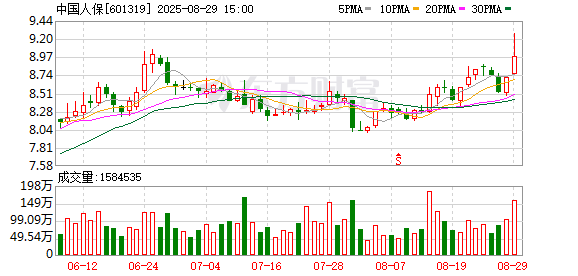
上市险企业绩报|中国人保股价创新高 加码新能源车险出海
Xin Hua Cai Jing· 2025-08-29 07:43
Core Viewpoint - China Pacific Insurance's stock price has reached new highs due to strong operating performance and favorable policies supporting the insurance industry [2][3][4]. Group 1: Financial Performance - In the first half of 2025, China Pacific Insurance achieved premium income of 454.6 billion yuan, a year-on-year increase of 6.4% [3]. - Property insurance premium income was 323.3 billion yuan, up 3.6%, while life insurance premium income rose to 131.2 billion yuan, an increase of 13.8% [3]. - The company's investment asset scale surpassed 1.7 trillion yuan as of June 30, 2025, reflecting a growth of 7.2% since the beginning of the year [3]. Group 2: Market Environment - The insurance industry is experiencing a historical development opportunity due to China's high-quality economic growth [4]. - The competitive landscape in the insurance sector is intensifying, particularly in the auto insurance market, which has entered a phase of stock competition [5][6]. Group 3: Strategic Initiatives - China Pacific Insurance is actively expanding its overseas insurance business for new energy vehicles, with over 1,000 units insured in Hong Kong by mid-2025 [6]. - The company plans to leverage its experiences in Hong Kong and Thailand to explore markets in Southeast Asia, Europe, and South America [6]. - Non-auto insurance premium income reached 26.7 billion yuan, a year-on-year increase of 16.6%, with a comprehensive cost ratio of 97% [7].

西部证券:中企在欧碳积分收入或好于预期 持续看好新能源车出海欧洲
智通财经网· 2025-08-28 01:37
Group 1 - The core viewpoint is that Chinese automakers' carbon credit income in Europe may exceed market expectations due to strict carbon emission requirements, despite a decrease in carbon credit scarcity as new energy penetration increases [1] - The report highlights that Chinese automakers are experiencing rapid growth in plug-in hybrid vehicle sales in Europe, which is expected to continue benefiting during the EU's carbon emission assessment transition period [3] - The collaboration between Chinese automaker Leap Motor and Stellantis illustrates the financial benefits of carbon credits, with Leap Motor's electric vehicles potentially reducing Stellantis' fines by approximately €8,900 per vehicle [1] Group 2 - The report emphasizes that the penetration of new energy vehicles in Europe is driven by various factors, particularly the low penetration rate of B/C class vehicles, which presents significant growth opportunities [2] - It is noted that while luxury brands like Mercedes and BMW have advanced in electrification, affordable brands such as Volkswagen and Renault are expected to outpace the industry average in their electric vehicle growth during this cycle [2] - The report suggests that Chinese automakers with local production capacity in the EU and plans to launch multiple affordable models will experience faster growth, recommending attention to companies like Leap Motor and BYD [3] Group 3 - Investment recommendations include focusing on companies such as Leap Motor, BYD, SAIC Motor, Geely, Xpeng, and NIO for electric vehicle manufacturers [4] - The European new energy vehicle supply chain is suggested to include companies like Weimars, Minth Group, Farah Electronics, Xinrui Technology, and Futech [4]


独家丨造车新兵「星空计划」工厂明年竣工,首款车2027年投产
雷峰网· 2025-07-03 11:07
Core Viewpoint - The article discusses the emergence of a new electric vehicle company, "Starry Sky Plan," which aims to export its first model before selling it domestically, highlighting the competitive landscape of the electric vehicle market in China and abroad [1][5]. Group 1: Company Overview - Starry Sky Plan was established in January 2025 and is focused on producing a high-end electric SUV, with its factory expected to be completed by Q1 2026 and production starting in 2027 [3]. - The company is indirectly owned by a well-known hardware company founder, holding an 80% stake [3]. - The project occupies a land area of 414,400 square meters in Shanghai's Lingang area, close to Tesla and CATL factories [3]. Group 2: Market Strategy - Starry Sky Plan intends to prioritize overseas markets for its first model, which is a strategic move given the current growth potential in international electric vehicle markets [5][6]. - The overseas market for electric vehicles is still in a growth phase, with penetration rates in Europe around 20%-30%, compared to nearly 50% in China [6]. - The company is actively recruiting for positions focused on overseas sales and channel development, indicating a strong commitment to international expansion [6]. Group 3: Competitive Landscape - In 2024, China is projected to export 6.41 million vehicles, marking a 23% increase year-on-year, maintaining its position as the world's largest automotive exporter [7]. - The SUV segment represents 53% of global new energy passenger vehicles, providing a favorable market for Starry Sky Plan's product [7]. - Established brands like Zeekr and NIO have already entered international markets, but Starry Sky Plan may find opportunities due to its competitive pricing and product positioning [7]. Group 4: Challenges and Timeline - The timeline for bringing a vehicle from concept to production is approximately 18 months, meaning Starry Sky Plan must complete design, trial production, and establish overseas channels within two years [8]. - Other automotive companies are also ramping up their international efforts, which could lead to intense competition by the time Starry Sky Plan launches its first model [8].

雷军直播回应小米YU7订单质疑和友商“截胡”
Xin Lang Cai Jing· 2025-07-03 00:49
Core Insights - Xiaomi's Yu7 vehicle received strong market response with over 200,000 pre-orders in just 3 minutes and 240,000 within 18 hours of launch [1] - CEO Lei Jun addressed concerns regarding the pre-order data, clarifying that the statistics align with industry standards and that the cancellation rate for Yu7 is low compared to other models [1] - Competitors have attempted to intercept Yu7 orders using misleading sales tactics, which Lei Jun criticized, emphasizing the importance of focusing on product strengths rather than disparaging competitors [1] Pre-order Data - The Yu7 achieved over 200,000 pre-orders in 3 minutes and 240,000 within 18 hours, indicating strong consumer interest [1] - Lei Jun stated that the cancellation rate for Yu7 is less than 15% of the total orders, which is significantly lower than the transfer orders for other models [1][2] - The decision not to disclose the 24-hour lock order data was made to avoid unnecessary speculation and discussion [1] User Demographics - The average age of Yu7 owners is approximately 33 years, which is three years older than SU7 owners [2] - Female ownership of Yu7 stands at 30%, which is 4.5% higher than the SU7 during its initial sales period [2] - Among Yu7 owners, 52.4% are iPhone users, which is 4.4% higher than the SU7 [2] Future Plans - Lei Jun indicated that due to high domestic demand, Xiaomi will focus on fulfilling local orders before considering international expansion, which may occur around 2027 [2]

出海战略“大获全胜”,比亚迪H股被海外投资者疯狂买入至溢价
2 1 Shi Ji Jing Ji Bao Dao· 2025-05-21 10:59
Core Viewpoint - BYD's stock prices have reached new historical highs in both A-shares and H-shares, reflecting strong market performance and investor confidence in the company's overseas expansion strategy [1][2]. Group 1: Stock Performance - On May 21, BYD's A-shares closed above 400 CNY per share, with an intraday high of 404 CNY, marking a significant milestone [1]. - BYD's H-shares also saw a notable increase, closing at 462.6 HKD per share with a daily gain of 4.05% [1]. - The H/A premium for BYD has risen to approximately 6.4%, indicating a strong preference for H-shares among investors [1][3]. Group 2: Overseas Expansion - BYD has successfully entered over 110 countries and regions with its electric vehicles, achieving a 72% year-on-year increase in overseas sales of passenger cars in 2024 [4]. - In Q1 2025, BYD's overseas sales of passenger cars and pickups exceeded 200,000 units, representing a 110% year-on-year growth [4]. - In April 2023, BYD's sales in key markets such as Brazil, Turkey, and Australia demonstrated significant growth, with sales figures of 8,485, 5,397, and 3,207 units respectively [4]. Group 3: Competitive Positioning - BYD has outperformed Tesla in several European markets, with sales in the UK and Italy reaching nearly five times and four times that of Tesla, respectively [4]. - The company's competitive advantage is attributed to its cost-effectiveness, local production capabilities, and strategic partnerships in Europe [5]. Group 4: Production Capacity and Investments - BYD has established production facilities in Thailand and Uzbekistan, with additional factories in Brazil and Hungary set to commence operations soon [6]. - The company plans to achieve close to one million units in overseas production capacity by the end of 2025, with specific annual capacities outlined for various locations [6]. - Recent reports indicate that BYD has ordered eight roll-on/roll-off ships to enhance its vehicle transportation capabilities [6]. Group 5: Investor Interest - Over the past 60 trading days, major brokers have net purchased approximately 12.77 million shares of BYD, amounting to around 49 billion HKD [7]. - Citibank has raised its target prices for BYD's shares, reflecting positive sentiment regarding the company's export growth and market positioning [7].