
AI资本支出

Search documents
“这个动作,真正的变盘信号!”美银Hartnett最新警告
华尔街见闻· 2026-02-17 11:30
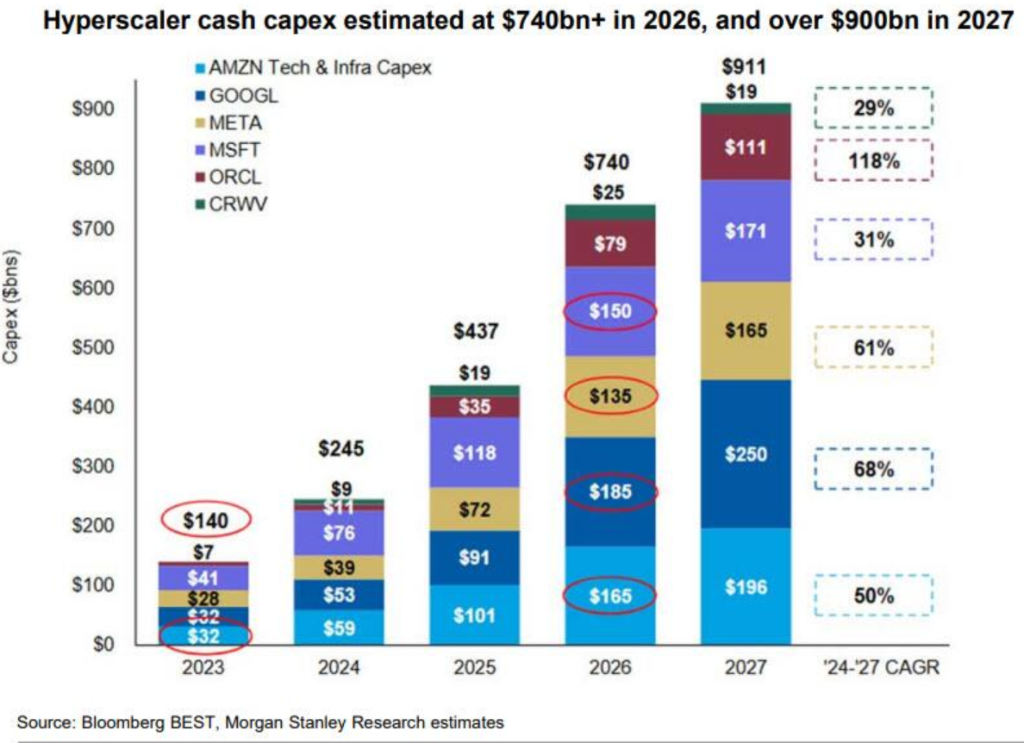
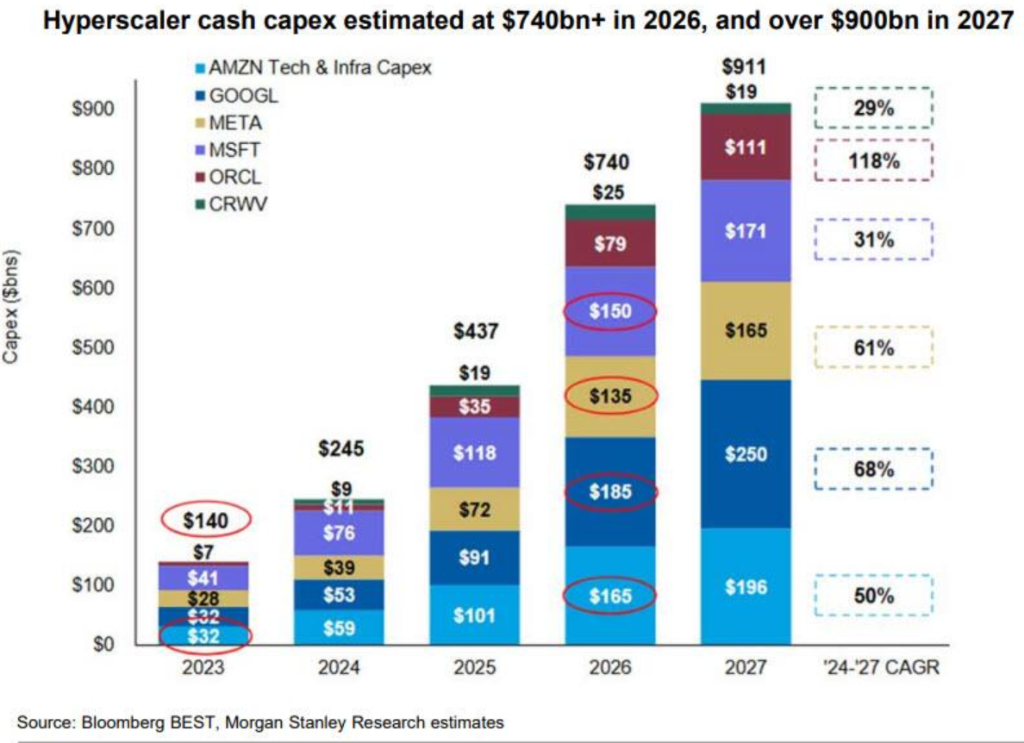
Group 1 - The core viewpoint of the article highlights a significant shift in AI capital expenditure from a "money printing machine" to a "money shredding machine," indicating potential liquidity and asset pricing upheaval [2] - Michael Hartnett from Bank of America has raised his market warning level, emphasizing that the "AI disruption trade" is rapidly spreading from the tech sector to traditional services [2][3] - The projected capital expenditure for hyperscalers has surged to $740 billion for 2026, up from a previous estimate of $670 billion, which poses financial risks [4] Group 2 - Hartnett warns that such massive investments could drive the free cash flow of the "Magnificent 7" tech companies towards zero or even negative [5] - To sustain this level of capital expenditure, tech giants may be forced into a large-scale bond issuance, indicating a shift towards "creditization" of previously strong balance sheets [8] - The narrative in the market is shifting from "awe of AI" to "being impoverished by AI," suggesting a growing concern over the financial implications of AI investments [9] Group 3 - A clear trading signal is identified: a major AI hyperscaler announcing a reduction in capital expenditure could trigger a significant rotation from tech giants to Main Street assets [10] - The disruption effect of AI is not limited to tech stocks; it is rapidly spreading to traditional service sectors, with various industries experiencing significant impacts [11][12] - Hartnett notes that once a sector is recognized as an "AI victim," its stock price recovery may take a long time, as seen with Indian tech stocks [12] Group 4 - Political factors are intensifying the asset rotation, with Hartnett highlighting the upcoming State of the Union address as a critical moment for potential policy shifts [14][16] - The article discusses the disparity in support for Trump between Wall Street and Main Street, with rising dissatisfaction among the public regarding inflation [15] - Hartnett suggests that if there is no "Trump bump" post-address, the government may adopt more aggressive affordability policies, benefiting small-cap stocks over tech giants [17] Group 5 - Despite a recent influx of $463 billion into global equities, the Bull & Bear Indicator remains in the "sell" zone, indicating ongoing caution in risk assets [21] - Hartnett emphasizes that the sell signal for risk assets, which began in December, is still valid until panic-driven cash hoarding occurs [22] - The article details recent capital flows, showing significant movements into stocks, bonds, and cash, with notable declines in tech and cryptocurrency assets [23][24] Group 6 - Hartnett reflects on the "great rotation" over the past 50 years, where major political and financial events have shifted asset leadership, suggesting a new cycle is emerging [25][26] - The next structural leaders are expected to be emerging markets and small-cap stocks, driven by shifts in service and manufacturing sectors [28] - The article concludes with a perspective on global rebalancing, emphasizing low asset allocation in China and India, which are now among the world's largest economies [31]


“这个动作,真正的变盘信号!”美银Hartnett最新警告
Hua Er Jie Jian Wen· 2026-02-17 10:50
Group 1 - The core message of the report indicates a significant shift in AI capital expenditure from a "money printing machine" to a "money shredding machine," suggesting potential liquidity and asset pricing upheaval [1] - The expected capital expenditure for hyperscalers has surged to $740 billion by 2026, up from a previous estimate of $670 billion, highlighting the alarming financial implications of such spending [2][3] - This excessive investment could push the free cash flow of the "Magnificent 7" tech companies towards zero or even negative values, indicating severe financial strain [3] Group 2 - To sustain this level of capital expenditure, tech giants may be compelled to engage in large-scale bond issuance, indicating a shift from previously strong balance sheets to a more credit-dependent model [5] - The narrative in the market is shifting from "awe of AI" to "being impoverished by AI," reflecting growing concerns over the financial sustainability of such investments [6] - A clear catalyst for reversing this trend would be an announcement from a major AI hyperscaler regarding a reduction in capital expenditure, which could trigger a significant rotation of assets from tech giants to Main Street [7] Group 3 - The disruptive effects of AI are rapidly spreading beyond the tech sector into traditional service industries, with significant impacts observed in sectors such as insurance, wealth management, real estate services, and logistics [8][9] - The first sector to be disrupted by AI, Indian tech stocks, has not seen any buying support since being labeled as "AI victims," indicating a prolonged period of price recovery challenges [10] Group 4 - Political factors are intensifying the asset rotation, with upcoming events such as the State of the Union address on February 24 being highlighted as critical moments for market sentiment [14][15] - The report suggests that if there is no significant boost from political figures, the government may adopt more aggressive affordability policies to address public concerns over inflation, which could favor small-cap stocks over large tech companies [16] Group 5 - The report notes a historical shift in the correlation between the Japanese yen and the Nikkei index, indicating a potential long-term bullish signal for Japanese equities [18][19] - Despite recent inflows into global equities, the Bull & Bear Indicator remains in the "sell" zone, suggesting that the adjustment in risk assets is not yet complete [23][24] - The analysis of the past 50 years of asset leadership transitions indicates that significant political and financial events often redefine market leaders, with emerging markets and small-cap stocks poised to be the next leaders [26][29]
美银Hartnett:“AI颠覆交易”加速扩散,一旦有科技巨头削减开支,将引发美股“轮动海啸”
Hua Er Jie Jian Wen· 2026-02-16 07:02
Group 1 - The core message of the report indicates a significant shift in AI capital expenditure from a "money printing machine" to a "money shredding machine," suggesting potential liquidity and asset pricing turmoil [1] - The expected capital expenditure for hyperscalers has surged to $740 billion by 2026, up from a previous estimate of $670 billion, raising concerns about extreme financial consequences for major tech companies [2] - The narrative in the market is shifting from "awe of AI" to "being impoverished by AI," with a clear signal for investors being the announcement of capital expenditure cuts by a major AI player [4] Group 2 - The report highlights a rapid spread of AI disruption effects into traditional service sectors, described as "wildfire AI disruption," impacting various industries sequentially [5][6] - The first sector affected by AI disruption was Indian tech stocks, which have not seen any buying support since being labeled as "AI victims," indicating a prolonged recovery period for such stocks [6] Group 3 - Political factors are intensifying the asset rotation, with a notable divergence in support for Trump between Wall Street and Main Street, leading to potential aggressive affordability policies ahead of the midterm elections [10][11] - The report suggests a strategy of "long Main Street, short Wall Street" is becoming effective, with significant asset performance divergence since the interest rate cut on October 29 [11] Group 4 - A historical shift in the correlation between the Japanese yen and the Nikkei index has been noted, indicating a potential long-term bull market for Japan, although a strong yen could negatively impact exporters [12][13] - Despite a $463 billion inflow into global equities, the Bull & Bear Indicator remains in the "sell" zone, suggesting that the adjustment in risk assets is not yet over [16] Group 5 - The report outlines a "great rotation" in asset leadership over the past 50 years, with significant political and financial events altering the flow of investments, indicating a potential shift towards emerging markets and small-cap stocks as the next structural leaders [17][20] - Emerging markets and small-cap stocks are expected to benefit from a transition in service-oriented to manufacturing-oriented investments, alongside rising costs in the AI arms race [20]
四点半观市 | 机构:当前市场表现并非周期逆转或所谓的“AI泡沫”破裂
Sou Hu Cai Jing· 2026-02-13 08:27
沪指蛇年上涨25.58%,十大牛股出炉;日韩股市2月13日收盘下跌;烧碱主力合约日间盘收涨逾2%;华 胜天成获资金净流入21.53亿元;景顺:当前市场表现并非周期逆转或所谓的"AI泡沫"破裂;保德信: 若AI资本支出不如预期 经济前景或落在"缓慢前行"增长模式。 【市场回顾】 A股蛇年行情宣告收官。纵观全年行情,仅去年4月初指数遭遇短期波动,随后一路震荡上行,沪指最 终收于4000点上方。 2月13日,日韩市场主要股指收盘下跌。日经225指数跌1.21%报56941.97点,本周累计上涨4.96%。韩国 综合指数下跌0.28%报5507.01点,本周累计上涨8.21%。 2月13日日间盘,国内商品期货主力合约跌多涨少,其中烧碱主力合约涨幅居前。截至15:00收盘,集运 指数(欧线)涨超3%,烧碱、碳酸锂、鸡蛋等涨超2%,苹果、双胶纸、焦炭等涨超1%,原木、工业 硅、菜粕等微涨;跌幅方面,沪锡跌超7%,沪银跌超5%,原油跌超4%,铂、沪镍、低硫燃料油等跌超 3%,国际铜、燃油、甲醇等跌超2%,纯苯、沪铝、纯碱等跌超1%,菜籽、锰硅、短纤等微跌。 2月13日,中证转债指数收跌0.43%,报526.44点。其中,微 ...
卡特彼勒股价创历史新高,市值突破3600亿美元
Jing Ji Guan Cha Wang· 2026-02-11 21:18
Core Viewpoint - Caterpillar's stock price increased by 4.40% on February 11, closing at $775.01, reaching a historical high with a market capitalization exceeding $360 billion, driven by strong quarterly earnings, improved industry conditions, active capital flow, and a shift in market style [1] Group 1: Performance and Operating Conditions - The company's revenue for Q4 2025 reached $19.1 billion, marking the highest quarterly record in recent years, with a year-on-year growth of 4% [2] - Strong demand in the power and energy sector led to an increase in both volume and price, alleviating the profit drag from rising tariff costs [2] - Although operating profit for the quarter decreased by approximately 9% year-on-year, growth in terminal equipment sales and structural highlights in the sector supported investor confidence [2] Group 2: Industry Policy and Environment - Increased global AI capital expenditure has positively influenced orders for heavy machinery, indirectly benefiting industrial equipment suppliers like Caterpillar [3] - The industrial distribution sector saw an overall increase of 3.74% on the same day, amplifying individual stock gains [3] - Market digestion of tariff policy impacts and expectations of economic resilience have driven short-term capital inflows [3] Group 3: Capital and Technical Conditions - The trading volume on that day reached $3.72 billion, with a volume ratio of 2.07, indicating active buying [4] - Year-to-date cumulative growth reached 35.60%, with some investors continuing to bet on industry recovery based on improved performance expectations [4] Group 4: Stock Price Situation - Recent trends in the U.S. stock market show a divergence, with the Dow Jones Industrial Average (which includes Caterpillar) outperforming the Nasdaq Technology Index [5] - Capital has shifted from overvalued technology sectors to value-oriented cyclical stocks, further propelling stock prices [5]
卡特彼勒股价创历史新高,财报业绩与行业景气提振市场
Jing Ji Guan Cha Wang· 2026-02-11 14:57
Core Viewpoint - Caterpillar's stock price increased by 4.17% on February 11, reaching a historical high with a market capitalization exceeding $360 billion, driven by strong quarterly earnings, industry conditions, and active trading [1] Group 1: Performance and Operating Conditions - The company's revenue for Q4 2025 reached $19.1 billion, marking the highest quarterly figure in recent years, with a year-on-year growth of 4% [2] - Strong demand in the power and energy sector led to both volume and price increases, alleviating the profit drag from rising tariff costs [2] - Although operating profit for the quarter decreased by approximately 9% year-on-year, growth in terminal equipment sales and structural highlights within the sector supported investor confidence [2] Group 2: Industry Policy and Environment - Increased global AI capital expenditure has positively influenced orders for related equipment, indirectly benefiting heavy machinery demand [3] - The market's digestion of tariff policy impacts and expectations of economic resilience may drive short-term capital inflows [3] Group 3: Stock Price and Trading Performance - The trading volume on the day reached $3.72 billion, with a volume ratio of 2.07, indicating active buying interest [4] - The industrial distribution sector overall rose by 3.06%, amplifying individual stock gains [4] - Year-to-date cumulative growth reached 35.30%, with some investors likely betting on recovery logic based on improved earnings expectations [4]

有色金属行业报告(2026.1.26-2026.1.30):金属板块大幅回调,建议逢低做多
China Post Securities· 2026-02-02 08:11
Industry Investment Rating - The industry investment rating is maintained at "Outperform the Market" [1] Core Insights - The report indicates that the precious metals market is experiencing a significant correction, but this is not seen as the end of the bull market. It suggests looking for low-position chips in gold between 4800-4900 USD per ounce [4] - Copper prices have shown considerable volatility, reaching historical highs above 14,000 USD before a sharp correction. The report anticipates a tight supply-demand situation for copper in 2026 due to production forecast downgrades by major companies [5] - The aluminum market is facing weak demand due to high prices, with expectations of a decline in operating rates. The report suggests that buying on dips remains a viable strategy [6] - Tantalum prices are expected to rise due to supply shocks from mining accidents in the Democratic Republic of Congo, which account for over 15% of global tantalum supply [6] - Tin prices have significantly dropped, influenced by macroeconomic events and supply uncertainties from conflict-affected regions. The report recommends buying on dips within a price range of 300,000 to 350,000 CNY [8] Summary by Sections Section 1: Market Performance - The non-ferrous metals sector has shown a weekly increase of 2.6%, ranking fifth among industry sectors [18] Section 2: Prices - LME copper decreased by 0.85%, aluminum by 1.88%, while zinc increased by 0.57%. Precious metals saw COMEX gold drop by 1.94% and silver by 17.94% [19][20] Section 3: Inventory - Global visible copper inventories increased by 28,066 tons, while aluminum saw a decrease of 6,204 tons. Other metals like zinc and lead also experienced inventory changes [32][34]
微软业绩超预期但股价因利润率展望下跌
Xin Lang Cai Jing· 2026-01-29 15:43
Core Insights - Microsoft (MSFT) shares dropped 11.8% in early trading on Thursday due to weak operational margin guidance and rising AI capital expenditures [1][2] Financial Performance - The company reported second-quarter revenue of $81.3 billion and earnings per share of $5.16 [1][2] - The cloud business achieved a significant milestone with $51.5 billion in revenue [1][2] Capital Expenditures - AI capital expenditures for the quarter reached $37.5 billion, contributing to concerns over future profitability [1][2]

工业金属+贵金属齐上涨,有色ETF鹏华(159880)涨超6.5%
Xin Lang Cai Jing· 2026-01-28 06:55
Group 1 - The core viewpoint of the news highlights a significant increase in non-ferrous metal prices, with LME three-month aluminum futures rising by 2.7% to $3,293.50 per ton, and spot gold surpassing $5,250 per ounce, reaching a historical high [1] - Standard Chartered Bank forecasts an average copper price of $12,950 per ton for the first half of the year and $11,475 per ton for the second half [1] - Zhongyou Securities emphasizes a strong hold on precious metals, citing increased safe-haven demand and net selling pressure on U.S. Treasuries, which enhances the value of gold allocation [1] Group 2 - The non-ferrous metal industry index (399395) has surged by 6.05%, with component stocks such as silver and aluminum companies experiencing gains of over 10% [2] - The non-ferrous ETF Penghua (159880) closely tracks the non-ferrous metal industry index and reflects the overall performance of listed companies in this sector [2] - As of December 31, 2025, the top ten weighted stocks in the non-ferrous metal industry index account for 51.65% of the index, including companies like Zijin Mining and China Aluminum [2]

“黄金的上涨关乎信任” 贵金属进入周期性牛市
Sou Hu Cai Jing· 2026-01-21 16:49
Core Viewpoint - The global economic landscape is facing significant challenges, leading to a strong performance in precious metals like gold and silver, which are seen as safe-haven assets. Analysts predict a potential cyclical bull market for these metals in the near future [1][4]. Precious Metals Performance - On January 21, 2023, spot gold reached a new historical high of $4,862.46 per ounce, with a monthly increase of over 12%. Silver prices hovered near historical peaks, while platinum also hit a new high [1][2]. - Analysts believe that the ongoing geopolitical tensions and concerns over U.S. monetary policy will drive gold prices to potentially reach $5,000 per ounce sooner than expected [2][7]. Market Dynamics - The recent sell-off in Japanese government bonds has raised concerns about the fiscal health of major economies, contributing to a "devaluation trade" where investors seek alternatives to currencies and government bonds [2][5]. - The London Metal Exchange (LME) copper contracts have seen a significant premium, with a recent contract trading at a $100 premium over the next contract, marking the highest level since 2021 [3][4]. Investment Trends - There is a growing belief among market participants that a long-term commodity cycle is beginning, with precious metals expected to continue their upward trajectory. Factors such as increased government spending and geopolitical uncertainties are driving this trend [4][5]. - Investment strategies are shifting as sovereign wealth funds and other investors move away from government bonds to seek alternative assets, with gold being favored for its hedging properties against negative events [6][7]. Future Projections - Metals Focus predicts that gold prices could exceed $5,000 by 2026, driven by de-dollarization and geopolitical risks, alongside continued accommodative monetary policies from central banks [7].