ETF资金

Search documents
策略周报:持股过节,还是持币过节?-20260207
Guoxin Securities· 2026-02-07 08:16
Core Conclusions - The probability of A-shares rising before and after the Spring Festival exceeds 70%, with a trend of reduced trading volume before the holiday and increased volume afterward [1][11] - Historical data shows that leveraged funds typically flow out before the holiday and flow back in afterward, while ETF funds show a pattern of inflow before and a slowdown in inflow after, contributing to the observed changes in trading volume and style differentiation in A-shares [2][16] - Current macroeconomic policies are positive, and overseas risks are manageable, suggesting that holding stocks during the holiday may be a better strategy, with a balanced allocation focusing on technology, particularly AI applications, and attention to cyclical sectors and real estate [2][19] Trading Volume and Style Differentiation - A-shares typically experience reduced trading volume before the Spring Festival, averaging a 4.0% decrease, while trading volume increases by an average of 22.3% after the holiday [11][13] - The probability of the Shanghai Composite Index rising in the week before the Spring Festival is 81%, with an average increase of 1.8%, while the probability for the week after is 76%, with an average increase of 1.3% [15] - Growth and value styles perform similarly before and after the holiday, but large-cap stocks outperform small-cap stocks before the holiday, while small-cap stocks significantly outperform large-cap stocks afterward, with a 87.5% probability of small-cap stocks rising in the week after [12][15] Fund Flow Analysis - Leveraged funds show a significant outflow before the Spring Festival, with an average net buy of -66.9 billion yuan, while they exhibit a net inflow of 14.2 billion yuan after the holiday [16][18] - ETF funds experience net inflows averaging 214.3 billion yuan before the holiday, but the net inflow decreases to 171.9 billion yuan after, with a lower probability of net inflows [16][18] - Foreign capital flows show little change before and after the holiday, maintaining a net inflow probability of 60-70% [16][17] Sector Allocation Strategy - The technology sector remains a key focus, driven by the AI wave, with expectations for the market to shift from hardware to application development [20] - There are opportunities in traditional value sectors, such as undervalued real estate and liquor stocks, as the spring market rally progresses [20][21] - The cyclical sector is also worth monitoring due to emerging demand from AI and new energy industries, alongside improving supply-demand dynamics in resource sectors [20]
可转债周报20260124:本轮转债行情是由ETF资金推动吗?-20260129
Changjiang Securities· 2026-01-29 07:41
Report Industry Investment Rating - No investment rating information is provided in the report. Core Viewpoints of the Report - Since the beginning of the year, the scale of convertible bond ETFs has rebounded, but its correlation with the index has weakened. Market fluctuations are mainly dominated by the equity side. The trading volume shows a divergence, which may reflect that investors' attitude towards valuation is marginally tightening [2][5]. - During the week, the A - share market was volatile and differentiated. The small - and medium - cap style was dominant. Cyclical manufacturing sectors such as building materials and chemicals led the rise, and trading was concentrated in the electronics and power equipment sectors [2][5]. - The convertible bond market strengthened as a whole. The small - cap index outperformed the large - cap index. The implied volatility and the median market price broke through historical highs, and the sentiment was warm. Some high - price and high - conversion premium rate targets led the gains [2][5]. - The primary market issuance was relatively stable with sufficient reserves. Clause games remained the focus. The willingness to lower the conversion price was still weak, while the call option game intensified, and the market's attention to call - counting varieties increased [2][5]. Summary According to Relevant Catalogs 1. Market Theme Weekly Review - During the week (January 18 - 24, 2026), the equity market strengthened as a whole. Themes in the photovoltaic and semiconductor directions performed strongly. Among them, the advanced packaging index, magnetoelectric storage index, photovoltaic selected index, and TOPcon battery index in the photovoltaic and semiconductor directions performed well, while the industrial Internet index, Chinese corpus index, and Sora index in the AI application direction were under pressure [28][29]. 2. Market Weekly Tracking 2.1 Main Indexes Differentiated, Science and Technology Innovation and Mid - cap Performed Strongly - During the week, the main A - share indexes were volatile and differentiated. The Shanghai Composite Index and the Shenzhen Component Index strengthened, while the ChiNext Index declined and then rebounded but still closed down. In terms of style, the small - and medium - cap indexes were relatively dominant, and the CSI 500 Index and the CSI 2000 Index outperformed the Science and Technology Innovation 50 Index and the CSI 300 Index [32]. - In terms of capital, the net outflow of the market's main funds converged. The average daily trading volume of the market declined, and the net outflow of the main funds slightly converged. Among them, the main funds were net inflow on Wednesday [33]. - The cyclical manufacturing sectors in the A - share market were relatively strong. Building materials, basic chemicals, steel, petroleum and petrochemicals, and non - ferrous metals led the rise, while non - bank finance, communication, media, and banking performed weakly [35]. - In terms of trading volume, the electronics and power equipment sectors were the focus of trading. The trading volume was mainly concentrated in these two sectors, and the trading volume of the electronics sector accounted for 19% [36]. - The market sector congestion was still significantly differentiated. The congestion in cyclical manufacturing directions such as machinery, national defense and military industry, basic chemicals, and petroleum and petrochemicals increased, while the congestion in sectors such as commercial retail, media, and social services decreased [39]. 2.2 Convertible Bond Market Strengthened as a Whole, Small - cap Index Performed Strongly - During the week (January 18 - 24, 2026), the convertible bond market strengthened as a whole. The CSI Convertible Bond Index strengthened, with the small - cap convertible bond index performing relatively strongly, and the large - cap convertible bond index performing weaker than the CSI Convertible Bond Index. The trading volume slightly converged, and the average daily trading volume was still around 100 billion [42]. - Valuation: By parity range, the convertible bond market valuation stretched as a whole. The conversion premium rate of convertible bonds in the 110 - 120 yuan parity range stretched significantly, while that in the 130 - 140 yuan parity range compressed significantly. By market price range, the convertible bond market valuation compressed as a whole, and only the conversion premium rate in the 120 - 140 yuan market price range stretched, while that in the 110 - 120 yuan market price range compressed significantly [46]. - The balance - weighted implied volatility of the convertible bond market strengthened. The balance - weighted implied volatility of the whole - market convertible bonds on Friday was stronger than that on the previous Friday, breaking through the historical high [49]. - The median market price of convertible bonds strengthened. The median of convertible bonds strengthened compared with the previous Friday, breaking through the previous historical high again [50]. - Convertible bonds in cyclical manufacturing sectors were more elastic. Machinery, basic chemicals, and national defense and military industry sectors led the rise. In terms of trading volume, trading was mainly concentrated in the electronics, basic chemicals, and power equipment sectors, and the total trading volume of these three sectors accounted for more than 35% [54]. - Individual bonds generally recovered. The number of convertible bonds with an interval increase of 0 or more was 335, accounting for 86.6% of the total number of outstanding convertible bonds in the market. The top five convertible bonds in the conversion period in terms of weekly increase were Fuxin Convertible Bond, Jiamei Convertible Bond, Tianchuang Convertible Bond, Zhekuang Convertible Bond, and Huayi Convertible Bond. The top five in terms of decline were Rundar Convertible Bond, Xinzhi Convertible Bond, Xinfu Convertible Bond, Tianjian Convertible Bond, and Dongshi Convertible Bond. The top five rising bonds generally had the characteristics of high market price and high conversion premium rate [56]. 3. Convertible Bond Issuance and Clause Tracking 3.1 Primary Market Pre - issuance Situation - During the week (January 18 - 24, 2026), there was no convertible bond listed, and 2 convertible bonds were available for subscription, namely Longjian Convertible Bond and Aiwei Convertible Bond. Longjian Convertible Bond is issued by Longjian Co., Ltd., with a latest debt rating of AA and an issuance scale of 1 billion. Aiwei Convertible Bond is issued by Aiwei Electronics Co., Ltd., with a latest debt rating of AA+ and an issuance scale of 1.9 billion [60]. - A total of 9 listed companies updated their convertible bond issuance plans. One was in the approved - for - registration stage, 4 were in the exchange - acceptance stage, and 4 were in the stage of passing the general meeting of shareholders. The total scale of projects in the exchange - acceptance stage and later stages was more than 80 billion [61]. 3.2 Lower - price - adjustment - related Announcement Summary - Three convertible bonds issued announcements of expected triggering of lower - price adjustment, with a market - value - weighted average PB of the underlying stocks of 2.7. Seven convertible bonds issued announcements of not adjusting the price down, with a market - value - weighted average PB of the underlying stocks of 3.0. One convertible bond issued an announcement of proposing to adjust the price down, with a PB of the underlying stock of 2.2 [66][67][68]. 3.3 Redemption - related Announcement Summary - Five convertible bonds announced expected triggering of redemption. Two convertible bonds announced not to redeem in advance. Six convertible bonds announced early redemption [69][70][72].
杠杆&ETF资金分化:流动性&交易拥挤度&投资者温度计周报-20251027
Huachuang Securities· 2025-10-27 15:36
Group 1: Liquidity and Fund Flow - The supply side of funds continues to shrink, with public fund issuance maintaining historical median levels, while leveraged funds have seen a net inflow returning to high levels[3] - Equity financing has expanded to a historical high, reaching a new peak since July this year, with southbound funds accumulating a net inflow of over 570 billion CNY in the past five months[3][10] - The net inflow of margin financing reached approximately 267.3 billion CNY, marking a significant turnaround from a previous outflow of 140 billion CNY, placing it in the 83rd percentile over the past three years[17] Group 2: Trading Congestion and Market Sentiment - The trading heat for insurance, central enterprises, and banks has increased, with insurance rising by 32 percentage points to 48%, central enterprises by 26 percentage points to 49%, and banks by 25 percentage points to 56%[3][57] - Conversely, the trading heat for electronics, home appliances, and media has decreased, with electronics down 23 percentage points to 53%, home appliances down 17 percentage points to 59%, and media down 14 percentage points to 13%[3][70] - Retail investor net inflow in the A-share market was 682.6 billion CNY, a decrease of 1,225.1 billion CNY from the previous value, placing it in the 23.1 percentile over the past five years[3] Group 3: ETF and Repurchase Trends - Stock-type ETFs experienced a net outflow of 299.2 billion CNY, a significant drop from a previous net inflow of 260.8 billion CNY, placing the sentiment at a low point in the past three years[24] - The amount of repurchase by listed companies decreased to 13.1 billion CNY from 16.0 billion CNY, which is in the 36th percentile over the past three years[27] Group 4: Sector Performance - The net inflow in the electronics sector was 148.6 billion CNY, while the automotive sector saw a net outflow of 13.5 billion CNY[23] - The net inflow in the communication sector was 46.2 billion CNY, with a net outflow in the pharmaceutical sector of 3.0 billion CNY[23]
资金跟踪系列之十二:北上活跃度回升,整体继续净卖出
SINOLINK SECURITIES· 2025-09-22 12:55
Macro Liquidity - The US dollar index has rebounded, and the degree of the China-US interest rate "inversion" has deepened, with inflation expectations also rising [1][14] - Offshore US dollar liquidity has generally loosened, while the domestic interbank funding situation remains balanced [1][19] Market Trading Activity - Overall market trading activity has increased, with most industry trading activities remaining above the 80th percentile [2][25] - Major indices' volatility has also risen, with the communication sector's volatility exceeding the 80th historical percentile [2][31] - Market liquidity indicators have declined, with all sectors' liquidity indicators below the 40th historical percentile [2][36] Institutional Research - The electronic, pharmaceutical, communication, non-ferrous metals, and automotive sectors have seen high research activity, while sectors like steel, electricity, utilities, machinery, light industry, building materials, and real estate have shown a rising trend in research activity [3][43] Analyst Forecasts - Analysts have continued to lower the net profit forecasts for the entire A-share market for 2025/2026, with the proportion of stocks with upward revisions increasing [4][50] - The net profit forecasts for sectors such as non-bank financials, chemicals, coal, and retail have been raised for 2025/2026 [4][21] - The net profit forecast for the Shanghai Stock Exchange 50 index for 2025/2026 has been adjusted upward [4][23] Northbound Trading Activity - Northbound trading activity has increased, but there continues to be a net sell-off overall [5][31] - Based on the top 10 active stocks, the buy-sell ratio in sectors like electronics, electric new energy, and communication has risen, while it has decreased in non-bank financials, pharmaceuticals, and non-ferrous metals [5][32] Margin Financing Activity - Margin financing has reached a high point not seen since September 2024, with a net purchase of 466.70 billion yuan last week [6][35] - The main net purchases in margin financing were in the electronic, non-bank financial, and machinery sectors, while net sales were seen in military, non-ferrous metals, and coal sectors [6][39] Active Equity Funds and ETFs - Active equity funds have increased their positions, particularly in coal, communication, and home appliance sectors, while reducing positions in computers, non-bank financials, and electronics [7][45] - ETFs have continued to see net subscriptions, primarily in personal ETFs, with significant net purchases in non-bank financials, non-ferrous metals, and machinery sectors [7][52]
ETF资金出手!杠杆资金出逃。。
格隆汇APP· 2025-09-05 13:11
Core Viewpoint - The article discusses the evolution of ETFs, highlighting the influx of capital into ETFs while also noting the withdrawal of leveraged funds from the market [1] Group 1: ETF Capital Flow - There has been a significant increase in capital flowing into ETFs, indicating strong investor interest and confidence in this investment vehicle [1] - The article mentions specific figures regarding the total assets under management in ETFs, showcasing a growth trend over recent months [1] Group 2: Leveraged Fund Dynamics - The article points out that leveraged funds are experiencing a notable outflow, suggesting a shift in investor sentiment towards more conservative investment strategies [1] - It discusses the potential reasons behind the withdrawal of leveraged funds, including market volatility and changing economic conditions [1]


银价创历史新高 后续走势如何?
Xin Hua Cai Jing· 2025-07-15 05:14
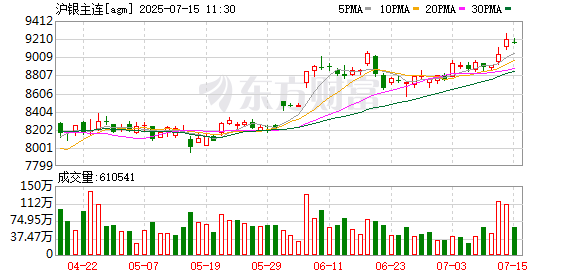
Core Viewpoint - The recent surge in silver prices, reaching over $39 per ounce, is driven by a combination of industrial and financial demand, with significant inflows into silver ETFs contributing to the upward trend [2][3][4]. Group 1: Price Performance - Silver has outperformed gold this year, with a year-to-date increase of over 35%, while gold has risen by more than 27% [3]. - The Shanghai silver futures have also seen a rise of approximately 22%, reaching a record high of 9,267 yuan per kilogram [3]. - The price of silver jewelry has increased by 15% to 20%, and sales of investment silver products have surged by over 40% year-on-year [3]. Group 2: Market Drivers - The strong performance of silver is attributed to the recovery of the gold-silver ratio, with the ratio rising from 80 to 105, indicating a relative undervaluation of silver [4]. - Geopolitical risks have heightened demand for safe-haven assets, with significant implications for silver as a strategic investment [4]. - The "big and beautiful" legislation signed by Trump is expected to increase the U.S. fiscal deficit to $3.6 trillion, raising concerns about sovereign debt risks and enhancing the strategic demand for precious metals [4]. Group 3: Industrial Demand - The rigid demand from the industrial sector, particularly from the photovoltaic industry in China, is expected to support silver prices, with projections indicating an increase in silver consumption in this sector [5]. - The semiconductor industry is anticipated to contribute significantly to silver demand, with electrical and electronic products expected to account for nearly 40% of global silver demand in 2024 [6]. Group 4: Future Outlook - The World Silver Association forecasts a 21% reduction in the global silver supply-demand gap by 2025, driven by a 1% decrease in demand and a 2% increase in total supply [6]. - Analysts suggest that the silver market may experience price volatility due to potential policy changes and technical corrections, with a possible short-term price pullback of 5% to 10% [7]. - Long-term projections indicate that the gold-silver ratio may have upward momentum, with expected trading ranges for silver prices between $36 and $35 per ounce in the upcoming quarters [7].