
企业创新

Search documents
发挥企业创新主体地位 构筑人才集聚高地
Sou Hu Cai Jing· 2025-09-04 23:40
Group 1 - The article emphasizes the importance of enterprises as the main body of technological innovation and suggests that local governments should focus on creating a favorable environment for innovation and business operations through talent attraction and retention strategies [1][2] - It highlights the need for a collaborative approach between government and enterprises to cultivate a talent-friendly atmosphere, including initiatives like entrepreneur training programs and talent exchange events [1][2] - The article advocates for a demand-driven talent recruitment mechanism, urging governments to eliminate barriers to talent mobility and support enterprises in attracting high-level talent through subsidies and resource allocation [2][3] Group 2 - It discusses the establishment of a systematic talent development ecosystem within enterprises, recommending a layered training system that integrates talent cultivation into the entire production process [2] - The article calls for a multi-faceted talent retention mechanism, where enterprises create supportive platforms and governments ensure a conducive environment for talent development, including diverse incentive structures and career advancement pathways [3] - It stresses the importance of addressing public service gaps related to education, healthcare, and other essential services to enhance the overall talent attraction and retention strategy [3]
申万宏源杨成长:地方经济增长动力从何而来?
申万宏源证券上海北京西路营业部· 2025-09-04 02:32
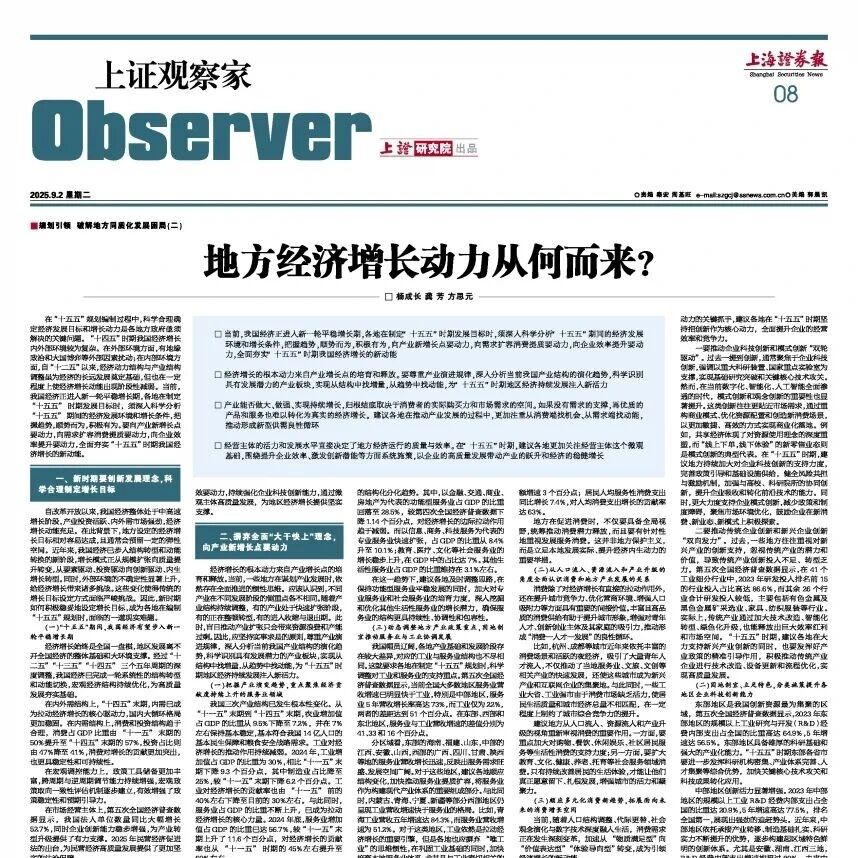
Core Viewpoint - The article emphasizes the need for local governments to scientifically analyze the economic development environment and growth conditions during the "14th Five-Year Plan" period, focusing on new growth points in industries, expanding demand, and improving enterprise efficiency to solidify new economic momentum for the "15th Five-Year Plan" period [5][6][9]. Group 1: Economic Growth and Development Goals - The article highlights that China is entering a new phase of stable economic growth, necessitating a careful determination of growth targets by local governments [6][7]. - It notes that internal demand has become the core driving force for economic growth, with consumption's contribution to GDP increasing from 50% at the end of the "11th Five-Year Plan" to 57% at the end of the "14th Five-Year Plan" [7]. - The article stresses the importance of setting realistic growth targets that are neither overly ambitious nor pessimistic, based on local resources and industrial foundations [8][9]. Group 2: Industry Development and Innovation - The article suggests that economic growth fundamentally relies on the cultivation and release of new industrial growth points, urging local governments to respect industrial evolution and identify promising sectors [11][12]. - It points out the significant shift in China's industrial structure, with the service sector's contribution to GDP rising to 56.7% by the end of 2024, while the industrial sector's contribution is declining [11][12]. - The article recommends focusing on enhancing the service sector's role in economic growth, particularly in lower-tier cities where its importance is often overlooked [12][14]. Group 3: Consumption and Demand Expansion - The article emphasizes the critical role of consumer purchasing power and market demand in driving economic growth, advocating for a focus on consumption-driven opportunities [15][16]. - It distinguishes between goods consumption and service consumption, noting that service consumption has a more direct local economic impact [16]. - The article highlights the need to adapt to changing consumer trends, particularly among younger and older demographics, to stimulate new consumption growth [18][19]. Group 4: Enterprise Development and Innovation - The article underscores the importance of enterprise vitality and development levels in determining local economic quality and efficiency, advocating for systematic policies to enhance enterprise efficiency and innovation [19][20]. - It calls for a dual focus on technological and model innovation to improve enterprise competitiveness, especially in the context of digital transformation [20][22]. - The article stresses the need for tailored strategies to enhance innovation capabilities across different regions, considering their unique industrial bases and development stages [23][24].

新财观|“十五五”时期地方经济增长从三方面找动力
Xin Hua Cai Jing· 2025-09-04 00:57
Group 1: Economic Growth Drivers - The article emphasizes the need for local economies to identify new growth drivers during the "14th Five-Year Plan" period, focusing on supply-side, demand-side, and enterprise development [1][5][6] - The contribution of the industrial sector to GDP is declining, with industrial value added expected to account for 30% of GDP by 2024, down 9.3 percentage points from the end of the "11th Five-Year Plan" [1][2] - The service sector has become the core driver of economic growth, projected to account for 56.7% of GDP by the end of 2024, increasing by 11.6 percentage points since the end of the "11th Five-Year Plan" [1][2] Group 2: Role of Service Industry - The service industry is crucial for economic resilience and sustainability, requiring local governments to enhance service systems and urban service capabilities [2][3] - Regions with rapid service industry revenue growth, such as Hainan, Fujian, and Shandong, should prioritize service sector development as a key component of modern industrial systems [2][4] - The article highlights the need for western regions to balance industrial growth with the development of local service industries, particularly in production-related and lifestyle services [2][4] Group 3: Consumer Demand and Trends - Consumer demand is shifting towards service consumption, with service retail expected to grow by 6.2% in 2024, outpacing goods retail growth by 3 percentage points [3][4] - The article notes a transformation in consumption patterns, driven by demographic changes and technological integration, leading to new consumption trends such as the "single economy" and "silver economy" [4][5] - Local governments are encouraged to innovate service offerings and consumption scenarios to stimulate economic growth [4][5] Group 4: Enterprise Development and Innovation - The vitality and development level of market entities are critical for local economic quality and efficiency, necessitating a focus on innovation across various sectors [5][6] - The article stresses the importance of both original technology and model innovation, with traditional industries also needing to embrace technological upgrades for efficiency gains [5][6] - Regional disparities in R&D investment are highlighted, with eastern regions leading in R&D spending, while western regions show strong growth in external R&D funding [6]
地方经济增长动力从何而来?
申万宏源研究· 2025-09-03 09:22
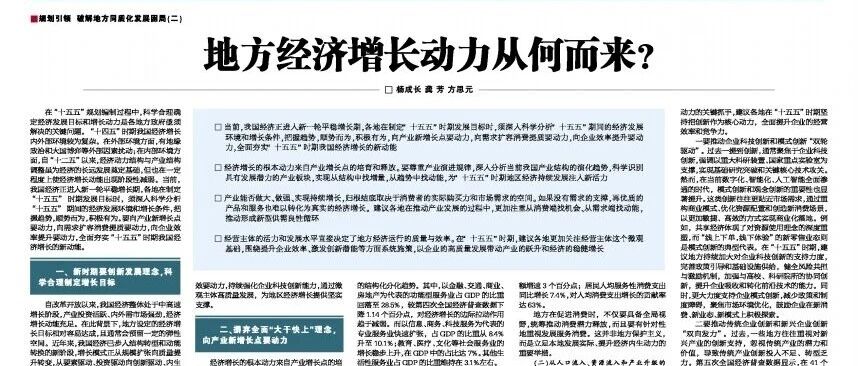
Core Viewpoint - The article emphasizes the need for local governments to scientifically analyze the economic development environment and growth conditions during the "14th Five-Year Plan" period, focusing on identifying new growth points in industries, expanding consumption, and improving enterprise efficiency to ensure sustainable economic growth in China [4][5][6]. Group 1: Economic Growth and Development Goals - The economic growth in China is transitioning from high-speed to stable growth, necessitating a shift in how local governments set growth targets during the "14th Five-Year Plan" [5][6]. - The contribution of consumption to GDP has increased, with its share rising from 50% at the end of the "11th Five-Year Plan" to 57% by the end of the "14th Five-Year Plan" [7]. - Local governments should set realistic growth targets based on local resources, industry foundations, and development realities, ensuring that these targets are both feasible and positively guiding [8][9]. Group 2: Industry Development and Structural Changes - The service sector has become a core driver of economic growth, with its contribution to GDP increasing from approximately 45% during the "11th Five-Year Plan" to 60% currently [10][11]. - Local governments are encouraged to focus on the service industry, especially in lower-tier cities, to enhance employment and improve living standards [11][12]. - The industrial structure is shifting, with traditional industries declining while high-end manufacturing is on the rise, necessitating targeted policies to support these transitions [12][13]. Group 3: Consumption as a Growth Driver - The article highlights the importance of consumer purchasing power and market demand as fundamental to economic growth, advocating for a focus on consumption-driven growth [16][17]. - Service consumption is identified as having a more direct impact on local economies compared to goods consumption, which often benefits external regions [17][18]. - The growth of service consumption is expected to continue, with a projected increase in service retail sales by 6.2% in 2024, outpacing goods retail sales [18][19]. Group 4: Innovation and Enterprise Development - The vitality and development level of enterprises directly influence the quality and efficiency of local economic operations, making enterprise development a priority [21][22]. - Local governments should promote both technological and model innovations within enterprises to enhance efficiency and competitiveness [23][24]. - There is a need for tailored policies that consider regional characteristics to boost the innovation capabilities of enterprises across different areas [25][26].
地方经济增长动力从何而来?
Shang Hai Zheng Quan Bao· 2025-09-01 18:54
Core Viewpoint - The article emphasizes the need for local governments in China to scientifically analyze the economic development environment and growth conditions during the "14th Five-Year Plan" period, focusing on new industrial growth points, expanding consumption, and improving enterprise efficiency to ensure sustainable economic growth [1][2][3]. Group 1: Economic Growth and Development Goals - The current economic environment in China is transitioning to a new phase of stable growth, necessitating a careful setting of growth targets during the "14th Five-Year Plan" [2][3]. - The shift from investment-driven growth to innovation-driven and endogenous growth requires local governments to adopt a more nuanced approach to economic goal setting [2][4]. - The contribution of consumption to GDP has increased from 50% at the end of the "11th Five-Year Plan" to 57% at the end of the "14th Five-Year Plan," highlighting the importance of domestic demand [3][4]. Group 2: Industrial Structure and Trends - The service sector has become the core driver of economic growth, with its contribution to GDP rising to 56.7% by the end of 2024, while the industrial sector's contribution has decreased [7][10]. - The article suggests that local governments should focus on the service industry, especially in lower-tier cities, to enhance employment and living standards [8][10]. - The industrial structure is undergoing significant changes, with traditional industries declining and high-end manufacturing rising, necessitating targeted policies to support these transitions [9][10]. Group 3: Consumption and Demand - The article stresses the importance of consumer purchasing power and market demand as fundamental drivers of economic growth, advocating for a focus on consumption to create a new supply-demand cycle [13][14]. - Service consumption is highlighted as having a more direct impact on local economies compared to goods consumption, which often benefits external regions [15][16]. - The growth of service consumption is projected to continue, with a 6.2% increase in national service retail sales in 2024, outpacing goods retail sales [15][16]. Group 4: Innovation and Enterprise Development - The vitality and development level of enterprises are crucial for the quality and efficiency of local economic operations, with a call for systematic policies to enhance enterprise efficiency and innovation potential [18][19]. - The article advocates for a dual focus on both traditional and emerging enterprises to foster innovation and improve overall economic performance [20][21]. - Local governments are encouraged to create a supportive environment for enterprises, emphasizing the importance of technological and model innovation to drive economic growth [19][21].
50万元省级资金到账!“点对点”辅导让企业精准享受政策红利
Sou Hu Cai Jing· 2025-08-27 11:50
Core Viewpoint - Chengdu Dongbu New District's Jianzhou New City has approved a total of 500,000 yuan in provincial-level intellectual property special funds for two key enterprises, Chengdu Aerospace Huatao and Diou Home, to support innovation through targeted policy guidance [1][3]. Group 1: Funding and Support - The Sichuan Provincial Government issued a notice for the application of the 2025 provincial-level fiscal intellectual property special funds, which was communicated to enterprises through online channels [1]. - The special funds are expected to assist the two enterprises in applying for 10 new patents and 20 trademarks, as well as promoting the registration of 10 patent-intensive products and the recognition of 1 patent-intensive product [6]. Group 2: Challenges and Solutions - Both enterprises faced difficulties in drafting project application documents, which required significant time and resources if done independently or through third-party agencies [3]. - The Chengdu Dongbu New District's ecological environment and urban management bureau provided one-on-one guidance to improve the quality and efficiency of the application process, including training, preliminary reviews, and real-time problem responses [3][6]. Group 3: Strategic Focus on Intellectual Property - Intellectual property is highlighted as a core competitive advantage for enterprises, enabling them to convert innovations into commercial value and enhance market competitiveness [5]. - Diou Home has invested heavily in product research, innovative design, and brand development, planning to use the special funds to implement brand cultivation strategies for sustainable market advantages [5]. Group 4: Ongoing Initiatives - The Chengdu Dongbu New District's ecological environment and market supervision bureau will continue to deepen its "one enterprise, one policy" customized guidance and support, enhancing the effectiveness of policy interpretation and practical guidance [6].
8-9月利好企业政策新规,助力企业腾飞!
Sou Hu Cai Jing· 2025-08-26 03:37
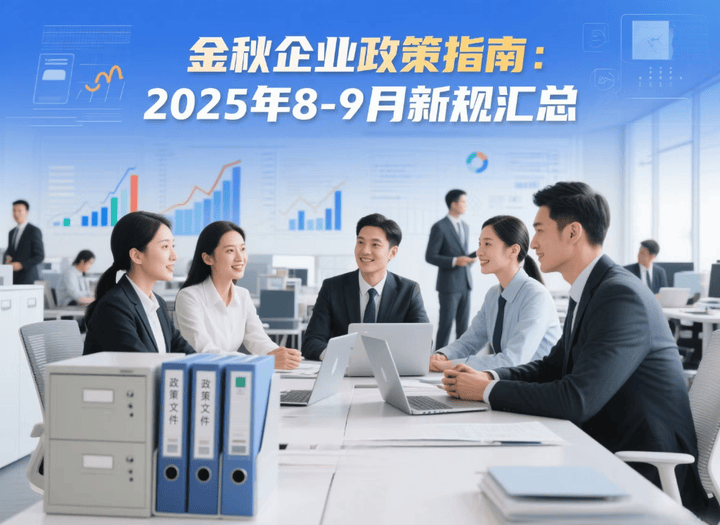
Group 1: Policy Support for Enterprises - A series of favorable policies introduced in August-September 2025 provide strong momentum for enterprise development across various sectors including finance, technology, and social security [2] - The "Guiding Opinions on Financial Support for New Industrialization" issued by multiple government departments supports mining enterprises in accelerating resource production while ensuring strategic resource supply [4] - The new policies enhance funding for innovation, facilitate rapid market introduction of new products, and support mergers and acquisitions to promote industrial chain collaboration and transformation [6] Group 2: Technological Empowerment - The Guangdong Provincial Government's policies encourage enterprises to focus on core technology breakthroughs in aerospace, including reusable liquid rocket engines and low-cost satellites from 2025 to 2028 [8] - Support for technology projects includes guidance on direction and funding, with up to 50% matching funds for eligible national major technology projects and 100% tax deductions for R&D expenditures [10] Group 3: Social Security Regulations - New social security regulations effective September 1, 2025, invalidate any agreements between employers and employees to not pay social security, potentially increasing labor costs but also creating new opportunities [13] - Companies can reduce costs by leveraging local social security rate adjustments and applying for unemployment insurance subsidies for retaining employees [13] Group 4: Legal Support for Enterprises - Legal firms play a crucial role in helping enterprises navigate complex regulations, ensuring compliance, and mitigating risks through contract reviews and legal documentation [15] - By balancing the rights of employers and employees, legal advisors contribute to a stable working environment, enabling enterprises to thrive under favorable policies [15]
解码市场脉搏,洞见产业趋势!——全景网集体接待日互动问答高频热词报告
Quan Jing Wang· 2025-08-13 05:51
Core Insights - The 2025 online collective reception day for listed companies saw participation from 1,072 companies and 3,669 executives, with a total of 20,530 investor questions and a response rate of 87.56% [1] Group 1: Strategy and Development - Development was mentioned 3,967 times, with future plans referenced 1,930 times and strategic discussions 1,905 times, indicating a strong commitment to high-quality growth by Chinese enterprises [1] - Growth commitments were noted 1,744 times and layout planning 1,317 times, reflecting the proactive approach of companies towards capital market engagement [1] Group 2: Operations and Management - Discussions on operations occurred 3,158 times, with management optimization mentioned 2,891 times and quality pursuits 1,584 times, showcasing the focus on refined operational practices [2] - Performance was referenced 1,560 times, and construction efforts 1,442 times, highlighting tangible value creation in the capital market [2] Group 3: Products and Technology - Product focus was emphasized 4,105 times, with technological breakthroughs noted 2,289 times and R&D investments 1,835 times, illustrating the innovation drive within Chinese companies [3] - Production discussions occurred 2,411 times and service-related topics 1,528 times, indicating a comprehensive approach to industry upgrades [3] Group 4: Market and Customers - Market attention was noted 4,498 times, with shareholder communications at 2,264 times and customer needs at 1,786 times, painting a vivid picture of market engagement [4] - Industry trends were discussed 2,254 times and project progress 2,215 times, demonstrating the effective value discovery function of the capital market [4] Conclusion - The data from the collective reception day reflects a comprehensive engagement across various dimensions, from strategic development to market dialogue, underscoring the commitment of companies to create value through communication and innovation [5]
183家待审, 平均历时306天,北交所IPO排起长龙
2 1 Shi Ji Jing Ji Bao Dao· 2025-07-28 10:38
Group 1 - The core viewpoint is that the Beijing Stock Exchange (BSE) is experiencing a surge in IPO applications, leading to a potential backlog in the approval process, with 183 companies currently under review, accounting for 60% of the total A-share IPO applications [1] - In June 2025, BSE received a record 97 IPO applications in a single month, surpassing the previous record of 92 applications in June 2022 [1] - Despite the high number of applications, the actual number of new listings on BSE remains low, with only 6 new listings compared to 14 on the Shanghai main board and 22 on the ChiNext board during the same period [1] Group 2 - The average waiting time for IPO approvals at BSE has increased significantly, with median waiting times rising from 218 days in 2022 to 306 days in 2024 [2] - As of 2025, BSE has received 115 IPO applications, with an average of 26 days from application to the first round of inquiries, which is longer than other boards [2] - For companies accepted in 2024, the average time from acceptance to the first round of inquiries is 26 days, while the time from the first inquiry to the listing committee meeting averages 258 days, significantly longer than other boards [2] Group 3 - Lin Tai New Materials, a company specializing in automotive automatic transmission friction plates, had the shortest waiting time for an IPO in 2024, completing the process in 173 days [3] - The company’s revenue from 2021 to the first half of 2024 shows rapid growth, with a 41% year-on-year increase in the first half of 2024 [4] - Lin Tai New Materials reduced its planned fundraising from 200 million yuan to 116 million yuan, indicating a significant decrease in its financing scale [5] Group 4 - The BSE has seen a stricter review process, with 107 companies terminating their IPO applications in 2024, reflecting a focus on improving the quality of listed companies [8] - The average revenue of companies currently under review at BSE is 738 million yuan, with 36 companies reporting over 100 million yuan in net profit [9] - The increase in the quality of companies applying for IPOs is attributed to better performance of newly listed companies on the New Third Board and improved resources from investment banks [9]
丽水龙泉“真金白银”激发企业创新力
Sou Hu Cai Jing· 2025-07-22 02:50
Core Viewpoint - The article highlights the positive impact of government financial support and policy optimization on local businesses in Longquan City, enhancing their confidence and encouraging expansion into new markets, particularly in the green and renewable sectors [1][2]. Group 1: Financial Support and Impact - Longquan City has disbursed 127 million yuan in enterprise subsidy funds through the "Longcaitong" application, benefiting 1,298 enterprises across various sectors including industry, technology, trade, and tourism [1]. - A specific cable company received a 200,000 yuan reward for accelerating its transition to a larger scale, with expectations to exceed 100 million yuan in output this year [1]. Group 2: Policy Optimization and Implementation - The city is focused on improving the execution of policies by simplifying approval processes and enhancing inter-departmental coordination, ensuring timely delivery of support to enterprises [2]. - The revised fiscal support policy for industrial enterprises aims to promote high-quality green development and the cultivation of characteristic industrial chains [1][2]. Group 3: Case Studies of Local Enterprises - A bamboo wood company in Longquan's Anren Town received 260,000 yuan in support for upgrading its operations, which will be used for new product development and expanding its product line [2]. - The company plans to shift its sales strategy to target both domestic and international markets, aiming to enhance overall sales performance [2].