贸易争端

Search documents
中加贸易争端再升级,中国向WTO提起诉讼,加拿大这下难受了
Sou Hu Cai Jing· 2025-08-18 04:51
Group 1: Trade Disputes and Economic Impact - The trade dispute between China and Canada has escalated, with China filing a complaint to the WTO against Canada's steel import restrictions, highlighting increasing friction in the steel sector and broader trade barriers [1][3] - Canada announced an expansion of steel import tariffs, imposing a 25% additional tax on products containing Chinese steel components, which is seen as a protectionist measure [3] - The Canadian steel import value is projected to exceed $16 billion in 2024, with approximately 10% sourced from China, indicating potential disruption to the bilateral trade valued at CAD 120 billion [3] Group 2: Agricultural Sector and Response Measures - China's imposition of a 75.8% deposit on Canadian canola oil and meal is expected to significantly impact Canadian farmers, particularly in Alberta and Saskatchewan, as China is the largest importer of Canadian canola [3][5] - The Canadian government acknowledges the significant impact of the canola tariffs on farmers and is seeking to diversify export markets to mitigate negative effects [5] Group 3: Historical Context and Future Outlook - The instability in China-Canada relations has historical roots, with previous tensions arising from the Meng Wanzhou incident and U.S. tariffs on steel and aluminum affecting Canada [7] - The ongoing disputes could lead to a GDP contraction of approximately 0.5% for Canada if they persist, while China may seek alternative suppliers for canola [7] - The WTO's role in resolving these disputes remains uncertain, but it could provide a platform for constructive dialogue and potential resolution [9][10] Group 4: Opportunities for Cooperation - Despite the escalating trade disputes, there is potential for renewed constructive cooperation between China and Canada, which could stabilize their economies and contribute to global trade recovery [12]


美大豆滞销困境加剧,中国买家转向巴西,川普喊话难挽颓势
Sou Hu Cai Jing· 2025-08-16 00:31
近期,美国大豆出口行业正经历一场前所未有的挑战。数据显示,截至7月24日,本年度美国大豆出口 量显著下滑,仅达到300余万吨,创下二十年来的最低记录。尤为引人注目的是,作为传统的大豆进口 大国,中国至今尚未预订任何新季美国大豆,这无疑给美国大豆市场带来了巨大压力。据预测,美国可 能面临高达8000万吨的大豆滞销困境。 面对这一严峻形势,美国总统特朗普于8月10日在社交媒体上急切地表示,只要中国能够迅速下单,采 购三倍于原订单量的大豆,美国将为中国提供"快速服务",并营造更为有利的贸易环境。然而,中国方 面的回应明确而坚定,经贸问题的立场一贯清晰。 然而,尽管关税有所降低,订单纷至沓来,中国企业的心态却已经发生了微妙的变化。一家国内个人护 理用品有限公司的负责人表示,他们不会再将所有宝押在美国单一市场上,而是会寻求全球范围内的更 多订单。同样地,该抗衰老制品的母公司也表示,除了继续巩固国内市场外,未来还将把重心从美国转 移到日韩等新兴市场。 实际上,自2005年以来,中国在美国大豆市场的采购行动从未如此迟缓。往年,中国通常会在年初就开 始预订秋季收获后的大豆,但今年受贸易争端的影响,中国转向巴西、阿根廷等国家采 ...

中国就加拿大钢铁进口限制向WTO起诉,“中加贸易争端再升级”
Sou Hu Cai Jing· 2025-08-15 19:06
Group 1 - Canada has implemented steel tariff quota measures and imposed discriminatory tariffs on products containing "Chinese steel components," leading China to file a lawsuit at the WTO on August 15 [1][5] - The trade dispute between China and Canada has escalated, with China recently announcing temporary anti-dumping measures on Canadian canola seeds [1][5] - The Canadian government has been facing challenges in its trade relations with China since the previous Trudeau administration imposed tariffs on Chinese electric vehicles and steel products [1][3] Group 2 - Canada has expanded its steel tariff quota and tightened existing quotas, imposing additional taxes on imports exceeding the quota, particularly targeting products containing Chinese steel [3][5] - In 2024, the bilateral trade volume between China and Canada is projected to be approximately CAD 120 billion, with significant steel import and export figures [3] - The Chinese Ministry of Commerce has criticized Canada's actions as unilateralism and trade protectionism, which disrupts the stability of global steel supply chains [5]

美国芯片设备巨头应用材料业绩展望逊色
Ge Long Hui A P P· 2025-08-15 00:17
Core Viewpoint - The sales and profit outlook for Applied Materials, the largest chip equipment manufacturer in the U.S., is disappointing, raising concerns that trade disputes are suppressing demand [1] Group 1: Financial Performance - Applied Materials expects revenue of approximately $6.7 billion for the fiscal quarter ending October 31, significantly below the analyst average estimate of $7.32 billion [1] - The company anticipates an adjusted earnings per share of $2.11, also lower than the analyst forecast of $2.38 [1] - In the previous fiscal quarter, Applied Materials reported a year-over-year revenue increase of 7.7%, reaching $7.3 billion, which exceeded the analyst average estimate of $7.21 billion [1] - The earnings per share for the last quarter was $2.48, surpassing the expected $2.36 [1] Group 2: Market and Demand Factors - CEO Gary Dickerson indicated a reduction in demand from certain customers and delays in technology export approvals [1] - Ongoing tariff negotiations and other economic factors have led major customers to postpone some purchases [1] - Following the disappointing outlook, Applied Materials' stock price fell by as much as 12% in after-hours trading [1]

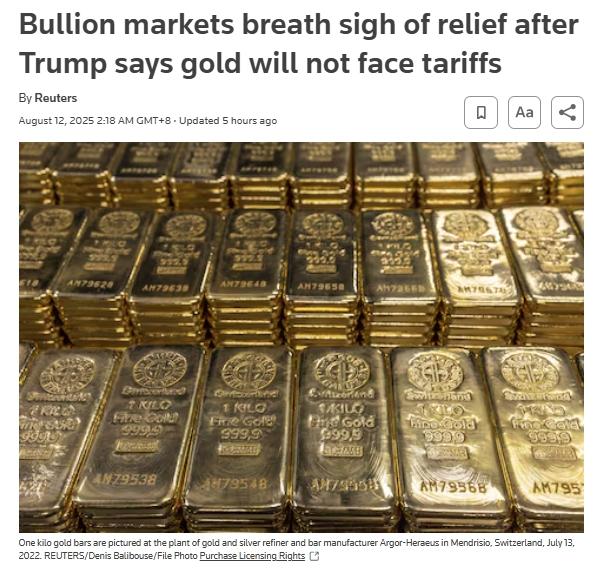
特朗普称不会对黄金加征关税
Zhong Guo Xin Wen Wang· 2025-08-12 01:13
Core Viewpoint - President Trump announced on social media that there will be no additional tariffs on gold, calming speculation regarding gold's involvement in the ongoing global trade disputes [1][3]. Group 1 - The U.S. Customs and Border Protection had previously indicated that it might impose country-specific tariffs on the most widely traded gold bars in the U.S., which led to fluctuations in gold prices [1][3]. - Trump's statement has alleviated concerns that gold could be affected by the current global trade tensions [3].
外媒:世贸组织确认巴西已就美国关税措施启动争端磋商程序
Zhong Guo Xin Wen Wang· 2025-08-11 23:17
Core Viewpoint - Brazil has initiated dispute consultation procedures with the World Trade Organization (WTO) against the United States, claiming that the U.S. tariff measures violate multiple trade agreements [1] Group 1: Trade Relations - On August 11, the WTO confirmed Brazil's complaint regarding U.S. tariffs [1] - Brazil's President Lula stated that the U.S. has no authority to impose a 50% tariff on Brazilian goods [1] - The U.S. government issued an executive order on July 30, imposing a 40% tariff on Brazilian imports starting August 6, raising the total tariff rate on most Brazilian products to 50% [1] Group 2: Economic Impact - Brazil plans to implement emergency measures to mitigate the economic and social impacts of the U.S. tariffs [1] - The affected Brazilian products include meat, coffee, and fruits, which are significant to Brazil's export economy [1]
“卖印度、买中国”!“关税战”逆转中印股市叙事
美股IPO· 2025-08-10 22:35
Group 1 - The Indian MSCI index has underperformed the Chinese stock market by approximately 10 percentage points this quarter, potentially marking the largest annual performance gap since 2017 [1][4] - Goldman Sachs predicts that the Indian stock market will continue to lag behind other emerging markets, maintaining a "neutral" rating on Indian stocks while reiterating an "overweight" stance on Chinese stocks and raising the 12-month target for the MSCI China index [4][6] - The market dynamics have shifted due to the recent imposition of a 25% additional tariff on Indian goods by Trump, which has led to a significant capital outflow from India, with around $3 billion leaving the market last month, the largest monthly outflow since February [4][6] Group 2 - The trade dispute has reshaped the investment landscape between China and India, with the recent tariff actions being particularly targeted and sudden [5] - The deteriorating US-India relations and new tariffs may undermine India's manufacturing ambitions, causing investor concerns regarding India's high valuations and slowing profit growth [7][8] - In contrast, China offers more attractive investment opportunities in rapidly growing sectors such as artificial intelligence, clean energy, and biotechnology, which may support the "buy China" investment logic in the short term [9]


白宫:美国可能对那些购买俄罗斯石油的国家征收25%的关税
Sou Hu Cai Jing· 2025-08-10 09:13
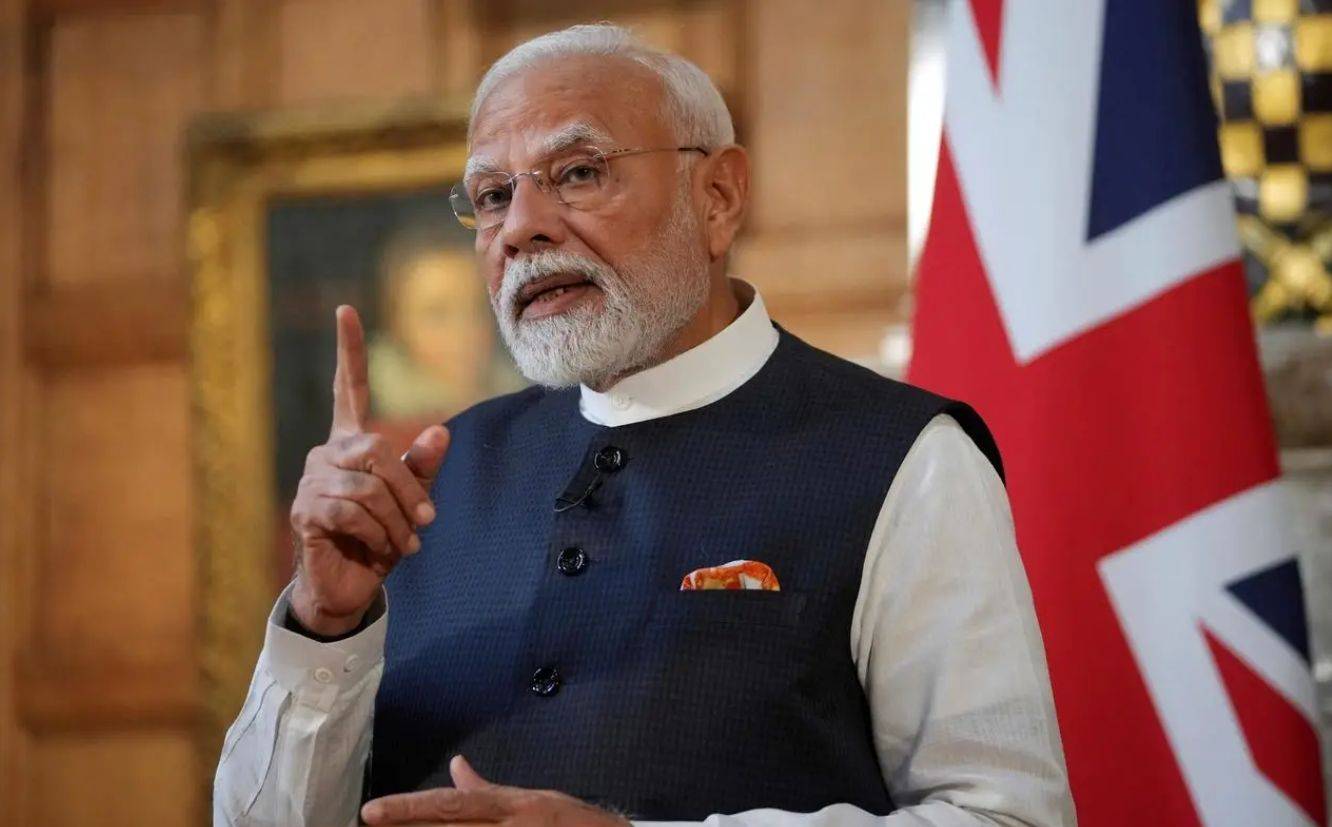
Group 1 - Indian Prime Minister Modi's upcoming visit to China in late August marks his first trip to the country in seven years, highlighting its significance [1] - Following the announcement of Modi's visit, US President Trump expressed the possibility of imposing new tariffs on China, particularly targeting countries purchasing Russian oil [3] - Trump's threats against China are seen as part of a broader strategy to counteract the growing cooperation between China and Russia, indicating a desire to maintain US dominance [5][7] Group 2 - The US has reduced tariffs on India from an initial 250% to 25%, reflecting a significant concession amid ongoing trade tensions [7] - Trump's aggressive stance towards both China and India is perceived as an attempt to exert pressure, but it may backfire, as indicated by India's response to the situation [5][6] - The dynamics of US-India trade are likely to be affected by the imposition of higher tariffs, which could complicate future negotiations [5]
美国对巴西加征50%高关税给智利带来难得机遇
Shang Wu Bu Wang Zhan· 2025-08-08 17:31
Core Viewpoint - The recent trade dispute between the U.S. and Brazil, initiated by a 50% tariff on various Brazilian imports, presents both challenges and opportunities for Chilean exports to the U.S. [1] Group 1: Trade Dispute Details - On July 30, U.S. President Trump signed an executive order imposing a 50% tariff on multiple products imported from Brazil [1] - The tariff affects 700 product categories, including civilian aircraft, energy, orange juice, precious metals, timber, and fertilizers, which account for 45% of Brazil's total exports to the U.S. [1] Group 2: Implications for Chile - Chilean analysts believe that the trade dispute provides a rare opportunity for Chile to increase its exports to the U.S. by substituting products previously imported from Brazil [1] - Chile can potentially boost its exports of coffee, meat products, and fruits to the U.S. as a result of Brazil's increased tariffs [1] Group 3: Competitive Landscape - Despite the opportunities, there is a risk that Brazil may export its products at lower prices to third countries, including Chile, to mitigate the impact of the tariffs [1] - This could lead to increased competition for similar products in the Chilean market, particularly in chicken and certain agricultural products [1]
加拿大自比中国,在贸易战中坚决“不跪”,美贸易代表灵魂拷问:中国反击美国,你也要跟?
Sou Hu Cai Jing· 2025-08-08 13:22
Core Viewpoint - The trade dispute between the United States and Canada has escalated, with President Trump signing an executive order to raise tariffs on Canadian goods from 25% to 35%, prompting strong reactions from Canadian officials and raising questions about Canada's ability to withstand U.S. pressure [1][3]. Economic Dependency - Canada is highly dependent on the U.S. market, with 75.9% of its exports and 62.2% of its imports coming from the U.S. This dependency makes it difficult for Canada to find alternative large-scale export markets if it loses access to the U.S. [4]. - In contrast, China, as the world's second-largest economy, has a diverse economic structure and can retaliate against U.S. tariffs by adjusting trade structures and exploring new markets [4]. Political and Strategic Relations - Canada has a long-standing alliance with the U.S., relying on it for political and military support. This relationship complicates Canada's ability to adopt a truly independent stance against U.S. trade policies [6]. - The current Canadian government's trade policies largely continue the strategies of former Prime Minister Trudeau, lacking innovative or independent proposals, which may lead to potential compromises under U.S. pressure [6]. Policy Consistency - Canada's trade policy lacks the coherence and stability seen in China's approach, which has effectively implemented a series of countermeasures in response to U.S. tariffs, demonstrating a commitment to national interests [6][7]. Actual Actions - While Canada has vocally opposed U.S. tariffs, it has not taken substantial retaliatory measures comparable to China's swift and impactful responses during the U.S.-China trade dispute [7]. U.S. Motivations - The U.S. aims to reshape trade relations and gain advantages for its industries through tariffs, while also using Canada as an example to deter other countries from resisting U.S. trade policies [9].