贸易战

Search documents
为讨好美国不惜得罪中国?7月25日,中方反击传来新消息
Sou Hu Cai Jing· 2025-07-26 00:02
Group 1 - The Canadian government's imposition of tariffs on Chinese steel is a reaction to potential U.S. sanctions, revealing a short-sighted strategy [1][3] - Canada has abandoned significant agricultural orders from China in an attempt to appease the U.S., which is seen as a poor trade-off [5][9] - The tariffs have led to increased costs for Canadian steel manufacturers, as they rely on imported raw materials from China, resulting in financial losses [5][11] Group 2 - In response to Canada's tariffs, Australia has capitalized on the situation by increasing agricultural exports to China, benefiting from the shift in trade dynamics [7][13] - The Canadian agricultural sector is facing severe challenges, with farmers struggling to manage excess grain and seeking loan extensions due to financial strain [9][15] - The political fallout in Canada includes significant backlash from farmers and opposition parties, questioning the government's trade strategy and its impact on the economy [15][19] Group 3 - The situation serves as a lesson in international trade, emphasizing the complexity of trade wars and the need for strategic planning [17][19] - Australia has demonstrated a flexible approach to trade, balancing firmness and adaptability, which has allowed it to benefit from the changing market conditions [20][22] - China's response to the tariffs has been strategic, using market dynamics to reinforce its position while supporting alternative partners [17][22]

隔夜美股 | 三大指数上涨 标普500、纳指再创新高
智通财经网· 2025-07-25 23:09
Market Performance - The three major indices in the US rose, with the Dow Jones up 1.26%, Nasdaq up 1.02%, and S&P 500 up 1.46% for the week [1] - The S&P 500 index set a new closing record for the fifth consecutive time, marking its 13th all-time high in 2025 [1] - Alphabet's strong earnings report contributed to a 4% increase in its stock price [1] - Over 82% of the 169 S&P 500 companies that have reported earnings exceeded Wall Street expectations [1] Individual Stocks - Intel (INTC.US) saw a decline of 8.53%, while Tesla (TSLA.US) increased by 3.52% [1] - Paramount (PARA.US, PARAA.US) and Skydance Media's merger has received regulatory approval, expected to complete by August 7 [8] - Intel plans to spin off its Network and Edge Group into an independent company and is seeking external investment for this division [9] International Markets - The German DAX30 index fell by 0.39%, while the French CAC40 index rose by 0.21% [2] - In the Asia-Pacific region, the Nikkei 225 index decreased by 0.88%, while the KOSPI index increased by 0.18% [3] Commodities - Gold prices fell by 0.94% to $3336.92 per ounce, with a weekly decline of 0.40% [4] - Crude oil prices also dropped, with light crude futures down 1.32% to $65.16 per barrel [3] Macro News - The Trump administration is preparing to issue a state of emergency declaration to impose tariffs on Brazilian goods [5] - There are reported discrepancies in the US-Japan trade agreement regarding profit sharing, with Japan denying the US's claim to 90% of profits [6]

再拉930亿反制清单,欧盟已在为“谈崩”做准备?
2 1 Shi Ji Jing Ji Bao Dao· 2025-07-25 14:42
Group 1 - The European Union (EU) has approved a unified retaliation list against the U.S. totaling €93 billion, which will take effect if no satisfactory trade agreement is reached by August 1 [1][2] - The EU's retaliation measures include two previous rounds of tariffs, with the first round targeting U.S. steel and aluminum tariffs amounting to approximately €21 billion, and the second round responding to threats of a 30% tariff on EU goods, valued at around €72 billion [1][2] - Germany's shift towards a more confrontational stance against the U.S. reflects a broader change in the EU's negotiation strategy, indicating a readiness to escalate tensions if necessary [2][3] Group 2 - The EU is considering the use of a "counter-coercion tool," a mechanism that has never been formally activated, which would allow the EU to impose trade and investment restrictions on countries attempting to coerce member states [2] - Recent economic data shows that the Eurozone has shown resilience against the initial impacts of the trade war, with the July PMI rising to 51, indicating growth in manufacturing and services [5] - However, there are concerns about potential supply chain disruptions and the impact on the service sector, particularly in areas heavily reliant on U.S. exports [5]
国投期货能源日报-20250725
Guo Tou Qi Huo· 2025-07-25 13:47
Report Industry Investment Ratings - Crude oil: ★★★ (indicating a clearer long - term trend and relatively appropriate investment opportunities currently) [1] - Fuel oil: ☆☆☆ (white star, suggesting short - term long/short trends are in a relatively balanced state with poor operability on the current market, advisable to wait and see) [1] - Low - sulfur fuel oil: No specific rating given [1] - Asphalt: ★★★ (indicating a clearer long - term trend and relatively appropriate investment opportunities currently) [1] - Liquefied petroleum gas: ★☆☆ (indicating a bullish/bearish bias, with a driving force for price increase/decrease, but poor operability on the market) [1] Core Viewpoints - The oil market has continued the inventory - building trend since the peak season in Q3, with a 0.6% reduction in crude oil inventory and a 1.7% increase in refined oil inventory. There is always a supply - demand surplus pressure under the OPEC+ production - increase path. Oil prices are mainly under oscillating pressure, but geopolitical factors may bring support at the end of August and early September [1]. - The fuel oil futures showed strong performance among oil products today. The high - low sulfur spread was under pressure again, and the rebound strength of FU cracking needs further observation. The LU's unilateral trend follows crude oil, but with a smaller fluctuation range and under pressure on cracking [2]. - The asphalt 09 contract rebounded after hitting the bottom during the day, with low inventory supporting the price, but the upside space is limited before the actual improvement in demand [2]. - The overseas market decline has led to a weakening of the domestic LPG market. Domestic chemical demand is strong in the short term, and domestic gas is expected to stabilize under the situation of weak supply and demand. The spot market is loose, and the futures market is mainly weak [3]. Summary by Directory Crude Oil - Overnight international oil prices rose, with the SC09 contract up 1.71% during the day. The oil market has continued the inventory - building trend since Q3, with a 0.6% reduction in crude oil inventory and a 1.7% increase in refined oil inventory. The US government may allow Chevron to operate in Venezuela, which may lead to a recovery of about 200,000 barrels per day in Venezuelan crude oil exports. Before the final implementation of trade agreements, there are still bearish risks related to trade wars. Oil prices are mainly under oscillating pressure, but geopolitical factors may bring support at the end of August and early September [1] Fuel Oil & Low - Sulfur Fuel Oil - Today, fuel - related futures showed strong performance among oil products, with FU leading the gains. The high - low sulfur spread was under pressure again after two consecutive days of rebound, and the FU cracking rebounded slightly from a low level. The Singapore diesel cracking dropped slightly from a high level. The LU's unilateral trend follows crude oil, but with a smaller fluctuation range and under pressure on cracking [2] Asphalt - The 09 contract rebounded after hitting the bottom at 3593 yuan/ton during the day, with a small increase at the close but a relatively weak increase among oil products. Chevron is allowed to continue operating in Venezuela, which may increase Venezuelan oil production. The August refinery production plan decreased significantly compared with July. Affected by the widespread rainfall, demand recovery was slower than expected. The inventory of refineries decreased, and the social inventory remained flat, with the overall commercial inventory decreasing month - on - month. Low inventory supports the price, but the upside space is limited before the actual improvement in demand [2] LPG - The overseas market decline has led to a weakening of the domestic LPG market. The increase in Middle East sales and high - level inventory accumulation in North America continue to suppress the market. Domestic PDH has resumed production rapidly, with good short - term chemical demand. The refinery's external supply volume has decreased slightly, and domestic gas is expected to stabilize under the situation of weak supply and demand. The spot market is loose, strengthening the delivery discount pressure, and the futures market is mainly weak [3]
【冠通研究】沥青:高开震荡
Guan Tong Qi Huo· 2025-07-25 11:25
制作日期:2025年7月25日 【策略分析】 【冠通研究】 沥青:高开震荡 区间操作 基差方面: 山东地区主流市场价上涨至3850元/吨,沥青09合约基差下跌至235元/吨,处于偏高水平。 供应端,本周沥青开工率环比回落4.0个百分点至28.8%,较去年同期高了4.0个百分点,沥青开 工率转而回落,处于近年同期偏低水平。据隆众资讯数据,7月份国内沥青预计排产254.2万吨,环 比增加14.4万吨,增幅为6.0%,同比增加48.5万吨,增幅为23.6%。本周,沥青下游各行业开工率多 数上涨,其中道路沥青开工环比上涨2个百分点至27.0%,只是仍处于近年同期偏低水平,受到资金 和降雨高温制约。本周,华北地区集中交付前期合同,出货量增加较多,全国出货量环比增加8.03% 至26.9万吨,处于中性偏低水平。沥青炼厂库存存货比本周环比转而回落,仍处于近年来同期的最 低位。美国允许雪佛龙恢复在委内瑞拉开采石油,或将增加沥青原料供给。全球贸易战的恐慌情绪 缓解,只是全球贸易战阴云仍未完全散去,近期原油价格震荡,工信部提到新一轮十大重点行业 (包括石化、建材等)稳增长工作方案近期将陆续发布,摸底石化、化工老装置清单,淘汰20 ...
贸易战避险有所消退,金弱银强持续分化?
Shan Jin Qi Huo· 2025-07-25 10:51
Report Industry Investment Rating No relevant content provided. Core Viewpoints of the Report - Short - term: Gold is weak and silver is strong, mainly due to the short - term high - level callback of risk - aversion demand, and the possibility of the Fed's near - term interest rate cut is eliminated. The expected supply - demand gap of silver still exists, and the inflation expectation rebounds due to the trade war, improving the expected industrial demand for silver [7]. - Medium - term: The risk of economic recession increases, which may force the interest - rate cut logic to be in the making. Precious metals will continue to fluctuate at a high level [7][9]. - Long - term: The global trade war promotes the reconstruction of the economic and political system and accelerates the reconstruction of the monetary system. There is still an upward trend for precious metals in the process of "de - dollarization" [7][9]. Summary by Relevant Catalogs 1. Risk - aversion Attribute - Trade agreements are reached in batches, and the negotiation of the US - EU trade agreement has made progress. The geopolitical risk eases, weakening the risk - aversion demand [2]. - Trump's threats to the Fed's independence have eased market concerns [2]. 2. Monetary Attribute - US economic data is mixed. In June, existing home sales dropped to a nine - month low, while the number of initial jobless claims last week hit a three - month low [3]. - The European Central Bank keeps interest rates unchanged, and the optimistic economic forecast triggers speculation about the end of interest rate cuts. The Fed is more divided and remains cautious about interest rate cuts. The market expects the next Fed interest rate cut to be stable until September, and the total interest rate cut space in 2025 drops to about 50 basis points. The decline of the US dollar index and US bond yields is blocked [3]. 3. Commodity Attribute - Although gold jewelry consumption is suppressed by high prices, the investment demand for gold bars offsets some of the impact. Emerging market central banks' "de - dollarization" strategy promotes central bank gold - buying demand to remain high [4]. - The World Silver Association expects that due to a 1% decline in demand and a 2% increase in total supply, the global silver supply - demand gap in 2025 will narrow by 21% to 117.6 million ounces (about 3,658 tons) [4]. 4. Capital Flow - Recently, the net long positions of CFTC managed funds in gold and silver have increased again. Domestic Shanghai gold futures companies have reduced their net long positions at a high level, and Shanghai silver institutions have slightly reduced their net long positions. The world's largest gold ETF and silver ETF have ended their long - term downward trends and slowly increased their positions [5]. 5. Future Investment Logic Evolution - Short - term: Gold is weak and silver is strong. - Medium - term: Precious metals will continue to fluctuate at a high level. - Long - term: Precious metals show an upward trend [7][9]. 6. Strategy - Short - term: Gold is weak and silver is strong. - Medium - term: Fluctuate at a high level. - Long - term: Step - by - step upward [7]. 7. Support and Resistance - Shanghai gold main contract: Support at 755 - 760, resistance at 790 - 795. - Shanghai silver main contract: Support at 9000 - 9030, resistance at 9600 - 9630 [7]. 8. 2024 - 2025 Fed Monetary Policy Path Review - From June 2024 to June 2025, the Fed's monetary policy has gone through multiple stages, including keeping interest rates unchanged, cutting interest rates, and adjusting the pace of interest rate cuts and balance - sheet reduction. The market's expectation of interest rate cuts has also changed accordingly [10][11][12].
日本又跪了?签订不平等条约,特朗普对中国摊牌,中方狂抛美债
Sou Hu Cai Jing· 2025-07-25 09:23
特朗普的关税政策:全球经济的新冲击 特朗普政府每一次通过提高关税来施压其他国家,都会有一定的后果。这一次,他再次对多个国家发起了无差别的关税攻势,毫不例外地,既包括美国 的传统盟友,也包括那些潜在的经济对手。这种无情的关税政策,像一场席卷全球的风暴,打破了许多国家的经济平衡。 全球经济正在变得愈加复杂,国际贸易紧张局势也加剧。日本,在经历了数月的抵抗后,最终不得不做出妥协。这样的让步,在很大程度上类似1985年 广场协议时的情形,成为了历史上具有深远影响的经济事件。 然而,为什么日本从最初的强硬立场转向了妥协呢?在美国施加的巨大压力下,中国却表现出极强的韧性。那么,中国又是如何应对特朗普提出的这些 关税挑战的呢? 美国关税政策:对盟友的忠诚度考验 最初,日本在涉及汽车、大米等多个关键产业时坚持自己的立场。然而,在美国施压日益增加的情况下,最终日本选择了妥协。表面上看,日本似乎让 步了,比如将汽车关税从25%降至15%,但这背后所付出的代价却远超想象。 特朗普的关税政策,某种程度上并不只是单纯的贸易手段,更像是一种试探盟友忠诚度的工具,甚至是变相的资金索取。日本作为美国的传统盟友,首 当其冲地成为了这一政策的受 ...
欧洲重要人物访华,准备和中国讨的“定心丸”,让特朗普如坐针毡
Sou Hu Cai Jing· 2025-07-25 09:01
Group 1 - The article highlights the escalating tensions between the US and the EU due to the proposed 30% tariffs on European imports, which has prompted a strong backlash from EU member states [1][3] - The tariffs are expected to severely impact key European industries, including Germany's €87 billion automotive sector, France's wine industry, and Italy's luxury goods sector, which may see a 15% loss in annual revenue [1][3] - In response, the EU has quickly developed a countermeasure list targeting US products, including bourbon whiskey from Kentucky, citrus from Florida, and auto parts from Michigan [1] Group 2 - Experts suggest that mere retaliatory measures will not resolve the underlying issues, and the EU should seek new markets, particularly through collaboration with China, which offers significant market demand and manufacturing capabilities [3][5] - Upcoming visits by European leaders to China aim to discuss economic, technological, and climate cooperation, with hopes of strengthening ties and exploring new opportunities [3][5] - The EU's leaders are motivated by two main objectives: to gain support from China amid US negotiations and to create anxiety in the US regarding the potential strengthening of EU-China relations [5] Group 3 - The article emphasizes the substantial trade volume between the EU and China, projected to exceed €730 billion in 2024, highlighting the importance of this relationship [7] - Some EU politicians are criticized for underestimating China's position and overestimating US willingness to compromise for European interests, leading to a dangerous illusion [7][8] - A significant percentage (67%) of German companies oppose following the US in technology restrictions against China, indicating a shift in market dynamics and the limitations of political influence [8] Group 4 - The ongoing EU-China dynamics reflect deeper global economic changes, with the need for Europe to navigate opportunities and challenges effectively [10]
大众Q2营业利润同比下降29%,称关税造成13亿欧元损失,下调全年销售预期 | 财报见闻
Hua Er Jie Jian Wen· 2025-07-25 08:51
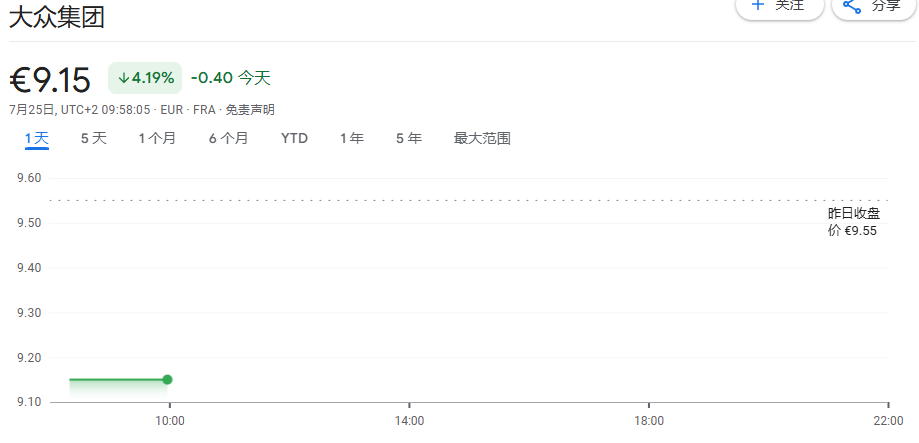
大众汽车因美国关税冲击下调全年销售和利润预期,首次评估特朗普贸易战对其造成的损害,仅在2025年上半年就因关税遭受13 亿欧元(约合15亿美元)损失。 作为欧洲最大汽车制造商,大众汽车现预计今年营业利润率将在4%至5%之间,低于此前预测的5.5%-6.5%区间,同时将全年销售 预期从此前预计的增长5%下调至与去年持平。 这一消息传出后,大众汽车欧股股价下跌逾4%,凸显出贸易冲突、中国竞争加剧以及电动汽车转型监管压力对欧洲汽车制造商的 多重打击。 最新财报显示,大众汽车二季度营业利润为38亿欧元,同比下降29%。除关税因素外,公司将业绩下滑归因于重组成本以及低利润 率电动车型销量增加。 关税冲击带来直接损失 大众汽车在其季度财报中明确表示,仅2025年上半年,关税就给公司造成13亿欧元的损失。自今年4月以来,大众及其竞争对手面 临25%的惩罚性关税,这严重侵蚀了其在美国市场的盈利能力。 对此,公司警告称:"关于关税的进一步发展、其影响以及任何连锁反应存在高度不确定性。"大众表示,如果关税在今年剩余时间 保持不变,其业绩将处于预期区间的下限;若关税率降至10%,则可能达到上限。 市场有风险,投资需谨慎。本文不构成 ...
美国威胁对欧盟征收30%关税!欧盟准备千亿欧元反制清单
Sou Hu Cai Jing· 2025-07-25 05:06
全球贸易格局正面临重大变化,美欧之间的贸易摩擦已进入关键时刻。美国威胁对欧盟商品征收高达30%的关税,而欧盟则准备启动强力反制措施。与此同 时,金融市场对贸易局势的变化反应激烈,黄金价格出现大幅波动。 欧盟准备强力反制措施 面对美国的强硬态度,欧盟正积极筹备一系列反制措施。欧盟委员会发言人奥洛夫·吉尔表示,如果谈判破裂,欧盟计划迅速对价值近1000亿欧元的美国商 品加征关税。这一反制方案将把此前针对210亿欧元美国商品的关税清单与涵盖720亿欧元美国商品的额外关税清单合并。 美欧贸易谈判陷入僵局 美国总统特朗普威胁自8月1日起对欧盟产品加征30%关税,这一税率被欧盟贸易执委谢夫乔维奇形容为"几乎阻断"跨大西洋贸易的毁灭性举措。欧盟原本期 待通过谈判达成协议,使大部分输美产品维持10%的关税水平,但美方在会谈中提出的方案税率远高于这一基准。 欧盟外交官透露,美国谈判代表之间缺乏一致性,每个人似乎都有自己的想法。美方还断然拒绝了欧盟提出的"冻结"安排,即在达成协议后不再加征新关 税。美国以"国家安全"为由,援引《232条款》对医药、半导体、木材等产品发起贸易调查,声称特朗普在国家安全问题上不能受到任何约束。 欧盟 ...