AI芯片

Search documents
DeepSeek正式发布新模型,还透露国产AI芯片关键信息
Xuan Gu Bao· 2025-08-21 23:22
Group 1 - DeepSeek's latest V3.1 version utilizes UE8M0 FP8 Scale parameter precision, designed for the upcoming domestic chip release [1] - FP8 is a cutting-edge low-precision format for AI computing, significantly enhancing GPU performance and reducing memory usage for large language model training [1] - Domestic GPUs are rapidly developing, transitioning from "usable" to "user-friendly" stages, although they have not yet matched international products [1] Group 2 - Companies like Cambrian, Haiguang Information, and Huawei are leading the A-share computing chip market [3] - Moer Thread provides AI training and inference cards, with its latest GPU supporting FP8 precision, significantly boosting AI computing power [1] - Muxi offers C series GPUs for integrated training and inference, and N series GPUs focused on cloud AI inference, showcasing strong mixed-precision computing capabilities [2] Group 3 - The global GPU market is projected to reach 36,119.74 billion yuan by 2029, with China's GPU market expected to reach 13,635.78 billion yuan, increasing its global market share from 30.8% in 2024 to 37.8% in 2029 [2] - DeepSeek is driving the shift of AI applications from centralized cloud services to mass terminals, necessitating high-cost performance dedicated chips [2] - The domestic chip manufacturers and application enterprises are accelerating their integration with DeepSeek, anticipating a significant increase in domestic computing power by 2025 [2] Group 4 - Huawei's Ascend ecosystem includes companies like Tuo Wei Information, Digital China, and Huafeng Technology, enhancing mixed inference architecture and agent capabilities [4] - The upgraded model shows significant improvements in tool usage and intelligent agent tasks through Post-Training optimization [4] Group 5 - Related companies include Dingjie Zhizhi, Fanwei Network, and Kute Intelligent [5]

半导体设备行业研究框架培训
2025-08-21 15:05
Semiconductor Industry Research Summary Industry Overview - The semiconductor industry exhibits a decreasing profitability trend across its value chain, with IC design being the most profitable, followed by wafer manufacturing, and equipment and materials being relatively lower in profitability [1][4] - The semiconductor manufacturing process is divided into front-end (80% value) and back-end processes (20% value), with front-end processes including diffusion, thin film deposition, lithography, and etching, while back-end processes involve wafer packaging [1][5] - The global semiconductor equipment market is approximately $100 billion, characterized by cyclical growth that fluctuates with semiconductor demand [1][10] Key Trends and Developments - The transition from 2D to 3D chip structures is increasing transistor density and complexity, driving capital expenditure [1][8] - Advanced processes significantly increase equipment demand, with capital expenditure density rising sharply; for instance, the capital expenditure for 7nm process is about $1.2 billion per 10,000 wafers, while for 5nm it reaches $8.3 billion per 5,000 wafers [9][11] - The semiconductor industry is highly concentrated, with the top five companies holding nearly 80% of the market share, including ASML, Applied Materials, Lam Research, Tokyo Electron, and KLA [13][15] Market Dynamics - The demand for semiconductor equipment is expected to remain robust, with China’s semiconductor equipment procurement projected to exceed $40 billion in 2025 and 2026 [3][18] - The domestic semiconductor equipment companies in China are benefiting from increased demand for self-sufficiency, with a low domestic production rate in lithography machines (below 5%) but higher rates in materials [3][19][16] - The semiconductor materials market is valued at over $60 billion, with wafer manufacturing materials accounting for approximately $42.9 billion and packaging materials around $24.6 billion [20] Investment Opportunities - The semiconductor materials sector offers advantages due to its continuous and cumulative demand, which is less affected by cyclical fluctuations compared to equipment manufacturing [21] - The current phase of expansion and increased self-sufficiency in the domestic semiconductor industry presents significant investment opportunities, particularly in advanced processes [22] - Despite some market segments being overheated, semiconductor equipment and materials remain undervalued, indicating a potential growth of about 30% from a valuation perspective [22]
中芯国际(688981):国产算力核心引擎,先进工艺蓄势待发
ZHESHANG SECURITIES· 2025-08-21 10:29
Investment Rating - The investment rating for the company is "Buy" (maintained) [7] Core Views - The company is positioned as a leading domestic wafer foundry, with the explosive demand for domestic AI chips and the trend of localization in edge-side chips expected to drive its performance growth beyond expectations [1][3] Demand and Supply Analysis - Demand Side: The growth in the AI cloud server industry is expected to drive the demand for AI chips. Additionally, domestic cloud manufacturers are increasingly seeking to localize AI chip production, which will further stimulate demand. There is potential for elasticity in advanced process wafer consumption if certain brands experience an upward turning point in sales expectations [3] - Supply Side: Domestic semiconductor equipment is being customized to better fit local process routes, which may lead to an unexpected improvement in wafer foundry yield rates. The long-term trend in the wafer foundry industry is expected to favor larger players, and the company is likely to benefit from the localization of advanced processes and the demand surge in the AI chip sector [3] Driving Factors - The explosive demand for AI chips in both cloud and edge markets is expected to create significant opportunities for advanced process expansion [4] Performance Metrics and Catalysts - Key performance indicators include the shipment pace of domestic AI chips and discrepancies between performance guidance and actual results. Catalysts for growth include orders for key production line equipment, breakthroughs in critical process yields, and accelerated localization in IC design tape-outs [5] Financial Forecast and Valuation - The company is projected to experience a new phase of revenue and profit elasticity from 2025 to 2027, with expected net profits of 5.352 billion, 6.370 billion, and 7.456 billion respectively, representing year-on-year growth rates of 44.7%, 19.0%, and 17.0%. The estimated P/B ratios for the same period are 4.5, 4.3, and 4.1, while the P/E ratios are 135.8, 114.1, and 97.5 [6][12]

创新高后遭遇短期回调 AI行情或仍可持续
Jiang Nan Shi Bao· 2025-08-21 07:42
Group 1 - The A-share market has recently experienced a pullback after reaching new highs, but mainstream brokerages remain optimistic about the future, viewing the short-term adjustment as a normal technical correction that could build momentum for future gains [1] - Industrial Securities believes that under the guidance of national strategic directions, combined with timely policies and funding support, the market is currently undergoing a "healthy bull" phase, with the AI sector being one of the strongest driving forces in this market uptrend [1] - Despite a recent short-term pullback in the AI sector, it is expected to continue performing well, as indicators such as rolling returns, trading volume, and congestion levels do not signal overheating, and the AI sector is now rotating with other growth sectors like innovative pharmaceuticals and military industry [1] Group 2 - The fund manager of Huian Fund, Shan Bailin, emphasizes that semiconductor computing power and AI chips are the core engines of the AI era, with global demand for computing power growing exponentially due to the rise of generative AI and large models [2] - The Huian Growth Preferred Mixed Fund, managed by Shan Bailin, has a high exposure to AI and has undergone structural optimization to increase weight in AI infrastructure and leading companies with strong performance, while reducing positions in overvalued stocks with uncertain short-term performance [2] - Looking ahead, institutions believe that the combination of operational capability, policy support, and performance-driven factors will provide strong profit elasticity and valuation expansion potential in the tech growth sector, suggesting that recent pullbacks offer opportunities for investors to enter the market [3]
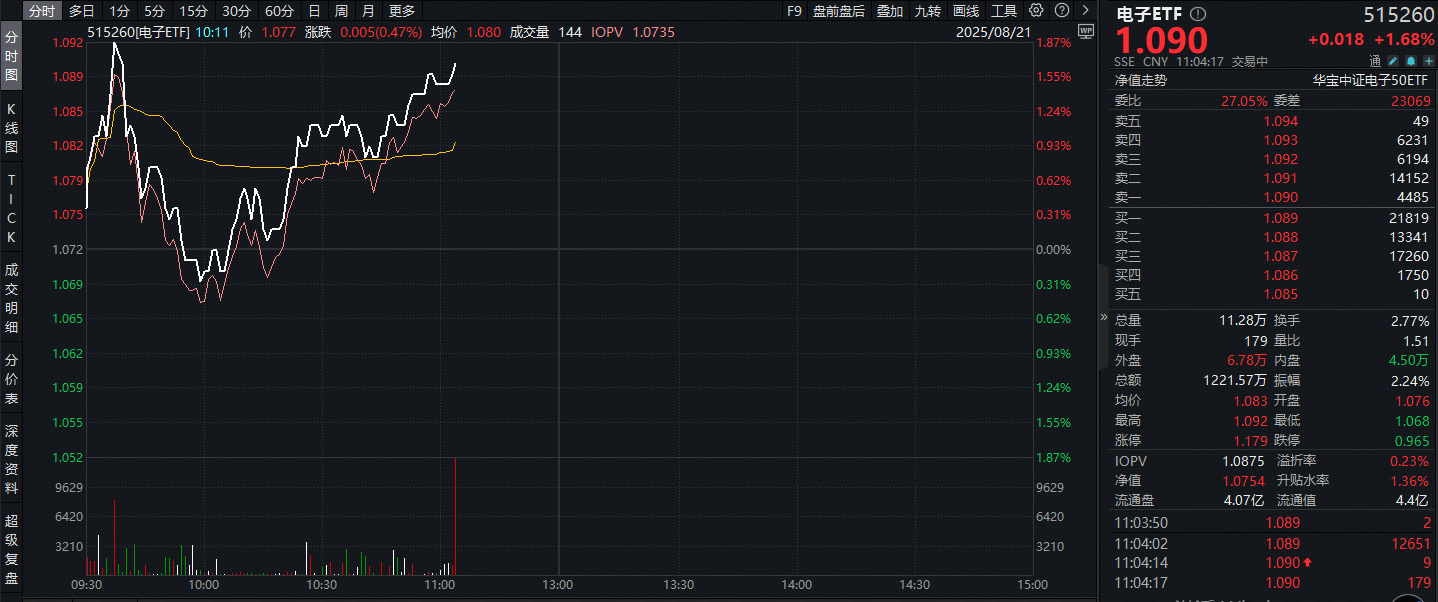
ETF盘中资讯|半导体产业链多重利好!电子ETF(515260)盘中拉升1.8%!兆易创新涨停,立讯精密涨超5%
Sou Hu Cai Jing· 2025-08-21 03:22
Group 1 - The electronic ETF (515260) focuses on sectors such as semiconductors, consumer electronics, and PCBs, showing a stable performance with a current fund size of 441 million yuan and an intraday price increase of over 1.8% [1][7] - The ETF passively tracks the Electronic 50 Index (931461), which rose by 0.87% on the same day, with top-weighted stocks including Luxshare Precision, SMIC, and BOE Technology [4][7] - Key stocks in the ETF include Luxshare Precision with a market cap of 289.7 billion yuan, Industrial Fulian at 955.6 billion yuan, and BOE Technology at 151.5 billion yuan [5] Group 2 - The global smart glasses market is expected to see a year-on-year shipment growth of 110% in the first half of 2025, with a projected compound annual growth rate of over 60% from 2024 to 2029, where AI smart glasses will account for 78% of the market [6] - The AI-PCB industry chain is experiencing strong demand driven by AI needs and rising tungsten powder prices, with leading companies fully utilizing their production capacity [6] - The semiconductor industry is showing a stable upward trend, with a projected 15%-20% quarter-on-quarter increase in DRAM prices due to supply-side reductions and increased demand from cloud computing and consumer electronics [6]



与字节跳动合作AI芯片?芯原股份回应
Shang Hai Zheng Quan Bao· 2025-08-20 14:50
芯原股份的股价波动源于一则"市场小作文":字节跳动正与芯原股份联手设计一款先进的AI算力芯片。不过,当日收盘前,有媒体发布求证信息称:字节 跳动相关负责人回复称,字节跳动与芯原股份并无AI芯片相关合作。 随后,芯原股份尾盘股价迅速下跌,一分钟内股价下降近5%,造成股价异动。 芯原股份董事会秘书石雯丽在接受上证报记者采访时表示,公司始终严格遵守商业合同约定,恪守对客户及合作事项的保密义务,对所有客户名称、合作 内容、项目细节等商业敏感信息均依法依规严格保密,均不会对外披露。对于市场上涉及具体客户项目的各类传言或猜测,公司无法作出确认或否认的回 应。 盘中涨停,却在收盘前最后5分钟突发炸板。8月20日,芯片大牛股芯原股份的走势引发市场广泛关注。 芯原股份:无应披露而未披露的重大信息 由于连续三个交易日内收盘价格涨幅偏离值累计超过30%,芯原股份于8月20日晚间发布了股票交易异常波动公告。 公司表示,经公司自查并向公司第一大股东VeriSilicon Limited发函确认,截至公告披露日,公司及第一大股东不存在应披露而未披露的重大信息,亦不存 在不应披露而披露的重大信息。公司目前日常经营情况正常,未发生重大变化。 ...


三星DRAM份额跌至十年低点!
国芯网· 2025-08-20 14:16
Core Viewpoint - Samsung Electronics' DRAM market share has dropped to 32.7% in the first half of 2025, down from 41.5% in the same period last year, raising concerns about its industry leadership [1][3]. Group 1: Market Performance - Samsung's DRAM market share fell below 40% for the first time in nearly a decade, having previously peaked at 48% in 2016 [3]. - The decline in DRAM market share is attributed to weak demand for high bandwidth memory (HBM), which is critical for AI chips [3]. - In contrast, Samsung's smartphone and television businesses have shown growth, with smartphone market share increasing by 1.6% to 19.9% and television market share rising by 0.6% to 28.9% in the first half of 2025 [3]. Group 2: Revenue and Exports - The Americas region leads in direct export revenue with 33.4 trillion KRW (approximately 24 billion USD), followed by China at 28.8 trillion KRW, a decline of about 11% from 32.3 trillion KRW year-on-year [3]. - The Asia-Africa region generated 20.8 trillion KRW, while Europe contributed 15.8 trillion KRW in export revenue [3]. Group 3: Pricing and Compensation - In the device experience (DX) department, the average price of mobile application processors (AP) and camera modules increased by 12% and 8%, respectively, compared to 2024 [4]. - The total compensation for Samsung's Vice Chairman and CEO Jun Young-hyun reached 11.9 billion KRW in the first half of 2025, while the head of the mobile experience (MX) business, TM Roh, received 11.95 billion KRW [4]. Group 4: R&D Investment - Samsung invested a total of 18 trillion KRW in research and development in the first half of 2025, with significant patent application activity, including 5,005 applications in South Korea and 4,594 in the United States [5].

晚间公告丨8月20日这些公告有看头
第一财经· 2025-08-20 13:58
Core Viewpoint - Several listed companies in the Shanghai and Shenzhen markets announced significant developments, including stock issuance, performance reports, and shareholder actions, which may present investment opportunities and risks for investors [3]. Group 1: Company Announcements - Tianwei Foods is planning to issue H-shares and apply for listing on the Hong Kong Stock Exchange to enhance its international strategy and brand recognition [4]. - *ST Yazhen's stock will resume trading on August 21 after a review, as its stock price had deviated significantly from the market [5]. - Wanto Development's subsidiary, Shudao Technology, is expected to begin mass production of PCIe 5.0 switch chips by the end of 2025, addressing performance bottlenecks in domestic AI chips [6][7]. - Kosen Technology clarified that it does not produce AI glasses or related components, despite being associated with the AI sector in media reports [8]. - Jiecheng Co. plans to transfer 5% of its shares to Hesheng Wealth for a total consideration of 679 million yuan [9]. Group 2: Performance Reports - Muyuan Foods reported a net profit of 10.53 billion yuan for the first half of 2025, a year-on-year increase of 1169.77%, with a revenue of 76.463 billion yuan [10]. - Hengrui Medicine achieved a net profit of 4.45 billion yuan, up 29.67% year-on-year, with a revenue of 15.761 billion yuan [11]. - Kingsoft Office's net profit for the first half of 2025 was 747 million yuan, reflecting a growth of 3.57% [12][13]. - Suotong Development reported a net profit of 523 million yuan, a significant increase of 1568.52%, with a revenue of 8.306 billion yuan [14]. - Weicai Technology's net profit reached 101 million yuan, up 831.03%, with a revenue of 634 million yuan [15]. - Yonghui Supermarket reported a loss of 241 million yuan, transitioning from profit to loss, with a revenue decline of 20.73% [16]. Group 3: Shareholder Actions - Dongfang Zircon's chairman plans to reduce his holdings by up to 1.315 million shares [17]. - Nanjing New Hundred plans to sell up to 6 million shares of its repurchased stock [18]. - Jinhongshun's major shareholder intends to reduce its stake by up to 3% [19][20]. - Xiamen Construction Machinery plans to reduce its holdings by up to 1% [21]. - Alloy Investment's major shareholder plans to reduce its stake by up to 3% [22]. - Rongzhi Rixin's controlling shareholder plans to reduce its holdings by up to 3% [23].



字节紧急辟谣合作传闻
21世纪经济报道· 2025-08-20 12:35
Core Viewpoint - The article discusses the recent stock performance of Chip Origin Co., Ltd. (芯原股份), highlighting a significant price fluctuation due to rumors of a collaboration with ByteDance on an AI chip, which was later denied by ByteDance [1][2]. Group 1: Company Overview - Chip Origin Co., Ltd. was established in 2001 and specializes in providing platform-based, comprehensive, and one-stop chip customization services and semiconductor IP licensing [1]. - The company operates in various application fields, including consumer electronics, automotive electronics, and computers [1]. - According to IPnest, Chip Origin ranks eighth globally in terms of IP licensing revenue for 2024 and second in terms of IP types [1]. Group 2: Financial Performance - The company's revenue for 2024 is projected to be 2.322 billion yuan, reflecting a year-on-year decline of 0.69% [2]. - The net profit attributable to shareholders is expected to be a loss of 601 million yuan, a significant drop of 102.68% year-on-year [2]. - In the first quarter of 2025, the company continued to face pressure, with revenue of 390 million yuan, a year-on-year increase of 22.49%, but still reporting a net loss of 220 million yuan, down 6.45% year-on-year [2].

【太平洋科技-每日观点&资讯】(2025-08-21)
远峰电子· 2025-08-20 12:01
Market Performance - The main board led the gains with notable increases in stocks such as Huaying Technology (+10.08%), Kesen Technology (+10.03%), and Huiwei Technology (+10.02%) [1] - The ChiNext board saw significant growth with Senba Sensor (+20.04%) and Zhidongli (+20.02%) leading the charge [1] - The Sci-Tech Innovation board also performed well, with Shengke Communication-U and Haocen Software both increasing by 20.00% [1] - Active sub-industries included SW Digital Chip Design (+4.62%) and SW LED (+3.95%) [1] Domestic News - Hubei Jiufengshan Laboratory announced a major technological breakthrough in indium phosphide (InP) materials, successfully developing a 6-inch InP-based PIN structure detector and FP structure laser with internationally leading performance indicators [1] - China Telecom's Sunshine Procurement Network published a public notice for the centralized procurement project of 12 million household FTTR devices for 2024-2025, with Huawei, ZTE, Tianyi Kanghe, and Fenghuo Communication shortlisted as candidates [1] - InnoSilicon launched its third-generation 700V GaN products, achieving a 30% reduction in chip area, a 20-30% improvement in switching performance, and a 20-30% reduction in capacitance compared to Gen2.5 [1] - Xiaomi Group reported a record total revenue of 116 billion yuan for Q2 2025, a year-on-year increase of 30.5%, with adjusted net profit reaching 10.8 billion yuan, up 75.4% year-on-year [1] Company Announcements - Yunda Technology reported total revenue of 289 million yuan for H1 2025, a year-on-year increase of 23.65%, with net profit attributable to shareholders of 16 million yuan, up 13.65% [3] - Hengmingda announced total revenue of 1.244 billion yuan for H1 2025, a year-on-year increase of 32.18%, with net profit attributable to shareholders of 234 million yuan, up 43.01% [3] - Optoelectronics reported total revenue of 683 million yuan for H1 2025, a year-on-year increase of 30.68%, with net profit attributable to shareholders of 146 million yuan, up 28.8% [3] - Huiyuan Communication reported total revenue of 236 million yuan for H1 2025, a year-on-year increase of 45.51%, with net profit attributable to shareholders of 9 million yuan, up 244.66% [3] Overseas News - SK Hynix is increasing the application of extreme ultraviolet (EUV) lithography technology in the next generation of DRAM, planning to add more than five EUV layers in its upcoming sixth-generation 10nm-class products [1] - NVIDIA plans to develop its own HBM memory Base Die using a 3nm process, with small-scale trial production expected to begin in the second half of 2027, marking a deepening of vertical integration in high-performance computing storage architecture [1] - Samsung Electronics signed a semiconductor wafer foundry contract worth at least $16.5 billion with Tesla, with its subsidiary Samsung Display also securing orders to supply 8-inch OLED screens starting in 2027 [1] - IDC reported that global smartphone shipments totaled 297 million units in Q2 2025, a year-on-year increase of 1.4%, with the top five manufacturers being Samsung, Apple, Xiaomi, Vivo, and Transsion [1]