生成式AI

Search documents
nv+
小熊跑的快· 2025-11-20 14:21
Core Insights - Nvidia reported strong financial results for FY26Q3, with revenue of $57.006 billion, a year-over-year increase of 62% and a quarter-over-quarter increase of 22%, exceeding market expectations [1] - The company achieved a net profit of $31.910 billion, up 65% year-over-year and 21% quarter-over-quarter, also surpassing market forecasts [1] - Earnings per share (EPS) reached $1.30, reflecting a 67% increase year-over-year and a 20% increase quarter-over-quarter, exceeding the expected $1.26 [1] Financial Performance - FY26Q4 revenue is projected to be $65 billion, representing a 65% year-over-year increase and a 14% quarter-over-quarter increase, surpassing market expectations of $61.6 billion [3] - Gross margin for FY26Q3 was reported at 73.4%, exceeding the previous guidance of 72.4%, with guidance for FY26Q4 set at 74.8% [4] Business Segments - Data Center revenue reached $43.028 billion, a 56% year-over-year increase and a 57% quarter-over-quarter increase, exceeding expectations [3] - Gaming revenue for FY26Q3 was $4.265 billion, falling short of the expected $4.425 billion [3] - Automotive revenue was $0.592 billion, also below the expected $0.622 billion [3] Market Outlook - Nvidia's CEO emphasized that AI investments are not in a bubble, citing three major paradigm shifts in the information technology sector that will drive infrastructure growth in the coming years [5] - The company has established strong partnerships across its supply chain, ensuring effective planning and management of resources [5] - The global AI infrastructure market is projected to reach $3-4 trillion by 2030, indicating significant growth potential [3]



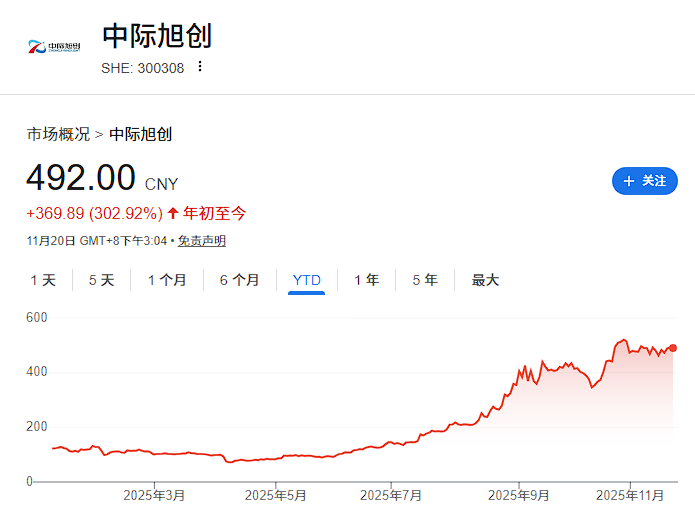
高盛上调中际旭创目标价至762:800G明年有望收入翻倍,1.6T技术迭代有望带来新增长周期
Hua Er Jie Jian Wen· 2025-11-20 14:11
Core Viewpoint - Goldman Sachs expresses strong confidence in the growth prospects of Zhongji Xuchuang, raising the target price by 62% to RMB 762 and maintaining a "Buy" rating based on the company's robust growth potential in the 800G/1.6T optical module and silicon photonics technology sectors [1] Group 1: Financial Projections - Goldman Sachs forecasts a compound annual growth rate (CAGR) of 59% for Zhongji Xuchuang's net profit from 2025 to 2028, with 800G optical module revenue expected to surge by 104% year-on-year in 2026 and 1.6T optical module revenue projected to skyrocket by 110% in 2027, supporting an overall revenue CAGR of 52% during the same period [3] - The net profit estimates for 2026 and 2027 have been raised by 23% and 28%, reaching RMB 21.645 billion and RMB 29.944 billion, respectively, driven by higher revenue and gross margin expectations [3] - Operating profit margin is anticipated to increase from 25% in 2024 to 39% in 2028, reflecting sustained growth supported by long-term demand trends in AI networks [3] Group 2: Market Dynamics - The diversification of ASIC chips is reshaping the demand landscape for optical modules, with ASIC chips expected to account for 38%, 40%, and 45% of the AI chip market from 2025 to 2027 [4] - The architectural differences between GPU and ASIC servers lead to a significant increase in the dependency on multiple chips, servers, and rack connections, thereby driving stronger demand for high-speed connections [5] Group 3: Technology and Product Upgrades - The transition from 400G to 800G is becoming a major driver for the optical module upgrade cycle, with expectations for continued trends in the coming years, including the deployment of 1.6T optical modules starting in the second half of 2025 [6] - As optical modules upgrade to higher speeds, market competition is expected to decrease due to higher technical barriers in design, testing, and production efficiency, benefiting technologically advanced companies [6] - Revenue contribution from 800G and 1.6T products is projected to increase significantly, from 64% and 8% in 2025 to 71% and 16% in 2026, respectively, making this product structure upgrade a core engine for revenue growth [6] Group 4: Margin Expansion - Gross margin is expected to rise from 41.6% in 2025 to 46.4% in 2027, primarily due to faster speed migration and the transition from EML to silicon photonics technology [7] - Silicon photonics technology offers better gross margin performance compared to EML, with reduced component costs and improved production efficiency [7] Group 5: Valuation Adjustments - Goldman Sachs has significantly raised its revenue forecasts for 2026 and 2027 by 24% and 35%, respectively, reflecting accelerated growth in mainstream products [8] - The target price has been adjusted from RMB 470 to RMB 762, applying a target price-to-earnings ratio of 31 times, consistent with recent trading averages [8]

容芯致远石旭:智算时代呼唤以GPU为核心的AI体系结构
2 1 Shi Ji Jing Ji Bao Dao· 2025-11-20 12:44
Core Insights - The demand for computing power has surged since the advent of generative AI in 2023, with high-end GPUs becoming essential production materials as AI applications proliferate by 2025 [1] - The transition from traditional computing to intelligent computing is marked by the introduction of the Deepseek mixture of experts (MoE) model, which allows for on-demand activation of sub-models, reducing training and inference costs [2] - The industry is moving towards a new data center architecture that utilizes electrical computing and optical transmission to overcome the limitations of traditional copper interconnects [3] Industry Trends - In 2023, China sold 4.7 million traditional computing servers and 150,000 intelligent computing servers, with projections indicating a decline in traditional server sales to over 1 million and an increase in intelligent server sales to over 100,000 by mid-2025 [1] - The shift towards GPU-centric architectures is driven by the limitations of CPUs in handling large-scale parallel computing tasks, with GPUs becoming the core of AI computing systems [4][5] - The industry is innovating to address the high failure rates and energy consumption of GPUs, with advancements in GPU hot-swapping and RAID technologies aimed at enhancing reliability and extending lifespan [5] Technological Innovations - The AGC (AI computer system with GPU as its Core) architecture proposed by companies like容芯致远 positions the CPU as a peripheral, reducing reliance on high-performance CPUs and allowing for better performance from domestic GPUs [5] - The effective utilization of computing power (MFU) can be improved from an average of 40% in traditional servers to over 60% through architectural innovations, enhancing overall computational efficiency [6]
英伟达(NVDA.O)FY26Q3跟踪报告:Q3营收及Q4指引均超预期,公司表示未见明显AI泡沫
CMS· 2025-11-20 11:16
Investment Rating - The report maintains a "Buy" recommendation for NVIDIA and its related industry chain companies, highlighting potential investment opportunities in server hardware components and domestic computing power manufacturers [9]. Core Insights - NVIDIA reported a record revenue of $57 billion for FY26Q3, representing a year-over-year increase of 62% and a quarter-over-quarter increase of 22%, exceeding expectations [1][14]. - The data center segment showed strong growth, with revenue reaching $51.215 billion, up 66.4% year-over-year and 24.6% quarter-over-quarter, driven by the transition to accelerated computing and generative AI [2][15]. - The company expects continued high growth in FY26Q4, with a revenue guidance midpoint of $65 billion, reflecting a year-over-year increase of 65.3% and a quarter-over-quarter increase of 14% [3][36]. - NVIDIA's Blackwell platform momentum is strong, with the GB300 product contributing significantly to revenue, and the AI ecosystem is rapidly expanding without signs of a bubble [4][37]. Summary by Sections Financial Performance - FY26Q3 revenue was $57 billion, with a non-GAAP gross margin of 73.6%, slightly below the previous year but above guidance [1][33]. - The operating expenses increased by 11% quarter-over-quarter, primarily due to rising costs in infrastructure and employee compensation [1][33]. Data Center Growth - Data center revenue reached $51.215 billion, with a significant contribution from the GB300 product, which accounted for about two-thirds of Blackwell's total revenue [2][20]. - The network products segment saw a revenue increase of 164.5% year-over-year, driven by advancements in NVLink and Spectrum-X technologies [2][22]. Future Outlook - The guidance for FY26Q4 indicates a revenue midpoint of $65 billion and a gross margin of approximately 75%, reflecting ongoing strong demand for the Blackwell architecture [3][36]. - The company anticipates that the global AI infrastructure market will reach $3 trillion to $4 trillion by the end of the decade, positioning NVIDIA as a key partner in this growth [15][41]. Market Dynamics - The report emphasizes the ongoing transition from traditional machine learning to generative AI, which is expected to drive significant capital expenditures in the cloud service provider sector, projected at $600 billion [16][38]. - NVIDIA's CUDA platform is highlighted as a critical enabler for this transition, supporting a wide range of applications across various industries [37][40].
AI视觉GPT时刻,Meta新模型一键“分割世界”,网友直呼太疯狂了
3 6 Ke· 2025-11-20 10:04
Core Insights - Meta has launched a new family of models called SAM 3D, which includes SAM 3D Objects for object and scene reconstruction and SAM 3D Body for human shape estimation [1][12] - The SAM 3D series allows users to extract 3D models from 2D images with high accuracy, enabling 360-degree rotation without noticeable flaws [1][11] - SAM 3 introduces a new feature called "promptable concept segmentation," enhancing the model's versatility in image segmentation tasks [1][19] SAM 3D Objects - SAM 3D Objects has achieved significant advancements in 3D object reconstruction, utilizing a data annotation engine that has labeled nearly one million images to generate over 3.14 million mesh models [7][9] - The model outperforms existing leading models in human preference tests with a 5:1 advantage, enabling near-real-time 3D applications [10][11] - SAM 3D Objects can reconstruct shapes, textures, and poses of objects, allowing users to manipulate the camera for different viewing angles [11][12] SAM 3D Body - SAM 3D Body focuses on human 3D reconstruction, accurately estimating human poses and shapes from single images, even in complex scenarios [12][13] - The model supports prompt inputs, allowing users to guide predictions through segmentation masks and key points, enhancing interactivity [12][13] - SAM 3D Body has been trained on approximately 8 million high-quality samples, ensuring robustness across diverse scenarios [13][16] SAM 3 Model Features - SAM 3 is a unified model capable of detecting, segmenting, and tracking objects based on text, example images, or visual prompts, significantly improving flexibility in segmentation tasks [18][19] - The model has shown a 100% improvement in concept segmentation performance on the SA-Co benchmark compared to previous models [19][20] - Meta has implemented a collaborative data engine involving both AI and human annotators to enhance data labeling efficiency and model performance [20][23] Conclusion - The rise of generative AI is transforming computer vision (CV) capabilities, expanding the boundaries of model training and data set creation [24] - Meta is actively applying these technologies in real business scenarios, suggesting that the SAM and SAM 3D series models may yield further innovations as data and user feedback accumulate [24]


谷歌盘前涨超2%
Ge Long Hui A P P· 2025-11-20 09:11
Core Insights - Google's stock rose over 2% in pre-market trading, indicating positive market sentiment towards the company [1] - The market recognizes the Gemini 3 model, suggesting that investors expect Google to maintain its leading position in the generative AI sector [1] Company Summary - Google's Gemini 3 model has received market approval, reflecting confidence in its capabilities [1] - Investor expectations are high regarding Google's ability to sustain its competitive edge in the generative AI field [1] Industry Summary - The generative AI sector is witnessing significant interest, with major players like Google being closely watched for advancements [1] - Market trends indicate a growing recognition of AI technologies, which could influence investment strategies in the tech industry [1]
HORIBA Q3财报:营收利润双增,重组三大业务,能源环境板块利润预增88%
仪器信息网· 2025-11-20 09:09
Core Viewpoint - HORIBA reported steady growth in revenue and profit for the first nine months of the fiscal year 2025, driven by a restructuring into three main business segments: "Energy & Environment," "Bio & Healthcare," and "Materials & Semiconductor" [2][6]. Financial Performance - For the period from January to September 2025, HORIBA achieved revenue of 230.245 billion yen, a year-on-year increase of 6.7%. Operating profit rose by 12.1% to 33.515 billion yen, while net profit attributable to shareholders surged by 21.0% to 24.096 billion yen, with a net profit margin of 10.5% [4]. - As of the end of September, total assets reached 490.211 billion yen, up 1.8% from the beginning of the year. The equity ratio increased to 65.9%, reflecting a 0.7 percentage point improvement [5]. Business Segment Performance - **Energy & Environment Segment**: This segment saw revenue of 85.968 billion yen, a 10% increase, and successfully turned a loss of 1.347 billion yen from the previous year into a profit of 2.023 billion yen. Growth was driven by increased demand for emission measurement systems amid a slowdown in electric vehicle transitions [8]. - **Materials & Semiconductor Segment**: Revenue grew by 5.4% to 114.768 billion yen, with a slight operating profit increase of 1.1%. The growth was fueled by strong demand for advanced semiconductors driven by generative AI [9]. - **Bio & Healthcare Segment**: Revenue increased by 2.4%, but the segment still reported an operating loss. The company expects improvements in the full year, despite a decline in sales of in vitro diagnostic reagents in the Americas [10]. Regional Market Insights - The European market showed the strongest performance with a 13.1% increase in sales, particularly in the Energy & Environment sector, which saw a 24.6% surge. The Asian market grew by 8.1%, with the Materials & Semiconductor segment in Asia increasing by 11.1% [11]. Strategic Outlook - HORIBA plans to deepen its long-term strategy outlined in the MLLMAP2028, focusing on advanced semiconductor process inspection, water resource protection, and precision medicine, aiming to solidify its leading position in high-end instruments [15].

再次受邀谷歌峰会,华曦达AI Home如何破解运营商增长难题?
Ge Long Hui· 2025-11-20 08:11
Core Insights - The article highlights the strategic shift of Huaxida towards becoming an AI company, focusing on its AI Home solutions that aim to transform telecom operators from "network pipeline providers" to "smart living service providers" [1][4][12] - Huaxida's AI Home solutions have seen significant growth, with a 73.01% increase in sales revenue from AI Home devices in the first half of 2025, and an overall revenue growth of 51.23% [1][4] Group 1: Industry Challenges and Opportunities - The global telecom industry is facing a transformation phase, with operators lacking growth stories despite having users, as traditional broadband services become low-profit "pipeline businesses" [3][4] - There is a growing consumer demand for smart home services, creating a critical opportunity for operators to shift from selling connectivity to offering services [4][10] Group 2: Huaxida's Strategic Position - Huaxida has positioned itself as a key player in the AI Home sector, leveraging its technological capabilities and ecosystem partnerships to deliver comprehensive AI-driven home service solutions to operators [4][10] - The company has gained recognition from over 300 enterprises across more than 80 countries, including several Fortune 500 companies and top telecom operators in 13 regional markets [4][10] Group 3: Cedar AI Agent - The core of Huaxida's AI Home ecosystem is the Cedar AI agent, which has integrated with Google Gemini's latest model, enhancing its capabilities in multi-modal information input and precise intent recognition [6][7] - Cedar's evolution has expanded its functionality from entertainment to high-value areas such as security, energy management, and caregiving, transforming it into the central AI hub for home life [8][9] Group 4: Future Prospects - Huaxida plans to expand its market share through existing product lines while also exploring new growth avenues with innovative products like home robots and smart glasses [11][12] - The company is fostering strategic collaborations with partners like Tencent and Luxshare Precision to enhance its R&D capabilities in Home AI and robotics, promoting an open ecosystem approach [11][12]
豪掷135亿,Adobe收购一家AI营销公司
3 6 Ke· 2025-11-20 07:33
Core Insights - Adobe announced the acquisition of AI search engine marketing SaaS platform Semrush for $1.9 billion (approximately 13.5 billion RMB) [1][3] - The acquisition is expected to enhance Adobe's digital experience business by integrating Semrush's tools for tracking search and AI platform visibility [3][11] - Following the announcement, Semrush's stock surged by 70.97%, reaching a closing price of $11.76 per share, with a market capitalization of $1.754 billion (approximately 12.5 billion RMB) [3][7] Company Overview - Semrush, founded in 2008 and publicly listed in 2021, provides core tools for search engine optimization (SEO) through an online management platform [3][11] - The company has 100,000 paid users and 1 million active free registered users, with major clients including Amazon and TikTok [3][11] - Semrush reported Q3 revenue of $112.1 million (approximately 800 million RMB) and a loss of $4.5 million (approximately 32.03 million RMB) [11] Strategic Implications - Adobe aims to leverage Semrush's capabilities to help marketers enhance brand visibility in both traditional search engines and AI-driven platforms [10][13] - The acquisition aligns with Adobe's broader strategy to support brand visibility in the evolving landscape of generative AI [13] - Adobe's digital experience business president emphasized the importance of embracing generative AI to avoid losing relevance and revenue [13] Market Reaction - Adobe's stock fell by 5% following the acquisition announcement, closing at $318.11 per share, with a market capitalization of $133.16 billion (approximately 947.8 billion RMB) [7] - The acquisition is part of a trend where generative AI platforms are becoming new interfaces between brands and consumers, with a reported 1200% year-over-year increase in traffic from generative AI channels to U.S. retail websites [10][13]

谷歌峰会上的中国力量:华曦达AI Home解决方案引领家庭AI革命
Ge Long Hui· 2025-11-20 07:30
Core Insights - The article highlights the strategic role of Huaxida in transforming the telecommunications industry through its AI Home solutions, positioning itself as a key player in the AI-driven smart home market [1][3][4]. Industry Context - The global telecommunications industry is facing challenges such as growth stagnation and service homogenization, with traditional broadband services becoming low-margin "pipeline businesses" [5]. - There is a growing consumer demand for smart home services, creating an opportunity for operators to shift from "selling connections" to "selling services" [5][6]. Company Strategy - Huaxida's AI Home solution is a comprehensive cloud-edge-end system that enables operators to transition from network providers to smart living service providers [3][4]. - The company has seen significant growth, with AI Home device sales revenue increasing by 73.01% in the first half of 2025, overall revenue growing by 51.23%, and net profit doubling [3][6]. Product Development - The core of Huaxida's AI Home ecosystem is the Cedar AI agent, which has advanced capabilities in multi-modal information input and precise intent recognition [7][8]. - Cedar has evolved from basic content retrieval to a more sophisticated system capable of recognizing household states and executing tasks autonomously, expanding its application from entertainment to security, energy management, and caregiving [8][9]. Technological Integration - Huaxida employs a cloud-edge-end collaborative architecture that enhances system intelligence, reduces response latency, and improves data privacy [9]. - The company is the largest global supplier of Android TV smart terminals, leveraging this advantage to enhance AI application layers and user interaction experiences [9][10]. Ecosystem Collaboration - Huaxida's AI Home solutions are fully compatible with the Matter standard, positioning the company as an ecosystem coordinator that can integrate various brands and devices [10]. - The company is actively collaborating with industry partners, including Tencent and Luxshare Precision, to develop innovative products like home robots and smart glasses [13]. Future Outlook - Huaxida plans to expand its market share through existing product lines while exploring new growth opportunities in home robotics and smart glasses [11][13]. - The company's approach to open collaboration and resource integration is expected to accelerate the fusion of AI with home scenarios, establishing AI Home as a core business model for operators [11][13].