
降息

Search documents
美联储古尔斯比:政府“停摆”致数据缺失,降息需谨慎
Sou Hu Cai Jing· 2025-11-07 03:10
Core Viewpoint - The President of the Chicago Federal Reserve, Goolsbee, expressed caution regarding further interest rate cuts due to delays in the release of federal economic data caused by the government shutdown, particularly inflation statistics [1] Group 1 - The government shutdown has led to the postponement of new federal economic data releases [1] - Goolsbee indicated that issues arising from the delay in economic data could take a significant amount of time to become apparent [1] - This situation has contributed to a more cautious stance on potential interest rate reductions [1]
富格林:应对黑幕看清陷阱有效追损
Sou Hu Cai Jing· 2025-11-07 02:29
Group 1 - Gold prices experienced volatility, initially rising above $4010 per ounce before dropping to close at $3977.17, a decrease of 0.05% [1] - Oil prices continued to decline for the fourth consecutive day, with WTI crude oil closing at $59.40 per barrel, down 0.13%, and Brent crude oil at $63.21 per barrel, down 0.18% [1] - The U.S. labor market showed signs of weakness, with a decrease of 9,100 non-farm jobs in October and a significant year-on-year increase of 175% in layoffs reported by Challenger [1] Group 2 - The Bank of England decided to maintain interest rates, with 4 out of 9 policymakers supporting a rate cut, and the removal of the term "cautious" in their guidance may indicate a potential rate cut in December [2] - The World Gold Council reported that global gold ETFs saw net inflows for five consecutive months in October, with average daily trading volumes reaching a historical high [2]
宁证期货今日早评-20251107
Ning Zheng Qi Huo· 2025-11-07 02:29
Report Industry Investment Rating No relevant content provided. Core Viewpoints - The remaining period of this year for crude oil is under pressure, and it should be treated with a weakening trend [1]. - Gold may experience high - level fluctuations in the medium - term, and the downward space is limited in the short - term [1]. - Lithium carbonate futures prices are strengthening, and it is expected to have a short - term strong and volatile trend [3]. - Steel prices may have a narrow - range fluctuation after a partial rebound in the short - term [3]. - Coking coal futures are running near the upper edge of the oscillation range, and the actual impact of safety supervision and anti - involution on supply should be focused on [4]. - There is a local rebound expectation for hog prices, but there is still downward pressure in the short - term [4]. - Soybean No. 1 will have a high - level oscillation in the short - term, and Soybean No. 2 will have a strengthening and oscillating trend [5]. - Palm oil will have a bottom adjustment in the short - term [6]. - Rubber should be treated with a weakening and oscillating trend [6]. - PTA should be traded in the short - term as its fundamentals lack significant driving forces [6]. - Treasury bond futures have increasing positive factors and a medium - term oscillating and strengthening trend [7]. - Silver will have a short - term oscillation and a long - term strengthening trend [7]. - Methanol 01 contract is expected to have a short - term weakening and oscillating trend [8]. - Soda ash 01 contract is expected to have a short - term oscillating trend [9]. - PVC is expected to have a short - term oscillating trend [10]. Summaries by Commodity Crude Oil - Saudi Aramco lowered the official selling price for Asia in December. The export volume of some crude oils in November is expected to be slightly lower than that in October. The market is worried about oversupply, and European and American futures prices have fallen [1]. Gold - There are large differences within the Fed on whether to cut interest rates in December. The decline of US stocks and the risk - aversion sentiment are positive for precious metals [1]. Lithium Carbonate - The market supply and demand are booming. The total market inventory has decreased, and the sentiment in the mid - stream has improved. The latest quotation of Australian mines has strengthened again [3]. Rebar - This week, the supply and demand in the steel market are both weak, and the inventory reduction has significantly slowed down. Most steel mills are in losses and are expected to increase maintenance and production reduction [3]. Coking Coal - The supply - demand pattern of coking coal has no obvious change recently. The upward driving force comes from anti - involution and the improvement of Sino - US trade relations. The multi - empty game in the market has intensified [4]. Hog - Hog prices are stable and strong in the north and weakly stable in the south. There is a local rebound expectation under the supply - demand game [4]. Soybean - Brazil's soybean exports in October increased significantly year - on - year. The purchase price of domestic new - season soybeans has increased, but the downstream demand suppresses the price to some extent [5]. Palm Oil - The production of Malaysian palm oil from November 1 - 5 increased compared with the same period last month. There is an expectation of production reduction in November, and the domestic demand has been significantly boosted recently [6]. Rubber - The inventory has increased this week, and the overall raw material inventory is at a low level. The demand side lacks substantial positive factors, especially the decline of synthetic rubber prices [6]. PTA - The polyester start - up rate is stable. The domestic supply has increased, and the demand side is stable. The balance sheet shows a slight inventory accumulation [6]. Short - term Treasury Bond - The money market interest rates have mostly declined, and the central bank's open - market operations and short - term liquidity injection are positive for the bond market [7]. Silver - The US federal government shutdown has led to the suspension of official inflation data release, causing concerns among some Fed officials about the future monetary policy [7]. Methanol - The domestic methanol start - up is at a high level, the downstream demand is relatively stable, and the port inventory has accumulated slightly [8]. Soda Ash - The production of soda ash has decreased slightly, and the inventory has increased slightly. The start - up of float glass is relatively stable, and the inventory has decreased [9]. PVC - The start - up of domestic PVC production enterprises has increased, and the production is expected to increase. The downstream demand is weak, and the social inventory has increased [10].
货币政策体系及其对国债利率的启示
Qi Huo Ri Bao Wang· 2025-11-07 01:17
Core Viewpoint - The 20th Central Committee's Fourth Plenary Session approved the "Suggestions on Formulating the 15th Five-Year Plan for National Economic and Social Development," emphasizing a stable and continuous monetary policy framework that will guide financial market operations during the 15th Five-Year Plan period [1] Monetary Policy Framework - The "scientific and stable" monetary policy aims to balance short-term and long-term goals, economic growth and risk prevention, as well as internal and external factors [1] - The central bank's liquidity toolbox is well-stocked, with a reasonable distribution of terms, allowing for both short-term and long-term liquidity adjustments [2] Liquidity Tools and Mechanisms - The central bank has shifted its focus from quantity targets to interest rate levels, indicating a reduced emphasis on the monetary supply's direct control [2] - Different liquidity tools serve distinct purposes, with reserve requirement ratio (RRR) adjustments being used more cautiously compared to other tools [3] Interest Rate Mechanism - The central bank will adjust the timing of MLF operations to follow LPR announcements, reinforcing the significance of the 7-day reverse repurchase rate as a policy interest rate [3] - The transmission mechanism of monetary policy is structured as "economic growth - policy interest rate - market interest rate," with the 7-day reverse repurchase rate becoming a key determinant for 10-year government bond yields [5] Economic Indicators and Policy Signals - Historical data shows that each round of RRR cuts corresponds with a decline in government bond yields, indicating that RRR adjustments signal policy easing [4] - The frequency of interest rate cuts is lower than that of RRR cuts, suggesting a more cautious approach by the central bank regarding interest rate adjustments [6]
美元被动走强
Hua Tai Qi Huo· 2025-11-07 00:50
Report Summary 1. Report's Industry Investment Rating No relevant information provided. 2. Core View of the Report - The short - term outlook for the USD/CNY exchange rate is expected to be range - bound between 7.1 and 7.15. In the short run, the strengthening of the US dollar is mainly due to the relatively weaker fundamentals and policy expectations of other major economies, giving the dollar a passive upward lift. If the relative differences narrow, the CNY has the potential to strengthen periodically. By the end of the year, if the Fed starts a substantial interest - rate cut cycle and domestic demand continues to recover, the CNY exchange - rate center may moderately rise to around 7.0. Exchange - rate policies will focus on stabilizing expectations and the pace. Attention should be paid to the possible short - term fluctuations of the US dollar and the corresponding increase in the CNY's volatility when the US government shutdown ends and a large amount of data is released [35]. 3. Summary by Relevant Catalogs 3.1 Quantity and Price Observation - The implied volatility curve of the 3 - month USD/CNY option shows an appreciation trend of the CNY, with the put - end volatility higher than the call - end [5]. - The policy counter - cyclical factor remains below 5%, and the 3 - month CNH HIBOR - SHIBOR spread fluctuates [9]. 3.2 Fundamental and View 3.2.1 Macro - Economic Situation - **US**: There are differences in the pricing of interest - rate cuts between the US and Europe. The TGA account balance increased to 905 billion on October 22, and the reserve balance of depository institutions decreased by 58.4 billion to 3.28 trillion. Fed Chairman Powell hinted in October that the Fed might stop shrinking its balance sheet in the coming months. The US central bank cut the federal funds rate by 25 basis points to 3.75% - 4.00% in October and announced the end of the balance - sheet reduction program on December 1. The September CPI increase was lower than expected, supporting future interest - rate cuts. The economic outlook was revised upward, with a slight increase in the October PMI, but the improvement in real - estate sales in September did not continue. The ADP employment data changed to weekly, and the private - sector employment in the US showed a slight recovery, indicating that the labor market was still cooling down [16][18][19]. - **China**: There is a structural differentiation in the economy. September's imports and exports exceeded expectations, but there is still significant pressure on fixed - asset investment. Consumption has been boosted by holiday spending in the short term, but high - frequency consumption data shows an increase in volume but a decrease in price. Against the background of increasing pressure, the government has loosened its policy window, and the gap between the fundamentals and market sentiment has widened [20]. 3.2.2 Economic Data - **US October PMI**: The US ISM Manufacturing PMI in October was 48.7. New orders slightly rebounded to 49.4, production declined again to 48.2, employment contracted continuously at 46.0, and the payment price dropped to a record low for the year at 58.0, indicating weak demand, slow output, labor - force reduction, and easing cost pressure [22]. 3.2.3 Exchange - Rate Drivers - **Tight USD Liquidity**: The Fed's balance - sheet reduction has led to a near - zero RRP balance, reducing the excess US dollars in the market. The increase in the TGA balance has further drained liquidity. At the end of October, the SOFR jumped significantly, indicating tight short - term funds. Against the backdrop of liquidity contraction, risk appetite declined, and the demand for safe - haven assets pushed up the US dollar [28]. - **Drivers for the USD to Break Above 100**: The market lacks a clear direction, and momentum dominates. In the fourth quarter, there is insufficient data and policy guidance, and the upward movement of the US dollar is more driven by sentiment and positions. The upward movement of the US dollar in October mainly occurred during the transition period between the Asian - European trading sessions, with limited driving force during the US trading session. The weakening of the Japanese yen, British pound, and South Korean won has contributed more to the strength of the US dollar, which has a passive upward characteristic [31]. 3.3 Macro - Economic Scenario Analysis - There are important events such as the APEC meeting from October to November, the postponement of the expiration of Sino - US tariffs in November, the Politburo meeting and the FOMC meeting in December, and the Central Economic Work Conference. In 2026, there are events such as the expiration of the Fed's temporary governor's term in January, the government work report in February, and the National People's Congress in March. The inflation realization period, the turning point of the inventory cycle, the Fed's increased easing, and the restocking cycle are also important factors to consider. Risks include the US government shutdown, liquidity risks, and the impact of the de - stocking cycle and tariffs [37][38][39].
纳指跌超400点,英伟达市值一夜蒸发1.2万亿元!马斯克万亿美元薪酬计划获批,特斯拉盘后一度涨超3%!美联储,降息大消息!
Mei Ri Jing Ji Xin Wen· 2025-11-06 23:44
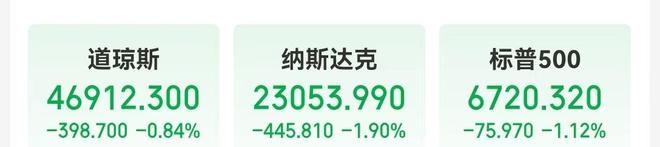
Group 1: Market Overview - On November 6, US stock indices collectively declined, with the Nasdaq dropping 445.81 points, a decrease of 1.90%, the S&P 500 falling by 1.12%, and the Dow Jones down by 0.84% [1] - Major tech stocks experienced widespread declines, with Tesla down over 3%, Intel, Amazon, and Meta down over 2%, and Microsoft down over 1% [2] Group 2: Tesla's Shareholder Meeting - Tesla's shareholders approved Elon Musk's $1 trillion compensation plan, with over 75% voting in favor [2] - The annual shareholder meeting took place on November 6, where Musk's compensation plan faced significant opposition from institutional investors [2] - The plan includes a performance-based agreement where Musk could receive up to 423.7 million restricted stock units, contingent on achieving specific financial targets, including an annual adjusted EBITDA of $400 billion [5] Group 3: Market Reactions and Predictions - Morgan Stanley warned that if Musk's compensation plan were rejected, it could be interpreted as a "vote of no confidence," potentially leading to a stock sell-off and a price drop of over 10% [5] - Individual investors expressed mixed feelings, with some viewing the compensation plan as essential for Tesla's future, linking their investment decisions to Musk's continued leadership [5] - Nvidia's stock fell by 3.65%, resulting in a market value loss of $173.3 billion [7] Group 4: Broader Market Trends - The Nasdaq China Golden Dragon Index saw a slight decline of 0.03%, with various Chinese stocks experiencing mixed performance [10] - Commodity prices showed slight decreases, with COMEX gold futures down 0.14% and WTI crude oil futures down 0.29% [10]


一觉醒来,一切都在大跌,泡沫被戳了一下
Xin Lang Cai Jing· 2025-11-06 22:39
Core Viewpoint - The U.S. stock market experienced a significant decline, with the S&P 500 dropping over 1% and the Nasdaq nearly 2%, indicating a shift from speculative trading to a focus on economic realities [3] Economic Data - In October, U.S. employers announced layoffs totaling 153,074, a staggering increase of 183%, marking the highest number of layoffs for this month in 22 years [3] - Revelio Labs revised September's job additions down from 60,000 to 33,000, and October's data showed a loss of 9,100 jobs, the second worst performance of the year [3] Market Reactions - Despite poor employment data typically raising expectations for interest rate cuts, the market reacted negatively, interpreting the bad news as indicative of a potential recession [3] - The market slightly increased the probability of a December rate cut to 70%, but the Federal Reserve's hawkish stance has intensified, with officials expressing concerns about inflation [4] Investor Sentiment - Investors are realizing that the Federal Reserve may not intervene to support the market, leading to a "policy vacuum" characterized by heightened volatility and declining confidence [5] - AI stocks led the market decline, with major companies like Nvidia, Microsoft, Amazon, and Tesla suffering losses after comments indicating no government support for AI firms [5] Strategic Insights - A report titled "Global Market Strategy: Peak Warning" was released, emphasizing the importance of understanding market cycles and avoiding mistakes during this period of uncertainty [5] - Goldman Sachs identified 27 Asian stocks and 21 U.S. stocks as favorable investments, specifically highlighting two Chinese stocks as particularly promising [6]


“鹰鸽”齐飞!美联储官员就货币政策前景发出不同信号
智通财经网· 2025-11-06 22:26
但芝加哥联储主席古尔斯比则表达了对降息路径的担忧。他称,由于政府停摆导致官方通胀数据暂时缺 失,决策者可能无法及时发现物价风险,这让他对继续降息"愈发不安"。古尔斯比强调,在缺乏关键信 息的情况下采取宽松政策存在风险。 当前,美国劳动力市场虽有降温迹象,但仍处于"总体健康"区间。哈马克预计到2026年初,失业率仅会 略高于长期均衡水平,她认为这进一步说明当前应优先控制通胀,而非过度担忧就业。如不及时遏制通 胀,长期高物价可能固化在经济中,造成更大成本。 智通财经APP获悉,周四,美联储官员就货币政策前景发表多项讲话,就当前货币政策走向释放出不同 信号。 克利夫兰联储主席哈马克表示,当前通胀仍"过高",并对经济构成的风险大于劳动力市场放缓。她强 调,货币政策应继续对通胀施压,并指出目前利率水平"几乎不具限制性",暗示进一步降息可能过早。 哈马克预计,美国通胀最快也要在2026年之后一两年才能降至美联储2%的目标,这意味着美联储将连 续近十年未能实现物价稳定目标。她还透露,辖区内企业反馈成本压力正在回升,并计划陆续向消费者 转嫁价格。 与此同时,纽约联储主席威廉姆斯发表了相对鸽派的讲话。他表示,市场对"中性利率" ...
芝加哥联储主席:政府停摆致通胀“数据盲区” 降息路径需更谨慎
智通财经网· 2025-11-06 14:37
Group 1 - The U.S. federal government shutdown has led to a pause in the release of official inflation data, raising concerns among some Federal Reserve officials regarding future monetary policy direction [1] - Chicago Fed President Goolsbee expressed unease about continuing interest rate cuts due to the lack of key price data, stating that the Fed has less clarity on price trends compared to employment indicators during the government shutdown [1] - Goolsbee emphasized the need for caution among policymakers in the face of data shortages and reduced economic visibility, suggesting that they should slow down their decision-making process [1] Group 2 - Despite the temporary interruption of official labor data, a real-time unemployment rate indicator based on private sector data from the Chicago Fed shows an October unemployment rate of approximately 4.36%, nearly unchanged from August's 4.35%, indicating that the labor market has not deteriorated further [2] - As the gap in inflation data widens and internal disagreements among officials increase, the market is beginning to bet that the Federal Reserve may slow down the pace of interest rate cuts, particularly ahead of the next rate decision in December [2] - Goolsbee's recent comments indicate a strengthening of hawkish voices within the Federal Reserve, contrasting with the dovish perspective that has recently advocated for continued policy easing to support employment [2]
刚刚宣布!不降息了
中国基金报· 2025-11-06 14:14
Core Viewpoint - The Bank of England decided to maintain the benchmark interest rate at 4%, aligning with market expectations, and pausing the trend of quarterly rate cuts that began in August 2024 [2][4][8]. Group 1: Interest Rate Decision - The decision to keep the interest rate unchanged reflects concerns over high overall inflation in the UK, despite a more balanced risk outlook regarding inflation and a more pronounced risk from weak demand [9]. - The Monetary Policy Committee voted 5 to 4 in favor of maintaining the rate, with Governor Bailey casting the decisive vote [12][13]. Group 2: Economic Forecasts - The Bank of England raised its GDP growth forecast for 2025 to 1.5% from 1.25%, while slightly lowering the CPI forecast for the same year [10]. - Inflation is expected to decline to around 3% by early 2026 and reach the 2% target by the second quarter of 2027 [10]. Group 3: Currency Impact - Following the announcement, the British pound fell approximately 30 points against the US dollar, indicating potential ongoing pressure on the currency [5][16]. - Analysts predict that if the Bank of England cuts rates in December, the pound may depreciate further, with expectations for the euro to rise against the pound [16]. Group 4: Upcoming Fiscal Considerations - The upcoming autumn budget is anticipated to influence future rate decisions, with expectations of tax increases to address fiscal deficits, which could further suppress consumer demand and alleviate inflationary pressures [18]. - The uncertainty surrounding the budget has led to a cautious approach from businesses and households, potentially stalling economic activity [18].
