
人工智能(AI)

Search documents
成本控制与数字化转型成油气发展核心
Zhong Guo Hua Gong Bao· 2025-12-05 02:51
Core Insights - The Deloitte report outlines a dual development path for the oil and gas industry, focusing on strict capital discipline and ongoing cost optimization to strengthen profitability and resilience, while also advancing large-scale digital transformation centered around AI to enhance operational efficiency and reduce project breakeven points [1][2] Group 1: Industry Challenges - Oil and gas companies are facing multiple cost pressures, particularly due to tariffs imposed by the U.S. on key materials like steel and aluminum, leading to significant supply chain cost increases [1] - The report indicates that the cost of oil country tubular goods (OCTG) could rise by up to 40%, with costs in offshore services, onshore operations, and liquefied natural gas (LNG) construction generally increasing by 4% to 15% [1][2] - Over $50 billion in new offshore projects are at risk of delays due to inflationary pressures and financial uncertainties [2] Group 2: Strategic Responses - In response to these challenges, oil and gas companies are implementing measures such as forming "tariff emergency teams," renegotiating contracts, increasing spare parts inventory, and optimizing business portfolios through structural cost reductions [2] - The core challenge for the industry is to allocate capital effectively in a volatile policy environment to achieve both short-term profitability and long-term sustainable growth [2] Group 3: Digital Transformation - The oil and gas sector is accelerating its digital transformation, with AI and generative AI becoming the focal points for technology investment [2][3] - Deloitte predicts that by 2026, spending on AI and generative AI by U.S. oil and gas companies could exceed 50% of their total IT spending, a significant increase from the current approximately 20% [2] - The application of AI is expanding from backend processes to core production operations, focusing on areas such as equipment maintenance, process optimization, and asset performance management [2][3] Group 4: Future Outlook - The year 2026 is projected to be critical for the oil and gas industry, emphasizing intrinsic growth and strategic execution [3] - Companies' core competitiveness will depend on their ability to balance strict cost control with investments in future technologies and successfully deploy digital tools to create tangible business value [3] - Successful transformation relies not just on technology procurement but on integrating technological innovation, business process reengineering, organizational capability upgrades, and long-term strategic focus to build a unique and sustainable competitive advantage in an uncertain environment [3]
AI需求虹吸产能:10月全球DRAM销售额同比暴涨90% 存储芯片“缺货涨价”周期才刚开始?
智通财经网· 2025-12-05 00:46
Group 1: Semiconductor Sales Growth - Global semiconductor sales surged by 33% year-on-year in October, reaching $71.3 billion, driven primarily by dynamic random-access memory (DRAM) sales, which skyrocketed by 90% to $12.82 billion [1] - NAND flash sales increased by 13% year-on-year, totaling $5.13 billion [1] Group 2: Market Dynamics and Strategic Shifts - Micron Technology announced a significant strategic shift by exiting its Crucial consumer business to focus resources on high-margin enterprise and commercial markets, driven by the surge in demand for memory and storage due to AI [2] - The memory market is experiencing a notable shortage, with contract prices for key DRAM products rising by 80% to 100% as of December, indicating the beginning of a multi-year upcycle [2] Group 3: Product Performance Insights - In October, microprocessor (MPU) sales reached $5.98 billion, reflecting a 16% year-on-year increase, although shipment volumes declined by 4%, indicating a "volume-price divergence" [3] - Analog chip sales grew by 18% year-on-year to $7.93 billion, with shipment volumes increasing by 11% [3] - Microcontroller (MCU) sales also saw an 18% year-on-year increase to $1.88 billion, with shipment volumes rising by 21% [3] - MOSFET power device sales increased by 19% year-on-year to $1.02 billion [3]

尾盘突发!国产算力爆拉,美元崩了,离岸人民币升至7.06
Sou Hu Cai Jing· 2025-12-04 09:03
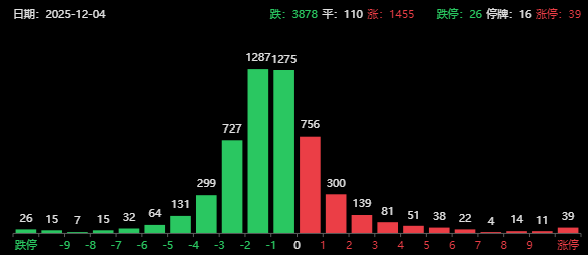
Market Overview - The trading volume has dropped to 1.56 trillion, marking a new low since September, with 26 stocks hitting the daily limit down [1] - The market sentiment is currently subdued, with funds remaining inactive, deviating from the usual trend of small-cap stocks being sold off in the latter half of the month [1] Key Events and Predictions - The upcoming listing of Moer Technology and the recent news from Cambricon are expected to boost technology stock sentiment [3] - The Federal Reserve is likely to lower interest rates by 25 basis points in December, with a probability close to 90% according to CME "FedWatch" [4] Employment Data - The ADP employment report indicates a decrease of 32,000 private sector jobs in November, the largest drop since March 2023, significantly below the market expectation of an increase of 10,000 jobs [4] Currency Movements - The US dollar index has weakened, falling below the 99 mark, while the offshore RMB has appreciated to 7.06 [6] Robotics Sector Developments - The US Commerce Secretary is actively engaging with CEOs in the robotics industry to promote its development, with potential executive orders expected next year [7] - Following this news, the US robotics sector saw significant gains, with Nauticus Robotics surging over 135% and iRobot rising nearly 80% [7] Stock Performance - Notable stocks in the robotics sector include: - Gokong Technology: 40.58, up 19.99% YTD - Double Ring Transmission: 41.02, up 6.13% YTD - Other stocks also showed strong performance, reflecting the positive sentiment in the robotics industry [8] Industry Trends - The mechanical equipment, electronics, defense, and communication sectors are leading the market, while sectors like beauty care, social services, and retail are lagging [11] - The long-term bond futures have experienced a significant decline, with the 30-year contract dropping 1.04% [12]


瑞银:投资者情绪好转推动中国互联网行业估值提升 但股价仍相对便宜
智通财经网· 2025-12-04 07:32
与此同时,国产算力持续发展。AI芯片层面,虽然仍存在性能差距,但在中国互联网公司持续的自研 投入,以及内地GPU厂商的发展推动下,性能正快速提升。系统层面,也看到积极进展,尤其是通 过"超节点"技术的采用,"超节点"技术通过扩大单机柜的GPU数量,在一定程度上弥补国产单颗GPU的 差距,实现机柜级上更好的算力表现。大模型算法层面,内地大模型开发者正在针对国产GPU进行算法 优化。 智通财经APP获悉,瑞银投资银行中国互联网行业研究主管方锦聪表示,今年中国互联网行业整体较为 有利的市场情绪推动了估值倍数提升;DeepSeek横空出世,让投资者对此板块的情绪转好;中国股票 今年开始追落后;从估值方面来看,主要互联网公司估值倍数仍然扩大约58%,至约17倍的调整后市盈 率,对应2024至2026年约10%的调整后每股盈利预测(EPS)复合增速,相较之下,美国"科技七巨头"估 值约31倍,对应18%的EPS复合增速。不难看出,中国互联网股价相对便宜。 方锦聪指,中国互联网行业展现出两大趋势。第一大趋势是,中国的互联网大厂正积极提升资本开支, 加大人工智能(AI)领域的投入。地缘不确定性让投资者担心芯片供给是否会影响中 ...
英国养老基金抛售美国股票
Sou Hu Cai Jing· 2025-12-03 11:21
Group 1 - UK pension funds are reducing their exposure to US stocks due to concerns over a potential bubble in the AI sector [1] - Several pension schemes managing over £200 billion in assets are shifting investments away from the US market or enhancing protective measures against potential declines in US equities [1] - Defined contribution pension plans in the UK are particularly vulnerable to stock market volatility, with younger savers typically allocating 70% to 80% of their assets to global equities, predominantly led by large-cap US tech stocks [1] Group 2 - The Nasdaq Composite Index has risen over 20% this year, driven by major tech companies like Nvidia and Alphabet, with a more than 100% increase since the beginning of 2023 [2] - The European Central Bank has warned that high valuations of US tech stocks, influenced by a "fear of missing out" sentiment, pose significant risks to investment portfolios if market optimism wanes [2] - Notable short-seller Michael Burry has reiterated his bearish stance on Nvidia, raising concerns about issues such as "circular investments" among US AI companies and the sustainability of Nvidia's AI infrastructure spending [2]
【特稿】英国养老基金抛售美国股票
Sou Hu Cai Jing· 2025-12-03 10:05
Group 1 - UK pension funds are reducing their exposure to US stocks due to concerns over a potential bubble in the AI sector [1] - Several pension schemes managing over £200 billion in assets are shifting investments away from the US market or enhancing protective measures against potential declines in US equities [1] - Defined contribution pension plans in the UK are particularly vulnerable to market fluctuations, with younger savers typically allocating 70% to 80% of their assets in global stocks, predominantly in large-cap US tech stocks [1] Group 2 - The Nasdaq Composite Index has risen over 20% this year, driven by major tech companies like Nvidia, Alphabet, and Meta, with a more than 100% increase since the beginning of 2023 [2] - The European Central Bank has warned that high valuations of US tech stocks, fueled by a "fear of missing out" sentiment, pose significant risks to investment portfolios if market optimism wanes [2] - Notable short-seller Michael Burry has reiterated his bearish stance on Nvidia, raising concerns about issues such as "circular investments" among US AI companies and the sustainability of Nvidia's AI infrastructure spending [2]

华为中国政企业务油气矿山军团作答: AI技术如何扎根能源化工行业?
Zhong Guo Hua Gong Bao· 2025-12-03 02:38
"当下先进的科技技术究竟该如何扎根于油气矿山行业,给行业带来改变?经过不断的摸索,我们的答 案是以用促建,让技术从业务的痛点中生长出来。"11月26日,在北京举行的华为中国政企业务油气矿 山2025媒体沟通会上,华为油气矿山集团副总裁吴海宇如是说。在这场媒体沟通会上,三位来自华为油 气矿山军团的发言人讲述了华为如何通过一场"自下而上"的技术渗透,让人工智能(AI)牢牢扎根于能源 化工行业,从辅助系统进入核心生产流程。 让技术沾上"机油味" 当前,传统能源化工行业面临多重挑战,安全管控、效率提升、绿色转型等不同要求为行业发展带来了 较为沉重的压力。在谈及如何应用AI助力能化行业转型时,吴海宇表示,AI的应用需要围绕真实的业 务难题,从场景出发,实现数字化技术的落地应用。 应用这一策略,华为瞄准石油化工行业能耗与安全性两大关键,联合云天化(600096)打造了全球首个 煤气化实时在线优化技术(RTO)大模型项目,使煤气化装置能够精确模拟并预测气化炉炉温、渣层厚度 及渣黏度等关键运行参数,从而保障生产过程的深度优化与极致稳定。该项目投用后,预计每年实现节 煤9000多吨、减少二氧化碳排放量2万多吨,带来每年超千万元 ...
市场“大扫除”完毕!高盛:波动性回落+股市广度改善 美股以更清晰格局步入12月
Zhi Tong Cai Jing· 2025-11-29 00:16
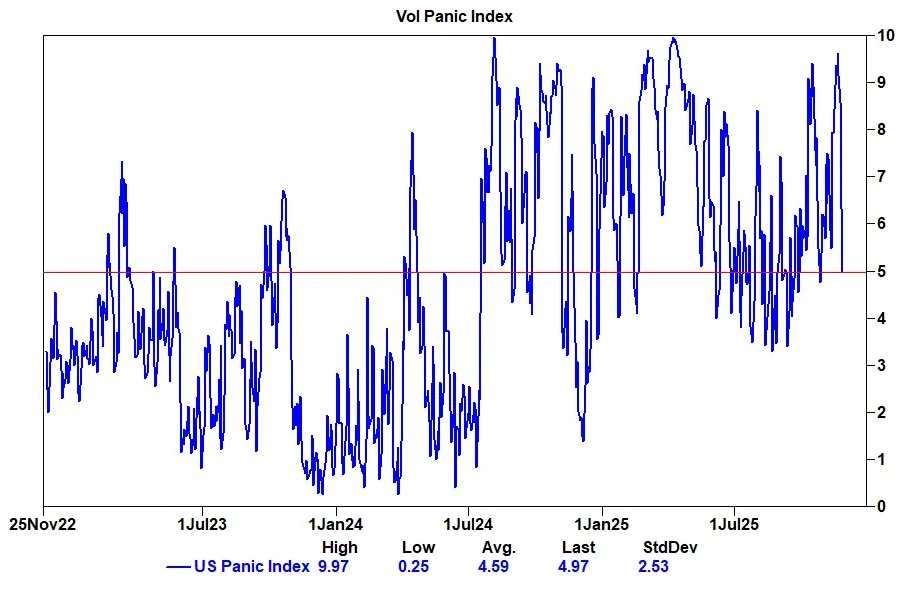
Group 1: Market Overview - The S&P 500 index ended November nearly flat, but signs of recovery are emerging as volatility decreases and market breadth improves [1] - Market breadth, measured by the five-day average of advancing and declining stocks in the S&P 500, rebounded from a low of -150 to around +150 before Thanksgiving, indicating a significant shift in market participation [1] - The "volatility panic index" is currently around 5, slightly above its three-year average and significantly lower than its peak earlier in November [1] Group 2: Systematic Strategies and Positioning - Approximately $16 billion in S&P 500-related sell-offs occurred over the past month, exacerbating previous market declines [3] - Following the market's digestion of this risk-off phase, the expectation for the upcoming month has shifted to a slight net buying scenario of about $4.7 billion [3] - Major U.S. stock indices experienced significant gains after a period of volatility, with the Dow Jones up 3.18%, S&P 500 up 3.73%, and Nasdaq up 4.91% [3] Group 3: Wall Street Outlook for 2026 - Multiple top investment banks have released forecasts for the S&P 500 index for the end of 2026, with a consensus that the index will continue to rise due to AI investment trends, a shift to accommodative monetary policy, and broadening profit growth [4] - JPMorgan and Deutsche Bank set ambitious targets for the S&P 500, with JPMorgan forecasting a target of 7,500 points, potentially exceeding 8,000 points if the Fed continues to lower interest rates [4][5] - Deutsche Bank predicts a 14% increase in earnings per share for the S&P 500 next year, driven by AI's growth potential extending beyond major tech stocks to other sectors [5][6] Group 4: Sector-Specific Insights - Analysts from Morgan Stanley express optimism about sectors such as consumer discretionary, healthcare, financials, industrials, and small-cap stocks, anticipating that the recent market sell-off is nearing its end [6] - UBS forecasts that the AI-driven market rally will persist until 2026, with a target of 7,500 points for the S&P 500, supported by strong corporate earnings growth [6] - Barclays raised its 2026 S&P 500 target to 7,400 points, citing strong performance from large tech stocks despite a sluggish macroeconomic growth environment [7]


中国文化遗产研学积极拥抱AI
Huan Qiu Wang Zi Xun· 2025-11-28 02:30
Core Insights - The Chinese research and study market is experiencing significant growth, particularly in the integration of cultural heritage education with artificial intelligence (AI) technologies [1][2] Group 1: Cultural Heritage Research and Study Innovations - The "Second Cultural Heritage Research and Study Top Ten Projects and Routes Promotion Event" recently took place in Zhengzhou, showcasing innovative practices from nearly a hundred cultural institutions [1] - Projects such as the "Fun Square Characters" program at the China Character Museum in Anyang utilize AI to create an immersive experience covering the origins, evolution, art, and application of Chinese characters [1] - Digital technologies, represented by AI, are enhancing the effectiveness of cultural heritage research and study, allowing participants to experience thousands of years of history in a single day [1][2] Group 2: Integration of AI and Digital Technologies - Various cultural heritage institutions are deeply integrating AI and digital technologies into their educational offerings, such as the interactive AI machine at the Zhengzhou Shang Dynasty Ruins Museum and the AR-based digital education course at the Xiamen Palace Museum [2] - The Henan Yin Ruins Museum employs AR technology and holographic projections in its "One Word, One Exhibition, One City" research course, bringing history and artifacts to life [2] - The current trend in cultural heritage research and study is shifting from mere observation to educational empowerment, utilizing VR restoration, AI interaction, and live streaming to reach a broader audience [2]
华尔街展望2026年美股前景:标普500目标位最高看至8000点 AI与政策成关键变量
Zhi Tong Cai Jing· 2025-11-27 08:23
Group 1 - Major Wall Street banks have released their outlooks for the S&P 500 index by the end of 2026, with a general consensus that the index will continue to rise due to the ongoing AI investment wave, a shift towards loose monetary policy, and expanding profit growth [1] - HSBC sets a target of 7500 points for the S&P 500 by the end of 2026, expecting a 12% growth in earnings per share for index constituents, driven by macroeconomic stability and the AI investment boom [2][3] - Societe Generale predicts the S&P 500 could reach 7300 points, with potential volatility higher than usual, influenced by the Federal Reserve's policy path [4] Group 2 - Barclays raises its target for the S&P 500 to 7400 points, citing strong performance from large tech stocks and improving monetary and fiscal conditions [5] - UBS forecasts a target of 7500 points for the S&P 500, driven by strong corporate earnings growth, particularly in the tech sector [7] - Morgan Stanley is optimistic about the S&P 500 reaching 7800 points, viewing recent market weakness as a buying opportunity [9] Group 3 - Deutsche Bank presents the most optimistic outlook, projecting the S&P 500 could hit 8000 points by the end of 2026, driven by widespread profit growth beyond just the major tech companies [10] - The reports highlight a K-shaped economic recovery, where the disparity between high-income and low-income consumers is expected to widen, impacting consumer behavior and confidence [3][8]