
汽车出海

Search documents
透视奇瑞出海成绩单,前三季度近百万辆出口“含金量”如何?
Ge Long Hui· 2025-10-17 09:11
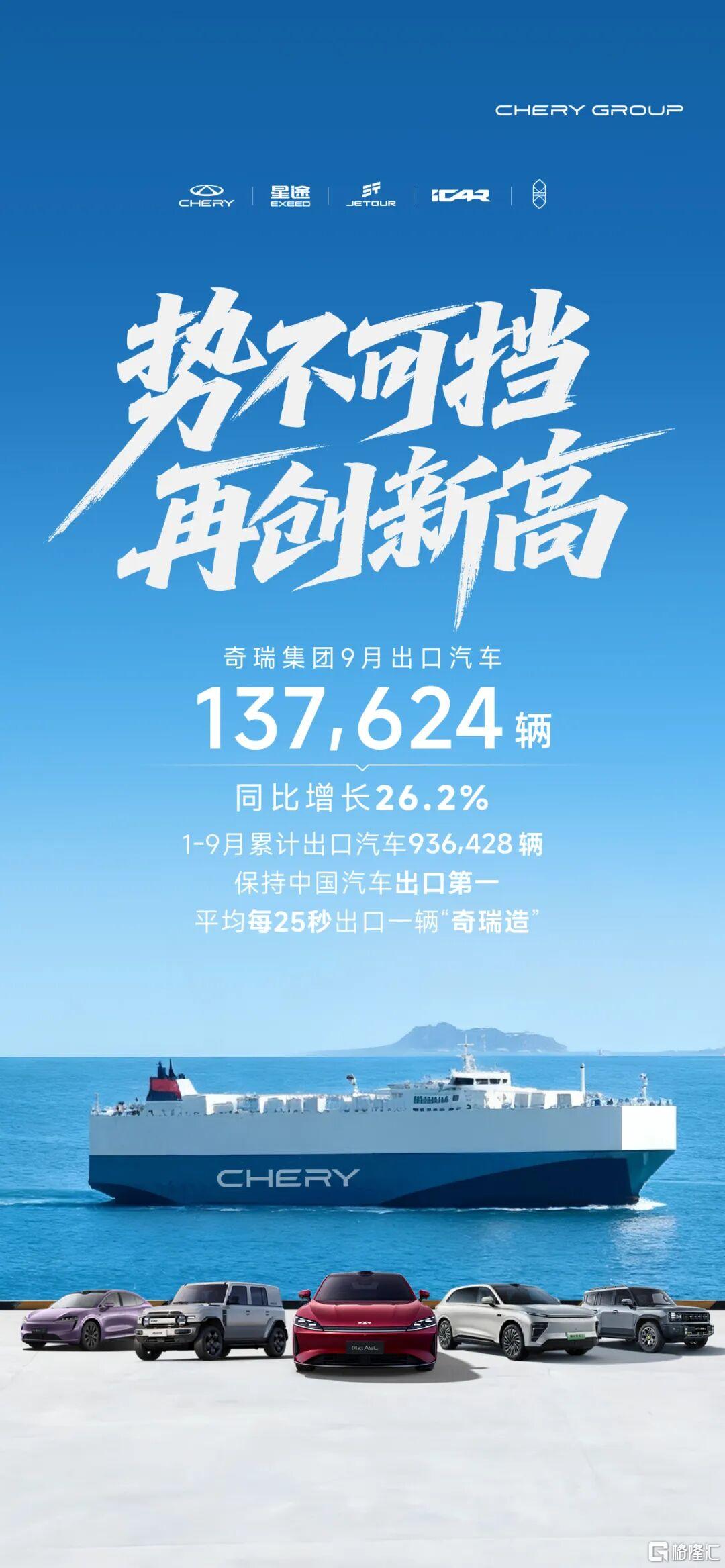
Core Viewpoint - The current trend of Chinese automotive companies going global is not only a sign of industry upgrade but also a focal point for capital market attention, with companies that can sustain overseas expansion and penetrate high-barrier markets expected to enjoy higher valuation levels [1][4]. Summary by Sections Export Performance - In the first three quarters of this year, China's automotive export volume reached 4.95 million units, a year-on-year increase of 14.8%. In September alone, the export volume was 652,000 units, up 21% year-on-year, indicating strong momentum [1]. - Chery's export performance stands out, with a single-month export of 137,624 units in September, a year-on-year increase of 26.2%, setting a new record. From January to September, Chery exported a total of 936,428 units, up 12.9% year-on-year [1][5]. Market Positioning - Chery leads the industry with an export volume that is double that of the second-ranked company, showcasing its strong scale effect. The models Chery exported, such as the Tiggo 7 and Tiggo 5X, consistently ranked among the top two in September [5][6]. - Chery has maintained its position as the top exporter of passenger cars in China for 22 consecutive years, achieving significant milestones such as the first Chinese brand to export over 5 million units cumulatively [8][9]. Growth Logic - Chery's success in overseas markets is attributed to its dual strategy of "technology defining standards" and "localization reconstructing ecosystems." The company has established a robust technological foundation through its "Yaoguang 2025" strategy, which includes five core technology matrices [11][12]. - Chery's global expansion is supported by eight R&D centers worldwide, allowing for localized product adaptations to meet regional market demands [11][12]. Financial Performance - Chery's overseas revenue has shown a consistent upward trend, with revenues of 30.39 billion yuan, 77.06 billion yuan, 100.90 billion yuan, and 26.29 billion yuan from 2022 to the first quarter of 2025, representing 32.8%, 47.2%, 37.4%, and 38.5% of total revenue respectively [10]. - The company plans to establish 45 sales outlets in Europe by the end of 2025, expanding to 100 by 2026, which will further solidify its market presence and revenue growth [17][18]. Investment Potential - Chery is transitioning from an "export champion" to a "global industrial ecosystem builder," which is expected to release significant value for investors. The company's focus on high-value markets like Europe positions it for quality growth [17][18]. - Chery's current PE TTM is 10.10, which is considered undervalued in the context of the recent automotive sector pullback. The company is expected to achieve revenues of 269.90 billion yuan and a net profit of 14.33 billion yuan in 2024, indicating a robust operational style [18][19]. Conclusion - Chery's impressive export achievements are the result of over two decades of commitment to globalization, technology development, and localization. This case serves as a benchmark for the global competitiveness of Chinese automotive brands, emphasizing the importance of solid technological foundations and sustainable global strategies [22].

中国车企征战欧洲,奇瑞前三季度已经卖了15万台
华尔街见闻· 2025-10-14 03:39
Core Viewpoint - Chery Automobile, a leader in China's automotive export for 22 consecutive years, is embarking on a new journey in the international capital market with its recent IPO on the Hong Kong Stock Exchange, aiming to allocate 20% of the raised funds for overseas market expansion [1][21]. Group 1: Globalization Strategy - Chery has achieved a significant milestone with 5.22 million vehicles exported in 2024, maintaining its position as the world's largest automotive exporter [3]. - The OMODA and JAECOO brands have rapidly expanded to cover 44 global markets within two years, demonstrating Chery's effective market penetration strategy [3]. - In the European market, Chery has sold 145,000 vehicles from January to September this year, marking over a twofold increase, indicating both quantitative and qualitative growth [3][13]. Group 2: Historical Development Phases - Chery's export journey can be divided into three distinct phases: initial exploration focused on trade exports, a localization phase with the establishment of overseas production bases, and the current phase emphasizing high-end and new energy vehicles [5][7][25]. - The initial phase involved exporting economical models like the QQ to developing markets, while the later phase saw Chery establishing its first overseas production base in Brazil in 2014 [5][6][7]. Group 3: Brand Positioning and Market Entry - Chery's strategy has evolved from product export to brand output, reflecting a broader shift in the Chinese automotive industry from scale-oriented to value-oriented development [4][11]. - The European market is viewed as a critical testing ground for Chery's brand elevation strategy, with a focus on high-end and new energy vehicles [9][12][21]. Group 4: Financial Performance and Future Outlook - Chery's overseas revenue is projected to reach 100.9 billion yuan in 2024, accounting for 37.4% of total revenue, highlighting the importance of international markets for the company's financial stability [22]. - The company has established eight global R&D centers to enhance its technological capabilities and adapt to local market demands, supporting its global strategy [23][24]. - Chery aims to position itself among the top ten global automotive brands, leveraging its advanced R&D and localized production strategies [24][26].
在马来西亚“狙击”日系的三种姿势
Hu Xiu· 2025-10-12 04:19
Group 1 - The core point of the article is that Malaysia has overtaken Indonesia to become the largest automotive market in Southeast Asia, with sales reaching 396,800 units compared to Indonesia's 390,500 units in the first half of the year [1] - Malaysia is actively promoting the development of electric vehicles, with government plans to increase the sales proportion of electric vehicles to 15% by 2030 and 38% by 2040, along with the establishment of 10,000 public charging facilities by 2025 [2] - The favorable automotive market, attractive new energy policies, and geographical advantages for exports have drawn several Chinese car manufacturers to Malaysia, including Chery, BYD, and Great Wall [3] Group 2 - Malaysia's unique characteristics include a friendly environment for the Chinese community, where 20% of the population creates 80% of the wealth, and it is the only country outside China with a complete Chinese education system [6][7] - The low fuel prices in Malaysia, due to government subsidies, make fuel vehicles the dominant choice, with 92% market share expected in the first half of 2025 [12][13] - Malaysia is the only ASEAN country with domestic automotive brands, Perodua and Proton, which hold nearly 60% of the market share, posing challenges for foreign brands [14] Group 3 - Great Wall Motors has become the fastest-growing automotive brand in Malaysia, with sales in the first half of the year surpassing the total for the previous year [18] - Great Wall's strategy includes a multi-energy approach and a focus on high-end products, targeting affluent Chinese consumers who are willing to pay premium prices for features and performance [21][22] - Chery aims to establish itself as a local brand in Malaysia, with a goal to become the third "national brand" by increasing market share and competing with established brands like Toyota and Honda [30][32] Group 4 - Proton, Malaysia's first domestic automotive brand, has successfully integrated with Geely's global strategy, launching models based on Geely's technology [41][42] - The launch of Proton's first electric vehicle, the e.MAS 7, has been well-received, significantly outperforming BYD's sales in the region [43][45] - Proton's competitive edge lies in its ability to leverage existing channel resources and supply chains to offer lower prices for its vehicles [48] Group 5 - The article highlights the importance of quality and durability for vehicles in the Malaysian market, where consumers have higher expectations compared to the Chinese market [59][63] - Historical lessons from the 1990s regarding the failure of Chinese motorcycle brands in Southeast Asia emphasize the need for car manufacturers to avoid price wars and maintain product quality [56][57]
港股敲完钟的奇瑞,还藏了好几手
Xin Lang Cai Jing· 2025-10-11 09:53
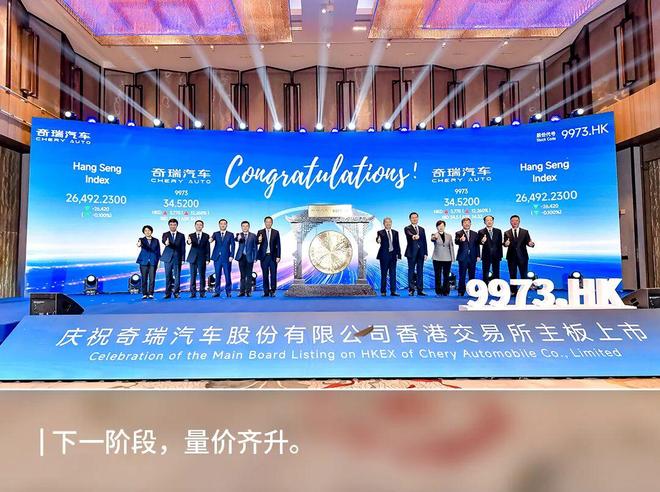
Core Insights - Chery Automobile (9973.HK) is undergoing a transformation towards new energy and smart technology, with its sales scale, brand, and performance ranking among the top private car manufacturers in China, yet its market value is considered undervalued [3][4] - The company’s overseas advantages and stable cash flow from its traditional fuel vehicles could support a significant revenue and profit growth from 2025 to 2027 if fundraising is effectively invested in the new energy sector [3][4] Sales Performance - Chery has sold over 15 million vehicles, predominantly fuel cars, but is now leveraging its established brands to enter the new energy vehicle market [4] - From January to September, Chery Group's new energy vehicle sales increased by 77.1% year-on-year to approximately 588,000 units [6][15] - The company aims to achieve a revenue peak of approximately 269.9 billion RMB in 2024, prompting a strategic IPO in 2025 [3] Global Expansion - Chery has established a global production and sales network, exporting over 936,000 vehicles in the first three quarters of 2025, a 12.9% increase year-on-year [7] - The brand has successfully entered several European markets, including Spain, Italy, and the UK, with a notable sales increase of 145,000 units in Europe from January to September [8][9] Product Innovation - Chery is focusing on enhancing its brand and product offerings, transitioning from a technology-centric approach to a more market-oriented strategy [11][13] - The launch of the new model, the Jietu Zongheng G700, featuring amphibious capabilities, has generated significant attention and is expected to be a highlight in Chery's product lineup [14][15] Market Position - Chery's cumulative new car sales exceeded 2 million units from January to September, reflecting a 14.5% year-on-year growth, supported by its classic IPs, global network, and innovative competitiveness [15]
比亚迪 | 9月:批发环比回升 高端化稳步突破【民生汽车 崔琰团队】
汽车琰究· 2025-10-08 14:44
Core Viewpoint - The company reported a slight decline in wholesale sales of new energy vehicles in September, but there was a month-on-month increase, indicating a recovery in terminal demand driven by continued subsidies in some regions [2][3]. Group 1: Sales Performance - In September, the wholesale sales of new energy passenger vehicles reached 393,000 units, down 5.9% year-on-year but up 5.8% month-on-month [3]. - Cumulative wholesale sales from January to September for new energy passenger vehicles totaled 3.219 million units, representing a year-on-year increase of 17.6% [3]. - The sales of plug-in hybrid vehicles in September were 188,000 units, down 25.6% year-on-year but up 9.4% month-on-month, while pure electric vehicle sales were 205,000 units, up 24.3% year-on-year and 2.7% month-on-month [3]. Group 2: Brand Performance and High-end Strategy - The company has made significant adjustments to its high-end brands, particularly the Tengshi brand, to enhance brand system construction and overcome high-end bottlenecks [4]. - The launch of the Fangchengbao Titanium 7, a mid-large SUV, has driven brand sales upward, with over 10,000 orders in the first week [4]. Group 3: International Expansion - In September, the export sales of new energy vehicles reached 71,000 units, a year-on-year increase of 115.8% but a month-on-month decrease of 11.8% [5]. - Cumulative exports from January to September totaled 697,000 units, up 134.0% year-on-year, supported by increasing demand in markets like Turkey, Brazil, and Europe [5]. - The company is accelerating its overseas factory establishment, with new plants planned in Uzbekistan, Hungary, Turkey, and Indonesia, which is expected to boost profitability [5]. Group 4: Financial Projections - The company forecasts revenues of 990.81 billion yuan, 1,188.97 billion yuan, and 1,397.04 billion yuan for 2025, 2026, and 2027 respectively, with net profits of 45.402 billion yuan, 60.353 billion yuan, and 70.419 billion yuan [6][9]. - The expected earnings per share (EPS) for 2025, 2026, and 2027 are 4.98 yuan, 6.62 yuan, and 7.72 yuan respectively, with corresponding price-to-earnings (PE) ratios of 22, 16, and 14 [6][9].


“智税”护航,“中国车谷”新能源汽车驶向全球赛道
Chang Jiang Ri Bao· 2025-09-30 07:05
Group 1 - The core viewpoint highlights the rapid growth of Lantu Automotive, with August deliveries reaching 13,505 units, a year-on-year increase of 119%, marking seven consecutive months of growth and setting a historical record [1] - The growth of Lantu Automotive reflects the rise of the new energy vehicle industry in Wuhan Economic and Technological Development Zone, known as "China's Auto Valley," which is a key area for the automotive industry in China [1] - In 2024, "China's Auto Valley" is expected to produce its 10 millionth new energy vehicle, with a regional GDP surpassing 220 billion yuan, playing a crucial role in Wuhan's strategic development [1] Group 2 - The government has implemented various tax policies to support the manufacturing sector, including VAT refunds and R&D expense deductions, enabling companies to enhance core technologies and seize market opportunities [2] - Lantu Automotive's smart workshop integrates AI and 5G technologies, utilizing 935 industrial robots to produce four vehicle models simultaneously, with a production time of just 118 seconds per vehicle [2] - The new energy vehicle production in the Auto Valley is projected to grow by 58% year-on-year, with 20 new models expected to launch in 2025 [2] Group 3 - The tax authorities have proactively engaged with companies in the Auto Valley, providing tailored services to help them benefit from tax incentives, resulting in over 10.4 million yuan in VAT refunds for more than 70 smart connected vehicle companies [3] - Since 2025, 6.995 million yuan in VAT refunds have been processed, alleviating financial pressures on R&D and capacity expansion for enterprises [3] Group 4 - The international competitiveness of China's automotive industry has led to a strategic focus on expanding overseas markets, with Lantu and Mengshi brands entering the Saudi Arabian market through a partnership [4] - The company has participated in seven major overseas exhibitions, securing over 7,500 orders, and achieving a 180% year-on-year sales increase in the Middle East in the first half of 2025 [4] - The tax authorities are providing specialized services to help companies navigate complex international tax environments and maximize benefits from tax treaties [4] Group 5 - The tax department has adopted a customized approach to assist companies like Dongfeng Import and Export Company in addressing challenges related to foreign tax policies and cross-border payments [5] - In the first half of the year, Dongfeng Export Company exported 50,711 vehicles, a 75% increase, with passenger vehicle exports rising by 105% [5] Group 6 - Wuhan is enhancing its logistics capabilities to support the automotive industry, establishing itself as a major inland transportation hub and facilitating efficient export channels for vehicles [6] - The launch of the "Car Valley" roll-on/roll-off ship has significantly reduced export costs, with the port serving as a key logistics center for the region [6] - The tax authorities have provided support to port enterprises, helping them secure tax incentives for large-scale commodity storage facilities [6] Group 7 - The automotive industry in Wuhan is experiencing a transformation, with "China's Auto Valley" now hosting 10 vehicle manufacturers and over 1,000 parts suppliers, contributing significantly to the region's economic development [7] - The presence of leading new energy vehicle companies is fostering deep integration within the automotive supply chain in "China's Auto Valley" [7]
国产汽车“出海”添新通道 上海南港码头新开澳新直航班轮航线
Zhong Guo Xin Wen Wang· 2025-09-29 09:23
Core Insights - The launch of the direct shipping route between China and Australia/New Zealand aims to enhance logistics for domestic automobile exports, particularly focusing on electric vehicles [1][2] Group 1: Shipping Route Details - The inaugural voyage of the "Viking Emerald," a roll-on/roll-off ship with a capacity of 4,300 vehicles, carried 2,330 items, including various brands of new energy vehicles and some engineering vehicles and parts [1] - The new route is expected to significantly improve the efficiency of exporting Chinese automobiles by reducing the number of intermediate ports and shortening the journey to within 14 days [4] Group 2: Market Demand and Policy Support - The new shipping line aligns with the growing demand for electric vehicles in Australia, where the government has set a target for electric vehicles to account for 30% of new car sales by 2030 [2] - The Chinese Ministry of Industry and Information Technology has set a target of approximately 15.5 million electric vehicles to be sold by 2025, representing a year-on-year growth of around 20% [2] - Australia is expected to become one of the most dynamic markets for new energy transportation in the Asia-Pacific region, supported by various government initiatives and incentives [2] Group 3: Historical Context and Future Outlook - Chinese shipping companies have previously established connections with the Australia/New Zealand market, successfully carrying vehicles since April 2023 [2] - The ongoing delivery of new ships and the accumulation of experience in scheduled operations since 2025 have positioned the new shipping route for comprehensive launch [2]

观车 · 论势 || 中国汽车“出海”,“扎根”比“捞金”更重要
Zhong Guo Qi Che Bao Wang· 2025-09-26 01:36
Core Insights - A Russian influencer's video criticizing Chinese automotive brands highlights issues regarding brand image and after-sales service in the Russian market [1] - Despite a significant increase in market share from under 10% in 2020 to 68% in 2024, many Chinese cars enter Russia through parallel imports and second-hand exports, bypassing official channels [1][2] Group 1: Market Dynamics - The operational model of Chinese automotive brands focuses on high profits from vehicle sales, often neglecting after-sales service and customer support [2] - Russian consumers have expressed dissatisfaction with the quality of Chinese vehicles, which has led to a decline in brand reputation [2][3] Group 2: Policy and Strategic Adjustments - Recent Russian government policies aimed at regulating the market and protecting local automotive industries have resulted in a decline in the market share of Chinese brands after reaching a peak in 2024 [3] - Chinese automotive companies need to adopt a long-term strategy for international expansion, focusing on local market integration and high-quality service [3][4] Group 3: Recommendations for Improvement - To improve brand reputation, Chinese automotive brands should enhance official channel development, establish localized production, and create a comprehensive service ecosystem [4] - Collaborating with local entities to address regulatory concerns and investing in local manufacturing and R&D can help build a positive brand image [4]
中金 | 乘用车出海洞察#5:全球格局再重构,中国汽车深受益
中金点睛· 2025-09-25 23:57
Core Viewpoint - The global automotive industry is undergoing a restructuring phase, with China expected to lead in electric vehicle (EV) penetration and export growth by 2025, achieving over 50% penetration in new energy vehicles (NEVs) [2][4][25]. Group 1: China's NEV Market - By 2025, China's NEV penetration rate is projected to exceed 50%, with a significant increase in sales volume, reaching 1,077,000 units in 2024, a 68% year-on-year growth [4][25]. - As of August 2025, the market share of Chinese brands in the NEV sector is 89%, indicating strong domestic performance [4][8]. - The export of NEVs from China is on the rise, with a 14.5% year-on-year increase in total passenger car exports, and NEVs accounting for 41% of total exports by August 2024 [8][20]. Group 2: Global NEV Trends - Global consumer awareness of electric and intelligent technologies has been established, leading to accelerated product launches by European, American, and Japanese automakers, with significant growth expected in NEV penetration rates in non-Chinese markets [3][24]. - The EU's NEV penetration rate is expected to rise to 27% by 2025, driven by regulatory pressures and increased model availability from automakers [28][29]. - Emerging markets, particularly in Southeast Asia and Latin America, are witnessing rapid growth in NEV sales, with Vietnam and Thailand showing significant increases in penetration rates [17][20]. Group 3: Competitive Landscape - Chinese automakers are expected to continue gaining market share in international markets, with projections indicating that by 2030, Chinese brands could achieve nearly 30 million units in global production, including over 5.5 million NEVs [2][39]. - In the EU, traditional automakers still dominate, but Chinese brands like BYD are increasing their market share, reaching 3.7% in the NEV segment by mid-2025 [12][19]. - The Latin American market is primarily led by traditional automakers, but Chinese brands are steadily increasing their presence, with BYD's market share in the NEV segment rising from 60% to 77% [23][20].
超15万辆 前8个月深圳港汽车出口同比实现翻倍增长
Shen Zhen Shang Bao· 2025-09-25 23:19
Core Viewpoint - The 2025 Shenzhen International Forum on Automotive Maritime Logistics aims to explore new pathways for the export of Chinese automobiles, emphasizing Shenzhen's role in becoming a global hub for new energy vehicle trade and a world-class automotive city [1][2]. Group 1: Forum Highlights - The forum gathered over 400 representatives from leading enterprises, experts, and international organizations to discuss the automotive industry's global expansion [1]. - Shenzhen is actively working to establish itself as a "global hub for international trade in new energy vehicles" and a "new generation world-class automotive city" [1]. Group 2: Logistics and Export Data - In 2023, Shenzhen Port's automotive throughput exceeded 240,000 vehicles, accounting for nearly 70% of the total transport volume at Shenzhen Port [1]. - From January to August 2025, Shenzhen Port exported over 150,000 vehicles, achieving a year-on-year growth of 100% [1]. - The first automotive iron-sea intermodal train service in the Guangdong-Hong Kong-Macao Greater Bay Area was launched, facilitating BYD's "Shenzhen No. 1" maiden voyage to Europe [1]. Group 3: New Initiatives and Collaborations - Shenzhen Port Group launched the "Automobile Export e-Station" mobile platform, integrating logistics, warehousing, and trade services for efficient vehicle exports [2]. - The logistics group introduced a land-based solution for automobile exports and launched the first "inland yard + on-site special train" iron-sea intermodal service in the Bay Area [2]. - Strategic partnerships were formed with multiple industry leaders, resulting in nearly 10 collaborations across port cooperation, automotive logistics, and trade shipping [2]. - The forum also released the "Shenzhen Automotive Roll-on/Roll-off Foreign Trade Hub Cooperation Initiative," aiming to transform Shenzhen Port into a comprehensive global shipping hub [2].