美国通胀

Search documents
美国CPI意外“爆冷”,美联储降息预期升温
Sou Hu Cai Jing· 2026-01-13 15:05
尽管目前通胀率相比几年前有所放缓,但食品、保险等必需品价格仍远高于以往。美国12月份食品杂货 价格上涨0.7%,为2022年10月以来最大单月涨幅。与2024年同期相比,价格上涨了2.4%。 美联储下次利率决议将于2026年1月27—28日召开,虽然1月大概率不会降息,但交易员们加大了押注, 认为美联储可能不会等到美联储主席鲍威尔5月任期结束后再降息,4月降息的概率接近50%。 高盛在1月11日发布的《2026年美国经济展望报告》中预测,美国通胀将趋于温和,到2026年12月,美 国核心个人消费支出(PCE)物价指数同比涨幅将降至 2.1%,核心CPI同比涨幅将放缓至2%。同时, 鉴于劳动力市场前景的不确定性有所上升,美联储预计将在6月和9月分别再降息25个基点。 南方财经 21世纪经济报道记者吴斌 报道 随着美国12月核心消费者价格涨幅低于预期,美联储今年预期降息时点有所提前。 据央视报道,当地时间13日,美国劳工部发布的数据显示,2025年12月美国消费者价格指数(CPI)同 比上涨2.7%;剔除波动较大的食品和能源价格后,去年12月核心消费者价格指数同比上涨2.6%。 数据公布后,美国短期利率期货大幅上 ...
降息预期升温!美国2025年12月通胀数据保持稳定
Sou Hu Cai Jing· 2026-01-13 14:58
Group 1 - The core viewpoint of the articles indicates that the US CPI data for December 2025 shows stability, with the overall CPI rising by 2.7% year-on-year, matching expectations, and the core CPI rising by 2.6%, slightly below expectations [1][2] - Following the CPI data release, international precious metals prices increased, with COMEX silver futures and London silver spot prices both rising over 2%, while COMEX gold futures and London gold spot prices reversed from declines to gains [1] - The December CPI data is viewed as a more reliable indicator of policy direction due to the previous month's data being affected by a government shutdown, reinforcing market expectations for a potential interest rate cut by the Federal Reserve in April 2026 [1] Group 2 - Despite the stable inflation data, the Federal Reserve's December meeting minutes revealed significant internal disagreement regarding future rate cuts, and the non-farm payroll data for December showed lower-than-expected job growth, leading to expectations that the Fed may pause rate cuts in January to better assess economic data [2]
美12月通胀率维持在2.7%,高物价持续给多数美国人带来压力
Xin Lang Cai Jing· 2026-01-13 14:53
美国劳工统计局周二发布的数据显示,12 月美国消费者价格同比上涨 2.7%。这一年,美国通胀水平虽 略有改善,但高昂物价带来的消费负担问题,仍困扰着众多美国民众。 消费者价格指数(CPI)用于衡量常见消费品和服务的平均价格变动情况。数据显示,12 月美国通胀同 比增速与 11 月持平。 不过,从环比数据来看,12 月通胀增速由 11 月预估的 0.1% 加快至 0.3%。 但需要注意的是,11 月的通胀报告在诸多方面存在异常 —— 由于美国政府此前经历了长达 43 天的停 摆,当年 10 月和 11 月的通胀数据收集工作受到了不利影响,这也使得此前发布的消费者价格指数报告 所呈现的通胀降温幅度被夸大。 专题:美12月核心CPI同比增2.6%,低于预期 美国劳工统计局周二发布的数据显示,12 月美国消费者价格同比上涨 2.7%。这一年,美国通胀水平虽 略有改善,但高昂物价带来的消费负担问题,仍困扰着众多美国民众。 消费者价格指数(CPI)用于衡量常见消费品和服务的平均价格变动情况。数据显示,12 月美国通胀同 比增速与 11 月持平。 经济学家此前曾预计,12 月消费者价格指数环比将较 11 月上涨 0.3%, ...


摩根士丹利:通胀并未升温但仍高于目标 不足以支持美联储1月降息
Sou Hu Cai Jing· 2026-01-13 14:25
Core Insights - The current inflation situation in the U.S. is not showing signs of re-acceleration, but it remains above target levels [1] - The cost transmission from tariffs is still limited, indicating that inflationary pressures are not significantly increasing [1] - There has been no improvement in housing affordability, which continues to be a concern [1] - The latest inflation report does not provide sufficient justification for the Federal Reserve to consider interest rate cuts in the near term [1]

美国12月核心CPI涨幅低于预期 降息押注略有升温
智通财经网· 2026-01-13 13:58
Group 1 - The core point of the article is that the December CPI data in the US shows stable inflation, with a year-on-year increase of 2.7% and a month-on-month increase of 0.3%, aligning with market expectations [1] - The core CPI, excluding food and energy, has a year-on-year increase of 2.6%, which is below the market expectation of 2.7%, and a month-on-month increase of 0.2%, also below the expected 0.3% [1] - Following the CPI report, traders increased bets on a potential interest rate cut by the Federal Reserve, although the market still expects the Fed to maintain the federal funds rate in the range of 3.50% to 3.75% during the upcoming policy meeting [1][2] Group 2 - The December CPI report is significant as it provides a comprehensive assessment of inflation trends after previous data was affected by measurement errors due to the government shutdown [2] - Despite a slowdown in inflation compared to previous years, prices for essential goods like food and insurance remain significantly higher than usual [2] - Market analysts noted that the core CPI's month-on-month increase of 0.2% is relatively mild, especially considering the expected price rebound in December [3]

【环球财经】12月美国CPI环比或大幅走高 美联储降息前景不明
Zhong Guo Jin Rong Xin Xi Wang· 2026-01-13 11:02
Group 1 - The core viewpoint of the articles indicates that the upcoming December CPI data is expected to show a significant rebound due to previous distortions caused by the U.S. government shutdown, with analysts predicting a month-on-month increase of 0.3% and a year-on-year increase of 2.7% [1][3][5] - Analysts from various investment banks, including Goldman Sachs and Morgan Stanley, suggest that the December CPI data may reflect a technical upward bias due to the previous month's artificially low price base, which was influenced by the government shutdown [3][4][5] - The Federal Reserve's interest rate cut expectations have decreased, with the probability of a rate cut in January nearly zero and a significant drop in the probabilities for April and June meetings [2][6] Group 2 - The December CPI data is seen as a critical indicator for assessing the impact of tariffs on inflation, with expectations that housing inflation may rebound, although the core CPI may still be underestimated due to statistical methods [4][6] - The market sentiment is leaning towards a bullish outlook, with the potential for a significant market reaction if the December CPI data deviates from expectations, particularly if it comes in lower than anticipated [7][8] - The analysis suggests that the Federal Reserve's easing cycle may experience phases of acceleration and deceleration, influenced by inflation trends and political pressures, with recommendations for asset allocation adjustments in response to these dynamics [8]

美元指数震荡蓄力冲击 美联储动向成关键指引
Jin Tou Wang· 2026-01-13 02:31
Core Viewpoint - The US dollar index is experiencing a slight rebound, supported by hawkish comments from Federal Reserve officials and a resilient US economy, despite political pressures on the Fed [1][2]. Group 1: Economic Indicators - The US unemployment rate for December was reported at 4.4%, slightly below expectations, alleviating concerns about the labor market [2]. - The Federal Reserve's stance indicates no immediate reason for interest rate cuts, with GDP growth projected between 2.5% and 2.75% for 2026 [1]. Group 2: Market Performance - The dollar index has shown a fluctuating upward trend since the beginning of January, rising from 97.905 to around 98.90, with a cumulative increase of over 1% [2]. - The dollar index is currently trading above the 5-day and 10-day moving averages, indicating a bullish trend [2]. Group 3: Support and Resistance Levels - Key support has shifted to 98.87, previously a resistance level, with additional strong support between 98.40 and 98.50 [3]. - The 99.00 level is identified as a critical short-term resistance, with potential upward movement towards 99.22 and further resistance at 99.50 and 100.00 [3].
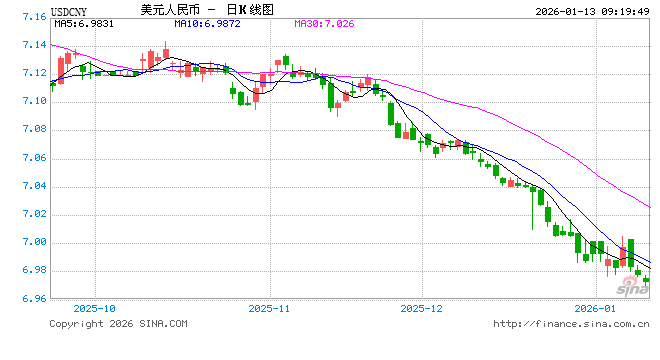
人民币兑美元中间价报7.0103,上调5点
Xin Lang Cai Jing· 2026-01-13 01:20
Core Viewpoint - The Federal Reserve is unlikely to lower interest rates in the short term, with a strong probability of maintaining current rates, as indicated by recent statements from officials and market expectations [4][10]. Group 1: Federal Reserve Interest Rate Outlook - The probability of the Federal Reserve maintaining interest rates in January is 95%, while the chance of a 25 basis point cut is only 5% [3][9]. - By March, the cumulative probability of a 25 basis point cut rises to 26%, with a 72.8% chance of rates remaining unchanged [3][9]. - The likelihood of a 50 basis point cut by March is minimal at 1.2% [3][9]. Group 2: Economic Projections by Federal Reserve Officials - New York Fed President Williams suggests that the U.S. economy will remain healthy through 2026, indicating no immediate need for rate cuts [4][10]. - He states that current monetary policy is well-positioned to support labor market stability and help bring inflation back to the 2% target [4][10]. - Williams projects GDP growth for the year to be between 2.5% and 2.75%, with unemployment rates stabilizing and expected to decline in subsequent years [4][10]. - Inflation is anticipated to peak between 2.75% and 3% in the first half of the year, averaging 2.5% for the year, and returning to 2% by 2027 [4][10].
中金:如果美国通胀与流动性冲击导致中美股票、黄金、美债等资产回调,建议逢低增配
Sou Hu Cai Jing· 2026-01-13 00:55
Core Viewpoint - The article discusses the potential for a compensatory rise in U.S. inflation as predicted by CICC, which may impact the Federal Reserve's interest rate decisions and global liquidity [1] Group 1: Inflation Predictions - CICC calculates statistical errors in U.S. inflation and forecasts a rise in CPI data for December 2025, January 2026, and April 2026 [1] - Recent strong U.S. inflation could lead the Federal Reserve to slow down its rate cuts, resulting in tighter global liquidity [1] Group 2: Investment Recommendations - There is an increase in uncertainty for major asset classes in both China and the U.S. due to inflation and liquidity shocks [1] - It is recommended to increase allocation in commodities to hedge against risks [1] - In the event of a pullback in U.S. stocks, gold, and U.S. Treasuries due to inflation and liquidity impacts, it is advised to buy on dips [1]
中金:重估美国通胀风险与市场影响
中金点睛· 2026-01-13 00:33
Core Viewpoint - The article suggests that statistical errors in measuring U.S. inflation may lead to a compensatory increase in CPI data in late 2025 and early 2026, which could impact the Federal Reserve's interest rate decisions and global liquidity [2][4][7]. Group 1: Inflation Analysis - The recent drop in U.S. CPI from 3% to 2.7% and core CPI from 3% to 2.6% is attributed to statistical method flaws rather than a genuine change in inflation trends [5][7]. - The U.S. inflation rebound risk is not resolved; the low CPI readings in November are significantly underestimated due to the "government shutdown" affecting data collection [7][8]. - The article identifies three main statistical underestimation effects: 1. The low estimation effect from the rental sample rotation, which could lead to a doubling of rental inflation by April 2026, compensating for previous underestimations [8][10]. 2. The underestimation from alternating monthly sample rotations, which may result in a compensatory increase in December 2025 inflation [10][12]. 3. The lagging statistical timing effect due to data collection during the Thanksgiving season, which could lead to overestimations in January 2026 [12][13]. Group 2: Economic Outlook - The article predicts that U.S. inflation will be in an upward cycle in the first half of 2026, with CPI potentially rising due to compensatory effects [13][16]. - It anticipates a temporary improvement in U.S. economic growth in early 2026, driven by government spending resuming after the shutdown and seasonal adjustments in economic data [22][24]. - The potential for a "temporary overheating" state in the economy is noted, with inflation and growth possibly rising simultaneously [24][29]. Group 3: Investment Recommendations - The company recommends increasing commodity allocations to hedge against inflation risks and suggests buying on dips for gold, U.S. Treasuries, and Chinese stocks if there are market corrections [2][30][31]. - It emphasizes that while inflation may rise in the short term, the long-term outlook suggests a return to lower inflation rates, which could lead to a faster pace of interest rate cuts by the Federal Reserve [30][31].