货币宽松政策

Search documents
杰克逊霍尔央行年会前夜,资金豪赌鲍威尔“放鸽”,押注“50基点降息”
Hua Er Jie Jian Wen· 2025-08-20 00:23
Group 1 - Traders are heavily betting on a 50 basis point rate cut by the Federal Reserve next month, despite a significant increase in the July PPI [1] - The number of options contracts betting on a 50 basis point cut has reached 325,000, with a premium cost of approximately $10 million, potentially yielding a profit of $100 million if the cut occurs [1] - Market sentiment is shifting, with investors moving from short positions to neutral positions ahead of Powell's speech [2] Group 2 - The percentage of direct short positions among JPMorgan clients has decreased by 4 percentage points, indicating a reduction in bearish sentiment [2] - There is a warning that if Powell does not align with the current dovish expectations, the front end of the yield curve could face bearish corrections [3] - Asset managers have increased net long positions in most bond futures, particularly in long and ultra-long bonds, while hedge funds have increased net short positions in 10-year Treasury futures [3]
美联储降息前,高盛点名一个“最爱交易”!
Jin Shi Shu Ju· 2025-08-19 09:00
Group 1 - The core viewpoint is that Wall Street is preparing for a potential interest rate cut by the Federal Reserve in September, with a strong preference for five-year U.S. Treasury bonds as a favored trade in this context [2][3] - Goldman Sachs' Chief Strategist, Josh Schiffrin, highlighted that the five-year Treasury yield is particularly attractive in the range of 3% to 4%, especially amid increasing economic uncertainty [2] - Schiffrin expects the Federal Reserve to ease monetary policy next month, citing weak employment data as a key factor, with only 73,000 jobs added in July, significantly below the expected 106,000 [2][3] Group 2 - A survey by Reuters indicated that 61% of economists expect the Federal Reserve to lower the benchmark interest rate by 25 basis points to a range of 4%-4.25% in September, marking the first rate cut since 2025 [3] - The political pressure on the Federal Reserve has intensified, with President Trump publicly urging for rate cuts, claiming that high borrowing costs are harming U.S. competitiveness [3] - Goldman Sachs anticipates a series of rate cuts, projecting reductions of 25 basis points in September, October, and December, followed by two additional cuts in 2026, ultimately lowering the policy rate to a range of 3%-3.25% [4]

美国财长突然“语出惊人”!贝森特呼吁美联储降息150基点 黄金应声大涨
Sou Hu Cai Jing· 2025-08-14 03:11
美国彭博社周三(8月13日)发布独家报道称,美国财政部长贝森特(Scott Bessent)就美联储开启降息 周期发出迄今为止最明确的呼吁,并表示美联储基准利率应比现在至少低1.5个百分点。 (截图来源:彭博社) 贝森特周三在接受彭博采访时表示:"我认为我们可能会进行一系列降息,首先是9月份降息50个基点。 无论你参考哪种模型,都表明我们的利率可能应该降低150至175个基点。" 金价亚市早盘一度逼近3375美元/盎司,日内大涨近20美元。较低的借贷成本和不断下降的收益率往往 会支撑黄金,因为黄金不支付利息。 贝森特指的是美国劳工统计局8月1日发布的数据,该数据将5月和6月的非农新增就业人数下修25.8万 人。 他说,6月的会议可能也是如此。贝森特表示:"我猜想我们本可以在6月和7月就降息。" 贝森特的降息建议超出债券市场的预期。降息1.5个百分点将使美联储目标区间的中点降至2.88%。 值得注意的是,美国财政部长通常不愿就美联储利率做出具体决定。贝森特几个月来一直表示,他只会 讨论美联储过去的政策决定,而非即将做出的决定。 美国总统特朗普(Donald Trump)曾多次批评美联储主席鲍威尔(Jerome ...
又一国央行 降息!
Zhong Guo Ji Jin Bao· 2025-08-13 14:22
【导读】泰国央行将基准利率下调25个基点 8月13日,泰国央行宣布降息25个基点,利率水平创2023年2月以来最低。 分析人士指出,泰国央行本次降息受内需疲软、美国关税等多重因素推动。 面对多重压力 泰国央行降息25个基点 上述分析人士指出,泰国当前利率已处于两年低位,进一步降息空间有限。 (文章来源:中国基金报) 泰国央行货币政策委员会(MPC)以全票通过下调单日回购利率25个基点,至1.50%,这是泰国央行10 个月内第四次降息,当前利率水平为2023年2月以来最低。 泰国央行声明称,预计今明两年泰国经济增速接近此前的评估,但美国的贸易政策将加剧结构性问题, 削弱竞争力,小企业容易受到影响。未来的货币政策应该是宽松的,以支持经济增长。 分析人士向中国基金报记者指出,泰国央行本次降息受多种因素推动。 通缩"阴影"持续。7月,泰国CPI同比下降0.7%,低于预期,连续五个月低于央行1%~3%目标区间。核 心通胀率走弱,反映泰国内需实质性疲软。 关税方面,尽管美国将对泰关税从最初提案的36%降至19%,但仍然直接冲击中小企业。当前,美联储 9月降息的概率升至90%,泰国实行货币宽松可避免资本外流加剧,同时缓冲美 ...
又一国央行,降息!
中国基金报· 2025-08-13 13:00
Core Viewpoint - The Bank of Thailand has lowered its benchmark interest rate by 25 basis points to 1.50%, marking the lowest level since February 2023, driven by weak domestic demand and external pressures such as U.S. tariffs [2][5][6]. Group 1: Monetary Policy Actions - The Monetary Policy Committee (MPC) of the Bank of Thailand unanimously decided to reduce the overnight repurchase rate by 25 basis points, making it the fourth rate cut in ten months [5]. - The current interest rate is the lowest since February 2023, reflecting ongoing economic challenges [5]. Group 2: Economic Conditions - The Thai economy is expected to grow at a rate close to previous assessments, but U.S. trade policies are anticipated to exacerbate structural issues and weaken competitiveness, particularly affecting small businesses [5][6]. - Inflation remains a concern, with the Consumer Price Index (CPI) in July showing a year-on-year decline of 0.7%, continuing a trend of being below the central bank's target range of 1%-3% for five consecutive months [6]. Group 3: Future Outlook - Analysts predict that the Thai economy will significantly slow down in the second half of the year, with signs of contraction in the tourism sector, a critical component of the economy [7]. - The current low interest rate leaves limited room for further cuts, although additional rate reductions may occur later this year due to moderate price pressures and weak growth prospects [8].


关注“反内卷”推行下中游开工情况
Hua Tai Qi Huo· 2025-08-05 05:10
Industry Overview Upstream - Energy: International crude oil prices have shown a slight upward trend [2] - Agriculture: Egg prices have dropped significantly recently [2] Midstream - Chemical industry: The operating rate of PTA has declined [3] - Energy: Coal consumption in power plants has remained stable recently [3] - Infrastructure: The operating rate of asphalt has been rising continuously recently [3] Downstream - Real estate: Recent sales of commercial housing have declined [3] - Services: The box office revenue of summer movies has been rising continuously [3] Policy Overview Production Industry - Shanghai has issued measures to support enterprises in increasing investment in basic research, with different levels of one - time financial subsidies for enterprises with different annual basic research investment amounts [1] - Hainan has released an action plan to build a modern industrial system, aiming to cultivate the commercial space industry chain and achieve an operating income of 10 billion yuan in the aerospace industry cluster in Wenchang International Aerospace City by 2027 [1] Service Industry - The People's Bank of China will continue to implement a moderately loose monetary policy, using various monetary policy tools to maintain sufficient liquidity and guide reasonable credit growth [1] Industry Credit Spread Tracking (as of 8/5) | Industry | Current | One Month Ago | Last Week | This Week | Quantile | | --- | --- | --- | --- | --- | --- | | Agriculture, Forestry, Animal Husbandry and Fishery | 82.26 | 77.04 | 56.21 | 49.35 | 0.30 | | Mining | 30.94 | 47.98 | 35.42 | 31.88 | 0.40 | | Chemical Industry | 65.92 | 62.95 | 47.54 | 45.37 | 43.20 | 0.30 | | Steel | 35.23 | 56.36 | 46.01 | 42.01 | 40.13 | 5.10 | | Non - Ferrous Metals | 37.37 | 58.80 | 48.05 | 43.33 | 41.11 | 4.40 | | Electronics | 49.90 | 78.23 | 53.17 | 42.82 | 44.06 | 0.70 | | Automobile | 54.05 | 51.85 | 37.90 | 34.43 | 32.96 | 1.10 | | Household Appliances | 35.59 | 21.45 | 46.36 | 42.79 | 41.10 | 5.80 | | Food and Beverage | 34.22 | 46.11 | 35.53 | 31.06 | 28.90 | 0.20 | | Textile and Apparel | 43.07 | 54.72 | 51.57 | 43.28 | 40.83 | 0.50 | | Light Industry Manufacturing | 44.25 | 168.19 | 142.28 | 133.76 | 131.32 | 7.20 | | Pharmaceutical and Biological | 49.06 | 73.61 | 21.88 | 47.68 | 45.75 | 0.60 | | Public Utilities | 23.59 | 34.55 | 26.02 | 23.85 | 22.13 | 0.80 | | Transportation | 24.68 | 39.10 | 28.96 | 27.63 | 26.86 | 4.50 | | Real Estate | 198.71 | 127.12 | 95.84 | 89.30 | 86.30 | 0.20 | | Commerce and Trade | 37.22 | 21.51 | 40.42 | 37.06 | 34.73 | 0.90 | | Leisure Services | 69.22 | 124.48 | 117.80 | 105.37 | 105.65 | 85.60 | | Banking | 22.29 | 19.16 | 16.05 | 16.05 | 14.40 | 1.20 | | Non - Banking Financial | 23.00 | 35.56 | 28.84 | 26.89 | 23.84 | 0.70 | | Comprehensive | 67.78 | 51.72 | 40.12 | 36.67 | 35.01 | 1.10 | | Building Materials | 31.30 | 47.42 | 35.15 | 28.51 | 26.59 | 0.50 | | Building Decoration | 34.80 | 56.69 | 50.46 | 46.97 | 45.62 | 8.90 | | Electrical Equipment | 51.00 | 80.45 | 73.91 | 69.86 | 68.68 | 26.70 | | Machinery and Equipment | 25.71 | 47.87 | 43.24 | 40.49 | 38.30 | 11.50 | | Computer | 63.70 | 63.32 | 44.59 | 37.41 | 34.72 | 0.30 | | Media | 238.93 | 45.77 | 35.91 | 34.82 | 33.51 | 1.20 | | Communications | 26.26 | 28.04 | 30.43 | 27.71 | 25.42 | 2.50 | [42] Key Industry Price Index Tracking (as of 8/4) | Industry | Index Name | Frequency | Unit | Update Time | Value | YoY | Past 5 - day Trend | | --- | --- | --- | --- | --- | --- | --- | --- | | Agriculture | Spot price of corn | Daily | Yuan/ton | 8/4 | 2328.6 | - 0.18% | | | | Spot price of eggs | Daily | Yuan/kg | 8/4 | 6.4 | - 5.59% | | | | Spot price of palm oil | Daily | Yuan/ton | 8/4 | 8888.0 | - 1.20% | | | | Spot price of cotton | Daily | Yuan/ton | 8/4 | 15172.2 | - 2.48% | | | | Average wholesale price of pork | Daily | Yuan/kg | 8/4 | 20.3 | - 0.88% | | | Non - Ferrous Metals | Spot price of copper | Daily | Yuan/ton | 8/4 | 78418.3 | - 0.92% | | | | Spot price of zinc | Daily | Yuan/ton | 8/4 | 22148.0 | - 2.12% | | | | Spot price of aluminum | Daily | Yuan/ton | 8/4 | 20493.3 | - 0.89% | | | | Spot price of nickel | Daily | Yuan/ton | 8/4 | 121600.0 | - 0.88% | | | Black Metals | Spot price of aluminum | Daily | Yuan/ton | 8/4 | 16737.5 | - 0.67% | | | | Spot price of rebar | Daily | Yuan/ton | 8/4 | 3307.7 | - 1.32% | | | | Spot price of iron ore | Daily | Yuan/ton | 8/4 | 786.2 | - 0.44% | | | | Spot price of wire rod | Daily | Yuan/ton | 8/4 | 3442.5 | - 1.57% | | | Non - Metals | Spot price of glass | Daily | Yuan/square meter | 8/4 | 15.4 | - 1.72% | | | | Spot price of natural rubber | Daily | Yuan/ton | 8/4 | 14433.3 | - 4.57% | | | | China Plastics City Price Index | Daily | - | 8/4 | 810.8 | - 0.24% | | | Energy | Spot price of WTI crude oil | Daily | US dollars/barrel | 8/4 | 67.3 | 3.33% | | | | Spot price of Brent crude oil | Daily | US dollars/barrel | 8/4 | 69.7 | 1.80% | | | | Spot price of liquefied natural gas | Daily | Yuan/ton | 8/4 | 4158.0 | 0.24% | | | | Coal price | Daily | Yuan/ton | 8/4 | 776.0 | 1.04% | | | Chemical Industry | Spot price of PTA | Daily | Yuan/ton | 8/4 | 4808.8 | - 1.11% | | | | Spot price of polyethylene | Daily | Yuan/ton | 8/4 | 7453.3 | 0.00% | | | | Spot price of urea | Daily | Yuan/ton | 8/4 | 1812.5 | - 0.55% | | | | Spot price of soda ash | Daily | Yuan/ton | 8/4 | 1315.0 | 0.00% | | | Real Estate | National cement price index | Daily | - | 8/4 | 129.0 | - 0.82% | | | | Building materials composite index | Daily | Points | 8/4 | 115.9 | - 1.96% | | | | National concrete price index | Daily | Points | 8/4 | 93.6 | - 0.73% | | [43]
利率 - 8月,中长期预期与债市拐点的证伪
2025-08-05 03:15
Summary of Conference Call Notes Industry Overview - The discussion primarily revolves around the bond market and its relationship with inflation, interest rates, and macroeconomic policies in the context of the Chinese economy [1][2][3][4][5][6][8][9][10][11][12][13]. Key Points and Arguments 1. **Market Sentiment and Interest Rates** - Short-term market sentiment is influenced by the results of Sino-US negotiations, unexpected tightening of funds, and rising stock markets, which collectively exert pressure on interest rates [1][2][11]. - The bond market experienced poor performance in July due to rising interest rates and market volatility, driven by policy expectations and structural policies [2][8]. 2. **Inflation and Demand-Supply Dynamics** - The potential for inflation to rise due to anti-involution policies hinges on the demand side stabilizing and supply-side contraction, but the sustainability of demand remains uncertain [1][3][4][5]. - The Producer Price Index (PPI) typically influences interest rates, but if the increase is solely supply-driven without demand support, the impact on the bond market will be limited [6][7]. 3. **Future Monetary Policy Expectations** - There is uncertainty regarding the likelihood of interest rate cuts or monetary easing before the end of the year. Without such measures, interest rates may stagnate, reducing the attractiveness of bond investments and potentially shifting funds to the stock market [8][9]. - The central bank is expected to maintain a flexible monetary policy, with potential interest rate cuts anticipated in September or October rather than August [9]. 4. **Economic Indicators and Market Trends** - Seasonal fluctuations in exchange rates and the recent rise in the US dollar index are increasing depreciation pressure on the Chinese yuan, which could affect market dynamics [12]. - The bond market outlook remains optimistic despite short-term stock market fluctuations, with adjustments viewed as buying opportunities [13]. 5. **Geopolitical Factors** - The ongoing Sino-US trade discussions have provided temporary relief, but long-term uncertainties persist, which are reflected in both the bond and stock markets [11]. Other Important but Overlooked Content - The discussion highlights the need for a comprehensive analysis of the structure and duration of price increases, emphasizing that traditional industries are experiencing weak demand, which limits the ability of supply-side factors to drive overall price increases [5]. - The potential for asset scarcity is deepening, as evidenced by a decline in government bond financing year-on-year, indicating a challenging environment for investors [12].
【财经分析】俄央行降息符合预期 释放积极信号 降息空间尚存
Xin Hua Cai Jing· 2025-07-26 01:59
Group 1 - The Central Bank of Russia has lowered the benchmark interest rate by 200 basis points to 18%, following a previous reduction to 20% in June, marking a shift from a long-standing high of 21% [1][2] - The decision to cut rates aligns with market expectations and is interpreted as a positive signal, particularly as inflation has turned to deflation for the first time in a long period [2][3] - Key factors for the rate cut include easing inflation pressures, a strengthening ruble, and a slowdown in GDP growth during the first half of the year [2][3] Group 2 - The Central Bank's announcement indicates that inflation is decreasing faster than anticipated, and domestic demand is slowing, allowing for a return to balanced economic growth [2][3] - Despite the high benchmark rates previously helping to control inflation, concerns about economic recession have emerged due to restricted financing for businesses [3][4] - Experts predict that the recent rate cut may signal the beginning of a new easing cycle, with expectations for further reductions in September and potentially lowering the rate to 15% by year-end [4][5] Group 3 - Following the rate cut, the ruble has weakened, trading at around 80 rubles per dollar, marking a six-week low, after appreciating 45% against the dollar earlier this year [5] - Analysts forecast that the annual inflation rate, which peaked at 10.3% in March, will decline to approximately 5.6% by year-end, supporting the case for continued rate cuts [5] - The Central Bank is expected to adjust rates by 100-200 basis points in upcoming meetings, with the next meeting scheduled for September 12 [5]
欧洲央行今晚料暂停降息 静待特朗普关税冲击明朗化
智通财经网· 2025-07-24 07:05
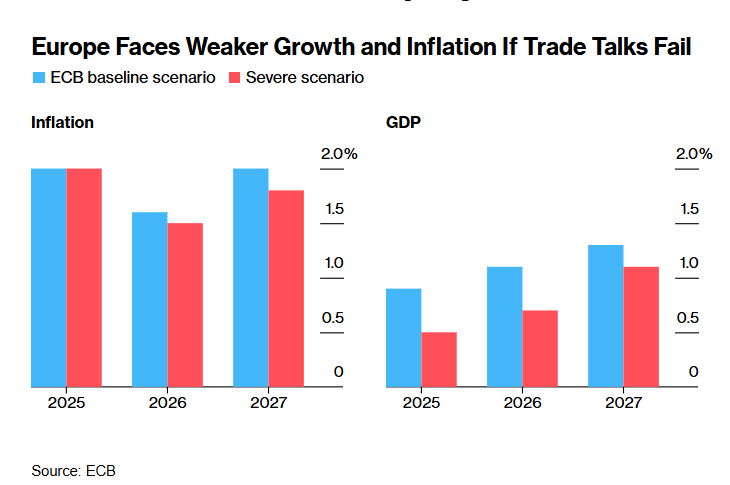
Core Viewpoint - The European Central Bank (ECB) is expected to maintain interest rates at 2% during its upcoming meeting, marking the first time in a year that rates will remain unchanged as the bank awaits clarity on the impact of U.S. tariffs on inflation [1][4] Interest Rate Decisions - The ECB plans to significantly lower borrowing costs by 200 basis points between June 2024 and June 2025, aiming to keep deposit rates within a range that neither suppresses nor stimulates the economy [4] - ECB officials are divided on future actions, with some advocating for further easing due to concerns that inflation may remain below the 2% target, while others warn that increased public spending could lead to higher prices in the future [4][7] Economic Outlook - The uncertainty surrounding U.S. tariffs, particularly President Trump's threat to impose a 30% tariff on the EU starting August 1, has increased risks of a worse-than-expected economic outcome [7] - The ECB's most severe trade scenario predicts a 20% tariff on all European goods, which could further depress inflation [7] Euro Strength - The euro has appreciated by 13% against the dollar this year, raising concerns among policymakers as it makes exports more expensive and lowers import costs [8] - ECB officials are cautious about the euro's strength, with potential implications for future interest rate decisions if the euro surpasses 1.20 against the dollar [8] Communication Challenges - The ECB's policy statement and President Lagarde's remarks are unlikely to change significantly, but the wording used to describe the decision to maintain rates could influence market expectations regarding future rate cuts [9][12] Official Changes - The July meeting marks the first for Olaf Sleijpen as a council member, succeeding Klaas Knot as the Dutch central bank governor, while the departure of hawkish figures like Austrian central bank governor Robert Holzmann may influence future policy discussions [13]
一年来首次!欧洲央行料按兵不动,降息前景迷雾重重
Jin Shi Shu Ju· 2025-07-24 05:52
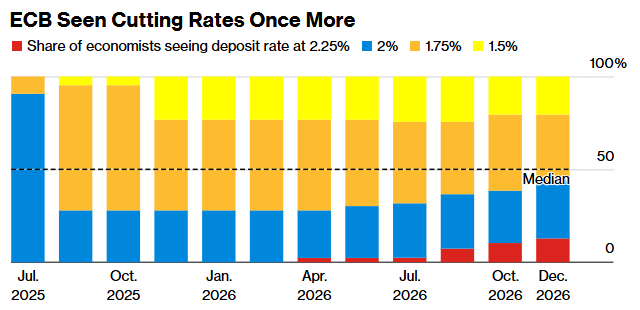
Core Viewpoint - The European Central Bank (ECB) is expected to maintain interest rates at 2% during its upcoming decision, marking the first pause in over a year, as it awaits clarity on the impact of Trump's tariff policies on inflation [1][2][5]. Interest Rate Policy - A Bloomberg survey indicates that all but two economists expect the ECB to keep the deposit rate unchanged, with a majority predicting a 25 basis point cut in September [1]. - The ECB is projected to cumulatively lower rates by 200 basis points between June 2024 and June 2025, aiming to position the deposit rate in a neutral zone [1]. - ECB officials are divided on future policy directions, with some open to further easing due to concerns about inflation potentially falling below the 2% target [2][3][4]. Economic Outlook - Trump's threat to impose a 30% tariff on the EU starting in August has heightened uncertainty, with risks of a less favorable outcome from trade negotiations compared to previous forecasts [6]. - The ECB's Vice President warned of potential stagnation in output for the eurozone in Q2 and Q3 if trade talks fail [6][9]. - Positive economic signals include planned military and infrastructure spending, with over 100 billion euros (approximately 117 billion dollars) in new projects announced by top German companies [9]. Euro Strength - The euro has appreciated by 13% against the dollar this year, raising concerns among policymakers about the impact on export prices and import costs [10]. - Some officials suggest that a stronger euro could lead to a reconsideration of rate cuts, while others believe such concerns are overstated [10][11]. Communication Challenges - The ECB's upcoming policy statement and President Lagarde's remarks will be closely monitored for indications of future rate cuts, particularly the use of terms like "pause" which may signal that rate cuts are not over [11][12]. - The assessment of economic risks is crucial, with expectations that if risks remain skewed to the downside, it could signal a forthcoming rate cut in September [11]. Personnel Changes - The July meeting will mark the first participation of the new Dutch central bank governor, who is viewed as a moderate hawk, while the Austrian hawk representative will attend for the last time before retirement [12].