
贸易冲突

Search documents
贸易冲突再升级,美股期货、欧股齐跌,日元、瑞士法郎、黄金小幅上涨
Hua Er Jie Jian Wen· 2025-07-04 07:45
Core Viewpoint - The intensification of tariff threats by Trump ahead of the negotiation deadline on July 9 has heightened market tensions, leading to declines in U.S. stock futures, European stocks, and fluctuations in Asian markets, while safe-haven assets like the yen, Swiss franc, and gold saw slight increases [1][10]. Market Performance - U.S. stock futures for the three major indices fell over 0.3% [1][7]. - European stocks experienced widespread declines, with the German DAX and UK FTSE both down over 0.2%, and the French CAC down over 0.7% [1][8]. - The Nikkei 225 index in Japan rose by 0.1%, while the Tokyo Stock Price Index fell by 0.04%, and the South Korean Composite Index dropped by 2% [1]. Currency Movements - The U.S. dollar index decreased by 0.2%, while the British pound and euro increased by over 0.1%, and the South Korean won rose by over 0.4% [2]. - The Japanese yen appreciated by approximately 0.4%, and the Swiss franc rose by over 0.2% [2][13]. Commodity Prices - Spot gold saw a slight increase of about 0.3%, while spot silver declined by approximately 0.2% [3][16]. - U.S. crude oil prices fell by over 0.3%, and Brent crude oil dropped by over 0.5% [4]. Cryptocurrency Trends - Bitcoin experienced a decline of about 0.4%, and Ethereum fell by approximately 1.5% [5]. Investor Sentiment - Some investors are adopting a cautious approach, holding more cash in their portfolios due to concerns about market optimism among other fund managers, leading to reduced equity positions [6].


ETO Markets 市场洞察:美元连跌五月创“世纪惨案”,下周汇市要“变天”?
Sou Hu Cai Jing· 2025-06-30 05:21
Group 1: Currency Performance - The US dollar has experienced a decline of over 2% this week, reaching a low of 96.99, marking its worst first half performance since 1986 with five consecutive months of decline [1] - The euro has appreciated against the dollar, rising 0.05% to 1.1705, with a weekly increase of 1.57%, the best since May 19 [8] - The Canadian dollar weakened by 0.5% to 1.37 CAD against the US dollar amid trade tensions [3] Group 2: Trade Relations - President Trump abruptly halted trade talks with Canada, accusing it of imposing new taxes on US tech companies, which he termed a "blatant attack" [3] - Canada plans to impose a digital services tax on US tech companies starting June 30, prompting Trump's strong opposition and a potential increase in tariffs on Canadian goods [3] Group 3: Federal Reserve Policy - Market expectations for multiple interest rate cuts by the Federal Reserve have increased, with traders anticipating a reduction of 65 basis points by the end of the year, up from 46 basis points a week prior [6] - Fed Chairman Powell's recent testimony has been interpreted as dovish, suggesting potential rate cuts if inflation does not rise as expected [5][6] Group 4: Geopolitical Risks - Trump's strong stance against Iran, including the possibility of military action if uranium enrichment reaches concerning levels, has heightened geopolitical risks [4] Group 5: Economic Indicators - Recent US economic data shows a surprising decline in consumer spending and an increase in unemployment claims, indicating a weakening economy [5]
科技股领涨引领“V型反弹” 标普500指数创历史新高
智通财经网· 2025-06-27 23:42
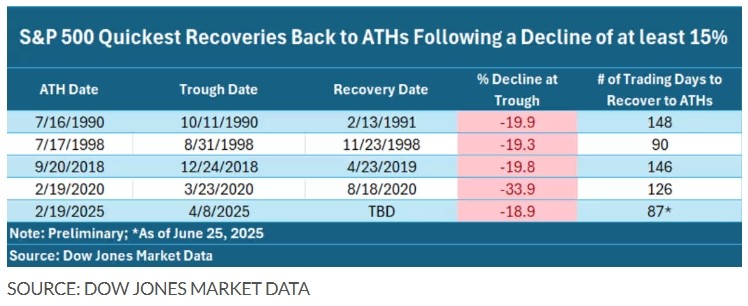
科技股是本轮反弹中的绝对主角。以科技股为主的纳斯达克100指数自4月8日以来上涨近32%,远超大盘 表现,而纳斯达克综合指数也在周五收涨0.52%,收报20,273.46点,为2024年12月16日以来首次创出收盘 新高。 相比之下,道琼斯工业平均指数表现相对滞后。该指数周五上涨432.43点,涨幅1%,收报43,819.27点,自 4月以来累计涨幅约16%,仍较历史高点低约2.7%。以价值股、传统行业为主的道指未能跟上科技股驱动 的强势节奏。 Zacks Investment Management的客户投资组合经理Brian Mulberry表示,"所有我们原本担忧的负面因素,尤 其是关税带来的冲击并未真正发生,经济数据的韧性也超过预期,这令市场重新恢复理性并走回正 轨。"他指出,目前市场已经回到了2月末的水平,而彼时的波动还未真正开始。 不过,尽管当前市场表现令人振奋,未来的上行动力仍有待观察。Granite Bay Wealth Management的首席 投资官Paul Stanley指出,市场目前正寻找新的催化剂来进一步推动股指上行。随着中东局势暂时缓和,投 资者的注意力逐渐回到美国国内政策的走向, ...
美欧关税博弈倒计时,德法立场分裂!
第一财经· 2025-06-27 14:39
Core Viewpoint - The article discusses the strategic divergence between Germany and France in response to the impending U.S. tariffs on the EU, highlighting the differing approaches to negotiations and potential impacts on the European economy [1][5][6]. Group 1: U.S. Tariff Threat and EU Response - The U.S. is threatening to impose a 50% tariff on EU steel and aluminum products, along with a 25% tariff on automobiles and a 10% baseline tariff on all EU imports [1]. - The European Commission is evaluating the latest U.S. proposal and is prepared for a potential breakdown in negotiations, indicating that "all options are on the table" [1][5]. Group 2: Economic Impact on Germany - According to the German Ifo Institute, the German manufacturing sector could face severe impacts from U.S. tariffs, with a projected overall shrinkage of 2.8% and a 38.5% drop in exports to the U.S. [9]. - The automotive and pharmaceutical industries are expected to be the most affected, with value losses of 6% and 9% respectively [9]. Group 3: Divergent Strategies within the EU - Germany's Chancellor Merz advocates for a focused approach to negotiate tariffs on key industries, while France's President Macron insists on a zero-tariff agreement, warning against perceived weakness in negotiations [6][7]. - Italy's Prime Minister Meloni suggests accepting some tariffs to avoid worsening the situation, indicating a willingness to compromise [7]. Group 4: Future Trade Strategies - EU officials are considering a framework agreement to buy time for further negotiations, acknowledging the challenges of aligning positions among 27 member states [8]. - The EU is actively seeking to diversify its trade networks, with leaders expressing support for a free trade agreement with the South American Mercosur bloc [10].

美欧关税博弈倒计时:德法立场分裂,欧盟已做好谈崩准备?
Di Yi Cai Jing· 2025-06-27 10:25
Group 1: EU-US Trade Negotiations - EU officials anticipate prolonged negotiations with the US due to unclear final demands from the US side [1][5] - The EU is currently facing strategic divisions, particularly between Germany and France, regarding how to respond to US tariff threats [3][4] - The EU Commission President stated that all options are being considered, including preparations for a potential breakdown in negotiations [1][3] Group 2: Economic Impact on Germany - The German manufacturing sector is expected to face significant risks if the US implements its proposed tariffs, with a potential 2.8% shrinkage in overall manufacturing size and a 38.5% drop in exports to the US [6] - The automotive and pharmaceutical industries are projected to be the most affected, with value losses of 6% and 9% respectively [6] - Germany is urged to establish new bilateral agreements with countries like South America, India, and Indonesia to mitigate the impact of US tariffs [6][7] Group 3: EU's Trade Strategy - The EU is actively seeking to diversify its trade network, with leaders agreeing to consider signing free trade agreements with the South American Mercosur bloc [7] - The EU's proposal for zero tariffs on industrial goods contrasts sharply with the US's demands for unilateral concessions [3][4] - The EU aims to balance trade negotiations by offering to purchase strategic goods from the US in exchange for lower tariffs [3]
相聚资本2025年中期投资策略:在变局中寻求突破
Xin Lang Ji Jin· 2025-06-27 05:19
相聚资本研究总监、基金经理余晓畅认为,下半年经济本身不是决定股市走向的胜负手,而是可能出现 的变局点,也对应着股市的变盘。宏观经济之外,新兴产业的发展趋势也是需要高度关注的核心变量, 比如AI的推进等。 责任编辑:石秀珍 SF183 余晓畅认为,在贸易冲突的不确定背景下,企业的内在质地尤为重要。具有全球竞争力、品牌力突出, 在海外市场具有广阔市场空间的公司,具备了从纷繁多杂环境下穿越周期的能力。当不确定成为常态, 更需要具备自下而上从变化中找到突破点的投资能力。比如二季度的新消费和创新药行情,便是这样的 变局点。看到变化,并有突破和获利的能力,这也将是未来的发力方向之一。 在余晓畅看来,虽然二季度A股市场AI板块有所沉寂,但国内AI的发展并未停歇,投资中需要更要关注 核心节点、比如产业趋势的临界点,淡化短期业绩,关键环节的突破是股价定价的核心。 对于近来火爆的新消费,余晓畅认为,本质是一代人有一代人的消费习惯和理念,消费习惯的变迁也带 来了对应消费公司的崛起,周期趋势概莫能外。落到投资上,理性客观看待板块炒作,具有内在持续运 营和业绩兑现能力的企业,才是长期投资的优选。 展望下半年,余晓畅认为,互联网、金属等 ...
瑞典央行会议纪要:瑞典央行行长特登表示,仍然认为当前的贸易冲突不太可能引发瑞典出现强烈的通胀压力。
news flash· 2025-06-25 07:36
瑞典央行会议纪要:瑞典央行行长特登表示,仍然认为当前的贸易冲突不太可能引发瑞典出现强烈的通 胀压力。 ...
【光大研究每日速递】20250617
光大证券研究· 2025-06-16 13:39
Market Overview - The market experienced fluctuations this week, with only the ChiNext index showing an increase. The ETF market continued to see net outflows, primarily from large-cap ETFs. The market is transitioning from wide fluctuations to narrower ones, with increased trading volume during this process, indicating potential consolidation in a weak market [4]. Copper Industry - In May, domestic waste copper production was 92,000 tons, a year-on-year decrease of 20% but a month-on-month increase of 5%. The negative impact of trade conflicts on the economy has not fully materialized, which continues to suppress copper price increases. Supply-side disturbances in copper mining have increased, while demand is weakening due to reduced export stocking effects and the domestic off-season [5]. Metal Prices - The price of London gold has reached a historical high. Sunac China’s offshore debt-to-equity swap plan received support from 82% of bondholders. In May, Sunac's total sales amounted to 4.9 billion yuan, a year-on-year increase of 128%, indicating strong performance [6]. Chemical Industry - Recent safety incidents in chemical parks have led to stricter approval and production regulations for high-risk chemical reactions. Leading companies in the chemical industry, with better safety management and advanced production technologies, are expected to benefit from stable production amid limited growth in high-risk products [7]. Construction Materials - The market performance showed a decline, with the CITIC building materials index down 2.16% and the CITIC construction index down 1.27%. The average price of PO42.5 cement was 365.70 yuan/ton, a slight increase, while glass prices decreased by 20 yuan/ton [8]. Agriculture and Livestock - In the pig farming sector, the industry capacity cycle has bottomed out, but high inventory levels continue to impact market dynamics. Recent policy-driven efforts are accelerating the reduction of inventory, which may lead to a rebalancing of supply and demand. Long-term, the end of inventory reduction could signal the start of a prolonged profit upcycle for the sector [9]. Renewable Energy - The nuclear fusion sector, while far from full commercialization, is seeing increased investment and research due to global military competition. Recent data from May indicates a downward trend in overall renewable energy prices, highlighting ongoing pressures in power supply and demand. Wind power, virtual power plants, and energy storage are identified as promising investment opportunities [10].

每日机构分析:6月16日
Xin Hua Cai Jing· 2025-06-16 08:46
Group 1: Federal Reserve and Economic Outlook - Russell Investments suggests that the Federal Reserve may maintain current interest rates throughout the summer, with potential rate cuts of one to two times by the end of the year [1] - Goldman Sachs has downgraded the U.S. recession outlook, citing that the impact of tariffs is lower than expected and the financial environment has returned to pre-tariff levels [2] - The current inflation data in the U.S. indicates that the impact of tariffs on consumer prices may be less significant than anticipated, although future CPI increases are expected due to tariff effects [2] Group 2: Global Economic and Market Trends - Analysts from Deutsche Bank note that the market's inflation and interest rate expectations in Japan are rising, putting pressure on the long-term bond market [1] - The performance of German and U.S. government bonds is influenced by inflation concerns and safe-haven demand amid escalating tensions in the Middle East [2] - The decline in new home sales in Singapore is attributed to a lack of new launches, reflecting uncertainty in the macroeconomic outlook due to global trade challenges [3] Group 3: Currency and Oil Market Dynamics - The recent appreciation of the U.S. dollar is primarily driven by a rebound in oil prices rather than traditional safe-haven dynamics [4] - The U.S. has become one of the largest oil producers globally, which means that rising oil prices not only benefit oil-producing countries but also support the dollar through improved trade conditions [4] - Investors are advised to focus on global oil price changes and their impact on U.S. trade conditions for a more accurate prediction of the dollar's performance in international markets [5]