
即时零售

Search documents
带着130万骑手“换东家”后,达达的故事还能怎么讲?
3 6 Ke· 2025-10-14 12:24
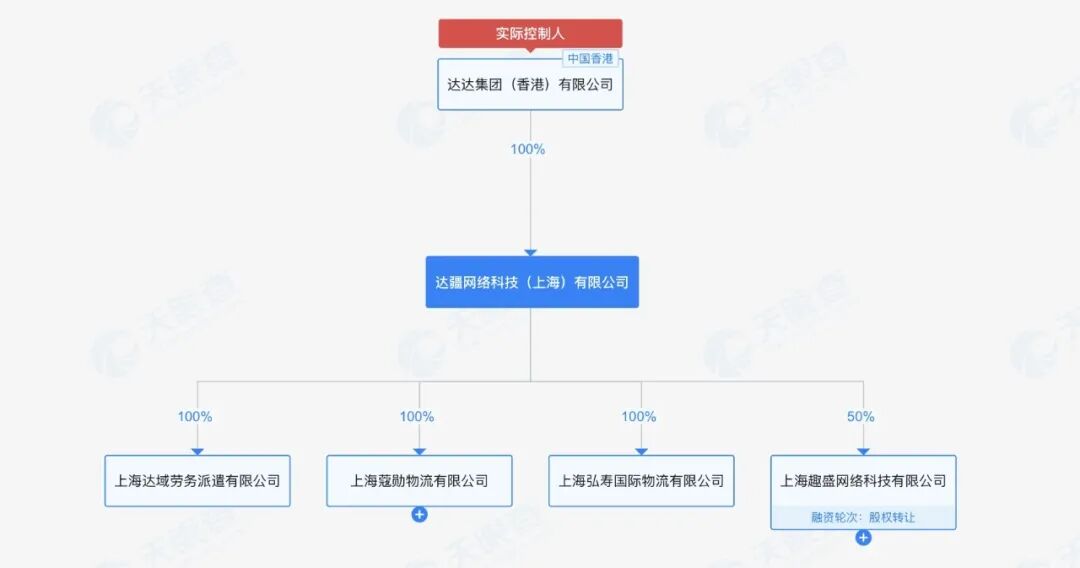
Core Viewpoint - The competition in the instant retail and delivery sector has intensified, particularly with JD's entry into the food delivery market, leading to a focus on delivery capabilities rather than just traffic acquisition [1][12]. Group 1: Acquisition Details - JD Logistics has officially completed the acquisition of two subsidiaries, Dajian and Dasheng, from JD Group for $270 million, marking a significant move in the instant delivery space [1][6]. - Dajian and Dasheng were previously core entities of Dada Group's instant delivery business, with Dajian being the main operational entity in China [2][4]. Group 2: Strategic Implications - The acquisition is part of JD's broader strategy to enhance its logistics capabilities and integrate Dada's instant delivery assets into its logistics framework, aiming to reduce fulfillment costs and improve delivery efficiency [8][9]. - By integrating Dada's network into JD Logistics, the company seeks to streamline operations and enhance its competitive edge in the instant retail market, particularly during high-demand periods like the Double 11 shopping festival [1][10]. Group 3: Market Context - The instant delivery market is becoming increasingly competitive, with JD's aggressive expansion leading to significant financial losses, prompting the need for strategic realignment through acquisitions [12][13]. - Dada's previous financial struggles, including a significant drop in market valuation and operational challenges, have created an opportunity for JD to absorb its assets and potentially revalue them within its ecosystem [10][11].

双十一微观察:大促呈现哪些新风向?
Xin Lang Cai Jing· 2025-10-14 10:26
双十一风向的变化,预示着电商行业正从价格与流量的角逐,开始进入精细化运营的新阶段。 平台持续改善消费者体验 今年,双十一迎来第十七年。从最初的单日购物狂欢,到如今持续一个多月,双十一成为名副其实 的"购物季"。 本文转自:新华网 今年,早在国庆中秋假期前,即有平台启动双十一购物节,国庆档直接嵌入大促周期。相比往年,今年 双十一开启时间更早、持续时间更长,各平台不约而同简化促销玩法,即时零售也成为今年双十一的新 看点。 网经社电子商务研究中心主任曹磊认为,购物周期加长,一方面有助于缓解消费者的购物焦虑,另一方 面也有助于商家和平台合理安排促销节奏,更从容安排发货、促销定价与活动策划,从而提升整体购物 体验。 平台主打直降,满减无需凑单,红包即点即用……今年,各平台在简化促销规则方面也做了大量探索。 有网友感慨,"以前的双十一套路太多,现在直接满减很香,很实在。"此外,今年双十一也涌现出红包 口令、现货直供等一些新的促销玩法。用户不用再做促销规则"数学题",双十一正回归大促的初衷。 从消费者心智看,双十一作为电商最重要的年度大促的认知早已深入人心。在中国国际电子商务中心专 家李鸣涛看来,平台所要做的就是在当前的消 ...
港股异动 | 恒科指午后跌幅扩大逾4% 阿里巴巴-W(09988)跌超4% 腾讯(00700)跌超3%
智通财经网· 2025-10-14 06:53
消息面上,近期贸易风波持续扰动市场。商务部10月14日发布公告,为反制美国对中国采取海事、物流 和造船业301调查措施,经国家反外国制裁工作协调机制批准,商务部公布《关于对韩华海洋株式会社5 家美国相关子公司采取反制措施的决定》,自2025年10月14日起施行。申万宏源认为,10月中美贸易摩 擦扰动,但国产模型与芯片的进步是应对底气,仍然坚定看好港股互联网AI云和自研芯片价值重估。 该行指出,更值得关注的是即时零售的激烈竞争边际变化,3季度预计是内卷高峰,后续竞争缓和幅度 将对港股互联网的盈利预期影响较大。 智通财经APP获悉,港股午后显著跳水,恒生科技指数跌幅扩大逾4%。截至发稿,成分股中,华虹半 导体(01347)跌14.84%,报75.2港元;金山软件(03888)跌7.44%,报33.84港元;阿里巴巴-W(09988)跌 4.61%,报155港元;腾讯(00700)跌3.05%,报619.5港元。 ...



“双十一”接档“黄金周”,有哪些新看点
Zhong Guo Qing Nian Bao· 2025-10-14 06:14
Core Insights - The upcoming "Double Eleven" shopping festival is characterized by an early start and extended duration, with major platforms like JD and Douyin launching their promotions ahead of schedule to capitalize on consumer interest from the recent holiday season [3][4]. Group 1: Event Overview - The "Double Eleven" shopping festival has been initiated earlier this year, with JD and Douyin starting their campaigns on October 9, following Su Ning's announcement on September 30 [2][3]. - This year's event is expected to last for 37 days, making it potentially the longest "Double Eleven" in history, concluding on November 14 [3][4]. Group 2: Promotional Strategies - Major platforms are simplifying promotional rules, moving away from complex discount structures to more straightforward offers like "direct discounts" and "instant reductions" [5][6]. - The focus on user experience is evident, with platforms like Douyin emphasizing "simple discounts" and JD showcasing "official direct price reductions" [6][8]. Group 3: New Growth Areas - AI e-commerce, instant retail, and cross-border e-commerce are identified as key areas for growth during this year's "Double Eleven," as traditional traffic sources reach saturation [1][9]. - Platforms are leveraging AI technologies to enhance efficiency and precision in transactions, with JD and Alibaba both introducing AI tools to support merchants during the festival [9][10]. Group 4: Market Expansion - Instant retail is emerging as a significant battleground, with platforms like Meituan and Taobao reporting substantial growth in transaction volumes during recent promotional events [10][11]. - Cross-border e-commerce is also a focus, with Taobao planning to launch its "Double Eleven" campaign in 20 countries, supported by a marketing budget of 1 billion yuan [11].
双11 战场再扩容,闪购首次参战,其他平台跟还是不跟?
第一财经· 2025-10-13 14:43
Core Viewpoint - The article discusses the evolving landscape of the "Double 11" shopping festival, highlighting the integration of instant retail and the increasing role of food delivery services in this year's event, which is expected to enhance competition among e-commerce platforms [3][8]. E-commerce Platforms' Strategies - Multiple e-commerce platforms, including Kuaishou, Douyin, and JD, have already initiated their "Double 11" promotions, with a focus on immediate sales and flash sales [3][4]. - Alibaba's Taobao is set to introduce flash sales during the "Double 11" period, offering exclusive discounts and promotions for 88VIP users [4][5]. Instant Retail and Delivery Integration - Instant retail is anticipated to play a significant role in this year's "Double 11," with platforms like Tmall Supermarket aiming for rapid delivery within four hours through enhanced supply chain capabilities [5][9]. - The integration of food delivery services into the "Double 11" framework is expected to blur the lines between online and offline shopping, providing opportunities for brands with physical stores to leverage their inventory [9]. Competitive Landscape - The competition among platforms is expected to intensify, particularly in categories such as daily necessities, baby products, and food, as they engage in price wars during the festival [8][9]. - The success of instant retail will depend on platforms' ability to differentiate their offerings and optimize their cost structures while avoiding internal competition [8][9]. Efficiency and New Business Models - The focus of this year's "Double 11" is shifting from sheer traffic generation to efficiency and the implementation of new business models, including the integration of AI for better matching of products and consumers [9][10]. - Brands will face challenges in aligning their pricing strategies, logistics, and inventory management to adapt to the new retail landscape created by the integration of online and offline channels [9].


申万宏源维持阿里巴巴买入评级 战略聚焦AI+云与即时零售
Xin Lang Cai Jing· 2025-10-13 11:57
Core Viewpoint - Shenyin Wanguo maintains a "Buy" rating for Alibaba, projecting a revenue of 252.8 billion yuan for Q2 FY26, representing a year-on-year increase of 6.9%, with a Non-GAAP net profit of 12.8 billion yuan, down 65% year-on-year [1] Group 1: Financial Performance - Projected revenue for Q2 FY26 is 252.8 billion yuan, reflecting a year-on-year growth of 6.9% [1] - Non-GAAP net profit is expected to be 12.8 billion yuan, which is a significant decrease of 65% year-on-year [1] Group 2: Business Operations - Healthy growth in GMV (Gross Merchandise Volume) for Taobao and Tmall, with an emphasis on improving monetization rates across the platform [1] - Cloud business maintains the largest market share, indicating strong competitive positioning [1] Group 3: Strategic Focus - International business is approaching breakeven, showcasing improved operational efficiency [1] - Strategic focus is on AI, cloud services, and instant retail, suggesting a long-term growth potential [1]

美团闪购引爆名酒销售!吃喝板块随市回调,估值跌至十年低位!抄底时机到了?
Xin Lang Ji Jin· 2025-10-13 11:53
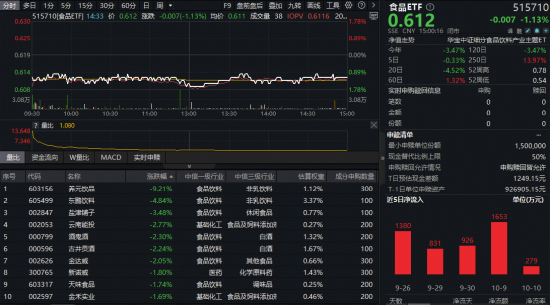
Core Viewpoint - The food and beverage sector continues to experience a pullback, with significant declines in major stocks, particularly in the liquor segment, while the Food ETF (515710) shows signs of increased investment interest despite the downturn [1][3][5]. Group 1: Market Performance - The Food ETF (515710) fluctuated throughout the day, with an intraday drop of 1.78% and a closing decline of 1.13% [1]. - Major consumer goods stocks, especially in the liquor category, saw substantial declines, with Yangyuan Beverage down 9.21%, Dongpeng Beverage down 4.84%, and Yanjinpuzi down 3.48% [1][3]. - Over the past five trading days, the Food ETF has attracted a total investment of 50.68 million yuan, and over the last ten days, it has exceeded 110 million yuan [1]. Group 2: Sales Growth in Liquor - During the National Day and Mid-Autumn Festival period, premium liquor brands experienced significant sales growth, with Moutai's sales increasing nearly tenfold year-on-year, and Wuliangye's sales growing nearly threefold [3]. - The rise in sales for these brands indicates a strong premium pricing capability in the instant retail channel, which is becoming a new growth driver for liquor companies [3]. Group 3: Industry Outlook - Analysts suggest that the food and beverage sector is currently at a favorable valuation point, with the food index's price-to-earnings ratio at 20.31, marking a low point in the last decade [3]. - The white liquor sector is expected to see a recovery in sales during peak seasons, with strong performance from leading companies and ongoing supply-side improvements [4]. - The overall sentiment in the liquor market is improving, with some leading companies signaling price stability and channel support [5].





双11 战场再扩容,闪购首次参战,其他平台跟还是不跟?
Di Yi Cai Jing· 2025-10-13 11:44
Group 1 - The core focus of this year's Double 11 is the increased role of food delivery services, indicating a shift in e-commerce strategies to capture new growth opportunities [1] - Major e-commerce platforms like Kuaishou, Douyin, and JD have already initiated their Double 11 promotions, with Taobao's flash sales set to participate for the first time [2][1] - The integration of near-field retail and e-commerce is expected to enhance platform efficiency and drive traffic, with Taobao allowing users to choose between standard delivery and instant retail delivery [2][5] Group 2 - JD's performance during the 618 shopping festival showed significant growth in categories like 3C accessories (up 177%) and office supplies (up 219%), highlighting the potential for similar strategies during Double 11 [4] - The competition among platforms is intensifying, particularly in the instant retail sector, as brands like Tmall Supermarket focus on categories such as beverages and dairy products [4][5] - The integration of instant retail with e-commerce is still evolving, presenting challenges for platforms in terms of customer acquisition and operational efficiency [5][6] Group 3 - The merging of online and offline sales channels is expected to be a significant change for this year's Double 11, benefiting brands with physical stores and inventory [6] - The focus is shifting from sheer traffic generation to efficiency in operations, with platforms needing to optimize their supply chains and customer engagement strategies [6] - The competition will become more refined, requiring platforms to differentiate their offerings and manage costs effectively to avoid internal competition [5][6]

社会服务行业2025年四季度策略报告:出海和线下零售有望超预期,底部反转可期-20251013
ZHESHANG SECURITIES· 2025-10-13 09:35
Group 1: Local Life and E-commerce - The competition in local life services is expected to continue in Q4 2025, with major platforms like Meituan, JD, and Alibaba intensifying their investments in delivery services and instant retail [2][3] - In Q2 2025, Meituan, JD, and Alibaba reported significant losses in local life services, but these losses are anticipated to peak in Q3 due to increased summer demand and promotional activities [2][3] - The e-commerce sector is experiencing reduced competitive pressure, with online retail sales reaching 1.02 trillion yuan in August 2025, reflecting a year-on-year growth of 7.1% [4] Group 2: Tourism and Hospitality - The tourism sector is witnessing a recovery, with a 7% year-on-year increase in cross-regional travel during the National Day holiday, indicating a shift in traveler preferences towards experiential travel [7][8] - Online Travel Agencies (OTAs) are benefiting from the overall growth in tourism, with major players maintaining stable performance despite increased competition from new entrants [7] - The hotel industry is expected to reach a bottoming out phase, with leading companies like Jinjiang and Huazhu showing resilience and potential for profit recovery in Q4 2025 [10][11] Group 3: Retail and Consumer Goods - The offline retail sector is undergoing significant transformations, with supermarkets like Yonghui Supermarket expected to complete major store renovations, leading to improved profitability [9] - The retail landscape is shifting towards quality retail, with community stores like convenience stores maintaining high growth rates, while traditional department stores face slower growth [9] - The mother and baby retail sector is benefiting from supportive government policies and adjustments in store formats, leading to a notable recovery in same-store sales [14] Group 4: Cross-border E-commerce - Cross-border e-commerce is experiencing profit differentiation due to external factors like tariffs, with platform-based companies showing stable performance while product-based companies seek innovative advantages [12][13] - The sales peak for cross-border e-commerce is anticipated in the second half of 2025, driven by promotional events like Amazon's Prime Day, which saw a 30.3% increase in online spending [12][13] Group 5: Recommendations - Key investment targets include Yonghui Supermarket, Alibaba, Meituan, and various hotel chains such as Jinjiang and Huazhu, reflecting a diversified approach across sectors [5]
美团闪购发布酒水国庆中秋假期战报
Qi Lu Wan Bao· 2025-10-13 02:27
Core Insights - The premium liquor market has seen significant growth during the National Day and Mid-Autumn Festival holiday period, with major brands leading the consumption surge [1] Sales Performance - Moutai's sales increased nearly 10 times year-on-year - Wuliangye's sales grew nearly 3 times year-on-year - Luzhou Laojiao's sales surged over 11 times year-on-year - Jinshiyuan's sales rose over 5 times year-on-year - Honghualang 15's sales increased nearly 7 times year-on-year - Baiyunbian 15-year aged liquor's sales grew nearly 6 times year-on-year [1] Market Trends - Instant retail is emerging as a new growth driver for major liquor brands and regional leaders, facilitating exponential sales growth - The strong sales performance of top brands like Moutai and Luzhou Laojiao highlights their strong pricing power in the instant retail channel - Regional leaders are leveraging instant retail to overcome geographical limitations and reach a broader consumer base [1] Consumer Behavior - The demand for "30-minute delivery" has led to a surge in scenario-based consumption, indicating a shift in consumer preferences [1] Future Outlook - The ability to balance channel efficiency with value competition will be crucial for liquor companies navigating the industry's adjustment period [1]


