
创新药

Search documents
创新药行情有望持续,PROTAC专题:蛋白降解东风起,国内产业链迎新机
2025-12-03 02:12
Summary of Key Points from Conference Call Records Industry Overview - The pharmaceutical sector experienced a correction in 2025 but rebounded towards the end of the year, with the innovative drug market expected to continue its momentum into 2026, presenting investment opportunities [1][6][10]. - Current industry hotspots include the flu epidemic, policy support, and breakthroughs in innovative fields such as small nucleic acid drugs, GLP-1, and BCL-2 inhibitors [1][7][8]. Core Insights and Arguments - The overall performance of the pharmaceutical sector in November 2025 was weak, with a decline of 3.6%, underperforming the CSI 300 index by approximately 1.16 percentage points [3]. - The application of AI technology in healthcare, including AI medicine and brain-computer interfaces, is gaining attention and is expected to present opportunities in 2026 [4][12]. - The release of the medical insurance negotiation directory and commercial insurance innovation directory will significantly impact the sales of related products once they enter the insurance system [10]. - Investment recommendations for 2026 include focusing on cutting-edge technologies such as dual antibodies, multi-antibodies, ADC, PROTAC, small nucleic acids, and GLP-1, as well as large companies with strong R&D capabilities and biotech firms with best/first-in-class potential [9][11]. Notable Developments - The flu data has reached new highs, driving up the stock prices of related testing drugs and vaccines [7]. - The third-party laboratory sector is expected to see performance bottoming out in Q4 2025, with a recovery starting in Q1 2026, aided by accelerated payment collection from companies like KingMed and Dian Diagnostics [4][19]. - The PROTAC technology is highlighted for its ability to degrade target proteins, addressing issues of drug resistance, with leading companies like Pfizer, BMS, and BeiGene making significant progress [4][16][17]. Investment Opportunities - Companies such as KingMed and Dian Diagnostics are recommended for investment due to their improving cash flow and potential recovery in the IVD industry [19][20]. - Jichuan Pharmaceutical is included in the December portfolio due to its expected performance rebound driven by flu season demand and low inventory levels [21]. - The CRO industry is poised for growth, with expectations of increased outsourcing rates and improved margins due to a decrease in new entrants [22][23]. Future Trends - The medical device sector is showing positive trends, with expectations for improvement in the consumer healthcare segment in 2026 [2][11]. - The potential for significant growth in the insulin business of companies like Lianbang Pharmaceutical is anticipated, with a projected revenue of 20 billion yuan in 2025 [32][35]. - The upcoming KMR data in December is expected to act as a catalyst for the global PROTAC market, with a focus on companies with substantial technology platforms [18]. Conclusion - The pharmaceutical and healthcare sectors are navigating through a period of adjustment, with various innovative technologies and market dynamics presenting both opportunities and challenges. Investors are advised to keep a close watch on regulatory developments, clinical trial outcomes, and emerging technologies that could shape the future landscape of the industry [1][6][10].



国信证券晨会纪要-20251203
Guoxin Securities· 2025-12-03 01:27
Macro and Strategy - The upstream resource sector is stabilizing, with coal prices slightly rising, while the oil and petrochemical sectors remain weak, with significant year-on-year declines in refined oil and natural gas prices [7][8] - The manufacturing sector shows overall recovery, with strong performance in machinery and equipment, while the automotive industry is gradually improving [7] - Consumer sectors are experiencing mixed recovery, with real estate showing marginal improvement and entertainment sectors rebounding significantly [8] Industry and Company - The Hong Kong stock market's December investment strategy suggests that the November pullback has created a favorable environment for 2026 [9] - The electronics sector is optimistic, with ASICs expected to open new markets and Quark's smart glasses enhancing AI edge trends [11][12] - The mechanical industry is focusing on humanoid robots and AI infrastructure, with significant developments in robot operating systems and standardization efforts [17][18] Investment Recommendations - Focus on AI-related sectors, including hardware localization and AI applications, as they are expected to be crucial in 2026 [10] - The materials and industrial sectors are anticipated to benefit from the "anti-involution" trend, with upstream metals and certain industrial companies likely to gain [10] - The innovative pharmaceutical sector is stable and worth holding, with potential for growth upon new project releases [10] Market Performance - The global smartphone market is projected to grow by 3.3% in 2025, with Apple expected to become the leading smartphone brand for the first time since 2011 [15][16] - The semiconductor industry is seeing broad growth, with companies like ADI reporting significant revenue increases and positive outlooks for 2026 [16] Key Events and Developments - The launch of Quark's smart glasses and Google's potential sale of TPU chips are notable developments in the electronics sector [12][13] - The introduction of new DDR5 and LPDDR5X products by Changxin Storage indicates growth opportunities in the storage market [14] Focused Investment Areas - Emphasis on humanoid robots and AI infrastructure, with specific attention to companies involved in energy supply and cooling solutions for AI data centers [19][21] - The low-altitude economy and smart welding robots are emerging sectors with significant growth potential [21][22]
2025年中国生物制剂行业政策、产业链、市场规模、研发支出、竞争格局及未来发展趋势研判:已成为医药行业增长最快的领域之一,市场规模将达到6752亿元[图]
Chan Ye Xin Xi Wang· 2025-12-03 01:24
Core Insights - The biopharmaceutical sector is one of the fastest-growing areas in the pharmaceutical industry, driven by an aging population and increased public health awareness [1][5] - China's biopharmaceutical market is projected to grow from CNY 312 billion in 2019 to CNY 587.1 billion in 2024, and is expected to reach CNY 675.2 billion by 2025, with a potential to hit CNY 1.149 trillion in the next five years [1][5][6] - Innovation remains the core driver of growth in the biopharmaceutical industry, which is capital-intensive and requires significant R&D investment [1][6] Industry Definition and Classification - Biopharmaceuticals are medical products manufactured using biological methods, aimed at replicating the activity of natural substances [2][4] - They can be categorized into vaccines, blood products, biopharmaceutical drugs, diagnostic reagents, and others, with further subdivisions based on source or mechanism of action [2] Current Industry Status - The global biopharmaceutical market is expected to grow from USD 286.4 billion in 2019 to USD 461.6 billion in 2024, with the original biopharmaceutical market projected to increase from USD 268.9 billion to USD 427.9 billion in the same period [5] - China plays a significant role in the global biopharmaceutical market, with rapid growth driven by favorable policies, increased R&D investment, and advancements in biotechnology [5][6] Industry Development Environment - Policies - The Chinese government has implemented various laws and policies to encourage biopharmaceutical R&D, including the Drug Registration Management Measures and regulations for clinical research and application of biomedical technologies [7] Competitive Landscape - The biopharmaceutical sector is recognized as a "new frontier" in the pharmaceutical industry, with major global players actively entering the market [9] - Key companies in China's biopharmaceutical industry include WuXi AppTec, Hengrui Medicine, ZhiFei Biological, BeiGene, and others, with a competitive landscape characterized by differentiated strategies [9] Future Development Trends - Market demand for biopharmaceuticals is expected to continue growing, supported by policy backing, technological advancements, and increased health awareness [10] - Domestic companies are transitioning from biosimilars to First-in-Class drugs, with examples like Hengrui Medicine's ADC drug showing superior efficacy [10][11] - Personalized medicine based on genetic testing is anticipated to become a trend, with increasing international recognition of Chinese innovative drugs [11]




12月2日港股创新药ETF鹏华(159286)份额增加200.00万份
Xin Lang Cai Jing· 2025-12-03 01:11
Core Viewpoint - The Hong Kong Innovative Drug ETF managed by Penghua experienced a decline of 1.32% on December 2, with a trading volume of 27.97 million yuan, indicating a challenging market environment for innovative drug investments [1] Group 1: Fund Performance - The latest net asset value of the Hong Kong Innovative Drug ETF is 600 million yuan [1] - Since its inception on August 20, 2025, the fund has reported a return of -9.83% [1] - Over the past month, the fund has achieved a return of 0.66% [1] Group 2: Fund Management - The fund is managed by Penghua Fund Management Co., Ltd., with fund managers Lin Song and Zhang Yuxiang overseeing its operations [1] - The performance benchmark for the fund is the National Index of Hong Kong Innovative Drugs, adjusted for exchange rates [1] Group 3: Fund Size and Activity - The fund's shares increased by 2 million to a total of 666 million shares, despite a reduction of 16 million shares over the last 20 trading days [1]
2025年12月港股金股推荐:关注创新管线确定性强的创新药龙头和基本面强劲的CXO龙头、互联网医疗龙头
Haitong Securities International· 2025-12-02 23:38
Investment Rating - The report recommends an "Outperform" rating for leading pharmaceutical and biotech companies with robust pipelines, as well as high-quality CXOs and internet healthcare firms [1]. Core Insights - The report highlights the strong performance of innovative drug leaders such as BeiGene and Innovent Biologics, which have shown significant revenue growth in Q3 2025, with BeiGene achieving USD 1.41 billion in revenue (up 41% year-on-year) and Innovent exceeding CNY 3.3 billion (up 40% year-on-year) [39][40]. - The CXO sector experienced a pullback in November, with notable declines in stocks like WuXi AppTec and Tigermed, attributed to profit-taking after strong performance in the first three quarters of 2025 and concerns over geopolitical risks [42]. - The report emphasizes the importance of upcoming clinical data readouts from major conferences such as ESMO Asia and ASH, which could serve as catalysts for stock performance [10]. Summary by Sections Top Picks - The report lists top picks including Hansoh Pharma, 3SBio, Kelun-Biotech, Innovent, Akeso, JD Health, and WuXi AppTec, all rated as "Outperform" [1][4][35]. Performance Overview - The Hong Kong stock picks portfolio gained an average of 5.2% in November 2025, outperforming the Hang Seng Healthcare Index, which declined by 0.1% [5][36]. - The top three performers in the portfolio were Hansoh Pharma (+12.9%), BeiGene (+10.2%), and Innovent (+10.0%) [5][36]. Market Trends - The innovative drug sector has shown resilience, benefiting from previous corrections and strong earnings catalysts from leading companies [39]. - The report notes that the recent implementation of key industry policies, including the 11th National Centralized Drug Procurement, has led to significant price reductions for selected products, impacting market dynamics [38]. Clinical Developments - Significant clinical progress is noted for companies like 3SBio, which is advancing its SSGJ707 (PD-1/VEGF) with Pfizer, planning to initiate multiple clinical trials [41]. - The report also highlights the potential of innovative therapies in oncology, with companies like BeiGene and Innovent expanding their product pipelines and market presence [32][40].
劲方医药董事长吕强:创业8年,明白了科学家做老板不能只想着过创新的瘾
Mei Ri Jing Ji Xin Wen· 2025-12-02 13:24
Core Viewpoint - The article discusses the journey and insights of Lü Qiang, the founder of Jinfang Pharmaceutical, highlighting the challenges and strategies in the innovative drug development landscape in China, particularly focusing on the RAS target and the company's approach to commercialization and investor relations. Group 1: Company Overview - Jinfang Pharmaceutical was founded in August 2017 by Lü Qiang in Shanghai Zhangjiang, capitalizing on the favorable conditions for innovative drug development in China [1] - The company successfully listed on the Hong Kong Stock Exchange, with its stock price increasing over 100% on the first day, but faced a subsequent decline of over 30% due to market adjustments [6] - Jinfang's lead drug, Dabotinib, is set to be the first RAS-targeted drug approved in China by August 2024, marking a significant milestone in the company's pipeline [3] Group 2: R&D Focus and Innovation - Jinfang is heavily invested in the RAS target, which has historically been considered "undruggable," with no approved drugs for over 40 years until Amgen's Lumakras received FDA approval in May 2021 [2] - The company aims to cover 80% to 90% of pancreatic cancer patients with its four RAS drugs, addressing a significant unmet need in the oncology market [11] - Lü Qiang emphasizes the importance of innovation beyond just targeting new mechanisms, advocating for a comprehensive understanding of existing research to drive breakthroughs [7][8] Group 3: Commercialization Strategy - Lü Qiang believes that the era of "single product dominance" is over, and that a product matrix approach is necessary for successful commercialization in the competitive oncology market [12] - The company has opted to partner with larger pharmaceutical firms for commercialization rather than pursuing independent sales, reflecting a strategic decision to leverage collective strengths [10] - Jinfang's strategy focuses on creating a "small but beautiful" commercial portfolio, aligning with clinical market gaps and technological advancements [12] Group 4: Market Dynamics and Future Outlook - The article notes that the Chinese biotech sector is increasingly scrutinized by professional capital, which now values the progress and breadth of R&D pipelines more than before [6] - Lü Qiang acknowledges the challenges of balancing innovation with market demands, indicating that the pressures of entrepreneurship are often underestimated [4] - The article concludes with insights on the evolving landscape of biotech and biopharma, suggesting that both sectors have distinct roles and that the current trend of high financial expectations in business development may require recalibration [13][14]

创新药遭遇“窜天猴” 两个月大涨30% 1只实验猴卖12万元仍“有价无猴”
Mei Ri Jing Ji Xin Wen· 2025-12-02 13:09
Core Insights - The price of experimental monkeys, specifically the crab-eating macaque, has surged above 100,000 yuan, marking a significant increase of over 30% from previous prices, leading to a budget shortfall for companies [1][2] - The supply of experimental monkeys is critically low, with a reported annual demand-supply gap of approximately 10,000 monkeys in China, exacerbated by the increasing reliance on these animals for drug safety evaluations [10][11] - The cyclical nature of monkey prices is influenced by a seven-year breeding cycle, making it difficult for breeding companies to respond to market demands in a timely manner [6][7] Price Trends - The price of crab-eating macaques has fluctuated dramatically over the past decade, with a 14-fold increase since 2017, and current prices are expected to stabilize between 70,000 to 150,000 yuan in the next two to three years [2][5] - The peak price reached 200,000 yuan in 2022 and 2023, but has since decreased to around 100,000 yuan, still significantly impacting the cost structure of drug development projects [3][6] Supply Chain Dynamics - The concentration of monkey breeding facilities has increased, with major CRO companies acquiring a significant portion of the available monkeys, leading to a tighter market for smaller companies seeking to procure these animals [9][10] - The breeding cycle for crab-eating macaques is lengthy, taking approximately 6 to 7 years from birth to maturity, which complicates the ability of breeding companies to scale up production in response to rising demand [6][7] Industry Implications - The high cost of experimental monkeys now constitutes a core part of the toxicology testing budget, with estimates suggesting that a single project may require four to five million yuan just for safety evaluation experiments [3][4] - The ongoing demand for innovative drug development, particularly in areas such as antibody drugs and gene therapy, continues to drive the need for crab-eating macaques in preclinical testing [7][11] Future Outlook - The industry is facing a potential decline in self-sustaining breeding capacity, with projections indicating that the annual production of self-bred crab-eating macaques may fall below 10,000 in the next two to three years if current trends continue [7][10] - Companies are urged to consider long-term strategies for breeding and procurement to mitigate the impact of fluctuating prices and supply shortages in the future [6][9]
5023万元研发投入!复星医药PDL1/VEGF 双抗首次获批临床
Xin Lang Cai Jing· 2025-12-02 12:05
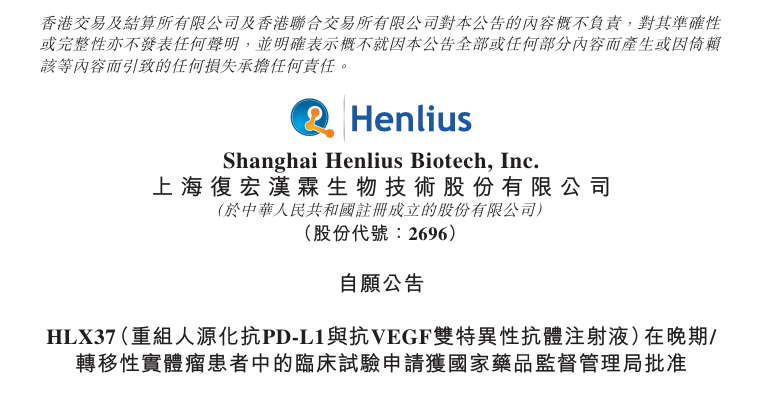
Core Viewpoint - Fosun Pharma's subsidiary, Fuhong Hanlin, has received approval from the National Medical Products Administration for clinical trials of HLX37 injection for treating advanced/metastatic solid tumors [1][4]. Group 1: Product Development - HLX37 is a recombinant humanized bispecific antibody targeting PD-L1 and VEGF, aimed at treating advanced/metastatic solid tumors [3][6]. - Preclinical studies indicate that HLX37 can inhibit tumor growth and has good safety profiles [3][6]. - The company plans to initiate Phase I clinical trials for HLX37 in China once conditions are met [3][6]. Group 2: Financial Investment - As of October 2025, the cumulative R&D investment for HLX37 is approximately 50.23 million yuan [3][6]. - According to IQVIAMIDAS™ data, the global sales forecast for PD-1/PD-L1 and VEGF bispecific antibody products in 2024 is around 920,000 USD [3][6]. Group 3: Company Performance - During the Q3 earnings call on November 20, the company reported that innovative drug revenue exceeded 6.7 billion yuan in the first three quarters of 2025, representing a year-on-year growth of 18.09% [3][6]. - The company has set a target for a 20% compound annual growth rate for innovative drug revenue from 2025 to 2027 [3][6]. - Future strategies include increasing R&D investment, accelerating clinical and commercialization processes for key projects, and strengthening global operations to drive steady growth in the innovative drug business [3][6].
这些海外癌症患者,到中国来寻药了 | 海斌访谈
Di Yi Cai Jing· 2025-12-02 11:54
Core Viewpoint - The article discusses the increasing interaction between Chinese innovative drugs and global patients, highlighting the appeal of CAR-T therapy in China for international cancer patients due to lower costs and efficient treatment processes [1][3][4]. Group 1: CAR-T Therapy in China - CAR-T therapy is a personalized treatment that enhances the ability of T-cells to recognize and kill tumors, with significant development concentrated in China and the US [3]. - The cost of CAR-T drugs in China ranges from 1 million to 1.3 million yuan, approximately one-third of the price in the US, making it a more attractive option for patients [4][5]. - Over the past year, more than 100 overseas patients have consulted with medical institutions in China, with around 90% of completed CAR-T treatments being for international patients [6]. Group 2: Growth of China's Oncology Drug Ecosystem - China's oncology sector has attracted substantial R&D funding, with advancements spanning from early screening to late-stage treatment [7]. - The approval of new indications for existing drugs, such as the combination therapy for non-small cell lung cancer, showcases the rapid development in the oncology field [7]. - The increasing recognition of Chinese pharmaceutical innovation is evidenced by the number of breakthrough therapy designations granted by the FDA to Chinese products [11]. Group 3: International Expansion of Chinese Drugs - Chinese companies are increasingly recognized for their innovation, with significant international collaborations and licensing agreements, such as the partnership between Innovent Biologics and Takeda Pharmaceuticals [10]. - The global market for Chinese CAR-T products is expanding, with companies like Legend Biotech achieving substantial sales figures in the US [10]. - The trend of Chinese pharmaceutical companies seeking international markets is driven by the need for growth outside the competitive domestic landscape [13]. Group 4: Challenges and Opportunities - While the Chinese pharmaceutical industry is making strides, challenges remain in establishing a robust international presence and navigating regulatory environments [12]. - The potential for growth in medical tourism in China is significant, but improvements in visa policies and treatment timelines are necessary to enhance competitiveness [8]. - The future of China's innovative drug sector is uncertain, with investors closely monitoring government policies and market dynamics [13].

上证早知道|AI手机,来了!《疯狂动物城2》,超20亿元!万科债,继续大跌!谷歌芯片,上调预测200万块!
Shang Hai Zheng Quan Bao· 2025-12-02 11:44
来源:上海证券报微信公众号 今日提示 •2025企业家博鳌论坛系列活动12月2日至12月5日在海南博鳌举办。 •2025年中国国际海事会展12月2日至12月5日在上海举办。 •据网络实时数据,截至12月1日18时30分,影片《疯狂动物城2》票房突破20亿元。 •沐曦股份发行初步询价日为12月2日,申购日为12月5日。 •12月1日,DeepSeek同时发布两个正式版模型:DeepSeek-V3.2和DeepSeek-V3.2-Speciale。 上证精选 •广期所发布通知,对多晶硅期货PS2601合约的交易保证金标准及交易限额作如下调整:自2025年12月3 日结算时起,多晶硅期货PS2601合约投机交易保证金标准调整为13%,套期保值交易保证金标准调整为 12%。自2025年12月3日交易时起,非期货公司会员或者客户在多晶硅期货PS2601合约上单日开仓量不 得超过500手。 •上海市政府近日印发《上海市引进人才申办本市常住户口办法》《持有〈上海市居住证〉人员申办本 市常住户口办法》,12月1日起施行。《办法》第三条明确规定,在本市行政区域内注册的用人单位引 进本市紧缺急需的国内优秀人才,可以申办本市常住户 ...
