
算力

Search documents
AI应用接棒AI硬件?创业板人工智能ETF收涨近1%终结三连阴!北美加码AI算力,光模块龙头应声反弹
Xin Lang Ji Jin· 2025-11-03 11:37
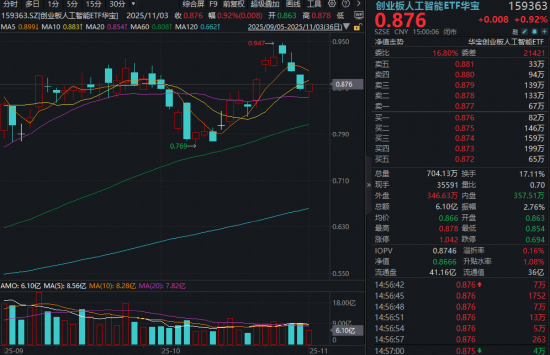
Group 1 - The core viewpoint of the articles highlights the recovery and growth in the AI sector, particularly in the application and hardware segments, with significant stock performance in related companies [1][3][4] - The AI application sector in China has seen a surge in mobile active users, surpassing 700 million, indicating a strong growth trajectory for AI applications [3] - North American cloud service providers (CSPs) have reported a substantial increase in capital expenditures, with a 68% year-on-year growth to $96.4 billion in Q3 2025, reflecting ongoing investment in AI infrastructure [3][4] Group 2 - The largest AI-focused ETF in the Chinese market, tracking the ChiNext AI Index, has shown a positive performance with a 0.91% increase in price and over 600 million yuan in trading volume [1][4] - The AI hardware sector is expected to maintain a high level of activity, with leading companies in the optical module space benefiting from the ongoing demand for advanced computing capabilities [4] - The AI sector is entering a new growth cycle driven by multiple favorable factors, with a focus on companies that have strong technology and customer relationships [4]


“你们尽管做空 OpenAI!”奥特曼霸气喊话,纳德拉亲述微软百亿投资内幕 | 巨头对话
AI科技大本营· 2025-11-03 06:51
Core Insights - The conversation between Satya Nadella and Sam Altman highlights the significant partnership between Microsoft and OpenAI, focusing on their collaboration and future plans in AI technology [3][4][5] - OpenAI's ambitious commitment to invest $1.4 trillion in computing power over the next few years raises questions about its revenue model and growth potential [4][20][19] - The structure of OpenAI as a nonprofit organization with a for-profit subsidiary is designed to ensure that advancements in AGI benefit humanity while also generating substantial financial returns [13][12] Investment and Financial Structure - Microsoft has invested approximately $130 to $140 billion in OpenAI since 2019, acquiring a 27% stake in the company [11][12] - The partnership includes a revenue-sharing agreement where OpenAI pays Microsoft a portion of its income, which is expected to continue until AGI is achieved [16][21] - OpenAI's revenue is projected to grow significantly, with Altman asserting that the company is not limited to its current income figures [20][21] Computing Power and Infrastructure - The discussion emphasizes the critical need for computing power, with Nadella stating that the biggest challenge is not a surplus of computing resources but rather the availability of electricity and data center construction [24][26] - OpenAI plans to allocate $500 billion to NVIDIA, $300 billion to AMD and Oracle, and $250 billion to Azure for computing resources [19][20] - The conversation suggests that the demand for computing power will continue to grow, and the ability to scale effectively will be crucial for both companies [22][23] AGI and Future Prospects - The partnership aims to ensure that AGI is developed responsibly and benefits all of humanity, with a focus on health and AI resilience [13][14] - Altman expresses confidence in the future development of consumer-grade devices capable of running advanced AI models locally [28][20] - The potential for AI to revolutionize various sectors, including healthcare and scientific research, is highlighted as a key area of focus for both companies [35][36] Regulatory Environment - Concerns are raised about the fragmented regulatory landscape in the U.S., with both leaders advocating for a unified federal approach to AI regulation [31][32] - The potential impact of state-level regulations on innovation and competition is discussed, emphasizing the need for coherent policies [32][33] Market Position and Competitive Landscape - The partnership between Microsoft and OpenAI positions them as leaders in the AI space, with Nadella noting that OpenAI's growth is comparable to the emergence of a new Google [19][21] - The exclusive distribution of OpenAI's models on Azure is expected to attract customers who might have otherwise chosen AWS [45][46]


光模块再度领跌,高“光”创业板人工智能ETF跌逾1%,机构:短期震荡不改景气趋势,重视板块布局机会
Xin Lang Ji Jin· 2025-11-03 02:25
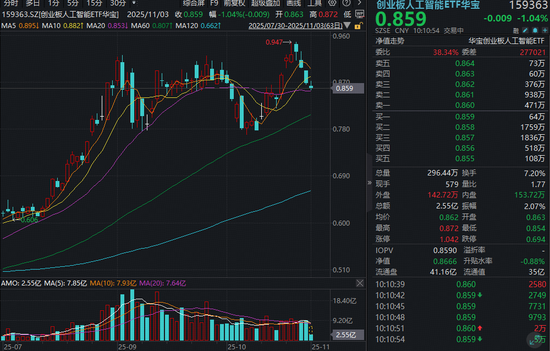
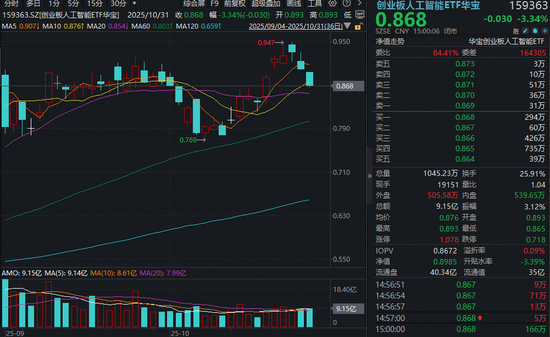
3日早盘,以光模块为代表的算力硬件继续回调,光模块含量超54%的创业板人工智能跌逾1%。其中, 天孚通信领跌超3%,全志科技、北京君正、长芯博创、锐捷网络、光库科技、中际旭创领跌超2%。热 门ETF方面,同类规模最大的创业板人工智能ETF(159363)场内继续回调逾1%,实时成交额超2.5亿 元。 消息面上,北美持续加大AI投入,算力基础设施高景气度延续。近日,北美四大云厂商(MAMG—— 微软、亚马逊、Meta、谷歌)近日已发布2025Q3业绩:MAMG 2025Q3合计资本开支同比增长68%至 964亿美元,Factset一致预期2025年资本开支将达到3633亿美元(同比+63%)。 同类比较看,截至10月31日,创业板人工智能ETF(159363)最新规模超35亿元,近1个月日均成交额 超7亿元,规模、交投在跟踪创业板人工智能指数的7只ETF中高居第一。 数据来源:沪深交易所等。注:"全市场首只"是指首只跟踪创业板人工智能指数的ETF。 风险提示:创业板人工智能ETF华宝被动跟踪创业板人工智能指数,该指数基日为2018.12.28,发布日 期为2024.7.11。创业板人工智能指数2020-2024 ...
北美持续加大AI投入,算力高景气度延续!创业板人工智能ETF(159363)四日累计吸金超2.8亿元
Xin Lang Ji Jin· 2025-11-03 01:44
Core Insights - The AI hardware sector, particularly optical modules, has experienced a significant rise followed by a pullback, indicating a critical investment window for funds [1] - North American cloud service providers (MAMG) have reported a substantial increase in capital expenditures, suggesting continued high demand for computing power [3] - The optical communication industry is entering a new growth cycle driven by technological upgrades from 800G to 1.6T, with leading companies poised to benefit [4] Investment Trends - The largest and most liquid AI-focused ETF in the ChiNext market has attracted over 280 million yuan in inflows over four days, reflecting strong investor interest [1][4] - The total capital expenditure of MAMG for Q3 2025 reached 96.4 billion USD, a 68% year-on-year increase, with expectations for 2025 capital expenditures to hit 363.3 billion USD, up 63% [3] - The ChiNext AI ETF (159363) has a market size exceeding 3.5 billion yuan, with an average daily trading volume of over 700 million yuan, indicating robust trading activity [4] Industry Outlook - Analysts predict that the high demand for computing power will continue to support the optical module and related sectors, despite short-term fluctuations [3] - The transition to 1.6T technology is expected to enhance the competitive edge of leading firms with strong customer relationships and delivery capabilities [4] - The AI application sector, including IoT module companies, is also recommended for investment consideration as it shows promising developments [3]



推动人工智能全方位赋能千行百业(专题深思)
Ren Min Ri Bao· 2025-11-02 22:21
Core Insights - Artificial intelligence (AI) is recognized as a strategic technology driving a new wave of technological revolution and industrial transformation, reshaping human production and lifestyle [1] - The Chinese government emphasizes the integration of AI technology and industry to enhance economic and social development, aiming for high-quality growth and improved living standards [1][4] - The "AI+" initiative is a comprehensive action plan aimed at empowering various sectors through AI, reflecting the government's commitment to harnessing AI for broad societal benefits [1][4] Group 1: AI Development and Integration - AI is a general-purpose technology with wide-ranging applications, driven by the synergy of data, algorithms, and computing power [2] - Data, as a new production factor, exhibits non-competitive use and increasing returns to scale, enhancing model training effectiveness as user scale and data accumulation grow [2] - Breakthroughs in deep learning algorithms enable machines to learn and reason, discovering complex patterns in data and providing customized decision support across industries [2][3] Group 2: AI Applications and Impact - AI demonstrates core capabilities in addressing complex real-world problems, significantly enhancing productivity and resource allocation in economic development [3] - In scientific research, AI fosters interdisciplinary collaboration and aids in solving major scientific challenges, potentially leading to a new paradigm in research [3] - AI's integration into daily life improves efficiency and service delivery, contributing to enhanced quality of life and societal advancement [3][4] Group 3: Government Initiatives and Policies - The Chinese government has implemented a series of policies to elevate the overall capabilities of AI, promoting deep integration of AI technologies across various industries [4] - Successful applications of AI in sectors such as industrial inspection, healthcare, and urban management illustrate its potential to improve operational efficiency and service quality [4] - The future focus includes promoting a collaborative ecosystem that encourages innovation and supports the transformation of traditional industries while fostering new strategic sectors [6] Group 4: Challenges and Strategic Focus - Despite advancements, challenges remain in foundational theories and key technologies, as well as obstacles in the practical application of AI [5] - The government aims to strengthen core technology research, enhance computing infrastructure, and develop a collaborative innovation system involving government, industry, academia, and users [6] - Emphasis is placed on establishing a robust legal and regulatory framework to ensure the safe and ethical development of AI technologies [6]
交易价10亿元! 德龙汇能将迎国资背景“新主”
Mei Ri Jing Ji Xin Wen· 2025-11-02 13:05
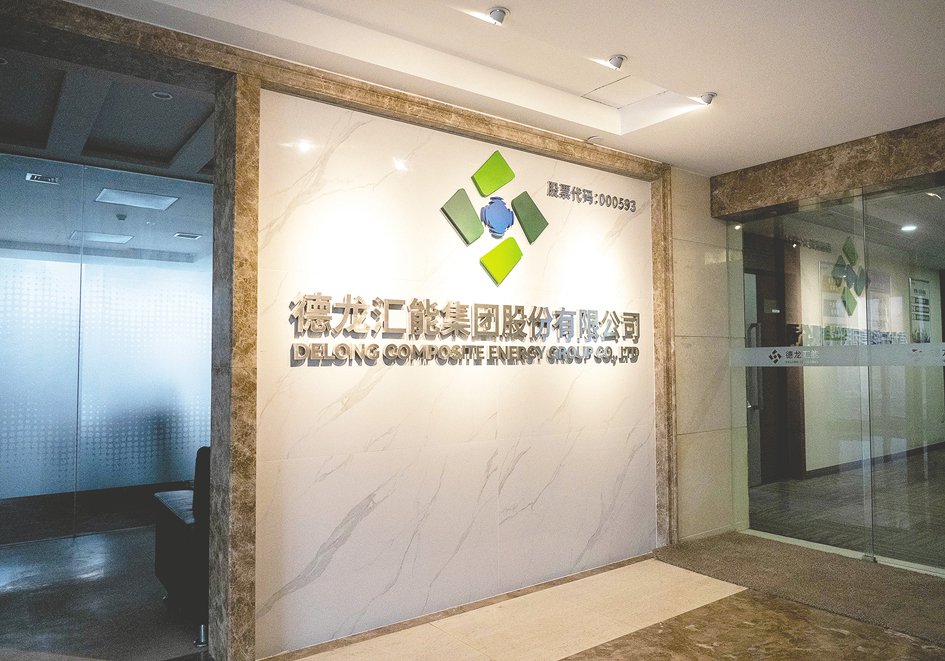
Core Viewpoint - The announcement of a share transfer agreement between DeLong Huaneng and Noxin New Materials indicates a significant change in control, with potential implications for the company's strategic direction and financial health [1][3]. Group 1: Share Transfer Details - DeLong Huaneng's controlling shareholder, Beijing Dingxin Ruitong Technology Development Co., plans to transfer 106 million shares, representing 29.64% of the total share capital, to Noxin New Materials at a price of 9.41 yuan per share, totaling 1 billion yuan [1][3]. - If the transaction is completed, the controlling shareholder will shift from Dingxin Ruitong to Noxin New Materials, with the actual controller changing from Ding Liguan to Sun Weijia [3]. Group 2: Financial Performance and Debt Situation - DeLong Huaneng has shown a trend of fluctuating net profits, with a reported loss of 241 million yuan in 2023, marking the largest annual loss since public financial data became available [5]. - The company's debt repayment capability has deteriorated over the past decade, with liquidity ratios consistently below 1, indicating weak solvency [5][6]. Group 3: Background of the Buyer - Noxin New Materials, established just three months prior to the agreement, has a complex ownership structure with ties to state-owned enterprises, particularly the East Yang Government through Dongwang Holdings [7]. - The firm has not yet commenced any operational activities, raising questions about its readiness and strategic intent in acquiring DeLong Huaneng [7]. Group 4: Market Reaction - Prior to the announcement, DeLong Huaneng's stock price surged, hitting the daily limit on October 24, with a trading volume of 474 million yuan, indicating speculative interest [9]. - Following the announcement, the stock price experienced a significant increase, with a premium of approximately 18.81% compared to the closing price before the announcement [10].

资本追捧下的AI产业竞争需慎思|法经兵言
Di Yi Cai Jing· 2025-11-02 12:41
Core Insights - The sustainability of the high-capital-driven AI growth model in the U.S. is under scrutiny, as GDP growth is heavily reliant on massive investments in data centers and information technology, with minimal contributions from other sectors [1][2][3] Investment and Economic Structure - In the first half of 2025, U.S. GDP growth was 1.6%, primarily driven by an expected $520 billion in AI data center spending, largely from tech giants like Microsoft, Google, Amazon, and Meta [1] - The current AI economic development is heavily dependent on capital investment rather than improvements in total factor productivity or consumer market prosperity [2] - The concentration of investment in AI infrastructure has not effectively permeated traditional sectors such as manufacturing, services, healthcare, and education, limiting broader economic benefits [2][3] Risks and Challenges - The heavy focus on capital investment in computing infrastructure may lead to an imbalance in resource allocation, stifling innovation in software areas such as AI algorithms and ethical considerations [4] - High capital barriers may solidify market competition dynamics, making it difficult for small and medium enterprises to compete, thus concentrating resources and talent among a few tech giants [4][5] - The over-reliance on a few tech companies for AI economic growth creates structural vulnerabilities, making the overall economy susceptible to fluctuations in specific industries or corporate decisions [4][5] Market Dynamics - The exponential growth in computing resource requirements for large model training creates significant market entry barriers, leading to potential monopolistic risks among major tech firms [5][6] - The high costs associated with maintaining computational advantages may become unsustainable, especially if economic conditions change [5][6] Balanced Development Strategies - A balanced approach to AI development is necessary, emphasizing both technological innovation and application integration across various sectors [7][8] - Legal and ethical frameworks must be strengthened to ensure responsible AI development, addressing issues such as data privacy and algorithmic governance [8][9] - Promoting fair competition and preventing market monopolies is crucial, with regulatory bodies needing to monitor the AI industry closely [8][9] - The ultimate goal of AI development should be to enhance societal welfare, ensuring that technological advancements benefit a broad range of social groups and industries [9]
【招商电子】比亚迪电子:Q3业绩短期承压,关注算力业务放量、A客户新品布局
招商电子· 2025-11-02 12:11
Core Viewpoint - The company reported a decline in Q3 performance primarily due to the delayed shipment of a new product from a major client, impacting revenue and profit margins [1][2]. Financial Performance Summary - Q3 revenue was 42.68 billion yuan, a year-on-year decrease of 2.0% and a quarter-on-quarter decrease of 2.4% [1]. - Gross profit for Q3 was 2.95 billion yuan, down 20.0% year-on-year and 8.5% quarter-on-quarter, with a gross margin of 6.9%, reflecting a decline of 1.6 percentage points year-on-year and 0.5 percentage points quarter-on-quarter [1]. - Net profit for Q3 was 1.41 billion yuan, a year-on-year decrease of 9.0% but a quarter-on-quarter increase of 27.0%, resulting in a net margin of 3.3%, down 0.3 percentage points year-on-year but up 0.8 percentage points quarter-on-quarter [1]. Business Outlook - For 2026, the company anticipates growth driven by three main areas: AI edge computing, smart vehicles, and computing power [2]. - In the consumer electronics sector, the company expects to increase its market share in A client's Pad and mobile glass business, while enhancing the quality and efficiency of mobile casing production [2]. - The automotive business is projected to maintain rapid growth despite a slowdown in the parent company's vehicle sales, driven by increased shipments of smart cockpit and thermal management products [2]. - The computing power segment is expected to expand significantly, with liquid cooling products anticipated to ramp up production in the first half of next year [2]. - The robotics sector will leverage the company's expertise in system integration and sensor fusion to enhance its offerings in key components and systems [2]. Investment Recommendation - The company is positioned as a leading precision manufacturing enterprise with strong material research, product design, and vertical integration capabilities [3]. - The long-term growth potential is supported by its strategic positioning in the innovation cycle of major clients, new product launches in smart vehicles, breakthroughs in computing power, and advancements in robotics [3].
行业周报:宏观扰动落地,继续关注算力、存储、消费电子板块-20251102
KAIYUAN SECURITIES· 2025-11-02 09:43
Investment Rating - The industry investment rating is "Overweight" (maintained) [1] Core Views - The report highlights a positive outlook for the electronic industry, driven by macroeconomic factors and ongoing developments in AI, storage, and consumer electronics sectors [6][4] - The report notes that the electronic industry index experienced a decline of 1.94% during the week, with mixed performances across sub-sectors such as consumer electronics and semiconductors [3][4] - The report emphasizes the importance of monitoring key players in the storage, computing power, and consumer electronics sectors, particularly in light of recent price increases and technological advancements [6][5] Market Review - Domestic risk assets have generally declined, while overseas core assets remain strong, with significant gains in companies like Nvidia and Google [3] - The report mentions that the recent US-China trade negotiations have yielded positive results, contributing to a more favorable environment for the electronic sector [3] Industry Updates - The storage sector continues to see price increases, with NAND and DRAM supplies tightening, impacting consumer electronics pricing [6] - New AI products, such as the Quark AI glasses from Alibaba, are being introduced, indicating a growing trend in consumer electronics [4] - Nvidia's optimistic GPU shipment guidance and Google's increased capital expenditure forecast reflect strong demand in the computing power segment [5] Investment Recommendations - The report suggests focusing on leading companies in the storage, computing power, and consumer electronics sectors, including Luxshare Precision, Zhuhai CosMX, and Semiconductor Manufacturing International Corporation [6]


方正科技(600601):2025年三季报点评:业绩环比高增,AI助力成长
Changjiang Securities· 2025-11-01 07:22
Investment Rating - The investment rating for the company is "Buy" and is maintained [6]. Core Insights - The company reported a significant increase in performance for the first three quarters of 2025, achieving operating revenue of 3.398 billion yuan, a year-on-year growth of 38.71%, and a net profit attributable to shareholders of 317 million yuan, a year-on-year increase of 50.81% [2][4]. - In Q3 2025, the company achieved operating revenue of 1.258 billion yuan, a year-on-year growth of 44.34% and a quarter-on-quarter growth of 5.83%. The net profit attributable to shareholders reached 144 million yuan, marking a year-on-year increase of 139.04% and a quarter-on-quarter increase of 53.08% [2][4]. - The company maintains a strong gross margin of 23.06% and a net margin of 9.32% for the first three quarters, with Q3 margins improving to 24.38% and 11.45% respectively [2][4]. Summary by Sections Financial Performance - For the first three quarters of 2025, the company achieved operating revenue of 3.398 billion yuan, with a gross margin of 23.06% and a net margin of 9.32% [2][4]. - In Q3 2025, the company reported operating revenue of 1.258 billion yuan, with a gross margin of 24.38% and a net margin of 11.45% [2][4]. Future Outlook - The company is focusing on expanding its high-end product operations, with plans to raise up to 1.98 billion yuan for investment in AI and high-density interconnect circuit board projects, which will significantly enhance its production capacity [11]. - The company has established itself as a leader in HDI products and is well-positioned to meet the growing demands of high-end server markets, particularly in AI and GPU acceleration [11]. Earnings Forecast - The company is projected to achieve net profits of 471 million yuan, 764 million yuan, and 1.078 billion yuan for the years 2025, 2026, and 2027 respectively, with corresponding price-to-earnings ratios of 117.17, 72.24, and 51.17 [11].
