AI算力

Search documents
ETF盘中资讯|台积电为应对苹果需求,积极扩张先进封装产能!果链含量46%的电子ETF(515260)反包大涨3.4%!龙芯中科涨停
Sou Hu Cai Jing· 2026-01-21 03:29
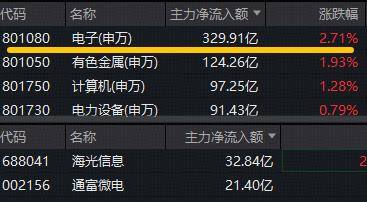
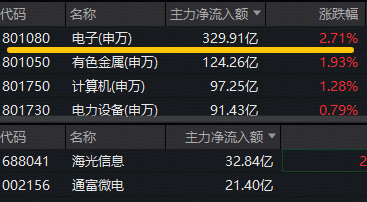
Core Viewpoint - The electronic sector is leading the market with a net inflow of over 32 billion yuan, making it the top industry in terms of capital absorption among 31 sectors [1][2]. Group 1: Market Performance - The electronic sector (Shenwan) has a net inflow of 329.91 billion yuan, significantly higher than other sectors such as non-ferrous metals (124.26 billion yuan) and computers (97.25 billion yuan) [2]. - Key stocks in the electronic ETF (515260) include Haiguang Information, Zhongke Shuguang, Tongfu Microelectronics, and SMIC, which attracted 32.83 billion yuan, 21.90 billion yuan, 21.42 billion yuan, and 20.29 billion yuan respectively, ranking them in the top four for capital absorption in A-shares [1][2]. Group 2: Stock Performance - Notable stock performances include Longxin Zhongke with a 20% increase, Haiguang Information up by 15.25%, and Tongfu Microelectronics rising by 10% [4][5]. - Other significant gainers include Lanke Technology (9.10%), Zhaoyi Innovation (7.01%), and Xinyuan Technology (6.29%) [5]. Group 3: Industry Trends - TSMC is expanding its advanced packaging capacity to meet the demand for 2nm chips for Apple's upcoming products, which is expected to enhance the supply chain [6]. - The electronic ETF (515260) has a significant weight of 46.31% in the Apple supply chain, indicating strong ties to future innovations such as foldable screens and AI functionalities [6]. - The demand for AI computing power is driving a surge in the storage chip market, with prices for certain chips expected to increase dramatically by 1800% for DDR4 16Gb and 500% for DDR5 16Gb by 2025 [6]. Group 4: Investment Tools - The electronic ETF (515260) and its linked funds provide a passive investment option tracking the electronic 50 index, focusing on semiconductor and consumer electronics sectors [7]. - The ETF includes major stocks like Luxshare Precision, Cambricon, and Industrial Fulian, making it an efficient tool for gaining exposure to core assets in the electronic sector [7].


台积电为应对苹果需求,积极扩张先进封装产能!果链含量46%的电子ETF(515260)反包大涨3.4%!龙芯中科涨停
Xin Lang Cai Jing· 2026-01-21 03:15
Group 1 - The electronic sector leads the market with a net inflow of over 32 billion yuan, ranking first among 31 Shenwan primary industries [1][9] - Major stocks in the electronic ETF (515260) such as Haiguang Information, Zhongke Shuguang, Tongfu Microelectronics, and SMIC attracted significant capital inflows of 3.283 billion, 2.190 billion, 2.142 billion, and 2.029 billion yuan respectively, dominating the A-share inflow rankings [1][9] - The electronic ETF's price increased by 2.99% during trading, indicating a potential upward trend [2][11] Group 2 - TSMC is expanding its advanced packaging capacity to meet the demand for 2nm chips for Apple's upcoming iPhone 18 and foldable devices, transitioning from InFO to WMCM architecture to enhance heat dissipation and AI performance [4][12] - The electronic ETF (515260) has a significant weight of 46.31% in the Apple supply chain, with expectations for new product launches in 2026, including foldable screens and smart glasses, which will drive demand for high-end components [5][13] - The storage chip market is experiencing a strong surge due to explosive growth in global AI computing power, with prices for certain chips expected to increase dramatically by 1800% for DDR4 16Gb and 500% for DDR5 16Gb by 2025 [6][13] Group 3 - Key stocks in the electronic sector such as Longxin Zhongke and Tongfu Microelectronics reached their daily limit, while Haiguang Information rose over 15%, and other stocks like Lanke Technology and Zhaoyi Innovation also saw significant gains [14] - The electronic ETF and its linked funds are designed to passively track the electronic 50 index, focusing on semiconductor and consumer electronics industries, including AI chips, automotive electronics, and 5G [15]

近9日净流入超94亿元,电网设备ETF(159326)规模连创新高,盘中再度翻红
Mei Ri Jing Ji Xin Wen· 2026-01-21 02:37
Group 1 - The A-share market saw all three major indices rise collectively, with the electric grid equipment sector experiencing significant gains, particularly the electric grid equipment ETF (159326), which recorded a trading volume of 1.11 billion yuan and saw stocks like Rongdian Electric and Hancable hit the daily limit [1] - The electric grid equipment ETF has attracted substantial capital inflow, with a net inflow of over 9.4 billion yuan over the past nine trading days, reaching a total scale of 14.506 billion yuan, marking a record high since its inception [1] - The State Grid announced that fixed asset investment during the 14th Five-Year Plan period is expected to reach 4 trillion yuan, a 40% increase compared to the previous plan, indicating strong support for the electric grid equipment industry's growth [1] Group 2 - The electric grid equipment ETF is the only one tracking the CSI Electric Grid Equipment Theme Index, with a strong representation in sectors such as transmission and transformation equipment, grid automation equipment, and cable components, where smart grid and ultra-high voltage equipment have the highest weightings in the market [2] - The green electricity ETF (562550) is the largest in scale, tracking the CSI Green Power Index, which includes clean energy companies as well as traditional energy sources like thermal and nuclear power [2]
科创人工智能ETF华夏(589010)开盘冲高,震荡上行
Mei Ri Jing Ji Xin Wen· 2026-01-21 02:31
Group 1 - The core viewpoint of the news highlights the strong performance of the Huaxia Sci-Tech AI ETF (589010), which saw a peak increase of 2.68% and a current price of 1.608 yuan, reflecting a 2.61% rise from the opening price [1] - The ETF tracks 30 constituent stocks, with over 20 showing gains, led by Lanke Technology with a 9.73% increase, indicating a positive trend in the AI sector [1] - The trading volume for the ETF reached 72.4 million yuan, with a turnover rate of 2.77%, suggesting high liquidity and active trading [1] Group 2 - Citic Securities expresses optimism about the AI computing power sector, noting that the demand for computing power remains strong as AI large models continue to evolve [2] - The report emphasizes the importance of both North American and domestic supply chains, highlighting the recent adjustments in domestic companies and the potential acceleration of AI infrastructure deployment due to improved domestic GPU capabilities [2] - The Huaxia Sci-Tech AI ETF closely tracks the Shanghai Stock Exchange Sci-Tech Innovation Board AI Index, covering high-quality enterprises across the entire industry chain, benefiting from high R&D investment and policy support [2]
【点金互动易】AI算力+服务器散热,这家公司高精密铜排已应用于全球顶级GPU散热方案中,液冷铜管批量供货头部企业算力服务器
财联社· 2026-01-21 00:54
Group 1 - The article emphasizes the importance of timely and professional insights in investment analysis, focusing on extracting investment value from significant events and analyzing industry chain companies [1] - A company specializing in high-precision copper bars has successfully applied its products in top global GPU cooling solutions, supplying liquid-cooled copper pipes in bulk to leading enterprises in the computing server market [1] - In the AI and gaming sector, AI tools have penetrated the entire business operation chain, with a company achieving a notable milestone by ranking fourth globally in gaming revenue [1]

“4万亿”在路上,电网投资站上强劲风口丨每日研选
Shang Hai Zheng Quan Bao· 2026-01-21 00:39
Group 1 - The core investment plan of the State Grid for the "14th Five-Year Plan" period is set at 4 trillion yuan, representing a significant increase of 40% compared to the previous plan, establishing a high-growth outlook for domestic grid construction [1] - The investment plan indicates an implied annual compound growth rate (CAGR) of approximately 7% from a baseline of 650 billion yuan in 2025, consistent with the previous plan's growth rate of 7.1%, suggesting a shift from stabilizing growth to accelerating the construction of a new power system [1][2] - The demand for high-voltage direct current (HVDC) and alternating current (AC) projects is at a high level, with core equipment manufacturers expected to benefit significantly from this trend [2] Group 2 - The joint guidance from the National Development and Reform Commission and the National Energy Administration emphasizes proactive grid investment, providing clear top-level design and policy support for the industry's long-term development [2] - AI data centers are becoming a new variable driving global grid investment, with their high power and reliability requirements exacerbating the electricity shortage in North America and creating new demand for supporting power equipment [2] - Domestic companies have strong cost and delivery advantages in transformers, switches, and smart meters, positioning them to capture a larger share of the overseas grid investment cycle [3]
公募基金抢筹电力设备股
Zhong Guo Dian Li Bao· 2026-01-20 13:28
Group 1 - The core viewpoint is that several leading public funds are shifting their investments towards the power equipment sector, with companies like Jerry Holdings, Guoguang Electric, and Dongfang Electric becoming key holdings [1] - The smart distribution segment is highlighted as a major focus for public funds, with intensive research conducted on quality stocks in the power equipment sector regarding technological barriers, capacity planning, and overseas market expansion [1] - Fund managers believe that energy and power are essential foundations for AI computing power, indicating that investments in power equipment are necessary to complement the AI industry chain [1] Group 2 - The industry is expected to enter a high prosperity cycle due to a combination of policy, demand, and technology, driven by the State Grid's 4 trillion yuan investment and the anticipated growth in power equipment exports in 2026 [2] - Key areas for investors to focus on include ultra-high voltage, flexible DC, and digital microgrids, with an emphasis on selecting companies that can leverage both domestic investment benefits and overseas market opportunities [2]

芯碁微装订单需求旺盛 2025年净利同比预增71.13%至83.58%
Zheng Quan Shi Bao Wang· 2026-01-20 12:19
Core Viewpoint - Chipbond Microelectronics (芯碁微装) expects a significant increase in net profit for 2025, driven by advancements in high-end PCB and semiconductor sectors [1][2] Financial Performance - The company forecasts a net profit of 275 million to 295 million yuan for 2025, representing a year-on-year growth of 71.13% to 83.58% [1] - The non-recurring net profit is expected to be between 264 million and 284 million yuan, with a growth rate of 77.7% to 91.16% [1] - In Q4 2025, the single-quarter net profit is projected to be between 76.19 million and 96.19 million yuan, showing a year-on-year increase of 12.56 to 16.12 times [1] Market Performance - Since the beginning of 2025, Chipbond Microelectronics' stock price has risen over 190%, closing at 167.62 yuan per share, with a market capitalization of 22.1 billion yuan [2] Business Growth Drivers - The growth is attributed to the company's breakthroughs in high-end PCB and semiconductor fields, with strong demand for high-layer and high-density technology [2] - The company has seen high capacity utilization rates and has received significant orders for its high-precision CO2 laser drilling equipment from leading clients [2] - In the semiconductor sector, the company has secured repeat orders for advanced packaging and board-level packaging equipment, contributing to new growth momentum [2] Product Development - Chipbond Microelectronics has launched its WLP series products, which have helped leading advanced packaging manufacturers achieve mass production of CoWoS-L products, with orders exceeding 100 million yuan [2] Industry Position - As a leader in direct imaging equipment, the company’s products cover various lithography processes from microns to nanometers [3] - The surge in global AI computing demand has accelerated the upgrade and production increase in high-layer PCBs and high-end HDI industries, leading to a significant increase in orders [3] - The company has initiated the construction of a second-phase facility to enhance delivery capacity for high-end direct imaging equipment, addressing the growing demand in AI servers, smart driving, and Mini/Micro-LED sectors [3] Global Strategy - Chipbond Microelectronics is advancing its globalization strategy, exporting equipment to regions including Thailand, Vietnam, Japan, South Korea, and Australia [3] - A subsidiary has been established in Thailand to serve as an operational hub for Southeast Asia, capitalizing on the local PCB industry's growth [3] Future Plans - The company is planning to issue H-shares and list on the Hong Kong Stock Exchange, with the process currently underway [4] - Future business plans focus on upgrading high-end equipment, penetrating multiple application scenarios, and enhancing international competitiveness through localized service networks [4]

上银基金卢扬:2026年有色金属板块投资注重估值、结构、稀缺三条主线
Zhong Zheng Wang· 2026-01-20 11:40
Group 1 - The core viewpoint of the articles highlights the strong performance of the metals sector, particularly gold and silver, which have reached new highs, making the sector a market focus since 2025, with a reported increase of over 90% in 2025 and over 12% in early 2026 [1][2] - The valuation of the non-ferrous metals sector is considered reasonable, with most companies trading at a PE ratio of around 10-12 times, which is lower than historical averages compared to other high-valuation sectors [1][2] - The fund managed by the company has achieved a return of over 90% since its inception in March 2025, significantly outperforming its benchmark by 34.47 percentage points [2] Group 2 - The investment outlook for the non-ferrous metals sector is positive, with a focus on metals linked to new demands such as copper, aluminum, and lithium, which are associated with renewable energy, AI computing power, and grid investments [2][3] - The investment strategy will emphasize three key themes: valuation, structure, and scarcity, with a close watch on the valuation levels of listed companies in 2026 and a focus on selecting companies with strong supply dynamics and robust downstream demand [3] - The scarcity of metals is highlighted as a significant factor for sustained price increases, as releasing supply requires substantial capital expenditure and time, making certain metals valuable for long-term investment [3]
兴业证券:A股业绩预告即将进入披露高峰 关注哪些方向?
智通财经网· 2026-01-20 10:56
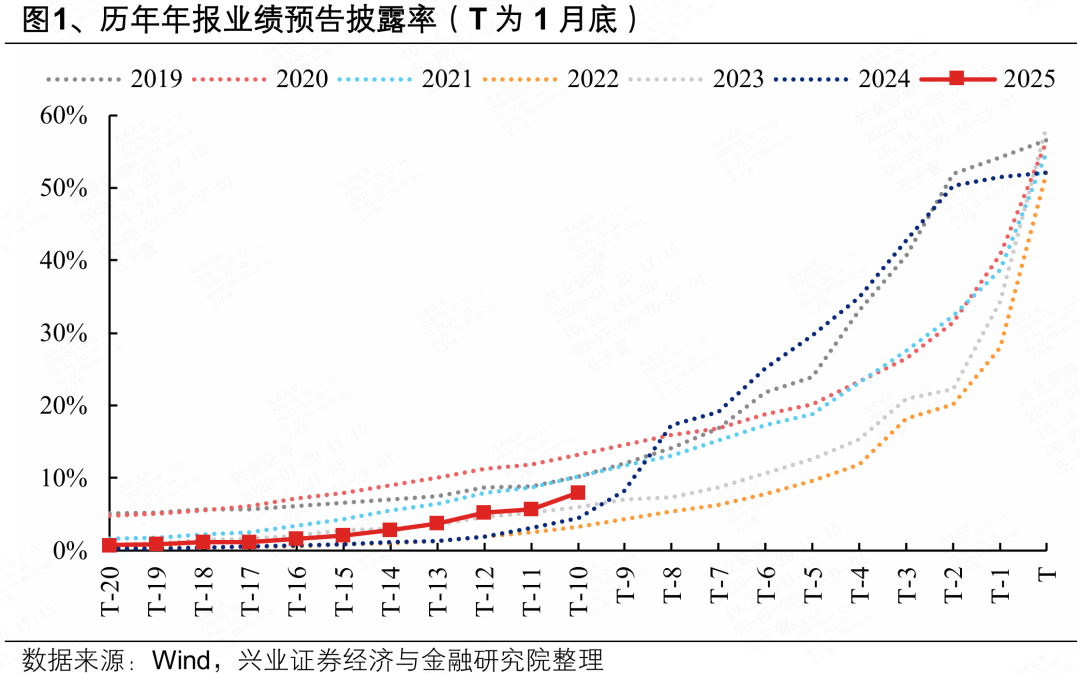
Core Viewpoint - As of January 19, the disclosure rate of annual performance forecasts for A-shares is 7.98%, with a peak expected in late January, where the final disclosure rate may reach around 55% [2][5]. Group 1: Performance Forecasts - The performance forecasts indicate that companies with significant net profit growth are primarily in sectors such as computing power, new energy, chemicals, pharmaceuticals, non-ferrous metals, and computers [6][10]. - By January 19, 447 A-share companies have released annual performance forecasts, with 144 companies expecting net profit growth exceeding 50%, mainly in computing power (semiconductors, communication equipment), new energy (batteries, photovoltaics), and chemicals [6][10]. Group 2: Market Reactions - As the performance forecasts enter their peak disclosure period, the correlation between stock prices and performance is expected to increase significantly in the latter half of January, with market sentiment returning to rationality [5]. - The market is likely to undergo a structural adjustment based on fundamentals, with previous hot sectors facing performance validation, while some low-performing but high-quality sectors may attract new capital inflows [5]. Group 3: Industry Insights - The sectors with upward revisions in profit forecasts since November include technology (especially in upstream computing hardware and downstream applications like consumer electronics and software), advanced manufacturing (new energy, military, automotive), and cyclical industries (building materials, non-ferrous metals, coal, steel) [12][13]. - The industries with lower performance growth since the last market rally include AI computing power, new energy, pharmaceuticals, and cyclical sectors like steel and glass fiber [14].