现房销售

Search documents
北大教授姚洋预测未来中国楼市走势,若无意外,或大概率是对的
Sou Hu Cai Jing· 2025-06-25 15:23
Group 1 - The Chinese real estate market has long been troubled by high housing prices, the pre-sale system, and shared area issues, with the pre-sale system being particularly criticized for leading to unfinished buildings and poor quality, causing significant economic risks for buyers and damaging market confidence [1][3] - The pre-sale system was introduced in the 1990s to stimulate development and meet housing demand, but its drawbacks have become increasingly apparent, prompting the Ministry of Housing and Urban-Rural Development to propose the concept of "selling existing houses" in early 2023, with several cities initiating pilot programs [3][5] - Many industry experts, including Peking University professor Yao Yang, believe that now is an opportune time to abolish the pre-sale system, arguing that buyers' lack of confidence presents a chance to guide the market towards healthier development [3][5] Group 2 - Opponents of abolishing the pre-sale system express concerns that it may restrict financing channels for developers, potentially leading to bankruptcies among small and medium-sized developers and a significant reduction in the supply of new homes, which could drive up housing prices [5] - However, the argument for abolishing the pre-sale system is strong, as it could effectively prevent unfinished buildings and protect buyers' rights, allowing them to inspect properties before purchase, thereby compelling developers to improve construction quality [5] - Current data from the Ministry of Housing indicates that China has over 600 million existing housing units, which is sufficient to meet the needs of its 1.4 billion population, suggesting that abolishing the pre-sale system could promote healthier market development and enhance buyers' living experiences and market confidence [5]

房地产行业最新观点及25年1-5月数据深度解读:销量同比震荡回落,新开工同比负增长收窄-20250622
CMS· 2025-06-22 11:01
Investment Rating - The report maintains a recommendation for the real estate sector, indicating that the sector has entered an investment range with a price-to-book (PB) ratio of approximately 1.0 times, reflecting concerns about the impact of current sales on business models [2][38]. Core Insights - The real estate market is experiencing a low-level oscillation in sales, with a year-on-year decline in new housing sales area of -3.3% in May, indicating continued pressure on sales due to weak inventory and new supply trends [14][15]. - The report highlights that the funding chain index for real estate has declined, remaining at historically low levels, but anticipates potential improvements in the financial situation of some companies as supply and demand policies gradually take effect [2][10]. - The report suggests that the decline in mortgage rates may help stabilize total demand for new and second-hand homes, with a focus on the new housing market showing earlier signs of marginal improvement compared to the second-hand market [38]. Summary by Sections Sales Data - In May, the adjusted year-on-year growth rate for sales area was -3.3%, with a total sales area of 35.3 million square meters, reflecting a continued low market heat [14][15]. - The cumulative sales amount from January to May was 3.4 trillion yuan, with a year-on-year decline of -3.8% [10][15]. Construction Data - The new construction area in May saw a year-on-year decline of -19.3%, indicating a tightening balance in new construction under the current market conditions [39][40]. - The report maintains that the completion rate will likely remain low until the second half of 2026, with a May completion area decline of -19.5% year-on-year [39][40]. Investment Trends - Real estate development investment in May showed a year-on-year decline of -12.0%, reflecting a synchronized drop in construction area and ongoing inventory reduction efforts by developers [2][39]. - The report emphasizes the importance of focusing on companies with stable cash flow generation capabilities and those that can navigate the current market challenges effectively [38].





房地产行业2025年5月月报:5月新房成交同比降幅收窄,二手房成交动能持续转弱,土拍溢价率持续回落-20250617
Bank of China Securities· 2025-06-17 08:23
Investment Rating - The report rates the real estate industry as "Outperforming the Market" [1] Core Viewpoints - New home sales in May showed a month-on-month increase, with a narrowing year-on-year decline. The total new home sales area in 40 cities reached 10.414 million square meters, up 12.4% month-on-month but down 3.2% year-on-year, with the year-on-year decline narrowing by 5.6 percentage points compared to April [12][15] - The second-hand housing market showed weakening momentum, with a month-on-month decline in transaction volume and a narrowing year-on-year growth rate. The total transaction area for second-hand homes in 18 cities was 8.104 million square meters, down 15.9% month-on-month but up 3.6% year-on-year, with the year-on-year growth rate narrowing by 8.7 percentage points [20][24] - The land market continues to exhibit a "quality over quantity" trend, with a decrease in transaction volume but an increase in average land prices. The average land premium rate in May was 4.6%, down 3.6 percentage points month-on-month but up 2.3 percentage points year-on-year [11][19] Summary by Sections New Home Sales - In May, new home sales area increased month-on-month and the year-on-year decline narrowed. The total area sold in 40 cities was 10.414 million square meters, with a cumulative year-on-year growth of 1.1% for the first five months [12][15] - First-tier cities saw a month-on-month increase of 14.9% and a year-on-year increase of 10.7%. Notably, Beijing's sales increased by 22% year-on-year, while Shenzhen experienced a decline [13][18] Second-Hand Home Sales - The second-hand home market showed a month-on-month decline in sales, with a year-on-year growth rate narrowing. The total area sold in 18 cities was 8.104 million square meters, with a cumulative year-on-year growth of 19.1% for the first five months [20][24] - First and second-tier cities experienced a decrease in transaction volume, while third and fourth-tier cities saw a shift from positive to negative year-on-year growth [21][25] Land Market - The land market showed a decrease in transaction volume but an increase in average land prices. The average land premium rate was 4.6%, indicating a continued trend of "quality over quantity" [11][19] - The total land transaction area in May was 17.1148 million square meters, with a month-on-month increase of 9.8% but a year-on-year decrease of 2.7% [19] Real Estate Companies - The top 100 real estate companies saw a year-on-year sales decline of 11.1% in May, with a cumulative decline of 8.4% for the first five months [35] - The land acquisition amount for the top 100 companies decreased month-on-month, with a total acquisition amount of 70.6 billion yuan in May, down 47.4% month-on-month [39] Policy Support - Multiple financial support policies for the housing market were implemented, including a 0.5 percentage point reduction in the reserve requirement ratio and a 0.1 percentage point reduction in policy interest rates [4][5] - The government aims to stabilize the real estate market and enhance financing mechanisms to support housing demand [4][5] Market Performance - The real estate sector underperformed compared to the CSI 300 index in May, with an absolute return of -0.4% and a relative return of -2.3% [47][48] - The report suggests that the market is still in a phase of adjustment, with ongoing efforts needed to restore confidence and improve supply-demand relationships [4][5]


今年房价利好基本出完,如果没有意外,房地产市场将迎来5大变化
Sou Hu Cai Jing· 2025-06-17 05:46
Core Viewpoint - The real estate market in China is experiencing a series of favorable policies aimed at stimulating demand and improving accessibility for potential homebuyers as 2024 approaches, with expectations for significant trends in 2025 [2] Group 1: Policy Changes - Most cities in China have lifted purchase restrictions, allowing more potential buyers to enter the market, except for core areas in first-tier cities like Shanghai and Shenzhen [2] - Financial policies remain accommodative, with mortgage rates dropping to around 3.2%, and down payment ratios reduced from 30% to 15%, effectively lowering the barriers to homeownership [2] - The government has implemented tax relief measures, including reductions in deed tax and value-added tax, to alleviate the financial burden on homebuyers [2] Group 2: Market Trends for 2025 - The market is shifting towards the sale of completed homes, moving away from the pre-sale model, which will enhance buyer confidence and impose higher standards on developers regarding financial strength and project quality [4] - The second-hand housing market is facing significant challenges, with listing volumes in major cities like Shanghai, Chongqing, and Chengdu exceeding 150,000 units, leading to price reductions as sellers seek to close deals amid weak demand [4] - The government aims to provide 6 million units of affordable housing over the next five years, which is expected to ease housing pressure for low-income groups and divert some demand from the commercial housing market [4] Group 3: Financial Outlook - Current mortgage rates are in the range of 3.2% to 3.5%, with predictions that they may drop below 3% in 2025 to stimulate demand amid a declining market [6] - The overall trend for housing prices is expected to be "stable with a downward bias," as the market has entered a long-term adjustment phase, with significant price drops observed in cities like Zhengzhou and Tianjin [8] - For instance, in Shanghai, prices have decreased from nearly 100,000 yuan per square meter to approximately 65,000 yuan per square meter, reflecting a decline of over 30% [8]
现房销售的政策路径与潜在影响
Changjiang Securities· 2025-06-09 23:30
Investment Rating - The investment rating for the real estate industry is "Positive" and maintained [12] Core Insights - The focus on ensuring the delivery of homes has made the sale of completed properties a key task, leading to accelerated promotion of this sales model in 2023. Central and local governments are progressively implementing pilot programs for completed property sales, with a high likelihood of gradual implementation and supportive policies [2][7] - The transition to completed property sales is expected to decrease project turnover rates and pressure profit margins, resulting in a significant short-term decline in sales scale for real estate companies. Maintaining sales scale will require additional financing, leading to a substantial reduction in the industry's financial attributes and an increase in manufacturing attributes. This shift will demand higher capabilities in land assessment and product quality from companies, benefiting those with the ability to generate excess cash flow and potentially increasing industry concentration [10] Policy Path - The policy path for completed property sales has evolved from suppressing overheating to preventing risks. The transition has been marked by pilot programs in various cities since 2014, which were largely paused except for Hainan. With the emphasis on ensuring home delivery, completed property sales are being accelerated again in 2023, with conditions set for their implementation [7][21] Project Analysis - Transitioning from pre-sale to completed sale models can significantly impact financial metrics. For instance, net profit margins may drop from 11.4% to 8.6%, and the internal rate of return (IRR) could decrease from 17.3% to 6.4%. The time to achieve positive cash flow may extend from 20 months to 34 months under the completed sales model [8][9] - The impact of completed sales is less severe in scenarios with higher land-to-value ratios or stricter pre-sale conditions. For example, if the land-to-value ratio increases from 1.8 to 2.0, the net profit margin and IRR would be less affected [9][10] Potential Impacts - The implementation of completed property sales is expected to lead to a decline in sales scale for real estate companies, with new land acquisitions unable to generate supply, relying instead on historical inventory. This will necessitate more financing to maintain sales levels in the medium to long term. Cities with lower inventory levels will be more affected, while those with higher inventory may transition more smoothly [10]
各地积极探索推进现房销售
Jing Ji Ri Bao· 2025-06-08 22:10
Core Viewpoint - The recent policy from the Housing and Urban-Rural Development Bureau of Xinyang, Henan Province, mandates that all newly developed commercial housing must be sold as completed properties, reigniting discussions on the implications and challenges of "existing house sales" in the real estate market [1][2]. Policy Developments - Existing house sales refer to the sale of properties that have been completed and meet legal delivery conditions, allowing buyers to occupy and register ownership immediately after the transaction [1]. - Since the end of 2022, various regions in China have been implementing policies to promote existing house sales, with notable examples in Anhui and Hubei where pilot projects have seen high sales rates [2]. - Xinyang's new policy is the first to comprehensively implement existing house sales in a city, distinguishing between new and old projects regarding pre-sale permissions [2]. Market Dynamics - The shift towards existing house sales is driven by the need to mitigate risks, reduce inventory, and control supply in the real estate market [2][4]. - The proportion of existing house sales in new housing has been steadily increasing, reaching 36% in the first quarter of this year [5]. - The transition to existing house sales is seen as a necessary evolution towards a more mature and stable real estate market that prioritizes risk control and buyer protection [3][6]. Industry Implications - Existing house sales require developers to invest fully in projects before recovering funds, increasing financial and time costs compared to pre-sale models [3]. - The focus on existing house sales is expected to enhance product quality as developers strive to attract buyers, thereby improving overall market standards [4]. - The current trend indicates a gradual coexistence of existing and pre-sale models, with existing house sales likely to dominate in the future [6][7]. Global Context - The global real estate market exhibits diverse sales models, with a common trend towards stricter regulation of pre-sale activities and enhanced buyer protection [7]. - The evolution of the real estate market in China reflects a broader movement towards ensuring safer transactions and better meeting housing demands through improved regulatory frameworks [7].
房地产板块最新观点:主要房企估值或已进入投资区间-20250608
CMS· 2025-06-08 12:03
Investment Rating - The report maintains a "Recommended" rating for the real estate sector, indicating a positive outlook for the industry based on fundamental improvements and valuation levels [4]. Core Insights - Recent market focus has shifted towards new real estate development models, particularly regarding current housing sales and loan management policies, which are expected to be implemented gradually rather than through a one-size-fits-all approach [2][3]. - The current valuation levels of major real estate companies are approaching the pre-rebound levels seen in April and September of the previous year, suggesting that the sector may be entering an investment zone [6][12]. - The adjusted price-to-book (PB) ratio for the sector is approximately 1.0, while the average adjusted PB for the top five companies in terms of sales is around 0.7, further supporting the notion that the sector's investment attributes are becoming more pronounced [8][12]. Summary by Sections Market Trends - The focus on current housing sales and loan management policies has led to a cautious sentiment among investors, which is reflected in stock prices [2]. - The gradual implementation of policies is expected to enhance the competitive landscape for high-quality companies within the industry, thereby increasing entry barriers [3]. Valuation Analysis - The current PB levels for major real estate firms are near the lower bounds of the past five years, indicating a potential for upward valuation adjustments [6][9]. - The report emphasizes that investments should be made when valuations are within a reasonable range, highlighting the increasing value of the real estate sector as it approaches these levels [12]. Investment Recommendations - The report suggests focusing on companies with a strong track record of cash flow generation and stable performance, such as China Overseas Development and Poly Development, as well as those with high dividend yields and stable earnings like China Resources Land [13]. - The potential for valuation recovery exists for companies like Gemdale and Longfor Group, especially as market volatility decreases and interest rates stabilize [13].
现房销售的海南经验
Changjiang Securities· 2025-06-06 12:52
丨证券研究报告丨 %% %% %% %% 行业研究丨专题报告丨房地产 [Table_Title] 现房销售的海南经验 报告要点 [Table_Summary] 海南 2020 年 3 月首推"现房销售",至今已超过 5 年,是观察现房销售影响的一个参照系。得 益于库存充足和市场上行,现房制度对海南市场的短期影响相对可控;微观层面,执行现房销 售使得开盘周期延长一年甚至以上,明显降低资金周转效率;尽管现房销售拖累周转速度,但 通过地价让利和其他配套支持,项目在利润率层面获得补偿。边际角度,高地价、严预售的城 市受影响更小,以及具备融资和产品优势的房企更具备抵抗力。 分析师及联系人 [Table_Author] 刘义 侯兆熔 SAC:S0490520040001 SAC:S0490525060001 SFC:BUV416 请阅读最后评级说明和重要声明 research.95579.com 1 [Table_Title2] 现房销售的海南经验 [Table_Summary2] 海南执行现房销售已超过五年 海南 2018 年 4 月实施"全域限购",2020 年 3 月首推"现房销售"。海南房地产市场在 2010 年 ...

5月百强房企销售数据及端午假期楼市解读
2025-06-06 02:37
Summary of the Conference Call on Real Estate Market Industry Overview - The conference call focuses on the real estate industry, particularly the performance of top real estate companies in May and the implications of recent market trends and policies [1][2][3]. Key Points and Arguments Sales Performance - During the Dragon Boat Festival, the real estate market showed a lackluster performance, similar to an ordinary weekend, with a year-on-year decline [4]. - Over 80% of real estate companies experienced a year-on-year sales decline of 20% to 30% during the May Day holiday [5]. - In May, approximately 40 companies saw month-on-month sales improvements, with some companies like Greentown and China Overseas achieving increases exceeding 30% [7]. - The top ten real estate companies had a sales threshold of 43.3 billion yuan, with a year-on-year increase of 8% [3]. Regional Disparities - There is significant differentiation in market performance across regions, with core areas showing better absorption cycles compared to non-core and suburban areas, where absorption rates are generally below 50% [6]. - In Shanghai, the supply of new projects increased by nearly 50% year-on-year, leading to a 24% increase in transaction volume [6]. Market Trends - The market is showing a slight upward trend, driven by good absorption of new projects in core cities and a recovery in supply [8]. - High-quality residential projects are gaining attention, with new regulations being implemented to promote their development [9]. - The phenomenon of "daylight sales" (where new projects sell out on the first day) reflects strong demand for high-quality residential products [10]. Buyer Sentiment - Buyers still have expectations for quality properties, influenced by delivery expectations and price forecasts [13]. - The adjustment of down payment ratios has had a less significant effect than in the past, with buyers being cautious about leveraging [15]. - Interest rate adjustments have a high sensitivity among buyers, with the central bank lowering the Loan Prime Rate (LPR) to reduce monthly payment pressure [16]. Future Outlook - The year 2025 is anticipated to be a year of comprehensive restart, with ongoing adjustments and reforms in core cities [20]. - New construction projects are expected to continue to decline, with completion areas returning to levels seen 20 years ago [21]. - The overall investment in real estate development is projected to decrease, but the decline is expected to narrow [22]. Impact of New Housing Models - The promotion of current housing sales is gradually gaining traction, enhancing buyer confidence [14]. - The introduction of high-efficiency housing models is expected to impact the pricing of lower-efficiency second-hand homes [28]. Policy Implications - Current policies aim to stabilize the real estate market through measures such as housing inspections and insurance [30]. - The focus is on enhancing the attractiveness of new residential properties through reasonable pricing and quality service, which is expected to support overall market recovery [31]. Additional Important Insights - The differentiation between new and second-hand housing markets is primarily driven by supply and market expectations [26]. - The rental market remains stable, with some areas experiencing rent increases despite high listing volumes in the second-hand market [27]. - The overall sentiment indicates that while there are challenges, the market is moving towards stabilization and potential growth, particularly in high-quality segments [19].
【成交数据】超1100套!越城5月新房、二手房网签数据出炉,袍江成交翻倍!
Sou Hu Cai Jing· 2025-06-05 10:29
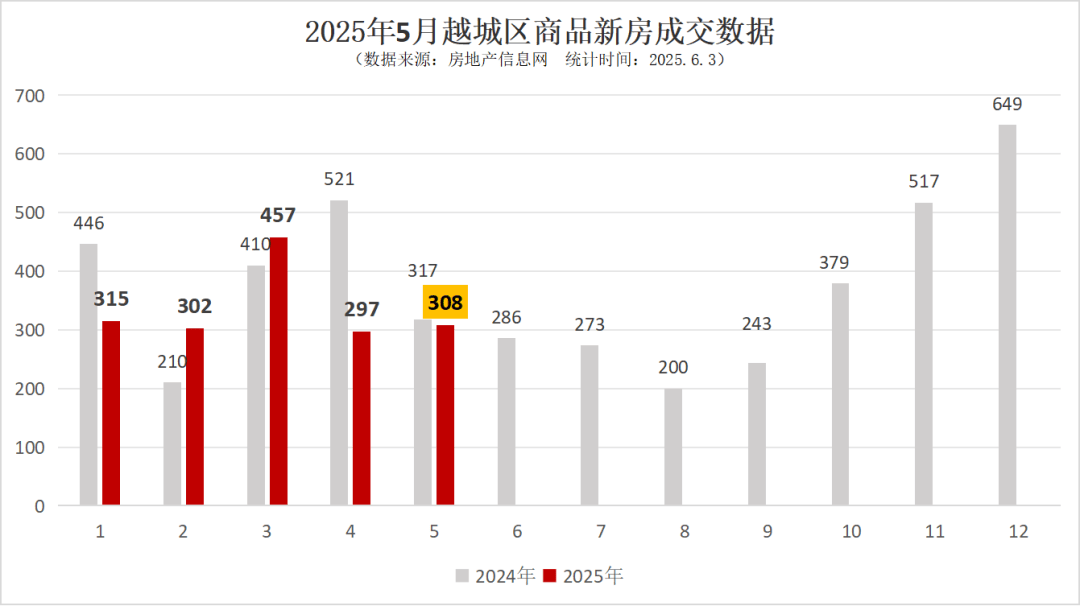
5月,越城区新建商品房成交308套,成交面积为37774.57平方米。 商品住宅成交278套,成交面积36018.69平方米; 商业物业成交11套,成交面积739.36平方米; 办公地产成交19套,成交面积1016.52平方米; | 2025年5月新手房成交情况 | | | | --- | --- | --- | | (信息来源:绍兴房地产信息网 制表时间:2025.6.4) | | | | 套数 | | 面积(m) | | 1 总体 | 308 | 37774.57 | | 、商品住宅 | 278 | 36018.69 | | 办公地产 | 19 | 1016.52 | | 商业物业 | 11 | 739.36 | | 主城区住宅 X | 48 | 6491.63 | | 镜湖住宅 | 167 | 22353.94 | | 袍汀住宅 | 63 | 7173.12 | 据绍兴市房地产信息网统计数据显示,越城区2025年5月新房+二手房共计成交1120套。 01. 新房 商品住宅成交中,主城区商品住宅成交48套,成交面积为6491.63平方米。 镜湖区域商品住宅成交167套,成交面积为22353.94平方米。 ...