
贸易战

Search documents
特朗普称将对进口铜征收50%关税,中方回应
财联社· 2025-07-10 07:25
Core Viewpoint - The article discusses the announcement by Trump to impose a 50% tariff on copper, highlighting the ongoing trade tensions and the stance of the Chinese government against such measures [1]. Group 1 - Trump announced a 50% tariff on copper on July 9 [1] - The Chinese government, represented by spokesperson Mao Ning, expressed a clear opposition to the broadening of national security concepts and emphasized that trade wars have no winners [1] - The Chinese stance indicates that excessive tariffs do not align with the interests of any party involved [1]


【外交部:美对铜加征关税不符合任何一方利益】当地时间7月9日,特朗普宣布对铜征50%关税。今天,中国外交部发言人毛宁对此表示:这个问题我们立场非常明确,我们一贯反对泛化国家安全概念,我们也始终认为关税战、贸易战没有赢家,滥施关税不符合任何一方的利益。(央视新闻)
news flash· 2025-07-10 07:19
【外交部:美对铜加征关税不符合任何一方利益】当地时间7月9日,特朗普宣布对铜征50%关税。今 天,中国外交部发言人毛宁对此表示:这个问题我们立场非常明确,我们一贯反对泛化国家安全概念, 我们也始终认为关税战、贸易战没有赢家,滥施关税不符合任何一方的利益。(央视新闻) ...
投行:澳元的涨幅可能会被贸易冲击迅速侵蚀
news flash· 2025-07-10 06:21
Core Viewpoint - The recent appreciation of the Australian dollar (AUD) against the US dollar (USD) may be quickly undermined by trade-related shocks, as indicated by the Australian Federal Bank's foreign exchange strategy head, Samara Hammoud [1] Exchange Rate Movement - The AUD/USD exchange rate has risen to 0.6540, compared to a level below 0.6000 a few months ago [1] - The implied volatility of this currency pair remains below its long-term average, suggesting that the financial market is underestimating the potential impact of significant tariff increases [1] Trade War Implications - Should trade war-related news directly affect Australia, the AUD/USD could potentially decline by two to four cents in the coming weeks [1]
中国能印度也能?莫迪突然吹响反击号角,轮到特朗普骑虎难下了
Sou Hu Cai Jing· 2025-07-10 06:18
Group 1 - India officially notified the WTO on July 4 about its plan to impose retaliatory tariffs on the US due to the impact of increased tariffs on auto and auto parts exports [1] - The US administration, led by President Trump, has shifted its approach to impose "across-the-board" tariffs without prior individual negotiations with countries, which has raised concerns among nations eager to reach trade agreements with the US [2][5] - The trade deficit between India and the US is significant, with India's exports to the US totaling $87.4 billion and US exports to India at $41.8 billion, resulting in a gap of $45.7 billion [2] Group 2 - The main contention in US-India trade negotiations revolves around India's reluctance to open its agricultural and dairy markets to US products, which is a critical issue for both economies [3][5] - India's agricultural sector is vital for its economy, and concessions in this area could lead to severe repercussions for small farmers and the dairy industry [3][5] - India is seeking lower tariffs from the US compared to those imposed on China, while also requesting the removal of tariffs on Indian-made electronics, but the US has refused to provide any exemptions [5] Group 3 - Indian Prime Minister Modi is determined to continue negotiations with the US, sending a delegation led by Rajesh Aggarwal to seek a mutually beneficial agreement [6] - Observers suggest that Modi may face disappointment, as the US's concessions to China were driven by specific economic needs that may not apply to India [6] - The ongoing trade conflict highlights the uncertainty in global trade dynamics, with India asserting its position against a "win-lose" partnership with the US [6][8]

关税战步步紧逼,特朗普屠刀砍向8国,鲍威尔再遭死亡点名!
Sou Hu Cai Jing· 2025-07-10 05:43
Group 1: Tariff Imposition - The Trump administration announced new tariffs on products from several countries, including a 50% tariff on all Brazilian products starting August 1, 2025, which exceeded market expectations [2] - Tariffs of 25% will be imposed on products from Brunei and Moldova, 30% on Algeria, Iraq, Libya, and Sri Lanka, and 20% on the Philippines [2] - The announcement led to a significant depreciation of the Brazilian real, with the USD/BRL exchange rate surpassing 5.60, reflecting a nearly 2.9% increase in the dollar's value [2] Group 2: International Reactions - Leaders from Japan and South Africa expressed regret and deemed the U.S. tariff actions as unreasonable, indicating a potential need for stronger countermeasures [3] - The European Union is preparing to respond to the U.S. tariffs, with ongoing disputes primarily focused on specific industries such as steel, automotive, and pharmaceuticals [3] - Analysts suggest that the trade war initiated by the Trump administration may accelerate a trend of "de-Americanization" as countries reassess their economic dependencies on the U.S. [3] Group 3: Federal Reserve Criticism - The Trump administration intensified criticism of Federal Reserve Chairman Jerome Powell, claiming that current interest rates are at least 3 percentage points too high [4] - If the Fed were to lower rates as Trump suggested, it would bring rates down to a range of 1.25%-1.50%, the lowest in three years [5] - The administration's criticism is linked to rising national debt levels due to the passage of the "Big and Beautiful" bill, prompting urgency in addressing interest rates [6]
大越期货沪铜早报-20250710
Da Yue Qi Huo· 2025-07-10 02:36
Report's Core View - The fundamentals of copper are neutral with smelting enterprises reducing production and the scrap copper policy being relaxed, and the manufacturing PMI remaining stable in June at 49.5%. The basis shows a premium for the spot over the futures, which is bullish. The inventory situation is neutral with an increase in copper inventory on July 9 and an increase in SHFE copper inventory from last week. The price is above the 20 - day moving average with the average trending upwards, which is bullish. However, the main positions are net short and the short positions are increasing, which is bearish. The market is expected to be volatile due to factors such as the slowdown of Fed rate - cuts, high - level inventory destocking, US trade tariff uncertainties, and geopolitical disturbances, including a 50% US copper tariff increase [2]. - The recent analysis of bullish and bearish factors involves domestic policy easing and the escalation of the trade war [3]. Industry Investment Rating - No industry investment rating is provided in the report. Summary by Relevant Directory Daily View - The fundamentals of copper are neutral; the basis is bullish; the inventory is neutral; the price trend on the disk is bullish; the main positions are bearish; and the market is expected to be volatile [2]. Recent Bullish and Bearish Analysis - Bullish and bearish factors involve domestic policy easing and the escalation of the trade war [3]. Spot - The report provides information on the location, mid - price, price change, inventory type, total quantity, and increase or decrease of copper spots, but specific data is not fully presented [6]. Exchange Inventory - On July 9, copper inventory increased by 4625 tons to 107125 tons, and SHFE copper inventory increased by 3039 tons from last week to 84589 tons [2]. Bonded Area Inventory - The bonded area inventory has rebounded from a low level [13]. Processing Fee - The processing fee has declined [15]. Supply - Demand Balance - The copper market is slightly in surplus in 2024 and in a tight balance in 2025. The report also provides a China annual supply - demand balance table for copper from 2018 - 2024 [19][21].
商品期货早班车-20250710
Zhao Shang Qi Huo· 2025-07-10 02:17
1. Report Industry Investment Ratings No industry investment ratings are provided in the report. 2. Core Views of the Report The report provides a comprehensive analysis of various commodity futures markets, including precious metals, base metals, black industry products, agricultural products, and energy chemicals. It offers market performance, fundamental analysis, and trading strategies for each sector, suggesting different approaches such as buying, selling, or holding based on the specific market conditions of each commodity [1][2][3]. 3. Summary by Related Catalogs Precious Metals - **Gold**: Prices are in high - level oscillation. China's central bank has increased gold holdings for 8 consecutive months. Suggest going long on gold due to the unchanged de - dollarization logic [1]. - **Silver**: It shows a rebound with good market sales recently. Long - term industrial silver demand is downward, so consider long - term short positions or going long on the gold - silver ratio [1]. Base Metals - **Copper**: Prices oscillated. Trump's tariff increase affected the market. It is recommended to wait for a full adjustment and then buy at low prices [2]. - **Aluminum**: The price of electrolytic aluminum is expected to oscillate. It is advised to wait and see due to macro uncertainties and a consumption off - season [2]. - **Alumina**: Prices may be strong in the short term. It is recommended to buy at low prices or purchase call options [2]. - **Industrial Silicon**: Short - term market sentiment is strong with high unilateral risks. It is recommended to wait and see [3]. - **Carbonate Lithium**: It is recommended to wait and see due to expected marginal improvement and industrial information disturbances [3]. Black Industry - **Rebar Steel**: Supply and demand are relatively balanced. It is recommended to wait and see and try a reverse spread [4]. - **Iron Ore**: Supply and demand are neutral. It is recommended to wait and see and layout long positions on the far - month coil - ore ratio [4][5]. - **Coking Coal**: Supply is relatively loose with improving fundamentals. It is recommended to wait and see [5]. Agricultural Products - **Soybean Meal**: Short - term US soybeans are in a range - bound oscillation. Domestic soybeans follow international cost - side trends [6]. - **Corn**: Futures prices are expected to oscillate within a range due to reduced surplus grain and wheat substitution [6]. - **Sugar**: Zhengzhou sugar 09 contract is expected to be weak and oscillate. It is recommended to short in the futures market, sell call options, or lock in prices for end - users [6]. - **Cotton**: It is recommended to wait and see and adopt a range - bound trading strategy [7]. - **Palm Oil**: It is expected to be strong in the short term with wide - range oscillations. Pay attention to production areas and bio - diesel policies [7]. - **Eggs**: Futures and spot prices are expected to oscillate due to high supply and cost support [7]. - **Pigs**: Futures prices are expected to oscillate and adjust due to increasing supply and weakening demand [7]. - **Apples**: It is recommended to wait and see, and the market is affected by weather [7]. Energy Chemicals - **LLDPE**: Short - term supply and demand improve. It is recommended to go short on far - month contracts in the long term [8][9]. - **PVC**: It is recommended to wait and see after gradually closing short positions [9]. - **PTA**: It is recommended to go long on PX, do a positive spread on PTA, and short processing fees in the long term [9]. - **Glass**: Fundamentals are weak. It is recommended to wait and see [9]. - **PP**: The short - term trend is weak and oscillating. It is recommended to go short on far - month contracts in the long term [9][10]. - **MEG**: It is expected to be weak. It is recommended to short at high prices [10]. - **Crude Oil**: The long - term trend is bearish. It is recommended to short at high prices and pay attention to inventory accumulation [10]. - **Styrene**: The short - term trend is weak and oscillating. It is recommended to go short on far - month contracts in the long term [10]. - **Soda Ash**: Fundamentals are weak. It is recommended to short at high prices [10][11].
【UNFX课堂】特朗普经济实验:高风险的政策赌注与经济迷途
Sou Hu Cai Jing· 2025-07-10 02:11
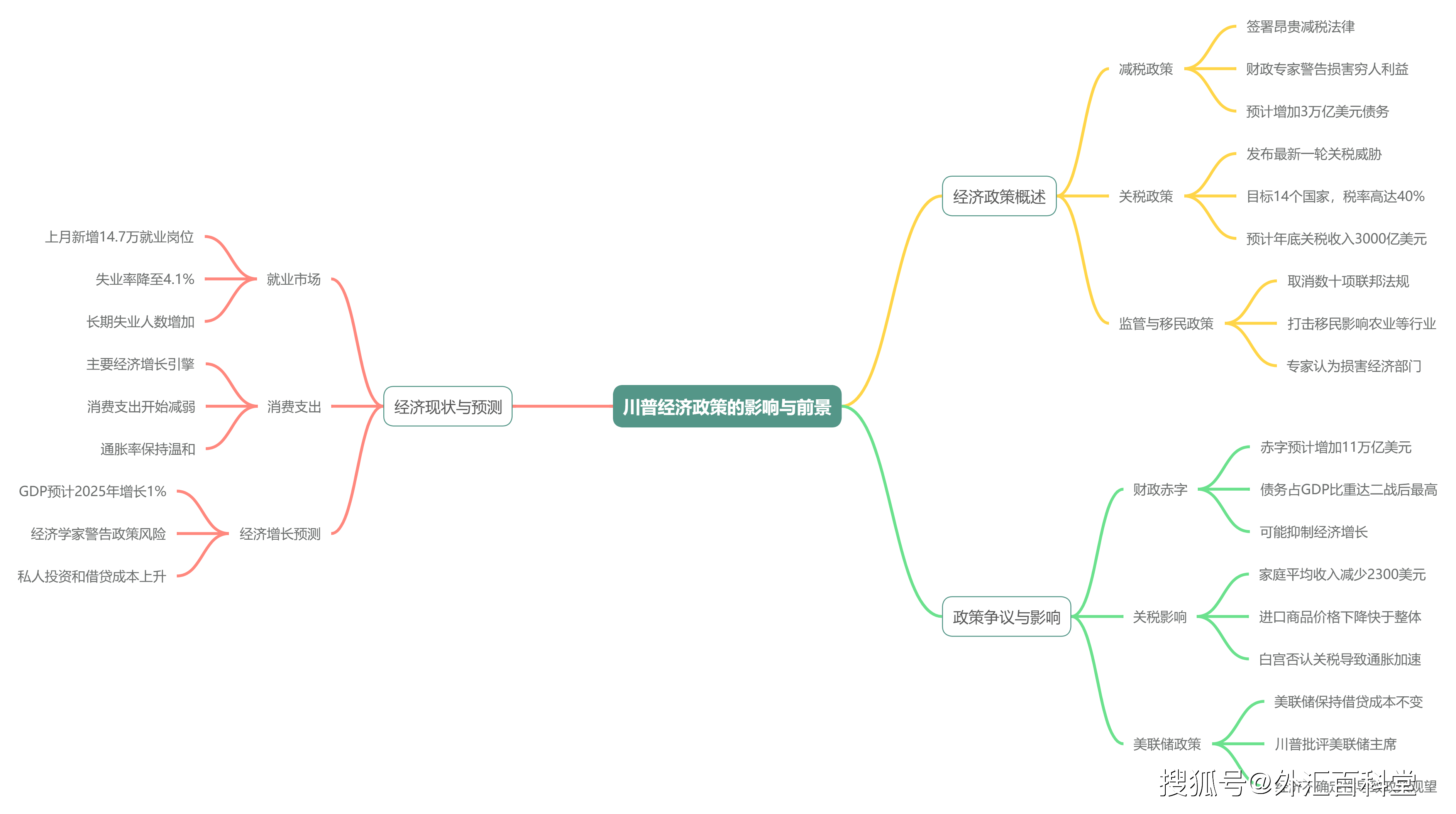
Core Policy Analysis - The large-scale tax cuts primarily benefit corporations and high-income individuals, with supporters arguing it will stimulate investment and economic growth, but concerns arise over the financing method, which involves significant cuts to social safety nets and an expected increase of over $3 trillion in national debt [3] - Mainstream economists warn that expanding the deficit on top of already high debt levels will raise borrowing costs, crowd out private investment, and potentially slow long-term economic growth, pushing the debt-to-GDP ratio to a post-World War II high, posing a serious test to fiscal sustainability [3] Tariff Policy - Tariffs are a central tool of Trump's "America First" trade policy, threatening to impose tariffs as high as 40% on multiple countries and expanding the scope to critical imports like pharmaceuticals and chips, aiming to force trade partners into favorable agreements and increase government revenue [5] - Economists generally agree that tariffs effectively act as a tax on domestic consumers, leading to higher import costs that will be passed on to end prices, exacerbating inflationary pressures and eroding consumer purchasing power, with estimates suggesting a potential decline in household income [5] - The tariff war disrupts global supply chains, harming domestic companies reliant on imported components or export markets, and may provoke retaliatory measures from trade partners, further damaging U.S. economic interests [5] Other Related Policies - In addition to fiscal and trade policies, deregulation and tightening immigration policies are also being implemented, which may lower costs for businesses in some areas but could introduce risks related to environmental, financial stability, or labor rights [7] - Large-scale deportations of immigrants, particularly in sectors like agriculture that rely heavily on immigrant labor, could lead to labor shortages, increased wage costs, and impact the stability of supply chains [7] Current Economic Conditions and Future Outlook - The current U.S. economy shows some resilience, but signs of potential pressure are emerging, such as changes in employment growth structure and weak consumer spending, with the full impact of these policies yet to be realized [8] - The Federal Reserve is maintaining interest rates while awaiting clear signals from this economic experiment, with President Trump positioning Fed Chair Powell as a potential scapegoat should economic data worsen [8] Conclusion - The Trump administration is rapidly reshaping the U.S. economic policy framework, based on a unique economic philosophy that believes tax cuts and trade protection can achieve extraordinary growth while downplaying mainstream economic warnings about fiscal imbalance and trade wars [9] - The coming months will be critical for assessing whether this high-risk economic experiment will yield the promised prosperity or lead to new economic challenges and turmoil, with the overall impact of policies, market reactions, and economic data collectively determining the outcome [10]
五矿期货农产品早报-20250710
Wu Kuang Qi Huo· 2025-07-10 02:06
五矿期货农产品早报 五矿期货农产品团队 从业资格号:F0273729 交易咨询号:Z0002942 邮箱:wangja@wkqh.cn 农产品早报 2025-07-10 杨泽元 美豆产区未来两周降雨偏好,覆盖大部分产区,天气有利。巴西方面,升贴水近期稳中小涨,叠加雷亚 尔升值,中美大豆关税仍未解除等支撑当地升贴水,对冲美豆跌幅。总体来看,大豆进口成本暂稳为主, 但也需要注意贸易战若缓和或宏观影响带来的超预期下跌。 【交易策略】 斯小伟 外盘大豆进口成本目前受估值偏低、EPA 政策利多及 9-1 月大豆由巴西单独供应影响震荡运行,总体大 豆或蛋白供应仍过剩。国内豆粕市场则处于低估值、短期高供应、下游提货积极、饲企库存天数中性偏 高但 9-1 月大豆采购因中美关税存在成本支撑局面。因此豆粕市场多空交织,建议在豆粕成本区间低位 逢低试多,高位关注榨利、供应压力,等待中美关税进展及供应端新的驱动为主。 油脂 【重要资讯】 白糖、棉花研究员 从业资格号:F03116327 交易咨询号:Z0019233 邮箱:yangzeyuan@wkqh.cn 油脂油料研究员 从业资格号:F03114441 交易咨询号:Z002249 ...
关税及美联储分歧推动?价反弹
Zhong Xin Qi Huo· 2025-07-10 01:10
投资咨询业务资格:证监许可【2012】669号 中信期货研究|贵⾦属策略⽇报 2025-7-10 关税及美联储分歧推动⾦价反弹 4)美国总统特朗普周二表示,美联储主席鲍威尔应立即辞职。 5)欧洲议会贸易委员会主席朗格(Bernd Lange)周三表示,欧盟可 能即将与美国达成贸易协议,但可能难以争取到立即减免关税和承诺 不出台新措施。 价格逻辑: 金价下破3300美元后反弹,主要因为美联储会议纪要显示美联储内部 对于经济前瞻存在分歧,特朗普公布新关税政策。 基本面上,美联储方面,6月会议纪要显示,政策制定者指出,对于 关税对通胀潜在影响的时间、规模和持续性存在"相当大的不确定 性"。由于关税在经济中的传导路径及贸易谈判的不同结果,官员们 对其通胀影响持不同观点。 关税方面,美国总统特朗普宣布将对12国加征25%-40%关税,并对所 有金砖国家商品额外征10%关税,尽管"对等关税"最后谈判期限延 至8月1日暂时支撑美元,但整体贸易战风险仍挥之不去。此外,自8 月1日起,美国将对菲律宾产品征收20%的关税,对文莱和摩尔多瓦征 25%关税,对阿尔及利亚、伊拉克、利比亚和斯里兰卡征30%关税。 特朗普公布的对巴西新征 ...