人民币国际化

Search documents
结算 “分钟办”、成本降30%,解码浙江外贸金融服务体系
2 1 Shi Ji Jing Ji Bao Dao· 2025-10-31 14:21
Core Insights - Financial support is crucial for the high-quality development of foreign trade in Zhejiang, a major province in China's foreign trade landscape [1] - The People's Bank of China (PBOC) Zhejiang Branch has introduced 17 targeted measures to stimulate foreign trade, focusing on areas such as foreign exchange, cross-border RMB, and digital finance [1][2] Financial Measures and Support - The PBOC Zhejiang Branch has implemented guidelines to support the comprehensive reform of international trade in Yiwu, enhancing the vitality of foreign trade through various financial services [1] - As of September, the loan balance for AEO (Authorized Economic Operator) enterprises in the province reached 185.4 billion yuan, with an increase of 19 billion yuan since the beginning of the year [1] - The bank has facilitated cross-border e-commerce by serving approximately 590,000 small and micro merchants, improving settlement efficiency by nearly 40% and reducing costs by over 30% [1] Cross-Border Trade Facilitation - The PBOC has included more "specialized, refined, and innovative" small and medium-sized enterprises in its facilitation policies, with 6,450 compliant enterprises registered [2] - A total of 2.5 million facilitation transactions have been processed, amounting to 350.7 billion USD, significantly saving processing time [2] - The establishment of dual channels for online and offline market procurement has led to a 17% year-on-year increase in dual convenience settlement, totaling 38.7 billion USD [2] RMB Internationalization - The cross-border RMB settlement volume reached nearly 2 trillion yuan in the first three quarters, with 1.3 trillion yuan related to current accounts and direct investments, ranking fourth nationally [3] - The cross-border RMB business has covered over 46,000 market entities, accounting for nearly 40% of the province's foreign trade enterprises [4] - The RMB settlement volume for cross-border e-commerce reached 319.79 billion yuan, with a year-on-year growth rate of 33.8% [4] Future Directions - The PBOC Zhejiang Branch aims to further enhance the role of cross-border RMB in facilitating trade and investment, promoting higher-level trade and investment facilitation pilot programs [5] - A three-year action plan has been introduced to optimize cross-border financial services in county areas, with 29 implementation measures [6] - The initiative includes the development of a WeChat mini-program for policy promotion and business consultation, enhancing service efficiency for foreign-related enterprises [6]
美国经济雪崩开始?180亿打水漂,政府损失惨重,对华影响超想象
Sou Hu Cai Jing· 2025-10-31 13:16
Economic Impact - The recent government shutdown resulted in an economic loss of $18 billion, with nearly half of this amount, approximately $9 billion, being irreversible [3][4][6] - The shutdown led to the suspension of federal employees and contractors, causing a direct halt in productivity and economic activity [4][6] - Government services such as visa approvals and trade regulations were interrupted, negatively impacting business operations and investment decisions [6][12] Consumer and Business Confidence - The uncertainty caused by the shutdown led to reduced consumer spending and investment, further exacerbating economic downturn pressures [6][12] - Small businesses and local economies, particularly those reliant on government contracts or nearby federal employees, experienced significant revenue declines during the shutdown [15][12] Data Collection and Policy Implications - The interruption of key economic data collection during the shutdown hindered the federal government and the Federal Reserve's ability to make informed policy decisions [7][9] - The inability to assess the current economic state accurately may lead to delayed or inappropriate monetary policy responses, worsening the economic situation [9][11] Long-term Consequences - The shutdown highlighted systemic governance issues within the U.S. political system, raising concerns about the stability of the country's credit rating and overall economic governance [11][19] - Frequent shutdowns could lead to a loss of trust among international investors, potentially affecting U.S. debt rates and the dollar's value [11][21]


专访AMRO首席经济学家何东:国际货币体系存在较大网络效应,数字货币兴起带来显著机遇
Sou Hu Cai Jing· 2025-10-31 11:07
Core Insights - The international monetary landscape is undergoing significant changes, with a trend towards diversification of non-dollar currencies and the rapid application of emerging technologies like blockchain in digital currency development [1][5][7] Group 1: International Monetary System - The process of "de-dollarization" is still under observation, but the evolution of the international monetary system presents opportunities for currencies like the Renminbi [1][6] - The weakening of the US dollar is attributed to multiple factors, including its overvaluation and concerns regarding the US fiscal situation, leading to a depreciation of approximately 10% compared to early 2025 [5][6] - Countries are not necessarily pursuing "de-dollarization" but are focusing on risk management strategies in response to the changing landscape [6] Group 2: Digital Currency and Blockchain - The rise of digital currencies offers significant opportunities in two main areas: financial inclusion and cross-border payments, potentially reducing costs through a unified blockchain network [7][8] - Blockchain technology can address issues of data independence among financial institutions, enhancing data portability and privacy [8] - The development of central bank digital currencies (CBDCs) is still in the exploratory phase, with varying strategies among developed and emerging markets [10] Group 3: ASEAN and Regional Cooperation - The ASEAN economies have experienced a slowdown this year but remain stable, with potential for growth in investment and trade within the "ASEAN+3" framework [3] - The integration of ASEAN with China, Japan, and South Korea can leverage financial and technological advantages to foster internal growth and productivity [3] Group 4: Renminbi Internationalization - High levels of openness in the Chinese economy are crucial for the internationalization of the Renminbi, supported by stable economic growth and deepening financial markets [12] - The gradual process of Renminbi internationalization is influenced by external factors, including US policy changes that may affect the dollar's dominance [12]
王文涛最新发文!详解全面落实扩大高水平对外开放四大主要任务
券商中国· 2025-10-31 11:03
Core Viewpoint - The article emphasizes the importance of expanding high-level opening-up in China, focusing on self-initiated openness, trade innovation, bilateral investment cooperation, and high-quality construction of the "Belt and Road" initiative [1]. Group 1: Expanding Self-Initiated Openness - The Ministry of Commerce aims to align with international high-standard economic and trade rules while expanding market access, particularly in the service sector [2]. - Plans include expanding pilot projects in sectors like value-added telecommunications, biotechnology, and foreign-funded hospitals, as well as enhancing openness in education and culture [2]. - The government will implement zero-tariff treatment for all least developed countries with diplomatic relations and accelerate the process of regional and bilateral trade investment agreements [2]. Group 2: Promoting Trade Innovation Development - The focus is on enhancing the quality and efficiency of foreign trade, aiming to build a strong trading nation [3]. - Strategies include optimizing goods trade, expanding intermediate goods trade, and promoting digital trade [3]. - The government encourages the development of service trade, particularly in knowledge-intensive and traditional service sectors, while also enhancing the management of cross-border service trade [3]. Group 3: Expanding Bilateral Investment Cooperation - The initiative aims to create a strong "Invest in China" brand and promote international cooperation in industrial and supply chains [4]. - Efforts will be made to reduce the negative list for foreign investment access and improve the service guarantee system for foreign enterprises [4]. - The government plans to enhance the overseas comprehensive service system and promote a collaborative ecosystem for outbound investment [4]. Group 4: High-Quality Construction of the "Belt and Road" - The focus is on strengthening mutual trust and benefit integration with partner countries, expanding win-win development opportunities [5]. - The government aims to enhance strategic alignment with partner countries and improve connectivity networks [5]. - There will be an emphasis on green development, artificial intelligence, digital economy, and other emerging fields to foster new cooperation spaces [5].
专访AMRO首席经济学家何东:国际货币体系存在较大网络效应,数字货币兴起带来显著机遇
证券时报· 2025-10-31 10:47
Group 1: International Monetary Landscape - The international monetary landscape is undergoing significant changes, with a trend towards diversification of non-dollar currencies [1] - The rise of digital currencies and blockchain technology presents opportunities for inclusive finance and cross-border payments [2][12] Group 2: Economic Outlook - The international economic situation is influenced by U.S. tariff policies and the rapid development of artificial intelligence, leading to a more positive outlook for the Asia-Pacific region than initially expected [5][6] - China's foreign trade has shown resilience and vitality, suggesting stability despite external uncertainties [7] Group 3: ASEAN and Regional Cooperation - The ASEAN+3 region (ASEAN plus China, Japan, and South Korea) remains one of the fastest-growing economic areas globally, with significant potential for investment and trade growth [8] - Strengthening integration and reducing non-tariff barriers within ASEAN can enhance productivity and income for local enterprises [8] Group 4: De-dollarization and Currency Alternatives - The trend of de-dollarization is accelerating, with countries considering risk management strategies in response to the weakening of the U.S. dollar [10][11] - The potential for other sovereign currencies, such as the euro and renminbi, to gain prominence in the international monetary system is increasing [11] Group 5: Digital Currency Challenges and Opportunities - Digital currencies offer significant opportunities for financial inclusion and cost reduction in cross-border payments, but they also pose challenges in maintaining financial stability and preventing illicit activities [12][13] - The development of central bank digital currencies (CBDCs) is still in the exploratory phase, with varying strategies across countries [15] Group 6: Renminbi Internationalization - High-level openness in China's economy is crucial for the internationalization of the renminbi, supported by stable economic growth and deepening financial markets [16] - The gradual process of renminbi internationalization is influenced by external factors, including U.S. policy frameworks and China's capital market openness [17]

【黄金期货收评】黄金长期看涨逻辑未改 沪金上涨1.27%
Jin Tou Wang· 2025-10-31 09:39
Core Viewpoint - The gold market is experiencing upward pressure due to a combination of factors including expectations of further interest rate cuts by the Federal Reserve, rising geopolitical tensions, and increased demand for gold as a safe-haven asset [3][4]. Market Data - On October 31, the closing price of Shanghai gold futures was 921.92 yuan per gram, reflecting a daily increase of 1.27% with a trading volume of 395,964 lots and an open interest of 156,891 lots [1]. Fundamental News - The spot price of gold in Shanghai on October 31 was quoted at 916.60 yuan per gram, indicating a discount of 5.32 yuan per gram compared to the futures price [3]. - The expectation of further interest rate cuts by the Federal Reserve is fueled by recent weak employment reports, which have intensified the urgency for monetary easing [3]. - Heightened risk aversion due to factors such as U.S. debt expansion, de-dollarization, escalating geopolitical conflicts, and the reshaping of economic dynamics has increased the strategic value of gold as a hedge [3]. Institutional Perspectives - According to Heng Tai Futures, in the long term, non-U.S. assets are expected to outperform due to the deterioration of the U.S. credit system and the restructuring of the global monetary system. Gold remains a key asset for long-term allocation [5]. - In the short term, after a significant rise in gold prices, technical indicators suggest that the market is in an overbought condition, indicating a potential for a substantial pullback. Traders are advised to take partial profits on long positions [5].
郭凯:中企出海要有长期意识,不能简单将出海当成一个“跳板”
Zhong Guo Jing Ji Wang· 2025-10-31 09:37
Core Insights - The report by the China Financial Forty Forum (CF40) highlights the new characteristics and trends of Chinese enterprises going abroad, particularly through the lens of Sino-Thai cooperation, amidst a backdrop of global economic adjustments and uncertainties [1][2] Group 1: Opportunities and Challenges - The current wave of Chinese enterprises going abroad is driven by increased global trade uncertainties, geopolitical tensions, and favorable conditions in Southeast Asia [1] - ASEAN has become China's largest trading partner, with a noticeable trend of specialization in manufacturing investments in the region [1] - The "new three types" of industries have emerged as key investment focuses for Chinese enterprises in ASEAN [1] Group 2: Financial Needs and Stages of Expansion - Chinese enterprises face dual regulatory barriers from both China and Thailand during the initial stages of expansion, relying heavily on parent company funding [1] - In the medium to long-term expansion phase, large Chinese enterprises shift their financial needs towards more complex and strategic aspects, with a focus on foreign exchange risk management and working capital [1] - Small and medium-sized enterprises prioritize practical operational support, with significant demand for equipment and asset leasing/installment [1] Group 3: Long-term Strategy and Local Integration - Chinese enterprises should not view local markets merely as a "springboard" but should adopt a long-term perspective, integrating into local markets and cultures to enhance corporate image and comply with local regulations [2] - Macro guidance is necessary, including improving cross-border investment regulations and strengthening the overseas support ecosystem [2] - Recommendations include granting regional financial institutions greater operational autonomy, promoting RMB internationalization, and simplifying and digitizing overseas investment approval processes [2]
好书推荐·赠书丨《货币新局》
清华金融评论· 2025-10-31 09:32
Core Viewpoint - The article discusses the transformation of the international monetary system and the new opportunities for the internationalization of the Renminbi (RMB), emphasizing the shift towards a multi-polar currency system and the acceleration of digital currency development [3][4]. Summary by Sections Introduction - The book "New Currency Landscape: Restructuring of International Financial Landscape and New Opportunities for Renminbi" explores the changes in the international monetary system and the implications for RMB internationalization [3][4]. Part One: Evolution of the International Monetary System and New Positioning of the Renminbi - This section analyzes the evolution of the international monetary system and discusses the new positioning and opportunities for RMB internationalization, focusing on the logic of the system's evolution and future diversification [4][13]. Part Two: Strategies and Support Systems for RMB Internationalization - This part examines key topics such as offshore financial experimental zones, digital RMB, cross-border payment and settlement, and the construction of a new international monetary system, providing strategies and support for RMB internationalization [4][10][13]. Author Backgrounds - The authors, including Pan Yingli, Guan Tao, and Zhang Ming, have extensive experience in international finance and monetary research, contributing to the depth of analysis in the book [5][6][7].

王文涛最新发文:详解全面落实扩大高水平对外开放四大主要任务
Zheng Quan Shi Bao· 2025-10-31 08:41
Core Viewpoint - The article emphasizes the importance of expanding high-level opening-up in China, focusing on self-initiated openness, trade innovation, bilateral investment cooperation, and high-quality construction of the "Belt and Road" initiative [1] Group 1: Expanding Self-Initiated Openness - The Ministry of Commerce aims to align with international high-standard economic and trade rules while expanding market access, particularly in the service sector [2] - Plans include expanding pilot programs in value-added telecommunications, biotechnology, and foreign-funded hospitals, as well as enhancing openness in education and culture [2] - The government will implement zero-tariff treatment for all least developed countries with diplomatic relations and accelerate the process of regional and bilateral trade investment agreements [2] Group 2: Promoting Trade Innovation Development - The focus is on enhancing the quality and efficiency of foreign trade, with an emphasis on optimizing goods trade and expanding intermediate goods and green trade [3] - There will be efforts to promote digital trade and improve the facilitation of import trade, including the establishment of national import trade innovation demonstration zones [3] - The government encourages the export of knowledge-intensive services and traditional advantage services while enhancing the management of cross-border service trade [3] Group 3: Expanding Bilateral Investment Cooperation - The initiative aims to create a strong "Invest in China" brand and promote international cooperation in industrial and supply chains [4] - The government plans to reduce the negative list for foreign investment access and implement a new encouraged foreign investment industry catalog [4] - A comprehensive service guarantee system for foreign investment will be established, including roundtable meetings and special visits to foreign enterprises [4] Group 4: High-Quality Construction of the "Belt and Road" - The strategy focuses on strengthening mutual trust and benefit integration with partner countries, expanding win-win development opportunities [5] - There will be an emphasis on enhancing cooperation in various fields, including green development, artificial intelligence, and digital economy [5] - The government aims to establish a diversified, sustainable, and risk-controlled investment and financing system to support enterprises in overseas investments [5]
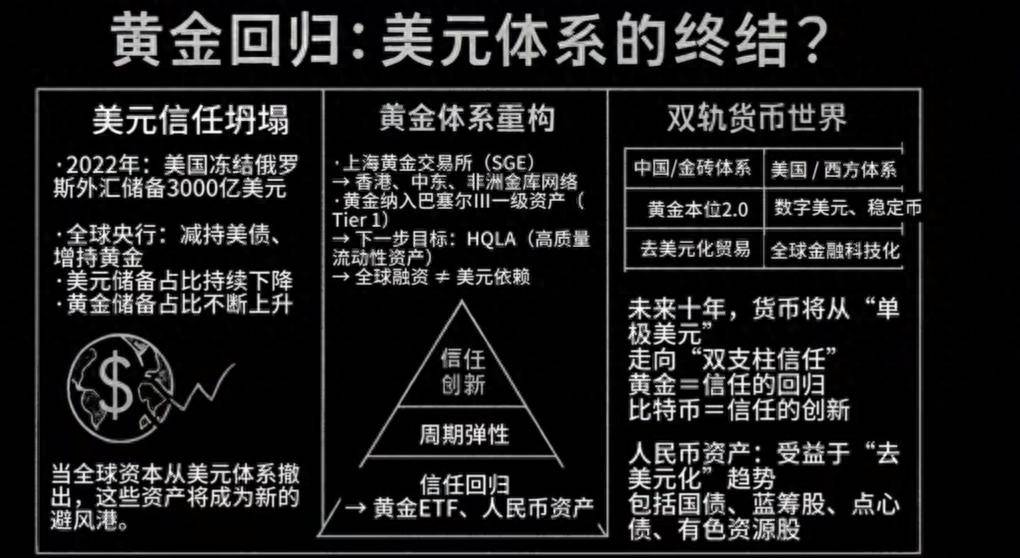
中国挑战美元霸权!黄金回归:中国正在重建全球货币体系
Sou Hu Cai Jing· 2025-10-31 08:41
Core Viewpoint - The article discusses the emerging challenge to the US dollar's global dominance, highlighting China's efforts to rebuild a trust system for currency using gold, marking a revolutionary shift in the concept of money [1]. Group 1: Dollar Trust Erosion - For decades, over 70% of global foreign exchange reserves were tied to dollar assets, with countries relying on US Treasury bonds to safeguard their wealth [3]. - The freezing of approximately $300 billion of Russia's foreign reserves by the US in 2022 shattered this trust, signaling that the dollar is not merely an asset but a liability of the US [3]. - This incident prompted central banks worldwide to reduce their holdings of US Treasuries and increase their gold reserves, with China emerging as the largest official gold buyer [3]. Group 2: China's Gold Corridor - China has established a "Gold Corridor" centered around the Shanghai Gold Exchange, which is the largest physical gold market globally, supported by a network of vaults in Hong Kong, the Middle East, and Africa [6]. - This system allows countries holding renminbi to directly exchange it for physical gold, effectively transforming the renminbi into a reserve currency backed by gold [6]. - The initiative aims to create a parallel financial system to the US dollar, bypassing traditional systems like SWIFT and the IMF, with a focus on BRICS nations [6]. Group 3: Future of Gold in Finance - By July 2025, gold will be recognized as a level one asset under Basel III, allowing it to be counted at 100% value on banks' balance sheets, restoring its status as a monetary asset [6]. - Central banks are pushing for gold to be classified as a "high-quality liquid asset," which would enable it to be used for collateral in repurchase financing, fundamentally altering the global financial system [6]. Group 4: Diverging Financial Systems - A clear division is emerging between two financial systems: one led by China and the BRICS, anchored in gold, and the other by the US and the West, based on digital dollars and stablecoins [9]. - This transformation is already impacting asset prices, with central banks and sovereign funds averaging 20% of their reserves in gold or equivalent physical assets, with recommendations to increase this to 30% [9]. - The anticipated increase in gold demand could reach approximately $2 trillion globally, as gold cannot be printed like dollars, suggesting a potential "structural revaluation" of gold prices in the next five years [9]. Group 5: Investment Strategies - Investment strategies are becoming clearer, with recommendations for strategic allocations in gold ETFs, cyclical assets like copper and other metals, and innovative assets such as Bitcoin [9]. - Assets denominated in renminbi, including government bonds, blue-chip stocks, and commodities, are expected to benefit from the trend of de-dollarization, becoming new safe havens as global capital exits the dollar system [9]. Group 6: Trust in Currency - Gold represents a return to "trust," while Bitcoin symbolizes "innovation in trust," together forming the dual pillars of the post-dollar era [11]. - The future may see a diversified currency landscape, with China rebuilding tangible trust through gold and the US maintaining institutional trust through technology [11].