
碳中和

Search documents
泰达环保碳中和ABN顺利发行 中债增信提供信用增进服务
Xin Hua Cai Jing· 2025-11-18 11:08
新华财经北京11月18日电 日前,由中债信用增进投资股份有限公司提供增信支持的"天津泰达环保有限 公司2025年度第一期绿色资产支持票据(碳中和债)"顺利起息发行,各层级产品均获得市场投资人的 积极认购。 据悉,本期资产支持票据共设五档优先级别,涵盖1年至5年不同期限结构,发行票面利率分别为 1.97%、2.15%、2.30%、2.70%和2.97%。市场认购热情高涨,其中优先01档边际倍数达6.67倍,全场认 购倍数1.92倍;优先03档全场认购倍数更是达到3.15倍,反映出投资人对绿色低碳资产的高度认可与信 心。 编辑:王柘 公开资料显示,本期票据基础资产为天津泰达环保有限公司旗下垃圾焚烧发电项目。该公司长期致力于 固体废弃物资源化处理与绿色能源开发,实现垃圾年处理量数百万吨,显著替代传统化石能源,助力碳 减排与土地资源节约。 值得关注的是,中债信用增进公司为本期资产支持票据提供了专业信用增进服务,有效提升产品信用等 级,降低融资成本,保障项目高效落地。 ...
长三角海上CCUS产业联盟在沪成立,为低碳转型注入新动能
Xin Hua Cai Jing· 2025-11-18 10:15
Core Points - The establishment of the "Yangtze River Delta Offshore CCUS Industry Alliance" aims to accelerate the development of Carbon Capture, Utilization, and Storage (CCUS) technology, which is crucial for achieving carbon neutrality goals, contributing approximately 15% to global emission reductions [1][2] - The alliance is led by China National Offshore Oil Corporation (CNOOC) and includes over 30 entities such as China Baowu Steel Group, COSCO Shipping, and Zhejiang University, focusing on collaborative innovation and resource integration in the CCUS sector [1][2] Group 1 - CCUS is identified as a key technology for energy transition and achieving China's "dual carbon" goals, with significant strategic importance for energy security [1] - The Yangtze River Delta region has a strong foundation in CCUS technology research and application, supported by local enterprises, universities, and research institutions [1][2] - The alliance will focus on information sharing, technology exchange, talent cultivation, policy research, standard formulation, project demonstration, and industry cultivation to promote commercial and large-scale applications of CCUS [2] Group 2 - Shanghai will leverage the establishment of the alliance to enhance technological innovation and industrial collaboration, supporting the region's green and low-carbon development [2]
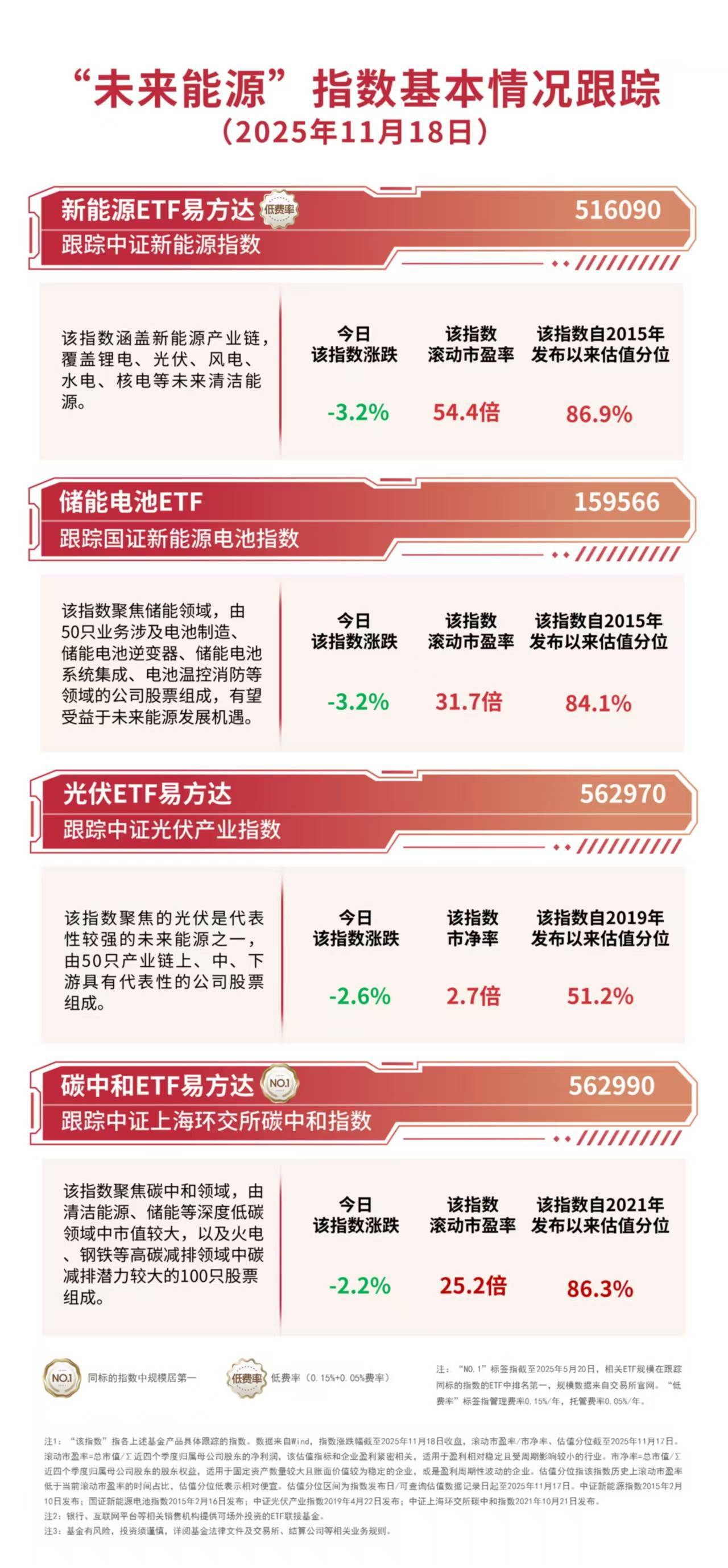
新能源板块全天走弱,资金逆势加仓,储能电池ETF(159566)全天净申购约5000万份
Sou Hu Cai Jing· 2025-11-18 10:00
Core Viewpoint - The renewable energy sector experienced a decline, with significant drops in indices related to carbon neutrality, photovoltaic, and new energy batteries, indicating a challenging market environment for these sectors [1]. Summary by Category Market Performance - The China Securities Shanghai Carbon Neutral Index fell by 2.2% - The China Securities Photovoltaic Industry Index decreased by 2.6% - Both the China Securities New Energy Index and the National Securities New Energy Battery Index dropped by 3.2% - The Energy Storage Battery ETF (159566) saw a net subscription of approximately 50 million units throughout the day - As of the previous trading day, the Energy Storage Battery ETF (159566) had a net inflow of over 1.1 billion yuan in the month [1]. Industry Insights - Analysts suggest that Chinese energy storage companies will leverage their supply chain advantages to gain a competitive edge in the global market - In the first half of this year, overseas orders for Chinese energy storage companies increased by 246% year-on-year - The production of energy storage devices is expanding the consumption scenarios for lithium battery materials beyond just electric vehicles, indicating potential growth in demand for the lithium battery industry [1].

站稳3000万辆、增长超过20%,“十四五”中国汽车硕果盈枝
Zhong Guo Qi Che Bao Wang· 2025-11-18 09:50
Core Insights - The article highlights the significant growth and transformation of China's automotive industry during the "14th Five-Year Plan" period, showcasing advancements in production, sales, and technology [2][10]. Production and Sales Growth - China's automotive production and sales increased by over 5 million units during the "14th Five-Year Plan," with a market size growth of 20% [2]. - In 2021, automotive production and sales reached 26.08 million and 26.27 million units, respectively, marking a year-on-year increase of 3.4% and 3.8% [3]. - By 2023, production and sales surpassed 30 million units for the first time, reaching 30.16 million and 30.09 million units, with year-on-year growth of 11.6% and 12% [3]. - In 2024, production and sales are projected to reach 31.28 million and 31.44 million units, reflecting year-on-year growth of 3.7% and 4.5% [3]. Market Dynamics - The market for Chinese brands has significantly expanded, with market share for domestic passenger cars rising from 44.4% in 2021 to 65.2% in 2024 [4]. - In the first ten months of 2023, sales of Chinese brand passenger cars reached 16.8 million units, a year-on-year increase of 21.3% [4]. Export Milestones - China's automotive exports reached a historic milestone, with exports surpassing 2 million units for the first time in 2021, and reaching 4.91 million units in 2023, a year-on-year increase of 57.9% [4]. - By 2024, exports are expected to exceed 6 million units, solidifying China's position as the world's largest automotive exporter [4]. New Energy Vehicles (NEVs) - NEV sales in China experienced over 4-fold growth during the "14th Five-Year Plan," leading the global market [5]. - In 2021, NEV production and sales reached 3.55 million and 3.52 million units, respectively, with a market share of 13.4% [6]. - By 2024, NEV production and sales are projected to exceed 12 million units, with a market share of 40.9% [6]. Infrastructure Development - The charging infrastructure for electric vehicles has expanded significantly, with over 18 million charging points established by September 2025, reflecting a year-on-year growth of 54.5% [7]. - The improvement in charging facilities has enhanced the convenience and efficiency of energy replenishment for NEV owners [7]. Technological Advancements - The automotive industry has made substantial technological breakthroughs, particularly in battery technology, with a 30% reduction in battery costs and a 40% increase in battery lifespan [9]. - The penetration rate of vehicles with L2-level driving assistance features reached 62% in the first half of 2023, indicating a strong push towards intelligent vehicle technology [9]. Conclusion - The "14th Five-Year Plan" period has marked a transformative era for China's automotive industry, characterized by significant growth in production, sales, and technological innovation, positioning the country as a leader in the global automotive market [10].

广期所,重要人事调整!
中国能源报· 2025-11-18 09:48
Group 1 - The core viewpoint of the article highlights the leadership changes at the Guangzhou Futures Exchange, with Xing Xiangfei appointed as the new Deputy Secretary of the Party Committee and General Manager, while Zhu Lihong has been reassigned [1] - The Guangzhou Futures Exchange was established on April 19, 2021, as China's fifth futures exchange and the first mixed-ownership exchange, playing a crucial role in supporting green development and initiatives like the Guangdong-Hong Kong-Macao Greater Bay Area and the Belt and Road [2] - The exchange has listed three new energy products: industrial silicon, polysilicon, and lithium carbonate, with platinum and palladium futures set to launch on November 27 [2] Group 2 - The appointment of Xing Xiangfei is expected to usher in a new phase for the Guangzhou Futures Exchange in product development, risk management, and market ecosystem cultivation, particularly in the areas of new energy metals and carbon neutrality [2] - The leadership changes at the Guangzhou Futures Exchange are part of a broader adjustment among national futures exchanges, with notable shifts at Zhengzhou Commodity Exchange and Dalian Commodity Exchange [1]
中国、欧盟、巴西发起成立碳市场开放联盟|碳中和周报
2 1 Shi Ji Jing Ji Bao Dao· 2025-11-18 09:07
Carbon Neutrality Policies - China, the EU, and Brazil have jointly established the "Carbon Emission Trading Market Open Alliance" to enhance international cooperation on carbon pricing mechanisms and emission trading systems, aiming for a transparent global compliance carbon market network [1] - The National Energy Administration of China has issued guidelines to promote the integrated development of renewable energy, emphasizing multi-dimensional collaboration and non-electric utilization by 2030 [2] - China has signed 55 climate change cooperation documents with 43 developing countries, focusing on capacity building and technology transfer in climate governance [3] Local Developments - Wuhan has signed 14 green low-carbon technology projects, including a CO2 capture and electrochemical conversion technology, showcasing its commitment to a comprehensive green transition [4][5] Corporate Practices - Envision Group has launched the world's largest AI-driven power system, enhancing the economic viability and stability of renewable energy systems, successfully applied in a zero-carbon hydrogen industry park [6] - Green computing is emerging as a new investment focus, with a significant portion of data center emissions stemming from electricity consumption, prompting a shift towards energy efficiency and green electricity usage [7]
中国、欧盟、巴西发起成立碳市场开放联盟
2 1 Shi Ji Jing Ji Bao Dao· 2025-11-18 08:58
Carbon Neutrality Policy - The establishment of the Carbon Market Open Alliance by China, the EU, and Brazil aims to create a framework for international cooperation on carbon pricing mechanisms and emission trading systems, enhancing the voice of developing countries in the global carbon pricing system [2] - The National Energy Administration of China has issued guidelines to promote the integrated development of renewable energy, emphasizing multi-dimensional collaboration and non-electric utilization, with a goal for integrated development to become a key approach by 2030 [3] - China has signed 55 climate change cooperation documents with 43 developing countries, focusing on capacity building, technology transfer, and infrastructure support in climate governance [4] Local Developments - Wuhan has signed 14 green low-carbon technology projects, including advancements in CO2 capture and electrochemical conversion technology, showcasing a comprehensive green transformation approach [5][6] Corporate Practices - Envision Group has launched the world's largest AI-driven power system, enhancing the economic viability and stability of renewable energy systems, successfully applied in the global largest green hydrogen and ammonia industrial base [7] - Green computing is emerging as a new investment focus, with a significant portion of carbon emissions from data centers stemming from electricity consumption, highlighting the importance of energy efficiency and green electricity usage [8]
碳中和50ETF(159861)盘中回调超3%,资金逢回调布局,连续5日迎净流入
Mei Ri Jing Ji Xin Wen· 2025-11-18 07:09
申港证券表示,11月8日,国务院新闻办公室8日发布《碳达峰碳中和的中国行动》白皮书。白皮书指 出,我国将碳达峰碳中和作为国家战略,广泛深入开展碳达峰行动,加快经济社会发展全面绿色转型, 坚定不移推进碳达峰碳中和,我国能源绿色低碳转型取得显著成效。 碳中和50ETF(159861)跟踪的是环保50指数(930614),该指数从中国A股市场中选取涉及清洁能 源、节能技术、污染治理及生态修复等环境保护相关领域的上市公司证券作为指数样本,以反映绿色经 济领域内领先企业的整体表现。该指数注重可持续发展和环境友好型业务模式,旨在为投资者提供跟踪 环保产业发展的投资工具。 (文章来源:每日经济新闻) ...
国泰海通:维持钢铁供给端收缩预期 行业基本面有望逐步修复
智通财经网· 2025-11-18 05:57
Core Viewpoint - The steel industry is experiencing a decline in demand and inventory, with expectations of a gradual recovery in profitability as supply-side constraints persist [1][3]. Group 1: Demand and Supply Analysis - The apparent consumption of five major steel products was 8.606 million tons, a decrease of 63,300 tons week-on-week; construction materials consumption was 3.0335 million tons, down 40,200 tons; and sheet materials consumption was 5.5725 million tons, down 23,100 tons [1]. - The production of five major steel products was 8.3438 million tons, a decrease of 223,600 tons week-on-week, while total inventory stood at 14.7735 million tons, down 262,200 tons [1]. - The operating rate of blast furnaces at 247 steel mills was 82.81%, a decrease of 0.32 percentage points week-on-week, while electric furnace operating rate was 60.9%, an increase of 1.28 percentage points [1]. Group 2: Profitability Trends - The average gross profit per ton for rebar was 81.4 CNY, an increase of 4.3 CNY week-on-week, while hot-rolled coil showed a negative gross profit of -16.6 CNY, also up by 4.3 CNY [2]. - The profitability rate for 247 steel companies was 38.96%, a decrease of 0.87 percentage points week-on-week [2]. Group 3: Future Outlook - The real estate sector's ongoing decline is expected to reduce its negative impact on steel demand, while demand from infrastructure and manufacturing is anticipated to stabilize [3]. - The steel industry has been in a loss phase since Q3 2022, with nearly 60% of steel companies still reporting losses, indicating a market-driven supply clearance is beginning to occur [3]. - The recently released "Steel Industry Stabilization and Growth Work Plan (2025-2026)" emphasizes continued production reduction policies to promote dynamic supply-demand balance [3]. Group 4: Investment Recommendations - Long-term trends indicate that increased industry concentration and high-quality development will benefit steel companies with product structure and cost advantages [4]. - Key recommendations include Baosteel (600019.SH), Hualing Steel (000932.SZ), and Shougang (000959.SZ) for their leading technology and product structures, as well as CITIC Special Steel (000708.SZ) and Yongjin Co. (603995.SH) for their competitive advantages [4].

佳华科技跌2.08%,成交额2454.48万元,主力资金净流出524.71万元
Xin Lang Cai Jing· 2025-11-18 05:50
Group 1 - The core point of the news is that Jiahua Technology's stock has experienced fluctuations, with a year-to-date increase of 121.18% but a recent decline of 4.56% over the last five trading days [1] - As of November 18, Jiahua Technology's stock price is 46.05 CNY per share, with a market capitalization of 3.561 billion CNY [1] - The company has seen a net outflow of 524.71 thousand CNY in main funds, with significant selling activity [1] Group 2 - Jiahua Technology, established on September 14, 2007, and listed on March 20, 2020, operates in sectors such as smart environmental protection and smart cities [2] - The company's revenue composition includes 67.98% from smart environmental protection, 20.00% from smart cities, and 11.38% from smart dual-carbon initiatives [2] - As of September 30, the number of shareholders decreased by 13.36% to 4,397, while the average circulating shares per person increased by 15.42% to 17,587 shares [2] Group 3 - Jiahua Technology has distributed a total of 88.8568 million CNY in dividends since its A-share listing, with no dividends paid in the last three years [3]
