
全国统一大市场

Search documents
国家发改委:要素市场化配置改革是建设全国统一大市场关键环节
Jing Ji Guan Cha Wang· 2025-09-11 08:30
经济观察网据人民财讯消息,9月11日,国家发展改革委副主任李春临在国务院政策例行吹风会上表 示,深化要素市场化配置改革,是建设全国统一大市场的关键环节。此次在全国部分地区实施要素市场 化配置综合改革试点,将聚焦要素市场建设的重点领域、关键环节和经营主体反应强烈的问题。综合改 革试点强调因地制宜,各展所长,可更好发挥地方改革探索的积极性和主动性,对经济社会发展增添新 的动力。 ...
中国人民银行:将加大对要素市场化配置综合改革试点地区的金融支持力度
Zheng Quan Shi Bao Wang· 2025-09-11 08:28
责任编辑:曹睿潼 9月11日,国务院新闻办公室举行国务院政策例行吹风会,介绍全国部分地区实施要素市场化配置综合 改革试点有关情况。中国人民银行研究局局长王信表示,下一步,中国人民银行将围绕增加有效金融服 务供给,推动更高水平的金融开放合作,推动数智赋能金融发展等方面,加大对要素市场化配置综合改 革试点地区的金融支持力度,为建设全国统一大市场作出积极贡献。 ...
利好来了!国务院,重磅印发!
证券时报· 2025-09-11 08:09
Core Viewpoint - The State Council of China has approved a comprehensive reform pilot plan for the market-oriented allocation of factors in several regions, aiming to enhance the efficiency of resource allocation and promote a high-level socialist market economy [1][2][3] Group 1: Pilot Areas and Implementation - The pilot areas include Beijing's urban sub-center, key cities in southern Jiangsu, Hangzhou-Ningbo-Wenzhou, Hefei metropolitan area, Fuzhou-Xiamen-Quanzhou, Zhengzhou, Changsha-Zhuzhou-Xiangtan, nine cities in the Guangdong-Hong Kong-Macao Greater Bay Area, Chongqing, and Chengdu [2][3] - The implementation period is set for two years, starting immediately [2] Group 2: Objectives and Responsibilities - The plan aims to deepen the reform of factor market allocation, improve market systems and rules, and eliminate institutional barriers to the free flow and efficient allocation of factors [3] - Provincial governments are tasked with taking primary responsibility for organizing and implementing the reforms, focusing on enhancing factor coordination and efficiency [3] Group 3: Key Areas of Focus - Emphasis on technology factor innovation, including the establishment of a system for the ownership of scientific achievements and the promotion of technology transfer [5][16][29] - Land factor efficiency will be improved through reforms in land management and the promotion of mixed-use land policies [6][31][45] - Human resources will be facilitated through reforms in the household registration system and the establishment of unified public employment services [8][20][47] Group 4: Data and Capital Factors - The plan includes the establishment of rules for data factor circulation and the promotion of data sharing and utilization [9][35] - Financial services will be enhanced to better support the real economy, including the development of innovative financial products and the establishment of a multi-level capital market [12][22][37] Group 5: Environmental and Resource Management - The creation of a green factor trading mechanism is proposed, focusing on ecological protection and resource utilization [13][38] - The plan aims to improve the market-oriented allocation of environmental resources and promote sustainable development practices [24][38]


21社论丨加快建设全国统一大市场,治理非理性竞争
21世纪经济报道· 2025-09-11 00:12
Group 1 - The core viewpoint emphasizes that irrational competition can destroy enterprises and industries, potentially overnight, and must not be tolerated [1] - Irrational competition, particularly the "involution" phenomenon, has emerged in various sectors, leading to disordered competition that undermines market efficiency and innovation [1][2] - Price competition is prevalent in low-value-added sectors, while high-value-added sectors rely on technological differentiation and brand building for competitive advantage [1][2] Group 2 - Non-rational competition leads to a vicious cycle where companies cut production costs and lower product quality to gain price advantages, squeezing profit margins across the industry [2] - This situation not only affects the sustainability of enterprises but also damages consumer trust and the overall development potential of the industry [2][3] - The transition from rapid growth to high-quality development in China necessitates a focus on technological innovation and the establishment of a globally competitive modern industrial system [2][3] Group 3 - Innovation is crucial for economic circulation, enhancing productivity, and fostering new industries, which in turn increases household wealth and government revenue [3] - Persistent irrational competition undermines the ability of manufacturing and innovation to attract investment, jeopardizing the innovation-driven growth model [3] - Addressing irrational competition is vital for the fate of industries and the successful establishment of a new economic structure in China [3]

十四届全国人大常委会第十七次会议审议多部报告
Ren Min Ri Bao· 2025-09-11 00:09
Economic Performance - The report indicates that China's economy has shown a recovery trend in the first half of the year, with GDP growth of 5.3%, an increase of 0.3 percentage points compared to last year [2] - Key economic indicators have performed well, with fixed asset investment growing by 1.6% and retail sales of consumer goods increasing by 4.8% in the first seven months [2] - The high-tech manufacturing sector has seen a significant increase, with added value growing by 9.5% in the same period [2] Fiscal Policy and Budget Execution - The fiscal policy has been proactive, with total public budget revenue reaching 135839 billion yuan, a year-on-year increase of 0.1% [4] - Tax revenue has decreased by 0.3% to 110933 billion yuan, while non-tax revenue has increased by 2% to 24906 billion yuan [5] - Public budget expenditure has grown by 3.4% to 160737 billion yuan, with central government expenditure increasing by 8.8% [5] Cultural and Tourism Development - The integration of culture and tourism has been emphasized, with the cultural and related industries' added value reaching 5.95 trillion yuan and tourism-related industries at 5.48 trillion yuan [7] - Domestic tourism is projected to reach 56.15 billion trips in 2024, with total spending of 5.75 trillion yuan [8] - The report highlights the growing influence of Chinese culture, with 1.32 billion inbound tourists expected in 2024, contributing to a total expenditure of 942 billion USD [8] Climate Change and Energy Transition - China has built the world's largest renewable energy system, contributing to a quarter of the global increase in green areas [10] - The report states that carbon intensity has decreased, and the share of non-fossil energy consumption is on track to meet the 2030 targets [10] - The establishment of a national carbon market is progressing, covering over 60% of national carbon emissions [10] Labor and Employment - The report indicates that the political role of labor unions has been strengthened, with significant contributions to social stability and worker rights [12] - The number of grassroots unions has increased significantly, with 37.6 million new members added from 2021 to 2024 [13] - There is a focus on improving labor relations and enhancing the legal framework for labor rights protection [13]
为市场经济毛细血管注入更多制度活水
Sou Hu Cai Jing· 2025-09-11 00:05
Core Viewpoint - The implementation of the national standard for individual business credit evaluation aims to enhance credit financing for individual businesses by establishing a standardized evaluation system that incorporates various dimensions such as tax compliance, social security contributions, and digital operations [1][2][3] Group 1: Standard Implementation and Impact - The new standard addresses the long-standing issue of the lack of a credit assessment system for individual businesses, which has hindered their access to financing due to their small scale and insufficient collateral [1][2] - By transforming daily operational data into quantifiable credit assets, the standard allows for a shift from traditional collateral-based lending to a model that values reputation and stable business records [1][2] - The establishment of a standardized credit information sharing channel will significantly reduce investigation costs for financial institutions and facilitate the market circulation of credit elements [2][3] Group 2: Broader Economic Implications - The credit evaluation system is expected to generate institutional benefits beyond financial services, enabling timely risk detection and supporting the identification of high-potential businesses [2][3] - The integration of credit accumulation with policies aimed at transforming individual businesses into enterprises will help overcome institutional barriers during their upgrade process [2][3] - The standard's implementation is strategically significant for China's economic transformation, as it aims to release the vitality of microeconomic entities and reduce transaction costs [3][4] Group 3: Long-term Effects and Future Considerations - A favorable credit environment is anticipated to attract more resources to individual businesses, creating a virtuous cycle of improved credit leading to easier financing and faster development [4] - The enhancement of the credit system is expected to foster a stronger spirit of contract within society, thereby lowering transaction costs and improving economic efficiency [4] - Continuous efforts are needed to address practical challenges such as data collection standardization and the protection of individual business rights, ensuring the effective application of the new credit evaluation system [3][4]
21社论丨加快建设全国统一大市场,治理非理性竞争
2 1 Shi Ji Jing Ji Bao Dao· 2025-09-10 23:05
Group 1 - The Ministry of Industry and Information Technology emphasizes that irrational competition can destroy enterprises and industries overnight, which is intolerable [1] - Irrational competition, particularly "involution-style" competition, has emerged in various sectors in China, leading to disordered competition as the economy transitions to innovation-driven development [1][2] - Price competition is prevalent in low-value-added sectors, while high-value-added sectors rely on technological differentiation and brand building for competitive advantage [1] Group 2 - Non-rational competition leads to a vicious cycle where companies cut production costs and lower product quality to gain price advantages, squeezing profit margins across the industry [2] - This situation not only affects the sustainability of enterprises but also damages consumer trust and distorts resource allocation efficiency, ultimately hindering innovation [2][3] - The transition from high-speed to high-quality development in China necessitates a focus on technological innovation to enhance manufacturing competitiveness and create a modern industrial system with global competitiveness [2][3] Group 3 - Innovation is crucial for economic circulation, driving productivity and creating new industries, which in turn increases household wealth and government revenue for public services [3] - However, widespread irrational competition undermines this cycle by leading to low profits in manufacturing, making it difficult to attract investment for innovation [3] - Addressing irrational competition is essential for the fate of industries and the ability to achieve a new development pattern and establish a self-circulating economy [3]
核心CPI涨幅连续4个月扩大,“反内卷”推动行业价格改善
Di Yi Cai Jing· 2025-09-10 13:10
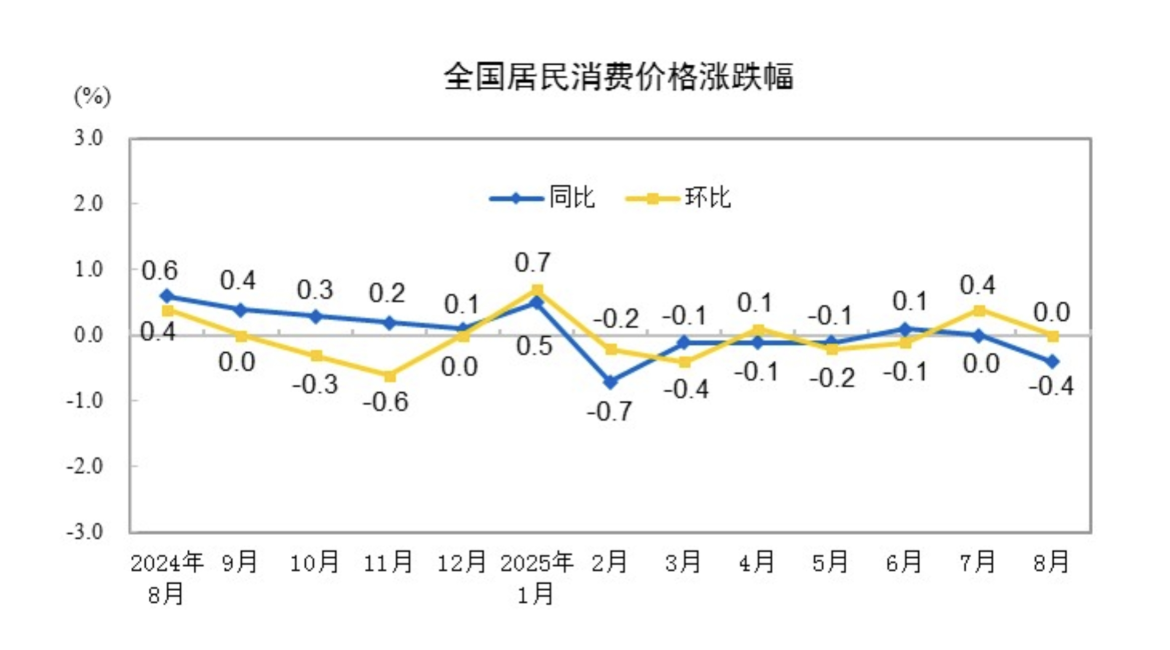
Group 1: CPI and PPI Trends - In August, the Consumer Price Index (CPI) remained flat month-on-month and decreased by 0.4% year-on-year, influenced by a high base from the previous year and a continuous decline in food prices [1][10] - The Producer Price Index (PPI) ended an eight-month downward trend, remaining flat month-on-month and decreasing by 2.9% year-on-year, with the decline narrowing by 0.7 percentage points compared to July [4][5] Group 2: Core CPI and Industrial Prices - The core CPI, excluding food and energy prices, increased by 0.9% year-on-year in August, marking the fourth consecutive month of growth [3][11] - Industrial prices showed positive changes, with certain sectors like coal processing and black metal smelting experiencing a narrowing of year-on-year price declines, contributing to the overall stabilization of PPI [7][8] Group 3: Policy Impact and Market Dynamics - The "anti-involution" policy has led to improvements in the supply-demand relationship, positively affecting industrial product prices and reducing disorderly competition in various sectors [3][9] - The implementation of more proactive macro policies is expected to support a gradual recovery in prices, with forecasts indicating a potential narrowing of PPI year-on-year declines in the coming months [8][12]
中国民生银行首席经济学家温彬:全年5%增长目标有望达成,扩内需是下半年稳增长的关键
Sou Hu Cai Jing· 2025-09-10 10:47
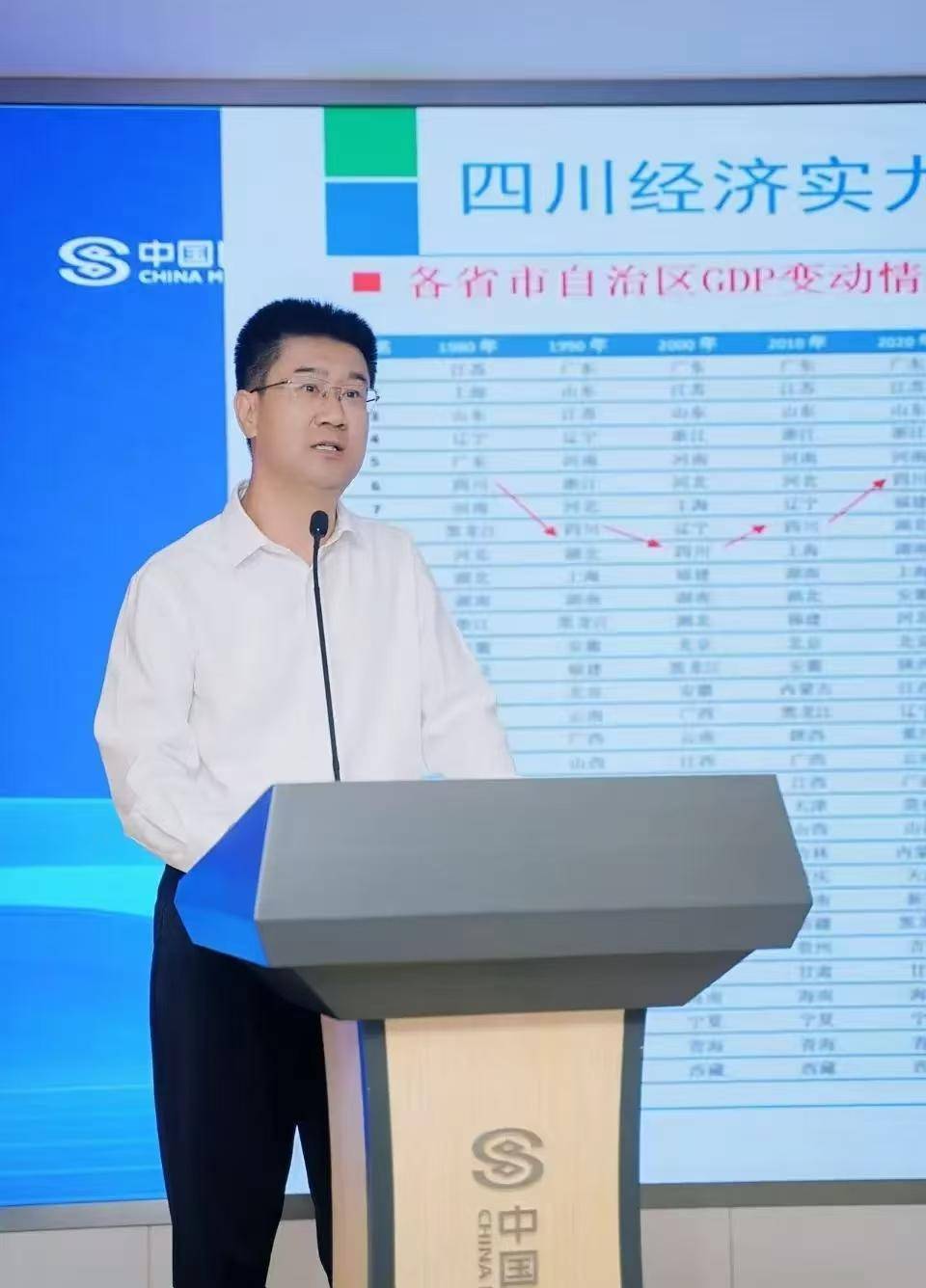
Core Viewpoint - The seminar highlighted the analysis and outlook of China's economic and financial situation for mid-2025, emphasizing the need for macroeconomic regulation and deepening reforms to enhance internal economic momentum in response to complex international challenges [1]. Economic Performance - In the first half of 2025, China's economy showed significant characteristics: consumption outperformed investment, and external demand was stronger than internal demand. The annual growth target of around 5% is expected to be achieved [5][6]. - The GDP growth rates were 5.4% in Q1 and 5.2% in Q2, leading to an overall growth of 5.3% in the first half. A growth rate of 4.7% in the second half would suffice to meet the annual target [5][6]. Regional Economic Development - Sichuan has emerged as the fifth-largest economy in China, with a continuously optimized industrial structure and enhanced competitiveness. Future efforts should focus on leveraging internal demand and upgrading industries to promote high-quality development [4][6]. Consumer and External Demand - Retail sales in May increased by 6.4% year-on-year, driven by holiday effects, promotional activities, and government subsidies for major consumer goods [6]. - Exports contributed 1.7 percentage points to economic growth in the first half, acting as a stabilizer amid slower domestic demand recovery [6][7]. Financial Indicators - The narrowing gap between M1 and M2 indicates a gradual recovery in corporate confidence, while the expansion of the gap between social financing and credit growth suggests that government bond issuance is a key driver of social financing growth [7][8]. Policy Focus for the Second Half - The policy direction for the second half of 2025 will prioritize domestic demand, with a focus on stimulating consumption and increasing infrastructure investment [8][9]. - Major projects in infrastructure, such as the Yarlung Tsangpo River hydropower station, are expected to play a crucial role in stabilizing investment growth [8]. Long-term Economic Strategy - To address the challenges posed by high savings rates and trade protectionism, reforms should focus on increasing consumption rates through income distribution reforms and enhancing social security systems [9][10]. - The establishment of a unified national market is essential for optimizing resource allocation and promoting new quality productivity [11]. Global Competitiveness - Chinese companies are encouraged to enhance their global perspective and operational capabilities while deepening their engagement in the domestic market to improve international competitiveness [11][12].

大公国际:城投企业视角下的反内卷路径研究
Da Gong Guo Ji· 2025-09-10 09:05
Group 1: Policy Context - The concept of "involution" was officially introduced in China's policy discourse during the Politburo meeting on July 30, 2024, emphasizing the need to prevent "malicious competition" in industries[1] - The 2025 Politburo meeting reiterated the importance of optimizing market competition order and regulating disorderly competition among enterprises[2] - A series of policies and regulations have been implemented since 2020 to combat administrative monopolies and local protectionism, aiming to break the cycle of homogeneous competition[3] Group 2: Characteristics of Involution in Urban Investment Enterprises - Urban investment enterprises exhibit involution through homogeneous business layouts, debt-income mismatches, and administrative intervention[5] - Homogeneous business layouts are evident in three core areas: industrial parks, cultural tourism projects, and infrastructure, leading to resource wastage[5] - Debt-income mismatches result in continuous debt service payments exceeding operational income, creating a rigid financial gap and forcing enterprises into a cycle of borrowing[6] Group 3: Causes of Involution - The root causes of involution include institutional environment, government-enterprise relations, and the inherent capabilities of urban investment enterprises[8] - Institutional factors involve market segmentation and local protectionism, distorting competitive logic and limiting asset allocation[8] - Government-enterprise relations lead to urban investment enterprises being treated as "government tools," undermining their market autonomy and operational capabilities[9] Group 4: Key Paths for Counteracting Involution - Reconstructing assessment indicators to detach urban investment enterprises from local government performance metrics is crucial[11] - Transitioning urban investment enterprises from "financing platforms" to "city operators" can enhance their market-driven operational capabilities[13] - Promoting cross-regional cooperation among urban investment enterprises can facilitate resource sharing and risk mitigation, transforming competition into collaboration[15]