
半导体

Search documents
美联储降息与中美会谈双利好!A股却跳水,三大原因戳破市场预期
Sou Hu Cai Jing· 2025-11-04 11:00
Group 1 - The core point of the article is that despite two significant external positive events (the Federal Reserve's interest rate cut and the China-U.S. meeting in Busan), the A-share market did not respond positively and instead experienced a decline [3][30]. - The market had already priced in the expected interest rate cut by the Federal Reserve, leading to a lack of momentum when the announcement was made [5][16]. - The ambiguity surrounding future interest rate cuts from the Federal Reserve created uncertainty in the financial markets, contributing to the negative reaction [7][30]. Group 2 - The Busan meeting did not yield significant breakthroughs on key strategic issues, which led to a lack of positive surprises for the market [11][13]. - The performance of high-tech sectors, which had previously driven the A-share market's rise, fell short of expectations in their quarterly reports, leading to a broader market decline [19][21]. - The overall market reaction was a result of external positive news being fully digested and internal performance not meeting high expectations, highlighting the importance of actual earnings supporting stock prices [28][32].


【太平洋科技-每日观点&资讯】(2025-11-05)
远峰电子· 2025-11-04 10:49
Market Overview - The main board saw significant gains with notable increases in stocks such as Jishi Media (+10.07%), Dahua Intelligent (+10.04%), and Jingquanhua (+10.02) [1] - The ChiNext board led with a remarkable rise in stocks like Haixia Innovation (+19.98%) and Zhongfu Circuit (+9.95%) [1] - The Sci-Tech Innovation board also experienced growth, with Fangbang Co. (+7.76%) and Zhongwei Company (+5.38%) showing positive performance [1] - Active sub-industries included SW Semiconductor Equipment (+2.13%) and SW Mass Publishing (+1.04%) [1] Domestic News - The robotics industry in China reported a robust growth of 29.5% year-on-year in revenue for the first three quarters of the year, with industrial robot production reaching 595,000 units and service robots at 13.5 million units, surpassing the total expected production for 2024 [1] - Kailun Co. announced a device procurement contract with BOE Technology Group, valued at 198 million yuan [1] - Guobo Electronics reported successful mass production of GaN power amplifier chips in collaboration with leading domestic terminal manufacturers, with cumulative deliveries exceeding 1 million units [1] - Geely Holding Group signed a strategic cooperation agreement with Renault Group to enhance local production and market expansion of new energy vehicles in Brazil, with the EX5 electric SUV set to be sold through Renault's distribution channels [1] Company Announcements - Zongheng Communication announced a cash dividend of 0.02 yuan per share, totaling 4.45 million yuan distributed among 222,411,494 shares [3] - Aisen Co. reported a share buyback progress, having repurchased 1,152,959 shares, accounting for 1.31% of total equity, with a total expenditure of approximately 50.21 million yuan [3] - Guomai Culture received a government subsidy of 3.78 million yuan, representing 24.90% of the company's audited net profit for the last fiscal year [3] - Geer Software's subsidiary received a government subsidy of 4.074 million yuan, which is about 11.07% of the company's audited net profit for 2024 [3] International News - ENG0 launched a lightweight smart AR glasses weighing only 36 grams, with a battery life of up to 12 hours, extendable to 24 hours in energy-saving mode [1] - The Semiconductor Industry Association (SIA) reported global semiconductor sales reached $208.4 billion in Q3 2025, a 15.8% increase from Q2, with September sales at $69.5 billion, up 25.1% year-on-year [1] - Adeia filed two patent infringement lawsuits against AMD, alleging the use of patented technologies related to hybrid bonding and advanced logic and memory manufacturing processes [1] - Following Apple's adoption of TSMC's N2 process, Qualcomm and MediaTek are accelerating their technology integration, which is expected to advance the mass production timeline for TSMC's A16 process [1]
国机精工(002046) - 002046国机精工投资者关系管理信息20251104
2025-11-04 09:00
Group 1: Diamond Heat Dissipation Business - The company began its diamond functionalization applications in 2015, focusing on the MPCVD method to produce heat sinks and optical window pieces, with revenue starting in 2023 primarily from non-civilian sectors [2] - Expected sales revenue from diamond functional applications is projected to exceed 10 million yuan this year, all from non-civilian fields [2] Group 2: Superhard Materials Tools Business - Revenue from the superhard tools business is approximately 580 million yuan in 2024, with applications in semiconductor and non-semiconductor sectors [3] - Products for the semiconductor sector have seen significant growth in recent years [3] Group 3: Semiconductor Sector Growth - The semiconductor business has shown a positive growth trend, focusing on enhancing product performance to increase market share in the packaging testing segment [3] Group 4: Cultivated Diamond Market - The price of cultivated diamonds has stabilized this year, with rough diamonds primarily sold through distributors and the company’s own retail brand "Daino" operating three stores in Shanghai [3] Group 5: Robotics and Aerospace Bearings - The company has included robotic bearings in its "14th Five-Year Plan," focusing on high-value products such as crossed roller bearings and thin-walled bearings [3] - The commercial aerospace sector is viewed as a "second growth curve," with private rocket companies primarily being clients [3]

华峰测控跌2.08%,成交额2.85亿元,主力资金净流出516.36万元
Xin Lang Cai Jing· 2025-11-04 06:44
Core Viewpoint - The stock of Huafeng Measurement Control has experienced a decline of 2.08% on November 4, with significant trading activity and a notable increase in revenue and profit year-on-year [1][2]. Company Performance - As of September 30, Huafeng Measurement Control reported a revenue of 939 million yuan, representing a year-on-year growth of 51.21% [2]. - The net profit attributable to shareholders for the same period was 387 million yuan, showing an increase of 81.57% year-on-year [2]. - The company has distributed a total of 565 million yuan in dividends since its A-share listing, with 336 million yuan distributed over the past three years [3]. Stock Market Activity - On November 4, the stock price was 185.29 yuan per share, with a total market capitalization of 25.113 billion yuan [1]. - The stock has increased by 78.59% year-to-date but has seen a decline of 10.94% over the last five trading days [1]. - The trading volume on November 4 was 285 million yuan, with a turnover rate of 1.12% [1]. Shareholder Information - The number of shareholders increased to 10,200, up by 45.32% compared to the previous period [2]. - The average number of circulating shares per shareholder decreased by 31.18% to 13,295 shares [2]. - Major shareholders include Hong Kong Central Clearing Limited, which holds 8.5111 million shares, a decrease of 333,000 shares from the previous period [3].

思特威跌2.05%,成交额4.43亿元,主力资金净流入1515.52万元
Xin Lang Cai Jing· 2025-11-04 06:39
Core Viewpoint - The stock of Sitwei (Shanghai) Electronic Technology Co., Ltd. has experienced fluctuations, with a recent decline of 2.05% in intraday trading, while the company has shown significant revenue and profit growth year-to-date [1][2]. Company Overview - Sitwei was established on April 13, 2017, and went public on May 20, 2022. The company specializes in the research, design, and sales of high-performance CMOS image sensor chips, with 100% of its revenue derived from chip sales [1]. - The company is categorized under the electronic-semiconductor-digital chip design industry and is associated with concepts such as the Big Fund, semiconductors, smart wearables, and chip concepts [1]. Financial Performance - For the period from January to September 2025, Sitwei reported a revenue of 6.317 billion yuan, representing a year-on-year growth of 50.14%. The net profit attributable to shareholders was 699 million yuan, marking a significant increase of 155.99% [2]. - Since its A-share listing, Sitwei has distributed a total of 126 million yuan in dividends [3]. Shareholder Information - As of September 30, 2025, the number of shareholders increased by 38.46% to 18,300, while the average circulating shares per person decreased by 27.78% to 17,619 shares [2]. - The top ten circulating shareholders include significant institutional investors, with Hong Kong Central Clearing Limited being the fifth largest, holding 11.2342 million shares, an increase of 4.8608 million shares from the previous period [3].

珂玛科技跌2.01%,成交额1.50亿元,主力资金净流出161.24万元
Xin Lang Cai Jing· 2025-11-04 06:34
Company Overview - Kema Technology Co., Ltd. is located in Suzhou, Jiangsu Province, and was established on April 27, 2009. The company specializes in the research, manufacturing, sales, and services of advanced ceramic materials and surface treatment services for semiconductor equipment [1]. - The main business revenue composition includes 91.74% from sales of advanced ceramic components, 7.20% from surface treatment services, 0.57% from other services, and 0.49% from sales of metal structural components [1]. Financial Performance - As of October 10, Kema Technology reported a total of 27,200 shareholders, a decrease of 1.64% from the previous period. The average circulating shares per person increased by 1.66% to 5,398 shares [2]. - For the period from January to September 2025, Kema Technology achieved operating revenue of 794 million yuan, representing a year-on-year growth of 28.86%. The net profit attributable to the parent company was 245 million yuan, reflecting a year-on-year increase of 8.29% [2]. Stock Performance - On November 4, Kema Technology's stock price fell by 2.01%, trading at 52.22 yuan per share with a transaction volume of 150 million yuan and a turnover rate of 1.94%. The total market capitalization stood at 22.768 billion yuan [1]. - Year-to-date, the stock price has declined by 11.28%, with a drop of 8.45% over the last five trading days, 10.90% over the last 20 days, and 3.33% over the last 60 days [1]. Shareholder and Dividend Information - Kema Technology has distributed a total of 87.2 million yuan in dividends since its A-share listing [3]. - As of September 30, 2025, several institutional investors exited the top ten circulating shareholders, including various ETFs and mutual funds [3].
江化微跌2.02%,成交额1.36亿元,主力资金净流出1200.48万元
Xin Lang Cai Jing· 2025-11-04 06:33
Core Viewpoint - Jianghua Micro's stock price has experienced fluctuations, with a recent decline of 2.02% and a total market value of 6.938 billion yuan, indicating potential investor concerns and market volatility [1]. Financial Performance - For the period from January to September 2025, Jianghua Micro achieved operating revenue of 910 million yuan, representing a year-on-year growth of 10.92%. However, the net profit attributable to shareholders decreased by 8.66% to 78.783 million yuan [2]. - Cumulatively, Jianghua Micro has distributed a total of 177 million yuan in dividends since its A-share listing, with 99.82 million yuan distributed over the past three years [3]. Shareholder Structure - As of September 30, 2025, the number of shareholders for Jianghua Micro was 50,400, a decrease of 2.18% from the previous period. The average number of circulating shares per person increased by 2.23% to 7,650 shares [2]. - Among the top ten circulating shareholders, Hong Kong Central Clearing Limited is the sixth largest with 3.3345 million shares, marking its entry as a new shareholder. The Guotai Zhongzheng Semiconductor Materials Equipment Theme ETF ranks eighth with 2.4637 million shares, an increase of 1.4057 million shares from the previous period [3]. Stock Performance - Year-to-date, Jianghua Micro's stock price has increased by 8.05%. However, it has seen a decline of 11.81% over the last five trading days, 14.33% over the last twenty days, and 2.44% over the last sixty days [1].

彤程新材跌2.01%,成交额1.94亿元,主力资金净流出334.89万元
Xin Lang Cai Jing· 2025-11-04 05:42
Core Viewpoint - Tongcheng New Materials experienced a stock price decline of 2.01% on November 4, with a current price of 39.45 CNY per share and a total market capitalization of 23.629 billion CNY [1] Financial Performance - For the period from January to September 2025, Tongcheng New Materials reported a revenue of 2.523 billion CNY, representing a year-on-year growth of 4.06%, and a net profit attributable to shareholders of 494 million CNY, which is a 12.65% increase compared to the previous year [2] - Cumulative cash dividends since the company's A-share listing amount to 1.493 billion CNY, with 847 million CNY distributed over the past three years [3] Shareholder Information - As of September 30, 2025, the number of shareholders for Tongcheng New Materials reached 60,200, an increase of 27.61% from the previous period, while the average number of circulating shares per person decreased by 21.42% to 9,914 shares [2] - The top ten circulating shareholders include new entrants such as Penghua CSI Sub-Segment Chemical Industry Theme ETF and Guotai CSI Semiconductor Materials and Equipment Theme ETF, indicating a shift in institutional holdings [3] Stock Performance - Year-to-date, the stock price of Tongcheng New Materials has increased by 14.44%, but it has seen a decline of 9.87% over the last five trading days and a decrease of 6.54% over the past 20 days [1] - The stock has shown a significant increase of 20.90% over the last 60 days [1] Business Overview - Tongcheng New Materials, established on June 4, 2008, and listed on June 27, 2018, specializes in the research, production, sales, and related trade of fine chemical materials [1] - The company's main revenue sources include rubber additives and other products (70.06%), electronic materials (26.69%), and fully biodegradable materials (3.25%) [1] - The company operates within the basic chemical industry, specifically in rubber additives, and is involved in sectors such as new materials, photoresists, rare earth permanent magnets, semiconductors, and graphene [1]

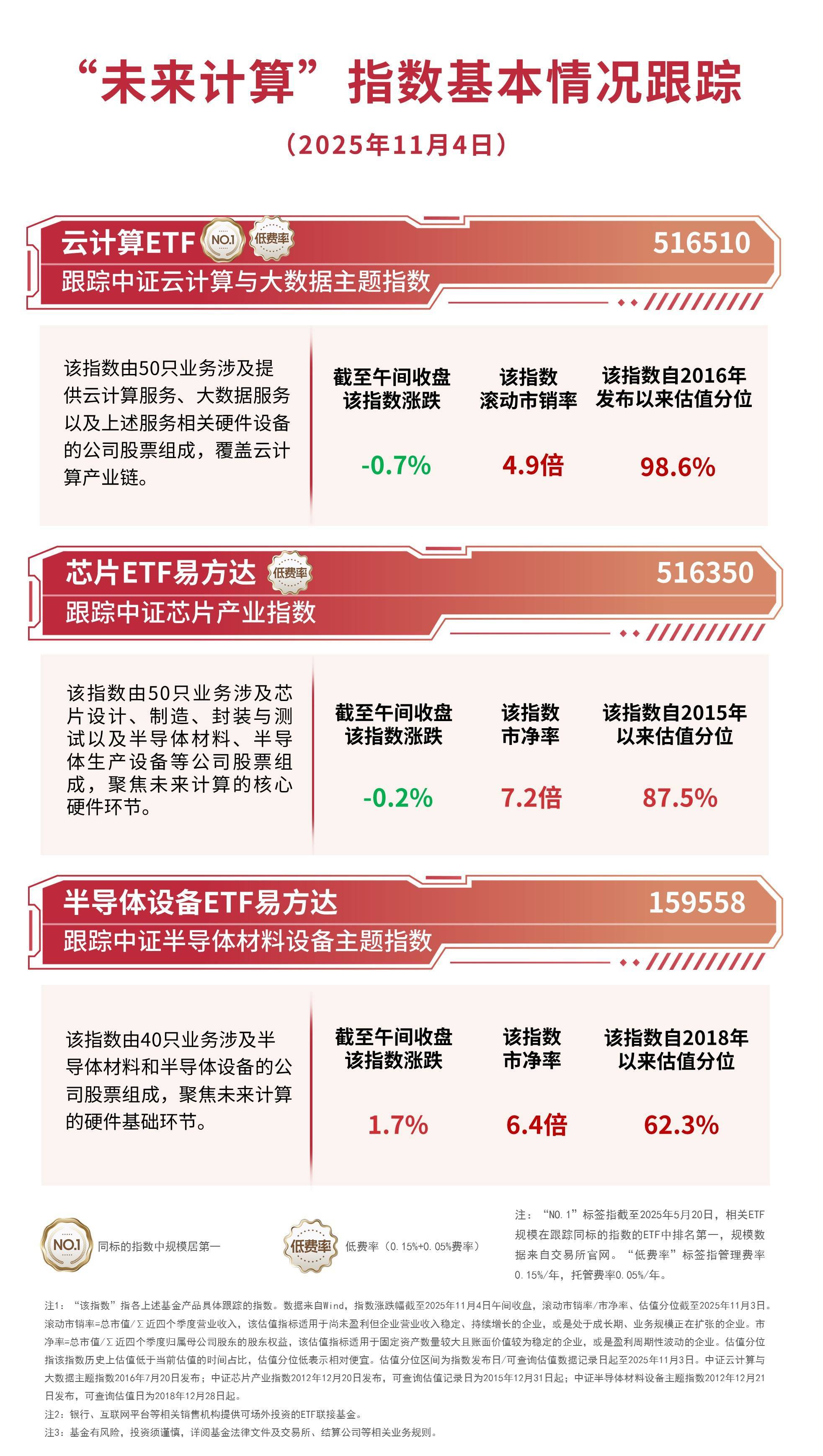
半导体设备板块逆势走强,半导体设备ETF易方达(159558)半日净申购超2000万份
Sou Hu Cai Jing· 2025-11-04 05:16
Group 1 - The index consists of 50 companies involved in chip design, manufacturing, packaging, testing, semiconductor materials, and semiconductor production equipment, focusing on the core hardware aspects of future computing [2] - The semiconductor equipment ETF managed by E Fund tracks the CSI Semiconductor Materials and Equipment Theme Index, which includes 40 companies related to semiconductor materials and equipment, emphasizing the hardware foundation for future computing [3] - As of the midday close, the index experienced a change of -0.2% [3]
格科微跌2.03%,成交额1.26亿元,主力资金净流出1892.82万元
Xin Lang Cai Jing· 2025-11-04 03:09
Core Viewpoint - Geke Micro's stock has experienced a decline recently, with a notable drop in trading volume and significant net outflow of funds, despite a year-to-date increase in stock price [1][2]. Company Overview - Geke Micro, established on September 3, 2003, and listed on August 18, 2021, is located in the Shanghai Free Trade Zone. The company specializes in the research, design, and sales of CMOS image sensors and display driver chips [1]. - The revenue composition of Geke Micro includes 80.51% from CMOS image sensors, 19.41% from display driver chips, and 0.08% from other sources [1]. Financial Performance - For the period from January to September 2025, Geke Micro reported a revenue of 5.723 billion yuan, representing a year-on-year growth of 25.66%. The net profit attributable to shareholders was 50.1886 million yuan, showing a significant increase of 518.75% [2]. - Since its A-share listing, Geke Micro has distributed a total of 152 million yuan in dividends [3]. Shareholder Information - As of September 30, 2025, the number of Geke Micro's shareholders increased to 29,100, up by 9.06% from the previous period. The average number of circulating shares per shareholder rose by 58.14% to 85,969 shares [2]. - Among the top ten circulating shareholders, Hong Kong Central Clearing Limited holds 41.0368 million shares, an increase of 15.1347 million shares from the previous period. Conversely, the holdings of E Fund's and Huaxia's ETFs decreased [3].
