
中国资产重估

Search documents
重视港股龙头公司投资机遇
Zhong Guo Zheng Quan Bao· 2025-10-15 20:15
Group 1 - The Hong Kong stock market has experienced greater volatility compared to the A-share market in recent years, with 2020 marking a significant turning point [1] - Prior to 2020, the Hong Kong and US stock markets were positively correlated, but this changed post-2020 due to high valuations of growth and consumer stocks, regulatory challenges for internet companies, continuous foreign capital outflow, and risks associated with leading real estate companies [1] - Recent trends indicate a reversal in these factors, with a surge in IPO financing, leading companies' stock prices in Hong Kong surpassing those in A-shares, and a consistent increase in net purchases of Hong Kong stocks by southbound funds [1] Group 2 - Over the past year, sectors such as technology, dividends, and pharmaceuticals in the Hong Kong market have significantly outperformed the A-share market, with the level of stock holdings in Hong Kong becoming a critical factor for investment success [2] - Hong Kong internet companies have notably benefited from advancements in artificial intelligence, while high-dividend stocks have thrived in a low-interest-rate environment [2] - The innovative pharmaceutical sector, which faced substantial declines in previous years, is now experiencing explosive growth, driven by increased overseas business and improved domestic healthcare policies [2] Group 3 - Despite the recent rebound in the Hong Kong market, major indices are still considered to be undervalued compared to other global markets, indicating potential for further price increases [2] - The overall profitability of companies in the Hong Kong market has improved significantly, suggesting a need for re-evaluation of Chinese assets, starting with Hong Kong stocks [2] - Leading companies in the Hong Kong market are viewed as having better liquidity and higher potential returns, with capabilities to operate globally across various industries [2] Group 4 - Over the past decade, many industries in China have seen increased concentration, and the next five to ten years may witness a widening gap between industry leaders and followers [3] - Investment strategies focused on long-term holding and selecting understandable companies align closely with value investing principles [3] - The essence of successful investing is to "choose wisely, buy right, and hold on," with the holding phase being the most challenging and critical [3]
(经济观察)关税扰动难改A股中长期向上趋势
Zhong Guo Xin Wen Wang· 2025-10-15 08:48
Core Viewpoint - The recent announcement of increased tariffs by the U.S. on Chinese goods has led to heightened volatility in the A-share market, but analysts believe this will not alter the long-term upward trend of the market [1][2]. Group 1: Market Reaction and Economic Resilience - Following the recent tariff announcements, the A-share market rebounded, with the Shanghai Composite Index rising over 1% to surpass 3900 points [1]. - Analysts assert that China's strong economic fundamentals and resilience can withstand the impact of U.S. tariffs, as evidenced by a significant year-on-year increase of 8.3% in China's total exports in September, despite a notable decline in exports to the U.S. [1][2]. - In the first three quarters, China's trade with Belt and Road Initiative countries reached 17.37 trillion yuan, a year-on-year increase of 6.2%, indicating a growing diversification in trade relationships [1]. Group 2: Limited Impact of Tariffs - Analysts, including Yuan Fang from Guotou Securities, believe that the impact of the newly announced 100% tariffs will be limited, as the market has become desensitized to tariff shocks following previous trade tensions [2]. - Historical context shows that high tariffs have often been used as negotiation tactics by the Trump administration, suggesting that the likelihood of these tariffs being fully implemented is low [2]. - The upcoming holiday season in the U.S. poses a risk of supply shortages for certain goods if the tariffs are enforced, which could lead to further negotiations [2]. Group 3: Long-term Investment Opportunities - Analysts emphasize that the current external shocks should be viewed as disturbances rather than threats to the overall market trend, with a clear boundary on trade risks compared to previous situations [3]. - The ongoing transformation of the Chinese economy, along with a decline in risk-free returns and capital market reforms, creates a strong demand for quality assets, making current market dips potential buying opportunities [3]. - The restructuring of the global monetary order and the declining safety of U.S. dollar assets are expected to lead to a revaluation of RMB assets, supporting a stable upward trajectory for the A-share market [3].
关税扰动难改A股中长期向上趋势
Zhong Guo Xin Wen Wang· 2025-10-15 08:38
Group 1 - The recent announcement by the US to impose additional tariffs on Chinese goods has led to increased volatility in the Chinese A-share market, but analysts believe this will not change the long-term upward trend of the market [1][2] - Despite a significant year-on-year decline in exports to the US in September, China's overall export value in USD increased by 8.3% year-on-year, indicating resilience in the face of tariff impacts [1] - In the first three quarters, China's trade with Belt and Road Initiative countries reached 17.37 trillion yuan, a year-on-year increase of 6.2%, accounting for 51.7% of total trade, suggesting limited impact from US tariffs [1] Group 2 - Analysts believe that the potential impact of the US's 100% tariff announcement on A-shares will be limited, as the market has become less sensitive to tariff shocks following previous trade tensions [2] - Historical data shows that high tariffs have not effectively changed trade dynamics, as evidenced by the significant drop in US imports from China after previous tariff increases [2] - Current trade risks are perceived to have clearer boundaries compared to earlier shocks, and ongoing policy signals are aimed at stabilizing the capital market, suggesting that external shocks will not derail market trends [3] Group 3 - The ongoing transformation of the Chinese economy, along with a decline in risk-free returns and capital market reforms, is creating a strong demand for quality assets, making any asset price declines due to external shocks a potential buying opportunity [3] - The restructuring of the global monetary order and the declining safety of dollar assets are expected to lead to a revaluation of RMB assets, supporting the long-term upward trajectory of the A-share market [3] - Upcoming policy planning related to the 14th Five-Year Plan and the positive fundamentals of the Chinese technology sector are expected to contribute to a stable and progressive market environment [3]
中国资产重估仍在延续,A50ETF(159601)一键打包核心资产
Mei Ri Jing Ji Xin Wen· 2025-10-15 04:36
Group 1 - The A-share market showed mixed performance after a strong opening, with the MSCI China A50 Connect Index demonstrating resilience, rising approximately 0.5% during the session, led by stocks such as Luzhou Laojiao, Haiguang Information, and Agricultural Bank [1] - According to the chief strategist of China International Capital Corporation (CICC), while short-term events may impact risk appetite, the medium-term market uptrend remains intact, supported by upcoming policy plans like the "14th Five-Year Plan," positive fundamentals in sectors like technology, and relatively reasonable overall A-share valuations [1] - The A50 ETF (159601) closely tracks the MSCI China A50 Connect Index, providing a diversified exposure to 50 leading stocks in the A-share market, making it a preferred choice for both domestic and foreign investors [1] Group 2 - The sector distribution of the A50 ETF's constituent stocks includes electronics, banking, food and beverage, and power equipment [1] - The top ten holdings of the A50 ETF include Zijin Mining, CATL, Industrial Fulian, Kweichow Moutai, Haiguang Information, BYD, Cambricon Technologies, Hengrui Medicine, China Merchants Bank, and Luxshare Precision [1]
外围扰动下短期市场避险情绪升温,机构仍看好中长期行情,A500ETF基金(512050)涨0.61%
Sou Hu Cai Jing· 2025-10-15 02:49
Core Viewpoint - The A-share market shows resilience despite recent external disturbances, with a potential for long-term upward trends supported by policy planning and favorable industry fundamentals [1] Market Performance - The three major stock indices opened lower but rebounded, with the CSI A500 index slightly up. As of 10:20 AM, the A500 ETF (512050) rose by 0.61% [1] - Notable component stocks included Zijin Mining up 1.63%, CATL up 1.44%, and Ping An Insurance up 0.89%, while Kweichow Moutai, Midea Group, and Dongfang Fortune also saw slight increases [1] Investor Sentiment - Recent market adjustments have led to increased risk-averse sentiment among investors, but the sell-off is not panic-driven, indicating market resilience [1] - Multiple investment institutions suggest that while risk assets may face short-term pressure, the long-term positive trend for A-shares remains intact [1] Analyst Insights - According to Li Qiusuo, Chief Analyst of Domestic Strategy at CICC, the recent events may impact risk appetite in the short term, but the foundation for market growth remains strong [1] - Upcoming policy frameworks such as the "14th Five-Year Plan" and the ongoing positive trends in technology sectors contribute to a favorable outlook for A-shares [1] - The overall valuation range of A-shares is considered reasonable, suggesting that any irrational short-term adjustments could present good reallocation opportunities [1]

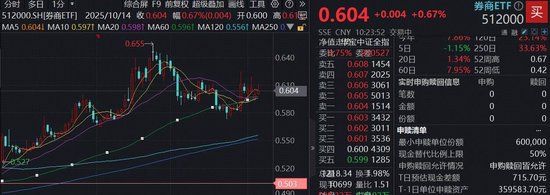
重回3900点,三季报将至,机构重申券商战略性配置机会!顶流券商ETF(512000)低调4连阳,单日再揽5.3亿元
Xin Lang Ji Jin· 2025-10-14 03:15
Market Overview - On October 14, the Shanghai Composite Index opened higher, surpassing 3900 points, with the brokerage sector showing strong performance [1] - The brokerage ETF (512000) saw a peak increase of over 1.8% during the session, currently up 0.67%, marking a four-day consecutive rise [1] - The trading volume exceeded 700 million yuan within half a day, indicating high trading sentiment [1] Brokerage Sector Performance - The brokerage sector is experiencing widespread gains, with Guoyuan Securities leading with a 4% increase, followed by GF Securities with over a 2% rise, and several others like Dongfang Securities and Huatai Securities rising over 1% [2] - As of September 30, the brokerage sector has seen a year-to-date increase of 9%, ranking 20th out of 32 industries, with a price-to-book (PB) ratio of 1.58, indicating potential for upward valuation [4] Institutional Insights - Institutions suggest that the global monetary order is accelerating its restructuring, leading to a decline in the safety of dollar assets, while renminbi assets are expected to continue being revalued [3] - The upcoming third-quarter reports are anticipated to show high growth in brokerage earnings, serving as a significant catalyst for the sector [3] Capital Market Dynamics - The capital market is undergoing a fundamental shift towards collaborative development in investment and financing, with enhanced strategic importance and policy support from various departments [3] - The low-interest-rate environment is reshaping asset allocation logic, leading to increased returns and reduced volatility in equity markets, which is driving a migration of funds from institutions and residents [3] ETF Performance - The brokerage ETF (512000) has seen a net inflow of 5.35 billion yuan recently, with a total net inflow exceeding 5.3 billion yuan over the past 20 days [4] - The ETF currently has a scale exceeding 36 billion yuan, with an average daily trading volume of over 1 billion yuan, making it one of the largest and most liquid brokerage ETFs in the A-share market [5] Investment Strategy - The brokerage ETF (512000) tracks the CSI All Share Securities Company Index, encompassing 49 listed brokerage stocks, with nearly 60% of its holdings concentrated in the top ten leading brokerages [6] - This ETF serves as an efficient investment tool, balancing exposure to leading brokerages while also capturing the high growth potential of smaller brokerages [6]
午评:创业板指跌3% 稀土永磁板块逆势爆发
Xin Hua Cai Jing· 2025-10-13 05:45
Market Overview - The A-share market experienced a collective decline, with the ChiNext Index dropping by 3% [1] - As of the midday close, the Shanghai Composite Index was at 3846.25 points, down 1.30%, with a trading volume of 727.1 billion; the Shenzhen Component Index was at 13013.34 points, down 2.56%, with a trading volume of 850.9 billion; and the ChiNext Index was at 3019.81 points, down 3.00%, with a trading volume of 391.8 billion [1] - The total trading volume for the Shanghai and Shenzhen markets was 1.58 trillion, a decrease of 65.9 billion compared to the previous trading day [1] Sector Performance - The rare earth permanent magnet sector saw significant gains, with stocks like Galaxy Magnetic and China Ruilin hitting the daily limit [2] - The military industry sector was active, with Changcheng Military Industry achieving two consecutive limit-ups [2] - The semiconductor sector continued its strong performance, with stocks like New Lai Material and Kaimete Gas also achieving two consecutive limit-ups [2] - Conversely, the robotics sector weakened, with Daying Electronics hitting the daily limit down [2] Institutional Insights - CICC noted that recent global events have caused noticeable disturbances in major assets, but the impact on A-shares is expected to be less severe than in early April [3] - The firm emphasized that the revaluation of Chinese assets is ongoing, supported by favorable policies and a reasonable valuation range for A-shares [3] - CITIC Securities highlighted that recent market fluctuations are influenced by adjustments in financing policies for popular stocks, but the overall impact is expected to be limited [4] - Starstone Investment suggested that the market may see a recovery in trading sentiment as risk-averse funds return, especially with the upcoming 20th National Congress [4] Export Growth - The General Administration of Customs reported a 54.9% increase in the export of industrial robots in the first three quarters [5] - The export of wind power equipment also saw a growth of 23.9% [5] - Traditional handicrafts like dragon boats and wood carvings have gained popularity in international markets, reflecting a blend of traditional craftsmanship with contemporary elements [5] Company News - Vanke announced the resignation of Chairman Xin Jie, with Huang Liping elected as the new chairman [6]


刚刚!美股期货大涨,多只中概股夜盘反攻
Zheng Quan Shi Bao· 2025-10-13 01:04
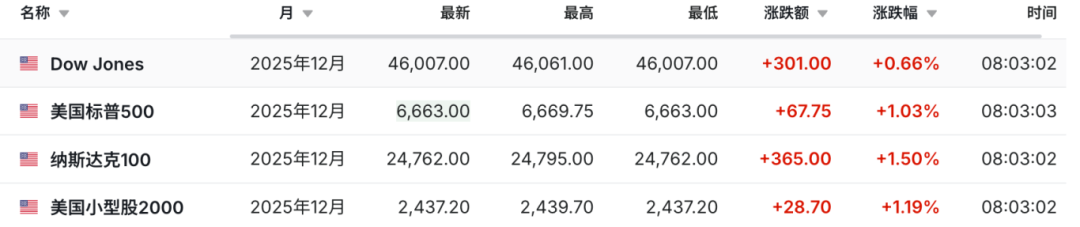
Market Overview - US stock index futures opened significantly higher on October 13, with the Dow futures up 0.66%, S&P 500 futures and Nasdaq 100 futures both rising over 1% [1] - The Dow Jones futures reached 46,007.00, marking an increase of 301.00 points or 0.66% [2] - The S&P 500 futures increased by 67.75 points to 6,663.00, reflecting a rise of 1.03% [2] - Nasdaq 100 futures rose by 365.00 points to 24,762.00, a gain of 1.50% [2] - The Russell 2000 futures for small-cap stocks increased by 28.70 points to 2,437.20, up 1.19% [2] Chinese Stocks Performance - Chinese stocks in the US market rebounded in after-hours trading, with Alibaba rising over 5%, Baidu and NIO up over 4%, and JD.com increasing by over 2% [2] Global Market Reactions - Following a significant drop in global assets on October 10, where the Nasdaq fell over 3%, the VIX fear index surged over 31% [5] - The Chinese government responded to the US's announcement of a 100% tariff on rare earth exports and software controls, emphasizing a need for dialogue and respect in trade relations [5] Investment Outlook - CICC's report indicates that the recent events have caused notable disturbances in global assets, but the medium-term trend remains intact, with a continued revaluation of Chinese assets expected [6] - The report suggests that the impact on A-shares will be less severe than in early April, as the market had already priced in rapid adjustments at that time [6] - Guotai Junan Securities expresses a more optimistic view compared to consensus, stating that the current trade risks are clearer and domestic financial stability is more assured, suggesting that external shocks will not derail the overall trend [7] Cryptocurrency Market - The cryptocurrency market saw a significant rebound, with Bitcoin rising over 4% to above $115,000, and Ethereum increasing by over 10% [7] - Other cryptocurrencies like SOL and Dogecoin also experienced gains of over 10% [7] Gold Market - Gold prices surged again, with spot gold reaching a high of $4,060.05 per ounce, marking a new historical record [10] South Korean Market - The South Korean stock market opened significantly lower but stabilized, with the KOSPI index initially dropping over 2.6% before narrowing its losses to around 1.4% [12]



中金:短期冲击不改中期趋势 中国资产重估仍在延续
Zheng Quan Shi Bao Wang· 2025-10-13 00:26
Core Viewpoint - The recent unexpected events have significantly disturbed major global assets, but the medium-term trend remains unchanged, with ongoing revaluation of Chinese assets [1] Group 1: Market Impact - The short-term impact of the recent events on A-shares is expected to be weaker than the situation in early April, as the market had already priced in severe and rapid adjustment expectations at that time [1] - China's quick and effective response during the previous incident is likely to reduce investor concerns about similar shocks in the future [1] Group 2: Future Outlook - In the short term, the recent events may affect risk appetite, potentially extending the market adjustment that began at the end of August [1] - From a medium-term perspective, the global monetary order is accelerating its restructuring, leading to a decline in the safety of dollar assets, while renminbi assets will continue to be revalued [1] - Factors such as upcoming policy plans like the "14th Five-Year Plan," positive trends in the technology sector, and relatively reasonable overall valuation ranges for A-shares suggest that the current market conditions may be more conducive to long-term and stable growth [1] - If A-shares experience irrational overshooting due to short-term emotions, it may provide a favorable opportunity for reallocation into A-shares [1]
中金:中美关税“再升级” 短期冲击不改中期趋势
Di Yi Cai Jing· 2025-10-13 00:15
Core Viewpoint - The recent escalation in the China-U.S. economic and trade conflict is expected to have a weaker impact on the A-share market compared to the situation in early April, due to prior market adjustments and effective responses from China [1] Group 1: Market Impact - The current situation may affect risk appetite, potentially extending the market adjustment that began at the end of August [1] - The overall assessment indicates that the impact on A-shares will be less severe than in April, as the market had already priced in significant adjustments at that time [1] Group 2: Long-term Outlook - The restructuring of the global monetary order is accelerating, leading to a decline in the safety of U.S. dollar assets, which will continue to favor the revaluation of RMB assets [1] - Upcoming policy plans, such as the "14th Five-Year Plan," and the positive fundamentals in sectors like technology suggest that the foundation for market growth remains intact [1] - A-share valuations are considered relatively reasonable, indicating that the current market conditions may support a more stable and long-term growth trajectory [1] Group 3: Investment Opportunities - If irrational market sentiment leads to excessive adjustments in the short term, it may present favorable opportunities for reallocation into A-shares [1]