
双碳政策

Search documents
近2000亿主力资金狂涌!化工板块震荡盘整,机构看好三大主线布局机会
Xin Lang Cai Jing· 2025-12-05 02:50
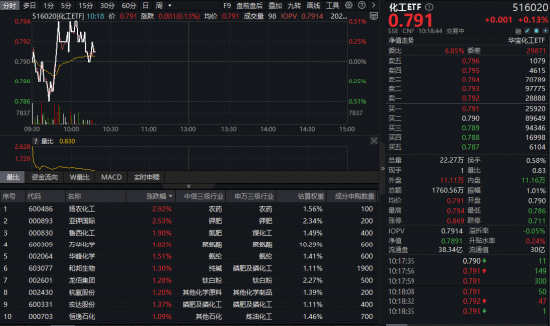
Group 1 - The chemical sector experienced fluctuations on December 5, with the chemical ETF (516020) showing a price increase of 0.13% [1][9] - Key stocks in the sector, including agricultural chemicals, potassium fertilizers, and polyurethane, saw significant gains, with Yangnong Chemical and Yaqi International both rising over 2% [1][9] - The basic chemical sector has attracted substantial capital recently, with a net inflow of over 2.2 billion yuan on the day, ranking fifth among 30 sectors [12][13] Group 2 - The chemical ETF (516020) has a price-to-book ratio of 2.32, which is at a relatively low level compared to the past decade, indicating potential value for long-term investment [4][11] - Future demand in the chemical industry is expected to recover gradually, driven by improvements in macroeconomic conditions and consumption stimulus policies [5][6] - Investment opportunities may arise in sectors such as organic silicon, polyester filament, and phosphate chemicals, which are expected to benefit from favorable supply-demand dynamics and government policies [12][13] Group 3 - Salt Lake Co. reported stable operations in its lithium salt project, achieving a daily output of 60-70 tons with a purity of over 99.7%, indicating strong production performance [10][11] - The basic chemical sector has seen a cumulative net inflow of 196.8 billion yuan over the past 60 days, ranking third among 30 sectors [12][13] - The chemical ETF (516020) provides exposure to a diversified range of chemical sub-sectors, with nearly 50% of its holdings in large-cap leading stocks [13]





周期团队联合展望 - 2026年度策略报告汇报会议
2025-12-03 02:12
Summary of Key Points from Conference Call Records Industry Overview - **Copper Market**: Expected price increase to 120,000 CNY/ton due to lower global copper mine production growth compared to demand growth, leading to a persistent supply-demand gap. A weak dollar environment is favorable for copper's financial attributes [1][4][3] - **Aluminum Market**: Benefiting from domestic supply-side reforms and strong demand, with projected consumption growth of 1.5% to 2.3% for electrolytic aluminum by 2028. Raw material prices are relatively weak, but product prices remain strong, leading to substantial profits [1][4][5] - **Precious Metals Market**: Long-term outlook remains positive due to global financial order restructuring, dollar credit issues, and geopolitical factors supporting gold prices. Silver has seen rapid price increases, and attention is drawn to the gold-silver ratio recovery [1][6] - **Minor Metals**: Thorium and tantalum show investment potential, with thorium's supply-demand mismatch due to global energy shortages and nuclear power development. Tantalum prices are expected to recover due to export controls [1][7] - **New Materials**: Fields such as AI chips, inductors, capacitors, and new materials for robotics have significant growth potential, driven by expanding applications of emerging technologies [1][7] Steel Industry Insights - **Challenges and Opportunities**: The steel industry faces a contradiction between the increasing proportion of high-end products and supply surplus. Attention is needed on production restriction policies, new iron ore capacity releases, and cost changes. High-end special steel is expected to see development opportunities [1][13] - **Demand Structure Changes**: The demand for construction steel has significantly declined, with manufacturing becoming the primary growth point, accounting for over 50% of demand. Key sectors include machinery, automotive, and energy [1][21][22] - **Profit Influencing Factors**: Steel industry profits are influenced by cost factors (iron ore and coking coal prices), demand from real estate and manufacturing, and the effectiveness of production restriction policies [1][28] Market Projections - **Iron Ore Market**: Supply is expected to increase significantly in 2026, with new projects contributing substantial increments. Iron ore prices are projected to be under pressure, potentially dropping from approximately 101 USD to around 90 USD [2][26] - **Coking Coal Market**: Expected to remain stable in 2026 after significant fluctuations in 2025, with supply gradually recovering from various regions [2][27] Investment Strategies - **Investment Recommendations**: Investors are advised to focus on high-dividend, high-return leading companies across various sectors. Continuous monitoring of real estate sales and construction starts is crucial, along with the development potential in special steel [1][30]
中原证券:化工行业逐步进入景气阶段 从供给与需求两端寻找投资机会
智通财经网· 2025-12-02 01:44
Core Viewpoint - The chemical industry is expected to see a marginal recovery in overall profitability due to the continuous improvement of China's macro economy and consumer stimulus policies, despite a slowdown in fixed asset investment [1][2]. Group 1: Industry Demand and Supply - The gradual recovery of downstream demand and the slowdown in new production capacity are contributing to a stabilization in chemical industry profits, with sectors like agrochemicals, fluorochemicals, and new energy experiencing rapid revenue and profit growth [2]. - The chemical industry has seen a decline in fixed asset investment growth in 2023, with further reductions expected from 2025, alleviating the pressure of overcapacity in the future [2]. - The demand from sectors such as automotive, home appliances, and textiles is expected to recover moderately starting in 2024, driven by both supply and demand factors [2]. Group 2: Regulatory Environment and Industry Structure - The ongoing implementation of anti-involution policies is expected to strengthen supply-side constraints in the chemical industry through administrative regulation and industry self-discipline [2]. - The decline in fixed asset investment is anticipated to gradually reverse the overcapacity situation in the industry, promoting a gradual recovery in industry prosperity [2]. - Enhanced regulatory requirements regarding environmental protection, safety supervision, and emissions reduction are expected to optimize the industry structure and promote high-quality development [2]. Group 3: Investment Strategy - Investment strategies should focus on sectors with orderly supply-demand dynamics and good self-discipline foundations, such as organic silicon and polyester filament industries [3]. - Attention should also be given to the phosphate chemical industry, which is benefiting from rapid growth in downstream energy storage demand, indicating a positive outlook for industry prosperity [3]. - The biofuel industry, which is supported by national policies and the dual carbon policy, is also recommended for investment [3]. - Key integrated leading companies to watch include Wanhua Chemical, Satellite Chemical, and Baofeng Energy, along with opportunities in organic silicon, polyester filament, phosphate chemicals, and biofuels [3].

第七届金麒麟宏观研究最佳分析师第一名浙商证券李超最新观点:2026年宏观年度展望——直挂云帆济沧海
Xin Lang Zheng Quan· 2025-12-01 03:13
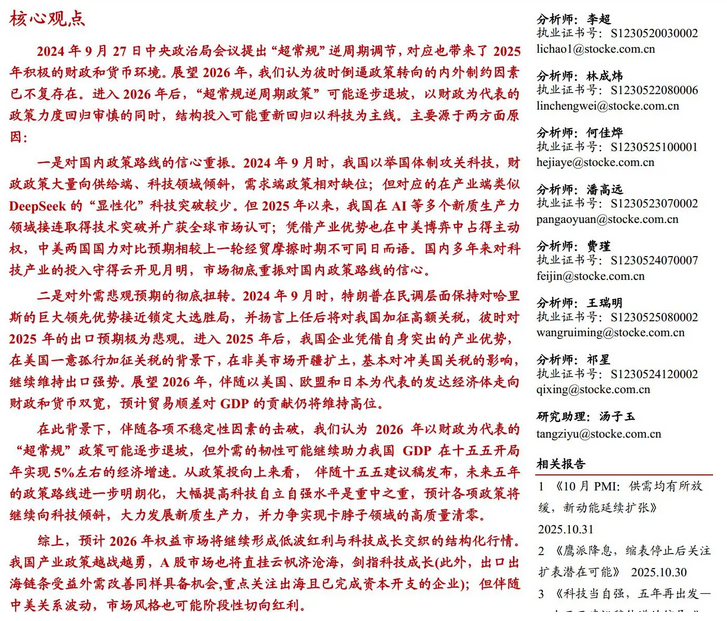
Core Viewpoint - The macroeconomic outlook for 2026 suggests a positive start for China's economy, with a focus on technological self-reliance and new productivity cultivation, supported by resilient external demand and domestic fiscal policies aimed at boosting consumption and investment [3][5][6]. Economic Outlook - The GDP growth rate for 2026 is projected to be around 4.8%, with expectations of a strong start to the "15th Five-Year Plan" [6][7]. - Industrial growth is expected to remain stable, with a focus on high-tech industries and a supportive policy environment [7][8]. - The service sector is anticipated to benefit from improved industrial production and consumer spending recovery [8]. Consumption - The nominal growth rate of retail sales is expected to be 4.1% in 2026, driven by policies promoting consumption upgrades and the gradual lifting of restrictive measures [10][12]. - The "old-for-new" consumption policy is likely to continue, focusing on sectors such as elderly care and health [12][13]. - The easing of restrictions in the automotive and housing sectors is expected to support consumer demand [13][15]. Investment - Fixed asset investment growth is projected at 2.5% for 2026, with manufacturing and broad infrastructure investments expected to drive growth [17][18]. - Manufacturing investment is anticipated to grow by 6.5%, supported by large-scale equipment updates and favorable export conditions [18][19]. - Broad infrastructure investment is also expected to grow by 6.5%, driven by new policy financial tools and local government initiatives [21][22]. Trade and Exports - Export growth is projected at 4.7% for 2026, supported by global fiscal expansion and China's efforts to penetrate non-US markets [29][30]. - The trade surplus is expected to maintain a high level, with a growth rate of 13.1% [29][30]. - China's exports to non-US markets are likely to continue to grow, aided by investments and trade cycles [33][34].

北交所万里行|滤清器首家上市公司安徽凤凰,守护车的“呼吸”
Xin Jing Bao· 2025-11-25 08:57
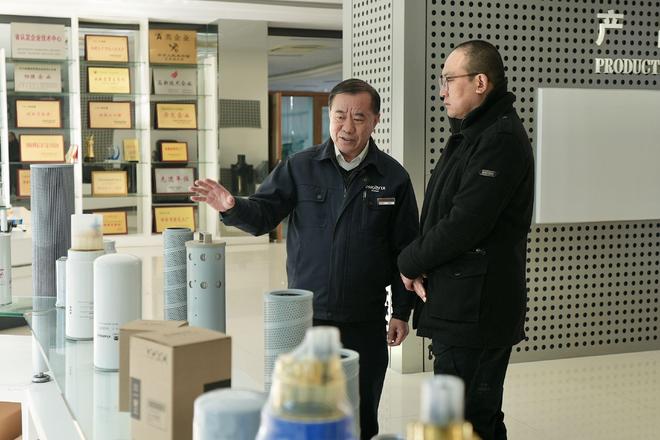
Core Viewpoint - Anhui Phoenix Co., Ltd. is a leading manufacturer of automotive filters in China, focusing on research, development, and production, with a wide range of products and a strong commitment to quality and innovation [1][3][4]. Group 1: Company Overview - Anhui Phoenix is located in Bengbu, Anhui Province, and is a high-tech joint venture specializing in automotive filter manufacturing [1]. - The company has developed over 9,000 types of filters, covering both passenger and commercial vehicles [1][3]. - It exports products to more than 30 countries and regions, including the EU and Southeast Asia [1]. Group 2: Research and Development - The company invests heavily in R&D, with over 10 million yuan spent in the first three quarters of the year, accounting for 3.3% of its revenue [3][4]. - Anhui Phoenix holds 135 valid patents and has participated in the formulation of national and industry standards [4]. - The company has developed specialized filters for electric vehicles, aligning with the industry's shift towards electrification and intelligence [3][4]. Group 3: Production and Quality Control - Anhui Phoenix emphasizes quality control throughout its production process, implementing smart manufacturing to enhance efficiency and product quality [4]. - The company has established a 4,500 cubic meter clean air chamber in its laboratory to ensure high-quality testing conditions [3][4]. Group 4: Market Position and Financial Performance - Anhui Phoenix became the first listed company in the automotive filter industry in China after successfully listing on the Beijing Stock Exchange [7]. - The listing has improved the company's financing capabilities, supporting its industrial projects and R&D center [7]. - The company has maintained a stable cash dividend policy for ten consecutive years, responding to investor interests [8]. Group 5: Future Development - The company plans to expand its product range into new sectors such as engineering machinery and motorcycles, adapting to market demands [8]. - It aims to develop new materials for filters to meet the lightweight requirements of modern vehicles [8].
广州“铜钱大厦”降价近1.4亿元二拍,曾被戏称为“最丑建筑”
Xin Lang Cai Jing· 2025-11-19 10:56
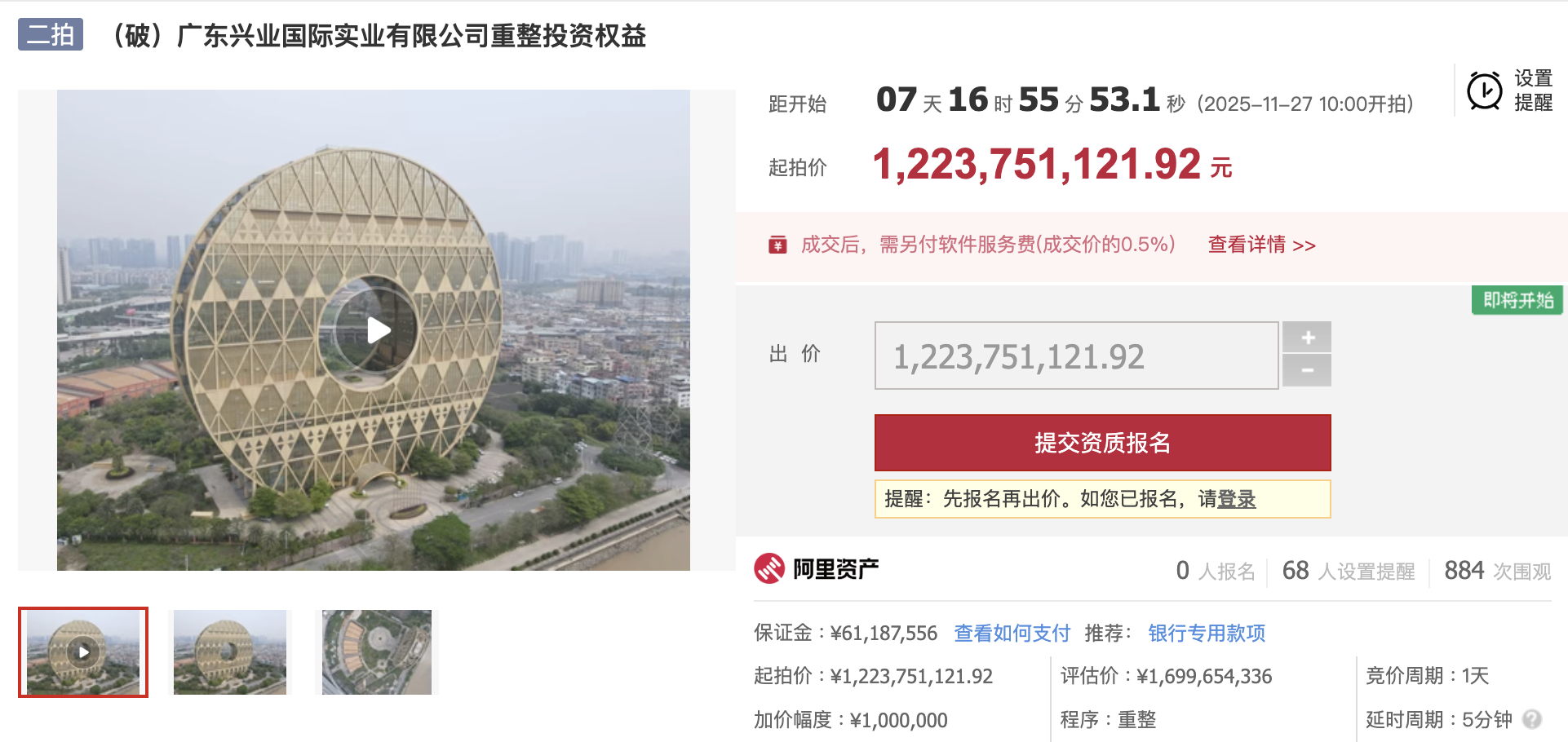
Group 1 - The auction for Guangdong Xingye International Industrial Co., Ltd.'s restructuring investment rights is set for November 27, with a starting price of 1.224 billion yuan, down from 1.36 billion yuan in the previous auction on November 13, which had no bids [1] - The core asset being auctioned is the controversial "Copper Coin Building," officially named Guangzhou Round Building, located in the Liwan District of Guangzhou, with a total construction area of approximately 105,000 square meters [4] - Guangdong Xingye International was established in June 2004, with a registered capital of 50 million yuan, and is primarily engaged in domestic trade and property leasing [6] Group 2 - Hongda Xingye Group, the major shareholder of Guangdong Xingye International, has faced declining profitability since 2019 due to a downturn in the chemical industry and increased environmental costs [6] - The Guangzhou Round Building was previously put up for auction in April 2022 as collateral due to Hongda Xingye Group's debt crisis, and the company applied for bankruptcy liquidation in February 2023 [7] - The starting price for the building was initially set at approximately 5.589 billion yuan but failed to attract any bids, leading to a subsequent auction with a reduced starting price of 1.36 billion yuan in October 2023 [7]
机构:“反内卷”重塑煤炭核心价值
Zheng Quan Shi Bao Wang· 2025-11-13 03:29
Core Viewpoint - The coal sector is undergoing a transformation characterized by a "de-involution" trend, which is reshaping its core value and presenting medium to long-term investment opportunities due to the recovery of profitability and high dividend yields [2][3]. Group 1: Policy and Regulatory Developments - The Inner Mongolia Autonomous Region government has issued a plan for the construction of a beautiful Inner Mongolia, emphasizing the clean, low-carbon, and efficient utilization of coal energy from 2025 to 2035 [2]. - The plan includes optimizing coal production capacities in regions such as Hulunbuir, Xilin Gol, and Ordos, while also promoting advanced capacity construction in Tongliao and managing rare coal types [2]. Group 2: Market Dynamics and Investment Outlook - According to Xinda Securities, the coal sector possesses "de-involution" characteristics and has not fully reflected the expected recovery in profitability, indicating a high dividend safety margin for quality coal companies [2]. - Open Source Securities highlights that coal has transitioned from being a traditional cyclical stock to embodying both cyclical and dividend attributes, making it a recognized value asset in a weak economic environment [3]. - The dual attributes of coal as both a cyclical and dividend stock are expected to position it as a priority asset for market capital allocation, especially in the context of supply-demand mismatches influenced by policy and market adjustments [3].
“江大系”储能黑马冲刺港股:20天估值大增44亿,却遭证监会追问
Sou Hu Cai Jing· 2025-11-11 13:16
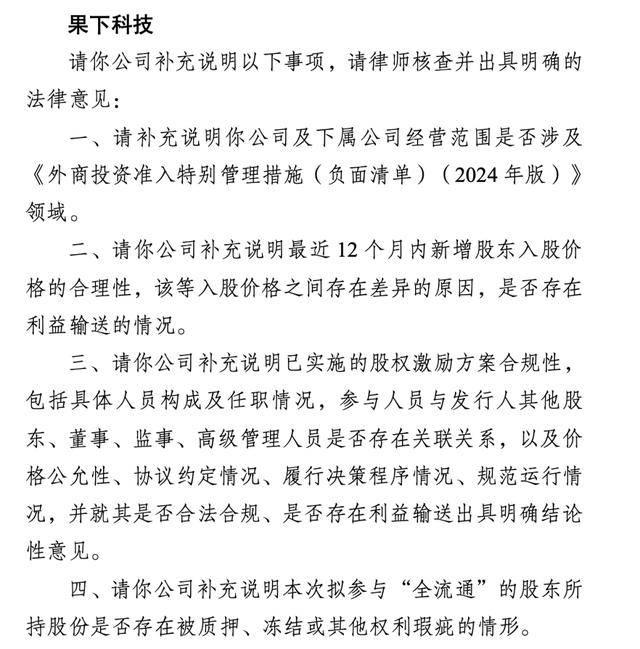
Core Insights - Guoxia Technology, a rising star in the energy storage sector, is preparing for its IPO on the Hong Kong Stock Exchange after a significant valuation increase [1][3][6] Company Overview - Founded in 2019, Guoxia Technology has rapidly grown, with its valuation reaching 6 billion RMB after a recent investment round [3][4] - The company initially focused on residential energy storage but has successfully transitioned to large-scale energy storage systems, with revenue from this segment increasing to 76.6% by 2024 [4][5] Financial Performance - Guoxia Technology's revenue has shown a steep growth trajectory, with figures of 1.42 billion RMB in 2022, 3.14 billion RMB in 2023, and projected 10.26 billion RMB in 2024 [4][6] - The company's profit margins have declined significantly, with gross margins dropping from 25.1% in 2022 to 12.5% in 2025 [7][8] Investment and Valuation - The company's valuation surged from 16.32 billion RMB to 60 billion RMB in just 20 days, raising regulatory scrutiny regarding the fairness of the investment pricing [3][6] - The influx of capital from investors like Shenzhen Ningqian and Kaibo Hongcheng is seen as a strategic move to enhance liquidity and attract mainland investors post-IPO [6][9] Strategic Partnerships - Guoxia Technology has established a strategic partnership with Zhongchuang Xinhang, which plays multiple roles as both a major customer and supplier [9][10] - The partnership includes a three-year agreement prioritizing procurement and project orders, indicating a mutually beneficial relationship [10]
构建石化行业央企ESG评价体系:核心在于能源环境管理和安全生产:A股央企ESG评价体系白皮书系列报告之十九
Shenwan Hongyuan Securities· 2025-11-11 09:07
Investment Rating - The report does not explicitly state an investment rating for the petrochemical industry or its central enterprises [32]. Core Insights - The petrochemical industry is crucial for national economic stability and is focused on achieving green and sustainable development alongside safe production practices [3][6]. - The report emphasizes the importance of constructing an ESG evaluation system for central enterprises in the petrochemical sector, highlighting energy transition and safety production as core indicators [8][27]. Summary by Sections 1. ESG Policies in the Petrochemical Industry - The industry primarily involves the processing and sale of crude oil and natural gas into various chemical products, with a significant focus on green and sustainable development [3][6]. - Recent government policies aim to guide the industry towards a green low-carbon transition and high-quality development, emphasizing strict energy efficiency constraints and enhanced management [7][8]. 2. Construction of the ESG Evaluation System - The ESG evaluation system for central enterprises in the petrochemical industry includes five additional secondary indicators: New Energy Business Transformation, Oil Leak Risk Management, Public Awareness Investment, Overseas Community Development, and Safety Production [8][10]. - The evaluation system consists of general indicators, environmental indicators, social indicators, and governance indicators, totaling 18 primary indicators and 45 secondary indicators [8][10]. 3. Environmental Indicators - Environmental indicators are designed under the guidance of dual carbon policies, with a focus on new energy business transformation and oil leak risk management as unique indicators for the petrochemical sector [10][12]. - The system includes metrics for waste management, biodiversity protection, and compliance with environmental regulations, reflecting the industry's commitment to ecological sustainability [10][11]. 4. Climate Change Response Indicators - The climate change response indicators assess the commitment of petrochemical central enterprises to global climate change management and domestic dual carbon policies, comprising one primary indicator and four secondary indicators [16][18]. - The report highlights the importance of aligning with national goals for carbon peak and neutrality, urging the industry to transition towards cleaner energy sources [16][18]. 5. Social Responsibility Indicators - Social indicators reflect the responsibilities of petrochemical central enterprises, particularly in public environmental safety awareness and employee training, with three primary indicators and nine secondary indicators [18][19]. - The report emphasizes the need for enterprises to integrate social responsibility into their operations, especially in overseas projects [19][20]. 6. Governance Indicators - Governance indicators are fundamental for sustainable development, focusing on corporate governance structures, mechanisms, and norms, with a total of 34 points available [23][24]. - The report does not introduce specific indicators unique to the petrochemical sector under governance but maintains a focus on overall governance quality [23][24].
构建石化行业央企ESG评价体系:核心在于能源环境管理和安全生产
Shenwan Hongyuan Securities· 2025-11-11 08:45
Investment Rating - The report rates the petrochemical industry as "Positive" [4] Core Insights - The petrochemical industry focuses on processing and selling crude oil and natural gas to produce various chemical products, with a significant emphasis on achieving green sustainable development and safe production [4][9] - The establishment of an ESG evaluation system for state-owned enterprises in the petrochemical sector is crucial, particularly in light of national policies aimed at promoting green and low-carbon transitions [4][10] - The ESG evaluation system incorporates specific indicators related to energy transition and safety production, highlighting the importance of environmental and social issues [4][11] Summary by Sections 1. ESG Policies in the Petrochemical Industry - The industry is primarily concerned with sustainable development and safe production, as emphasized by recent national policies [10] - Key policies include the "Action Plan for Accelerating Oil and Gas Exploration and Development and Integration with New Energy (2023-2025)" and guidelines for promoting green innovation in the refining industry [10][11] 2. Construction of the ESG Evaluation System - The ESG evaluation system includes five secondary indicators: "New Energy Business Transformation," "Oil Leak Risk Management," "Public Awareness Investment," "Overseas Community Development," and "Safety Production," all of which are considered positive factors [4][11] - The evaluation system is built on general indicators and includes 18 primary indicators and 45 secondary indicators, with a focus on environmental, social, and governance aspects [4][11] 3. Environmental Indicators - Environmental indicators are aligned with national dual carbon policies and include specific metrics such as "New Energy Business Transformation" and "Oil Leak Risk Management," with a total of 4 secondary indicators and 10 tertiary indicators [13][21] - The report highlights the importance of waste management and biodiversity protection as critical areas of focus for the petrochemical industry [13][14] 4. Climate Change Response Indicators - The climate change response indicators reflect the industry's commitment to managing climate change and adhering to domestic dual carbon policies, comprising 1 primary indicator and 4 secondary indicators [21][22] 5. Social Responsibility Indicators - Social indicators assess the industry's responsibility, particularly in raising public environmental awareness and ensuring safety in production, with 3 primary indicators and 9 secondary indicators [23][24] - The report emphasizes the need for effective training and awareness programs for employees and communities, especially in overseas projects [25] 6. Governance Indicators - Governance indicators are fundamental for sustainable development and include 3 primary indicators and 10 secondary indicators, focusing on corporate governance structures and mechanisms [28][30]