宽基指数

Search documents
中证A500ETF一周年:冷热不均渐显
Bei Jing Shang Bao· 2025-09-21 15:57
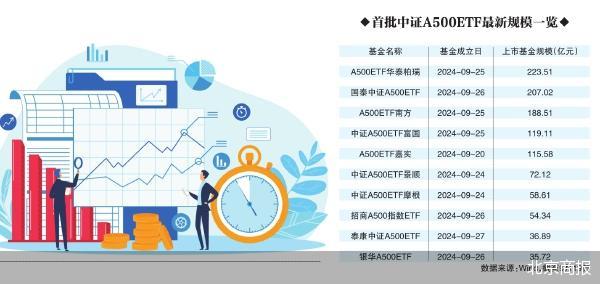
Core Insights - The China Securities A500 ETF has experienced significant growth and market presence since its launch, but it is now facing challenges with scale and differentiation in a competitive environment [1][3][10] Group 1: Market Performance - As of September 19, the total scale of the China Securities A500 ETF reached 1899.26 billion yuan, with the first batch of 10 funds accounting for 1111.41 billion yuan, or 58.52% of the total [3][4] - Five public funds have products exceeding 100 billion yuan, with Huatai-PineBridge and Guotai Asset leading at 223.51 billion yuan and 207.02 billion yuan respectively [4] - The average return of the 24 A500 ETFs launched in 2024 since 2025 has reached 21.71% [10] Group 2: Competitive Landscape - The market is witnessing a "winner-takes-all" scenario, where larger public funds are gaining a significant advantage over smaller ones, with some products from smaller firms struggling to exceed 30 billion yuan [7][9] - The first batch of A500 ETFs has shown a decline in scale for most products, with only Huatai-PineBridge's product showing a growth of 28.1% [7][8] Group 3: Strategic Adjustments - Companies are shifting their strategies from aggressive marketing to focusing on market outlook analysis and guiding investment strategies such as grid and regular investment [4][5] - There is an emphasis on building trust with institutional investors while also expanding outreach to individual investors [5][11] Group 4: Future Outlook - The A500 ETF is expected to require time to grow its market presence and attract stable, long-term capital [11][12] - The introduction of related derivatives is anticipated to enhance the attractiveness of the A500 index and draw in more diverse investors, including insurance funds and pension plans [12]

中证A500ETF面市一周年:总规模近1900亿,冷热不均现象渐显
Bei Jing Shang Bao· 2025-09-21 14:32
Core Insights - The China Securities A500 ETF has experienced significant growth and market attention since its launch, but recent trends indicate a divergence in performance among different funds within the A500 ETF family [1][10] - Despite a reduction in overall scale, the long-term growth potential of the A500 ETF remains significant, with expectations for increased institutional investment and product diversification [10][11] Group 1: Market Performance - As of September 19, the total scale of the A500 ETF reached 1899.26 billion yuan, with the first batch of 10 funds accounting for 1111.41 billion yuan, or 58.52% of the total [3][4] - Five public funds have products exceeding 100 billion yuan in scale, with Huatai-PineBridge and Guotai Asset leading at 223.51 billion yuan and 207.02 billion yuan, respectively [4] - The A500 ETF family has expanded from 10 to 43 products within a year, indicating strong market interest and participation [3][4] Group 2: Marketing and Strategy - Initial marketing strategies focused heavily on product promotion, but have shifted towards market outlook analysis and investment strategies like grid and regular investment [4][8] - Companies are enhancing their engagement with institutional investors while also expanding outreach to individual investors to build trust and increase product liquidity [5][8] Group 3: Challenges and Competition - The competitive landscape has intensified, with larger public funds outperforming smaller ones, leading to a "winner-takes-all" scenario in the ETF market [6][9] - Many smaller public funds are struggling to maintain market presence and profitability, with some funds experiencing significant scale declines [6][7] Group 4: Future Outlook - The A500 ETF is expected to require time to cultivate a stable investor base, with potential for growth as market conditions improve and investor recognition increases [10][11] - The introduction of derivative products related to the A500 index is anticipated to attract more institutional investors and enhance the overall market appeal [11]

一周市场数据复盘20250919
HUAXI Securities· 2025-09-20 07:26
- The report uses Mahalanobis distance to measure industry crowding based on weekly price and transaction volume changes[3][15] - Last week, the automobile industry showed significant short-term crowding, as identified by deviations exceeding 99% confidence levels in the Mahalanobis distance analysis[16][15]
A股市场快照:宽基指数每日投资动态-20250919
Jianghai Securities· 2025-09-19 09:23
- The report primarily focuses on tracking and analyzing the performance of broad-based indices in the A-share market, including metrics such as daily returns, moving averages, turnover rates, and valuation indicators like PE-TTM and dividend yield[1][2][3] - The turnover rate calculation is based on the formula: $ \text{Turnover Rate} = \frac{\Sigma(\text{Floating Shares of Constituents} \times \text{Turnover Rate of Constituents})}{\Sigma(\text{Floating Shares of Constituents})} $ This metric is used to evaluate the liquidity of the indices, with the highest turnover rate observed in the CSI 2000 (5.85) and the lowest in the SSE 50 (0.44)[17][18] - The daily return distribution analysis highlights the kurtosis and skewness of the indices. For instance, the ChiNext Index exhibits the highest positive kurtosis and skewness, indicating a concentration of returns and a higher likelihood of extreme positive returns, while the CSI 2000 shows the lowest values in these metrics[24][25] - Risk premium analysis uses the 10-year government bond yield as the risk-free rate. The CSI 500 and CSI 1000 indices show relatively high 5-year percentile values for risk premium (20.48% and 19.68%, respectively), suggesting higher relative investment attractiveness compared to indices like the SSE 50 (7.86%)[27][29][31] - PE-TTM analysis reveals that the CSI 500 and CSI All Share indices have the highest 5-year percentile values (99.92% and 96.78%, respectively), indicating elevated valuation levels. Conversely, the ChiNext Index has a lower 5-year percentile value (59.5%), suggesting relatively moderate valuation[39][43][44] - Dividend yield analysis shows that the ChiNext Index (65.79%) and CSI 1000 (41.16%) are at higher 5-year historical percentile levels, reflecting their attractiveness in terms of cash return. In contrast, the CSI 500 (14.63%) and CSI 2000 (11.4%) are at lower historical levels, indicating less emphasis on dividend payouts[48][52][53]
超150亿,猛加仓
Zhong Guo Ji Jin Bao· 2025-09-12 04:41
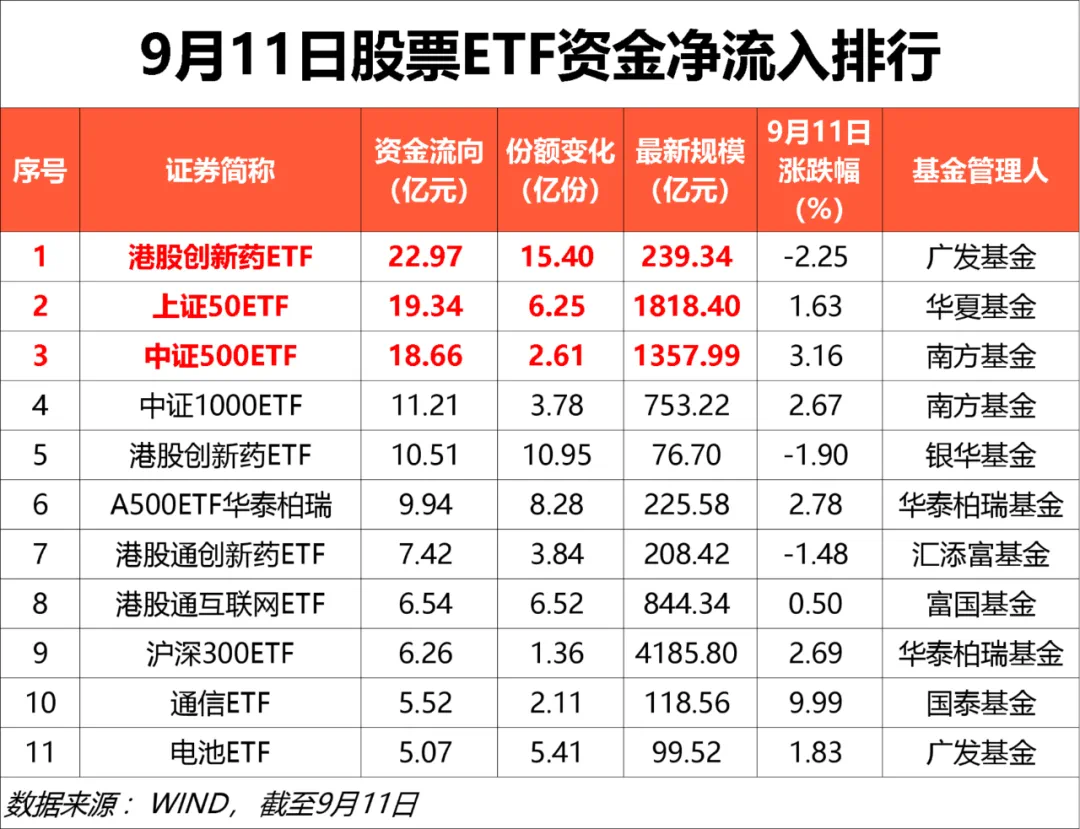
Core Viewpoint - The A-share market experienced a significant rally on September 11, with major indices rising, particularly the ChiNext Index which surged by 5.15%, indicating a strong inflow of funds into stock ETFs, totaling 15.611 billion yuan [1][2]. ETF Market Overview - As of September 11, the total scale of all stock ETFs in the market reached 4.32 trillion yuan, with a net inflow of 15.611 billion yuan on that day [2]. - The Hong Kong market ETFs saw the largest net inflow, amounting to 7.359 billion yuan, with innovative drug-related products attracting significant investment despite a drop in the sector [2]. Sector-Specific Inflows - The innovative drug ETFs led the inflow, with the Guangfa Fund's Hong Kong innovative drug ETF receiving a net inflow of 2.297 billion yuan, while the Yinhua Fund's similar ETF saw 1.051 billion yuan [2]. - Broad-based ETFs also performed well, with a net inflow of 5.396 billion yuan, particularly the ETF tracking the CSI A500 index, which attracted 2.524 billion yuan [2]. Broker and Battery Sector Performance - The brokerage sector, referred to as the "bull market flag bearer," saw multiple securities ETFs experience net inflows, with the Hong Kong Stock Connect non-bank ETF accumulating over 1 billion yuan in net purchases over three consecutive trading days [3]. - The battery sector also received substantial investment, with Guangfa Fund's battery ETF attracting 507 million yuan, making it the largest battery ETF in the market with a total scale of 9.952 billion yuan [3]. Fund Management Insights - E Fund's ETFs saw significant inflows, with the medical ETF gaining 370 million yuan and the Hang Seng Technology ETF receiving 280 million yuan [4]. - Guangfa Fund led the market with a total net inflow of 3.7 billion yuan across its ETFs, focusing on leading products in the innovative drug and battery sectors [5]. Market Outlook - The liquidity easing is expected to provide valuation support for A-shares, with potential for a continued upward trend in the market driven by favorable policies and improved market conditions [7].
一文详解:凭什么中证A500是超级指数
雪球· 2025-09-10 08:08
Core Viewpoint - The article discusses the unique characteristics and advantages of the China Securities A500 Index, highlighting its role in the A-share market and its potential for investment opportunities [3][8][33]. Group 1: Index Characteristics - The China Securities A500 Index includes leading companies from all industries, making it distinct in its comprehensive coverage [8][9]. - The selection process for the A500 involves multiple rounds of elimination based on trading activity, market capitalization, and ESG ratings, ensuring only the most viable stocks are included [12][14][18][19]. Group 2: Selection Process - The first round eliminates stocks with low trading activity, specifically those in the bottom 10% of average daily trading volume over the past year [12]. - The second round removes stocks with small market capitalization, specifically those in the bottom 70% [14]. - The third round excludes stocks that do not support trading through the Shanghai-Hong Kong or Shenzhen-Hong Kong Stock Connect, enhancing liquidity [16]. - The final round eliminates stocks with poor ESG ratings, ensuring the selected companies are sustainable and responsible [18]. Group 3: Industry Coverage - The A500 Index is designed to have a balanced industry representation, which helps mitigate risks associated with overexposure to any single sector [23]. - Compared to the CSI 300 Index, the A500 has a higher representation of emerging industries like industrials and information technology, while having less exposure to traditional sectors like finance and consumer goods [25]. Group 4: Advantages and Disadvantages - The balanced industry allocation of the A500 enhances its risk resilience, but it may lead to relatively average returns during market rallies driven by specific sectors [28]. - The A500 has a shorter historical data period compared to other indices like the CSI 300, which limits the ability to assess its performance across various market conditions [31]. Group 5: Performance Insights - The A500 has shown significant performance, with some quantitative private equity funds achieving nearly 35% returns year-to-date, compared to 14% for the CSI 300 Index [33].

宽基表现不凡,指增基金成超额收益利器
私募排排网· 2025-09-06 03:05
Core Viewpoint - The article emphasizes that broad-based indices remain a fundamental investment choice, while index-enhanced funds add value by combining the stability of broad indices with additional returns through quantitative stock selection, factor models, and risk control [3][15]. Market Overview - The A-share market experienced some fluctuations last week, but broad indices like the CSI 300, CSI 500, and CSI 1000 performed well, with high trading activity. The Shanghai Composite Index has maintained a stable position above the 10-day moving average for 19 consecutive trading days, indicating strong market momentum driven by policy expectations and capital inflows [5]. - As of September 3, 2025, the overall valuation levels of major broad indices are relatively high, suggesting that the current market logic is not driven by "undervalued opportunities" [5][6]. Industry Rotation - The speed of industry rotation remains high, with the constructed "industry rotation speed indicator" showing that the A-share market's sector switching rate has accelerated significantly over the past three years, reaching a peak at the end of 2023. Although there was a slight decline in 2024, the current indicator remains above the historical average, indicating that investors often miss out on profits due to rapid changes in market trends [8][9]. - Historical data suggests that when the size rotation speed indicator rises, large-cap stocks tend to outperform, while a decline favors small-cap stocks. The current indicator is above the average, indicating market style instability, making it challenging to rely solely on timing and sector betting [9]. Investment Strategy - In the current environment, focusing on broad indices rather than chasing rapidly changing sector trends is deemed a more rational choice. Relying solely on broad-based ETFs may yield returns equivalent to the index itself, making it difficult to achieve better performance in a high-valuation context. Index-enhanced funds stand out by providing both diversification and market exposure while striving for excess returns [12][15]. - The article highlights three index-enhanced funds with high excess Sharpe ratios: 1. Anxin Quantitative Selected CSI 300 Index Enhanced A, with a one-year excess Sharpe ratio of 1.13, utilizing big data and AI algorithms for stock selection [13]. 2. China Europe CSI 500 Index Enhanced A, with a one-year excess Sharpe ratio of 2.03, maintaining a balanced style and dynamic risk factor exposure [14]. 3. Guotai Junan CSI 1000 Index Enhanced A, with a one-year excess Sharpe ratio of 2.66, focusing on alpha factors and risk control through machine learning [14]. Conclusion - Broad indices continue to be a foundational investment choice, while index-enhanced funds provide an opportunity for excess returns without the need for frequent timing. In a market characterized by volatility and structural trends, index-enhanced funds may serve as a tool for balancing long-term allocation and excess returns [15].

中证A500ETF(159338)跌近2%,资金逢低买入,盘中净申购超3亿份
Mei Ri Jing Ji Xin Wen· 2025-09-04 12:19
Group 1 - The A-share market has significantly declined, with the CSI A500 ETF (159338) dropping nearly 2% and a trading volume exceeding 2 billion yuan, indicating that funds are positioning themselves for lower prices, with net subscriptions exceeding 300 million shares today [1] - The CSI A500 index represents a balanced investment tool, comprising approximately 50% traditional value sectors and 50% emerging growth sectors, making it suitable for investors looking to allocate in the A-share market [1] - Given the current market volatility, broad-based ETFs like the CSI A500 are expected to help investors diversify their portfolios, presenting potential investment opportunities [1] Group 2 - The management fee for the CSI A500 ETF (159338) is 0.15%, and the custody fee is 0.05%, making it a cost-effective tool for investors [1]
创业板ETF(159915)半日成交额近50亿元,居深市股票型ETF第一
Mei Ri Jing Ji Xin Wen· 2025-09-03 05:20
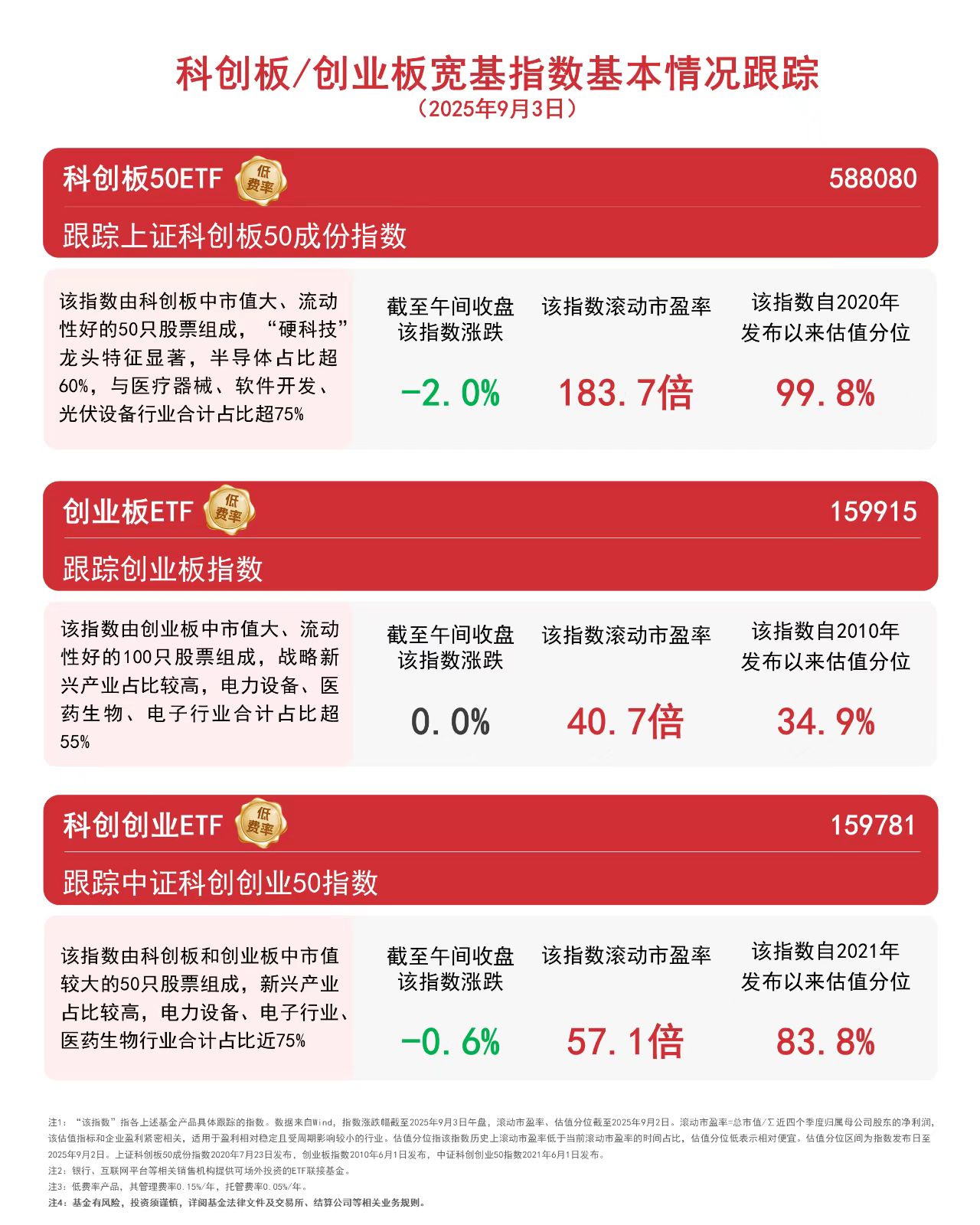
Group 1 - The Sci-Tech Innovation Board 50 ETF tracks the Shanghai Stock Exchange Sci-Tech Innovation Board 50 Index, consisting of 50 large-cap, liquid stocks with a significant focus on "hard technology," particularly in the semiconductor sector, which accounts for over 60% of the index [2] - The rolling price-to-earnings (P/E) ratio of the Sci-Tech Innovation Board 50 Index is 183.7 times, indicating a high valuation level [2] - The index has shown a price change of 20% since its inception [2] Group 2 - The ChiNext ETF tracks the ChiNext Index, which includes 100 large-cap, liquid stocks from the ChiNext market, with a high proportion of strategic emerging industries, particularly in power equipment, pharmaceuticals, and electronics, which together account for over 55% of the index [3] - The rolling P/E ratio for the ChiNext Index is 40.7 times, reflecting a moderate valuation [3] - The index has not shown any price change since its inception [3] Group 3 - The Sci-Tech Innovation and ChiNext ETF tracks the CSI Sci-Tech Innovation and ChiNext 50 Index, comprising 50 large-cap stocks from both boards, with a high concentration in emerging industries, particularly in power equipment, electronics, and pharmaceuticals, which together account for nearly 75% of the index [4] - The rolling P/E ratio for this index is 57.1 times, indicating a relatively high valuation [4] - The index has experienced a price change of 0.6% since its inception [4] Group 4 - The data for the indices is sourced from Wind, with the price changes recorded as of September 3, 2025, and the rolling P/E ratios and valuation percentiles as of September 2, 2025 [5] - The Sci-Tech Innovation Board 50 Index was launched on July 23, 2020, the ChiNext Index on June 1, 2010, and the CSI Sci-Tech Innovation and ChiNext 50 Index on June 1, 2021 [5]

中央汇金持仓ETF市值达1.29万亿元【国信金工】
量化藏经阁· 2025-09-02 00:06
Market Review - The A-share market saw all major broad-based indices rise, with the ChiNext Index, Sci-Tech 50, and SME Index leading gains at 7.74%, 7.49%, and 4.47% respectively, while the Shanghai Composite, CSI 1000, and CSI 300 lagged behind with returns of 0.84%, 1.03%, and 2.71% respectively [5][14] - The total net asset value of public funds reached a historical high of 35.08 trillion yuan as of the end of July 2025, an increase of 682.99 billion yuan compared to the end of June 2025 [11] - The central bank's net reverse repurchase operations amounted to 196.1 billion yuan, with a total of 22.731 trillion yuan in net open market operations [22][24] Fund Performance - Last week, newly established funds totaled 44, with a combined issuance scale of 27.205 billion yuan, showing an increase from the previous week [3] - Active equity, flexible allocation, and balanced mixed funds reported returns of 2.12%, 1.77%, and 1.51% respectively [33] - Year-to-date, active equity funds have performed the best with a median return of 25.09%, while flexible allocation and balanced mixed funds reported median returns of 19.08% and 10.88% respectively [36] Fund Issuance - A total of 46 funds were reported for issuance last week, including 9 FOFs and various ETFs focused on sectors such as new energy and technology [4][5] - This week, 42 funds are set to begin issuance, indicating a robust pipeline for new fund products [3] Central Huijin's ETF Holdings - Central Huijin's ETF investments reached 1.29 trillion yuan, covering 48 ETFs with a total holding of 383.5 billion shares [7] - The largest increases in holdings were seen in the Huatai-PB CSI 300 ETF, with an increase of 11.237 billion shares, followed by the Huaxia CSI 300 ETF and E Fund CSI 300 ETF [9][10] Industry Performance - The telecommunications, non-ferrous metals, and electronics sectors led the weekly gains with returns of 12.55%, 7.59%, and 5.94% respectively, while coal, transportation, and food and beverage sectors lagged with returns of -5.99%, 0.92%, and 1.21% [19][21] - Year-to-date, the telecommunications sector has shown the highest cumulative return of 62.57%, while the coal sector has the lowest at -5.99% [21] Bond Market - The central bank's net reverse repurchase operations and the downward trend in bond yields, except for the 10-year bonds, indicate a shift in the bond market dynamics [22][24] - The median premium rate for convertible bonds decreased to 23.78%, reflecting a reduction in market activity [28]