海洋经济

Search documents
中信建投证解读中央经济工作会议:积极政策取向未变,扩大内需为重点工作之首
Xin Lang Cai Jing· 2025-12-11 14:46
Core Insights - The central economic work conference concluded that current economic issues are primarily related to developing and transitioning challenges, which can be resolved through effort [1] - The conference outlined a 2026 economic vision focusing on expanding domestic demand, stabilizing investment, managing local government debt, advancing anti-involution measures, stabilizing the real estate market, and fostering new growth drivers [1][2] - Incremental policies were introduced, with a more proactive fiscal stance, maintaining a high deficit rate, expanding debt issuance, and tax reforms, while monetary policy remains "appropriately loose" targeting a reasonable recovery in prices [1][4] Fiscal Policy - The fiscal policy remains expansionary, with an emphasis on maintaining necessary fiscal deficits and total debt levels, with expectations for the deficit rate to stay at 4% and special bonds potentially expanding to 5 trillion yuan [5][17] - Local special bonds are expected to increase significantly to address fiscal difficulties and support local governments in debt management, with a notable rise in new special bonds issued this year [5][17] Monetary Policy - Monetary policy is anticipated to continue with rate cuts and reserve requirement ratio reductions, focusing on stabilizing economic growth and ensuring ample liquidity [6][18] - The emphasis on guiding financial institutions to support key areas such as domestic demand, technological innovation, and small and medium enterprises indicates the potential for more structural policy tools [7][19] Domestic Demand and Investment - Expanding domestic demand is prioritized, with strategies to boost consumption through income growth plans and optimizing policy implementations, while also addressing supply-side improvements [8][20] - Investment strategies aim to stabilize and increase central budget investments, optimize project implementations, and enhance urban renewal efforts, with expectations for infrastructure investment to improve [8][20] Real Estate Market - The real estate market is targeted for stabilization, with policies to control inventory and encourage the acquisition of existing homes for affordable housing, alongside potential demand-side support measures [9][21] - Despite stabilization efforts, real estate investment is likely to remain in negative growth territory due to ongoing constraints [9][21] Industry Trends - The focus on new growth drivers, including artificial intelligence, service industries, new energy, and marine economy, highlights the importance of innovation and industrial upgrading for economic development [10][22] - The commitment to addressing involution and enhancing service quality indicates a strategic shift towards sustainable economic practices, although consumer recovery remains uncertain [10][22]

中央经济工作会议点评:战略定力
Shenwan Hongyuan Securities· 2025-12-11 14:28
Core Insights - The report emphasizes the strategic determination reflected in the Central Economic Work Conference, which sets the tone for 2026 as "seeking progress while maintaining stability" with a focus on "more proactive fiscal policy" and "moderately loose monetary policy" [5] - It highlights the importance of integrating "stock and incremental policies" to address ongoing economic challenges and stresses the need to stabilize employment, enterprises, markets, and expectations [5] Fiscal Policy - The fiscal policy for 2026 is characterized as "more proactive," with expectations of maintaining a relatively high deficit ratio and advancing the pace of special bonds and government spending [5] - Key areas of focus include structural investments in "two new" and "two heavy" sectors, as well as a more rational approach to tax reductions and subsidies [5] - There is an ongoing emphasis on risk prevention, particularly regarding local government debt, urging proactive debt management and preventing the creation of hidden debts [5] Monetary Policy - The monetary policy is set to be "moderately loose," balancing price stability and liquidity [5] - The report stresses the importance of promoting stable economic growth and reasonable price recovery as key considerations for monetary policy [5] - It also calls for enhanced support from financial institutions for expanding domestic demand, technological innovation, and small and micro enterprises [5] Domestic Demand Expansion - Expanding domestic demand is prioritized for 2026, with a specific mention of implementing urban and rural resident income increase plans [5] - The report indicates a stronger emphasis on stimulating private investment and enhancing urban renewal projects [5] New Quality Productive Forces - The report notes that new quality productive forces are entering an "application landing phase," with a focus on integrating technological and industrial innovation [5] - It highlights the establishment of international technology innovation centers in key regions such as Beijing, Shanghai, and the Guangdong-Hong Kong-Macau Greater Bay Area [5] Reform Initiatives - Seven key reform initiatives are outlined, including the establishment of a unified national market and measures to combat "involution" [5] - Other reforms include deepening state-owned enterprise reforms, improving regulations for the private economy, and enhancing the local tax system [5] Risk Prevention - The report continues to address risk prevention in key areas such as the real estate market and local government debt [5] - It emphasizes the need for stable real estate market conditions and orderly promotion of quality housing construction [5] Regional Economic Development - The report introduces a focus on marine economic development and the planning of major bays [5] - It also reiterates the importance of stabilizing the birth rate and managing domestic economic work alongside international trade challenges [5] Long-term Investment Opportunities - The report identifies ten key investment directions for the future, including artificial intelligence, robotics, aerospace, and innovative pharmaceuticals [5] - It encourages capital market attention to these sectors as part of the "14th Five-Year Plan" investment opportunities [5] Market Outlook - The report maintains a mid-term "two-stage bull market" outlook, with expectations of a technology-driven bull market in 2025 and a subsequent phase in the second half of 2026 [5] - It highlights the need for high-level fluctuations and adjustments in the current market phase, while anticipating a comprehensive bull market supported by various positive factors [5] Spring Market Dynamics - The report continues to predict a spring market characterized by small-scale movements, with specific attention to sectors like commercial aerospace and robotics [5] - It notes that the upcoming policies and industrial themes will be significant sources of profit, particularly in the context of supply-side price cycles [5]
2025年中央经济工作会议学习体会:稳妥做增量,务实推存量
ZHONGTAI SECURITIES· 2025-12-11 12:48
Group 1: Economic Policy Framework - The central economic work meeting emphasizes the principle of "seeking progress while maintaining stability," focusing on stabilizing employment, enterprises, markets, and expectations to ensure smooth economic operation[2] - The meeting suggests a combination of "mandatory options + optional options" in macroeconomic policy, indicating a relatively stable approach to mandatory macro policies while allowing for counter-cyclical adjustments as needed[3] - The integration of stock and incremental policies is highlighted, with a commitment to continue implementing a more proactive fiscal policy while maintaining necessary fiscal deficits and total debt levels[3] Group 2: Consumer and Market Dynamics - Consumption is prioritized over investment in policy discussions, with specific measures to enhance consumer capacity, including the implementation of urban and rural resident income increase plans[4] - The meeting calls for the expansion of quality goods and services supply and the removal of unreasonable restrictions in the consumption sector to unleash service consumption potential[4] - The focus on addressing "involution" competition indicates a recognition of deeper structural issues, requiring comprehensive solutions rather than superficial capacity clearing[4] Group 3: Taxation and Industry Support - The meeting proposes to improve the local tax system, addressing the decline in local tax revenue share in fiscal income and expenditure, with potential adjustments to shared tax ratios to stabilize local government finances[5] - Specific industries are identified for targeted support, including artificial intelligence, digital trade, and green trade, aiming to create a favorable policy environment for development[5] - Employment remains a top priority in social policy, with a focus on stabilizing job opportunities for key groups such as college graduates and migrant workers[5] Group 4: Risk Management - The meeting emphasizes risk prevention, particularly in the real estate sector and local government debt, encouraging the acquisition of existing residential properties for affordable housing[6] - The report highlights potential risks including policy changes, unexpected economic fluctuations, and delays in updating research information[6]
【图解】速览!2026年经济工作八大重点任务
Zhong Guo Jing Ji Wang· 2025-12-11 12:29
Core Viewpoint - The Central Economic Work Conference held on December 10-11 in Beijing outlined eight key tasks for economic work in 2026, focusing on domestic demand, innovation, reform, openness, coordinated development, green transformation, public welfare, and risk management. Group 1: Domestic Demand - Emphasis on leading domestic demand and building a strong domestic market through actions to boost consumption and implement urban and rural income increase plans [1] - Expansion of quality goods and services supply, optimization of "two new" policy implementation, and removal of unreasonable restrictions in the consumption sector to unleash service consumption potential [1][2] - Encouragement of investment stabilization, with an increase in central budget investment scale and optimization of local government special bond usage [1] Group 2: Innovation - Focus on innovation-driven growth by developing a comprehensive plan for education, technology, and talent development [2] - Establishment of international technology innovation centers in key regions such as Beijing, Shanghai, and the Guangdong-Hong Kong-Macau Greater Bay Area [2] - Strengthening the role of enterprises in innovation and improving intellectual property protection in emerging fields [2] Group 3: Reform - Commitment to reform efforts to enhance high-quality development, including the establishment of a unified national market and further deepening state-owned enterprise reforms [3] - Initiatives to clear overdue payments to businesses and promote win-win scenarios for platform enterprises and their operators [3] - Expansion of market-oriented reforms and improvement of the local tax system [3] Group 4: Openness - Promotion of multi-field cooperation and gradual advancement of institutional openness, including the expansion of service sector autonomy and optimization of free trade zone layouts [4] - Encouragement of service exports and development of digital and green trade [4] - Strengthening of foreign investment promotion mechanisms and enhancing overseas service systems [4] Group 5: Coordinated Development - Coordination of urban-rural integration and regional collaboration, focusing on high-quality development in county economies [5] - Maintenance of arable land and food production stability, ensuring reasonable prices for key agricultural products [5] - Support for major economic provinces and enhancement of cooperation among key urban clusters [5] Group 6: Green Transformation - Advancement of energy-saving and carbon reduction initiatives in key industries and the establishment of a new energy system [6] - Strengthening of the national carbon emissions trading market and implementation of comprehensive waste management actions [6] - Promotion of environmental protection initiatives and improvement of disaster response infrastructure [6] Group 7: Public Welfare - Implementation of actions to stabilize employment for key groups such as college graduates and migrant workers, and support for flexible employment [7] - Adjustment of educational resource allocation to increase high school and quality university enrollment [7] - Optimization of drug procurement and deepening of medical insurance payment reforms [7] Group 8: Risk Management - Focus on stabilizing the real estate market with city-specific policies to control inventory and encourage the acquisition of existing housing for social welfare [8]


巨力索具(002342) - 巨力索具投资者关系管理信息
2025-12-11 09:46
Group 1: Company Overview and Product Lines - Giant Lifting Equipment Co., Ltd. is engaged in the development of deep-sea mooring technology, focusing on key technical bottlenecks in marine engineering equipment [2][3] - The company has established three main product lines: single-strand permanent mooring steel wire ropes, mooring fiber cables, and deep-sea mooring system accessories [3][4] - The company aims to enhance its industrialization and scale effects in the deep-sea mooring sector, establishing a wholly-owned subsidiary in Tianjin to support this goal [3] Group 2: Market Position and Competitive Advantages - Since 2023, the company has obtained multiple DNV factory recognition certificates, marking its transition from providing single mooring products to offering comprehensive long-term mooring solutions [4] - The company is the only enterprise with complete mooring system design and manufacturing capabilities, positioning it uniquely in the deep-sea mooring market [4][5] - The cost of mooring systems is significant in floating wind turbine projects, and the company’s lightweight and easy-to-install products are expected to be optimal choices for future industrialization and cost reduction [4] Group 3: Expansion and Future Plans - The company has established a wholly-owned subsidiary in Henan, which is expected to enhance production capacity and support the Tianjin subsidiary with quality raw materials [5][6] - The Henan subsidiary's first phase has fully released its production capacity, while the second phase is undergoing equipment debugging, expected to enter trial production by the end of the year [6] - The company has built stable sales channels with over 100 countries and regions, and has obtained certifications from eight national classification societies to facilitate international market expansion [6]

从水上到水下:海洋装备开辟新航道|OpenTalk直播预告
3 6 Ke· 2025-12-11 09:38
Group 1 - The government work report in 2025 highlights "deep-sea technology" as a core emerging industry, emphasizing the promotion of high-quality development in the marine economy, leading to a surge in marine economy concept stocks and financing for startups in the sector [2] - The marine technology sector is transitioning from "shallow sea exploration" to "deep sea development," with advancements in underwater robotics, intelligent sensing, and subsea data centers driving the rapid rise of marine equipment manufacturing and new marine energy industries [2] - China is positioned among the international leaders in marine technology due to continuous R&D investment, diverse application scenarios, and a well-established industrial ecosystem, despite facing challenges such as extreme environmental conditions and the need for key technology localization [2] Group 2 - A live event titled "From Water Surface to Underwater: Marine Equipment Opens New Channels" is scheduled for December 17, 2025, featuring discussions on intelligent ships, unmanned surface systems, underwater propulsion, and new energy ship power systems [3] - The event aims to explore the "breakthrough points" and "future trends" in marine technology, focusing on the development directions of waterborne equipment [3] - Entrepreneurs, investors, and industry practitioners interested in marine technology are encouraged to participate in the event for interactive discussions on the new driving forces of the blue economy [4]

机构:海洋经济驱动内需增长 相关产业链或受关注
Zheng Quan Shi Bao Wang· 2025-12-11 01:09
Core Insights - The Jiangsu Provincial Committee of the Communist Party of China has proposed to promote high-quality development of the marine economy and accelerate the construction of a strong marine province [1] - The focus is on enhancing marine technology capabilities, fostering high-level marine research institutions and technology enterprises, and advancing key marine technologies [1] - The development of modern shipping services and marine tourism industries is emphasized, along with the need for better port resource coordination and infrastructure improvements [1] Group 1: Marine Economy Development - The proposal includes the establishment of a national marine economy development demonstration zone, elevating the marine economy to a strategic level [2] - The potential of the marine economy is highlighted, with marine communication identified as a foundational infrastructure for future 6G networks [2] - The government work report has introduced "deep-sea technology" as a core emerging industry, indicating a shift towards supporting marine equipment, energy, and aquaculture sectors [2] Group 2: Industry Opportunities - The offshore wind and solar power sectors are expected to expand into deeper waters, indicating a significant growth opportunity [2] - The marine aquaculture industry is projected to have substantial growth potential, particularly for upstream feed companies that can leverage technological and service advantages [2] - Policy support and recovering demand are likely to benefit marine tourism enterprises with distinctive features [2]
中国海防:公司密切关注国家及各地方关于海洋经济发展的相关政策与规划
Zheng Quan Ri Bao Zhi Sheng· 2025-12-10 13:41
Group 1 - The company is closely monitoring national and local policies and plans related to the development of the marine economy [1] - The company is actively researching potential development opportunities in relevant fields, considering its own industry and technological characteristics [1] - This approach aims to provide references for long-term strategic planning [1]

盟浪常务副总裁葛兴安:壮大蓝碳交易市场 赋能海洋经济高质量发展
Xin Hua Cai Jing· 2025-12-10 07:38
Core Insights - The value of carbon sinks ultimately materializes in the market trading segment, with China's blue carbon trading market experiencing significant development since 2020 due to policy-driven initiatives [1] - Despite the progress, challenges remain in the blue carbon trading market, including insufficient liquidity, imperfect trading mechanisms, small transaction scales, and a limited number of participants [1] Group 1 - The blue carbon trading market in China has seen rapid growth since 2020, supported by national policies and successful pilot projects in coastal provinces [1] - Local governments have initiated distinctive blue carbon pilot projects that have shown significant results, expanding value realization from carbon trading to financial integration, such as carbon pledge and carbon insurance [1] - Current pain points in the blue carbon trading market include low liquidity, incomplete trading mechanisms, small transaction volumes, and a lack of diverse participants [1] Group 2 - To address these challenges, it is suggested to expand the participant base by encouraging listed companies to integrate blue carbon into sustainable information disclosure [2] - Innovative products such as small-scale blue carbon spot trading, blue carbon forward contracts, and resalable spot contracts could be introduced to enhance market liquidity [2] - Establishing a scientific pricing mechanism and a comprehensive trading ecosystem, along with clear regulatory frameworks and international cooperation, is essential for improving the market's international influence [2]
年终特别报道|这一年,经济运行总体平稳、稳中有进
Ren Min Ri Bao· 2025-12-10 03:57
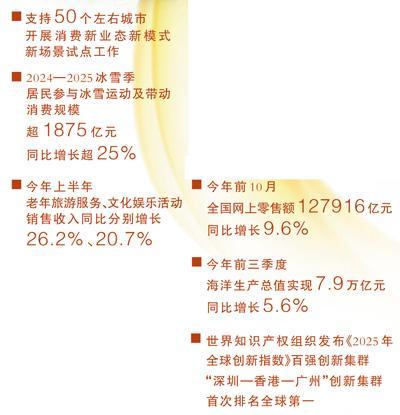
Group 1: Economic Development Trends - The year 2025 is significant for China's modernization process, with a focus on high-quality development and achieving major economic and social goals [2] - The Central Economic Work Conference highlighted the importance of developing new economic sectors such as the "first release economy," "ice and snow economy," "silver economy," and promoting healthy platform economy and county economy [3][4] Group 2: First Release Economy - The first release economy is gaining traction, with cities like Beijing, Shanghai, and Chengdu enhancing policy support to attract new brands and stores, becoming a key driver for domestic demand [3][6] - Chengdu has seen the establishment of 631 first stores in the first three quarters of the year, indicating a growing trend of "first release" becoming a lifestyle [8] Group 3: Ice and Snow Economy - The ice and snow economy is evolving from a seasonal focus to a year-round industry, with the market expected to exceed 1 trillion yuan by 2025 [3][9] - Harbin's Ice and Snow World is integrating technology and culture, offering diverse shopping and dining experiences to enhance consumer engagement [11] Group 4: Silver Economy - The silver economy is expanding with new service models for the elderly, including specialized travel services that cater to their needs, reflecting a shift in consumption patterns towards quality and personalization [12][13] - The elderly demographic is becoming a significant force in the tourism market, with over 80% of travelers on specialized trains being aged 60 and above [13] Group 5: Platform Economy - The platform economy is transitioning from a "what to sell" model to a "what is needed" approach, enhancing consumer experience through direct subsidies and one-stop services [14][15] - E-commerce platforms are driving growth in both domestic demand and foreign trade, with significant increases in sales and participation in global promotional events [16] Group 6: County Economy - The county economy is experiencing robust growth, with initiatives like "Hundred Villages, Thousand Stays" promoting eco-tourism and local industries, leading to increased income for local residents [17][18] - The integration of tourism and local agriculture is driving economic development, with significant increases in visitor numbers and revenue [18] Group 7: Marine Economy - The marine economy is focusing on green and low-carbon initiatives, with advancements in shipbuilding technology and sustainable practices [19][21] - The marine engineering sector is seeing growth, with a reported output value of 32.85 billion yuan in the first ten months of the year, reflecting a 16.9% increase [21] Group 8: Bay Area Economy - The Guangdong-Hong Kong-Macao Greater Bay Area is fostering innovation and collaboration, with companies leveraging regional strengths for technological advancements [22][24] - The synergy between Hong Kong's research capabilities and the manufacturing strengths of the Pearl River Delta is facilitating the commercialization of scientific innovations [24]