
量化宽松

Search documents
国联民生:流动性交易会如何变盘?
Xin Lang Cai Jing· 2026-01-18 15:03
Core Viewpoint - The article discusses the contrasting performance of global markets in early 2023, highlighting a broad rise in international stock markets while the U.S. market, particularly large-cap stocks, lagged behind, indicating a preference for small-cap stocks amidst a backdrop of liquidity and sentiment recovery [3][20]. Group 1: Market Trends - Global stock markets, including Japan, South Korea, and Singapore, have reached historical highs, while the Shanghai Composite Index has hit a 10-year peak [3][20]. - The U.S. market has shown a notable divergence, with large-cap stocks underperforming compared to small-cap stocks, suggesting a selective investment approach despite overall liquidity [3][20]. Group 2: Liquidity and Sentiment - The article emphasizes the importance of distinguishing between "big expectations" and "small certainties" regarding market liquidity and sentiment recovery [5][22]. - A significant drop in market trading activity was observed after the "Quadruple Witching Day" in December, marking the fastest decline in five years, which coincided with liquidity risk events [5][22]. - Following the year-end holidays, trading activity rebounded, leading to a notable market recovery [23]. Group 3: Fiscal and Monetary Policy - Fiscal expansion remains a key theme across major economies, driven by election-year dynamics in the U.S. and new leadership in Japan, alongside a revival in European fiscal efforts [7][25]. - The Federal Reserve's monetary policy adjustments, including the initiation of Reserve Management Purchases (RMP), are expected to enhance liquidity in the market [9][27]. - The anticipated scale of net purchases by the Federal Reserve over the next 12 months is projected to be $220 billion, with a monthly average of around $40 billion from January to April [9][27][28]. Group 4: Market Expectations and Risks - The market's expectations for fiscal and monetary stimulus are likely to be a significant source of volatility throughout the year [12][32]. - There is a cautious outlook on unconventional fiscal policies, such as direct payments to residents, due to potential legislative hurdles [12][32]. - The article outlines four potential scenarios for market dynamics based on the interplay of Federal Reserve policies and the strength of the U.S. dollar, indicating varying impacts on global assets [14][34].



数字人民币的出现对美元有啥影响?美联储印钱两年,大家怨声载道
Sou Hu Cai Jing· 2026-01-16 05:25
Group 1 - The article discusses the potential end of the US dollar's dominance and whether the Chinese yuan can rise to become a new global economic leader [1][3] - The US's superpower status relies on three pillars: a strong military, a dominant dollar system, and a democratic culture, all of which are interconnected [3] - The article raises questions about how the dollar's support structure might collapse and who could replace it, as well as how the dollar has helped the US recover from global crises [3] Group 2 - The COVID-19 pandemic significantly impacted the US, with over 65 million confirmed cases and nearly 870,000 deaths, yet there are claims of a return to normalcy [5][9] - The US government's response to the pandemic included a more relaxed approach, leading to severe economic challenges such as inflation and rising unemployment [9][10] - Quantitative easing was employed as a remedy, injecting money into the market, but it also raised concerns about inflation and wealth redistribution, particularly affecting the middle class [10][11] Group 3 - The wealth of US billionaires surged by $845 billion from March to September 2020, highlighting the disparity in economic recovery between the wealthy and the middle class [11] - The article notes that many countries, particularly Iran and Russia, are moving away from the dollar due to political opposition and the dollar's instability [13] - The introduction of digital yuan is seen as a strategic move by China to challenge the dollar's dominance, with its flexibility and central bank management being key advantages [13][14]


STARTRADER星迈:白银50天暴涨80%超黄金 本轮与历史有何不同?
Sou Hu Cai Jing· 2026-01-16 03:03
Core Viewpoint - The silver market has experienced a significant surge, with prices rising from $50.04 to $91.10 per ounce between November 24, 2025, and January 14, 2026, marking an 82.05% increase in just 50 days, surpassing gold's less than 75% increase during the same period [1] Group 1: Historical Context - Historical surges in silver prices in 1980 and 2011 ended in sharp declines, driven by speculative bubbles without fundamental support [3] - The 1980 surge was manipulated by the Hunt brothers, leading to a price spike to $50.35 per ounce, followed by a crash due to regulatory changes and liquidity tightening by the Federal Reserve [3] - The 2011 spike was fueled by quantitative easing, with prices reaching $49.80 per ounce, ultimately collapsing due to increased margin requirements and high leverage among speculators [3] Group 2: Current Market Dynamics - The current surge in silver prices is supported by both financial and industrial demand, unlike previous speculative-driven rallies [3] - Financially, global risk aversion and expectations of monetary easing have driven investment into precious metals, with weak U.S. inflation data reinforcing Fed rate cut bets [4] - Industrially, structural growth in silver demand from sectors like photovoltaics, AI servers, and electric vehicles has led to a supply-demand imbalance, with demand exceeding supply for five consecutive years [4] Group 3: Market Structure and Regulation - The current market structure is more diversified compared to past surges, with participation from retail investors, hedge funds, banks, ETFs, and some official institutions [4] - The largest silver ETF, iShares Silver Trust, has seen continuous net inflows, indicating a more varied funding composition [4] - Regulatory measures have been proactively implemented to curb excessive speculation, including raising margin requirements and limiting trading volumes, which may help mitigate extreme volatility [4] Group 4: Future Outlook and Diverging Opinions - There is a growing divide in market sentiment regarding the sustainability of the current price rally, with bullish forecasts predicting silver prices could reach $65 to $60 per ounce, while bearish views warn of overbought conditions and potential rapid declines [5] - Key variables influencing future price movements include Federal Reserve policy, geopolitical tensions, and industrial demand from sectors like photovoltaics and AI [5] - The effectiveness of regulatory policies and the flow of ETF investments will also play a crucial role in shaping market sentiment and price trends [5]
淡水泉陶冬:2026年 穿越“K型分化” 坚守“资产为王”
2 1 Shi Ji Jing Ji Bao Dao· 2026-01-15 14:36
Core Viewpoint - The global economy in 2026 is expected to experience significant differentiation, with geopolitical and economic uncertainties likely easing compared to 2025, while the logic of liquidity driving asset prices upward remains valid [1][4]. Economic Trends - The current economic landscape is characterized by a "K-shaped" development, where the disparity between GDP growth and the average citizen's living experience is stark, particularly in the U.S. [2][3]. - AI investments have surged, accounting for over 50% of total investments in the U.S., while other sectors are lagging and require new credit cycles to stimulate growth [2][6]. - The consumer market reflects similar disparities, with the top 10% of income earners capturing approximately 25% of stock market gains, while the lowest 10% are largely excluded from stock market benefits [2]. Political Implications - Economic disparities are translating into significant political changes globally, with moderate centrist influences declining and political polarization increasing [3]. Monetary Policy - The Federal Reserve is facing pressure to adjust its monetary policy due to rising wealth inequality, with potential leadership changes expected to lead to a more responsive approach to fiscal demands [4][5]. - The structure of the global bond market is changing, with rising long-term interest rates in Japan and Europe prompting a return of overseas funds to seek higher returns, impacting U.S. Treasury demand [5]. AI Investment Landscape - 2026 is anticipated to be a pivotal year for AI, transitioning from a focus on technological competition to a demand for profitability and sustainable business models [6][7]. - The financing landscape for AI companies is shifting, with some turning to bond markets and private credit, raising concerns about transparency and potential systemic risks [7][8]. Asset Allocation Strategies - The liquidity-driven asset price revaluation seen in 2025 is expected to continue into 2026, with a strong outlook for the Chinese yuan due to substantial trade surpluses [9][10]. - Precious metals are projected to remain attractive due to their independence from central bank policies and increasing industrial demand driven by technological revolutions [9]. - A-shares and Hong Kong stocks are likely to outperform U.S. stocks in 2026, attributed to valuation disparities and a low-interest-rate environment in China [10].
4100点很适合风险教育
集思录· 2026-01-14 14:48
Core Viewpoint - The article suggests that the current market is at the beginning of a bull market, with expectations to surpass the previous high of 6124 points in the coming years, driven by supply-side changes, low interest rates, and policy catalysts [3][12]. Group 1: Market Conditions - The supply-side factors indicate the end of the real estate cycle, which is expected to positively impact the market [3][12]. - Demand-side factors include bank interest rates remaining low at around 1% for the next three to five years, which could stimulate investment [3][12]. - Policy catalysts such as increased dividend payouts from state-owned enterprises are anticipated to further support market growth [3][12]. Group 2: Investor Behavior - There is a concern that without proper education, investors may mistakenly believe they are highly skilled, leading to potential market pitfalls [2]. - The article highlights the cyclical nature of the market, where investors may experience repeated patterns of sharp declines followed by recoveries, which can mislead them about the risks involved [5][10]. - The sentiment among investors is mixed, with some expressing caution and waiting for market corrections before making significant investments [9][13]. Group 3: Market Dynamics - The influx of trillions in new capital into the market suggests that some investors may have insider knowledge of upcoming market targets, prompting early investments [7]. - The article notes that the upcoming annual reports in April will serve as a critical threshold for assessing market performance and investor sentiment [8]. - There is a recognition that the market can behave unpredictably, with past performance not necessarily indicating future results, emphasizing the inherent uncertainty in investing [8][10].

申万宏源“研选”说——黄金供需复盘与配置风险再审视
申万宏源证券上海北京西路营业部· 2026-01-13 03:33
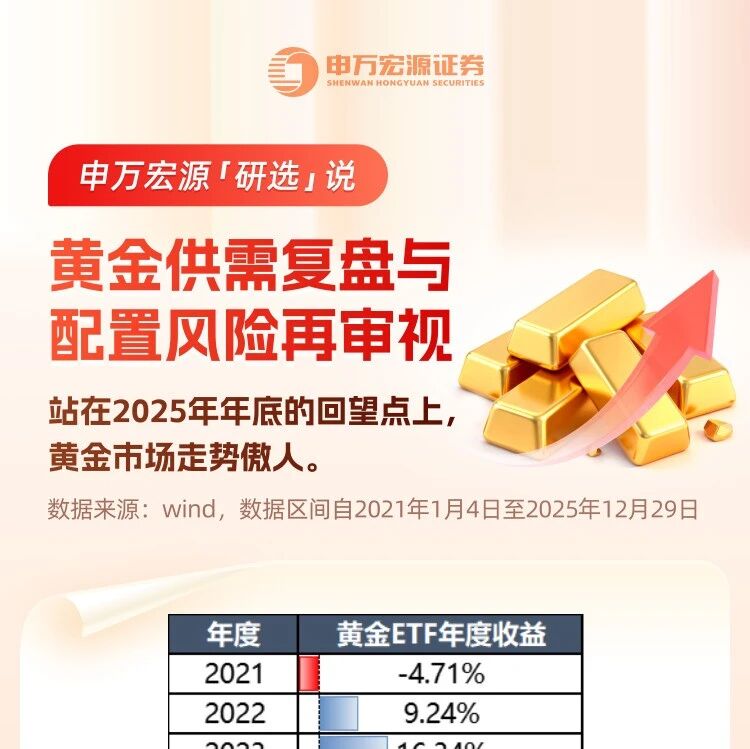
Core Viewpoint - The article discusses the impressive performance of the gold market from the perspective of the end of 2025, highlighting the evolving role of gold as both a strategic asset for central banks and a key focus for investors [1]. Supply and Demand Analysis - Gold supply has remained stable, averaging between 1,200 tons and 1,300 tons per quarter in recent years, with total supply in 2025 projected to be around 1,313.10 tons [3][4]. - Demand for gold has been driven by high levels of jewelry manufacturing, increasing investment in gold bars and coins, and significant purchases by central banks, which have reached levels not seen since 2010 [3][4]. Investment Performance - The annual returns of gold ETFs have shown a significant upward trend, with returns projected to reach 62.75% in 2025, following 27.45% in 2024 and 16.34% in 2023 [2][3]. - The volatility of gold ETFs has been relatively lower compared to the market index, with annualized volatility for gold ETFs at 18.61% in 2025, compared to 17.21% for the market index [11]. Price Dynamics - Long-term gold price movements are influenced by factors such as inflation hedging and monetary policy, particularly in a low-interest-rate environment, which challenges the credibility of the dollar [9]. - Short-term fluctuations in gold prices are affected by geopolitical risks and speculative trading, with significant events such as U.S. policy changes and regional conflicts impacting market sentiment [10]. Investment Considerations - For individual investors, the gold market in 2025 presents both opportunities and risks, with gold serving as a hedge against inflation over a long-term horizon, while short-term volatility necessitates careful monitoring of central bank activities and geopolitical risks [12].
特朗普提前“清算”鲍威尔
Sou Hu Cai Jing· 2026-01-12 16:07
Core Viewpoint - The ongoing conflict between former President Trump and Federal Reserve Chairman Jerome Powell has escalated, raising concerns about the independence of the Federal Reserve and the potential implications for monetary policy and consumer credit markets [1][2][3]. Group 1: Investigation and Political Pressure - Federal prosecutors are investigating Powell, focusing on his public statements and expenditure records, which have been approved by Trump's allies [2]. - Powell has faced criticism from Trump for refusing to lower interest rates, and Trump has indicated he will soon announce a successor to Powell [2][7]. - Powell claims the investigation is a political maneuver aimed at exerting pressure on him regarding interest rate decisions, emphasizing the need for the Federal Reserve to operate free from political influence [2][3]. Group 2: Administrative Interventions in Interest Rates - Trump has taken steps to directly influence interest rates, including instructing government-sponsored enterprises to purchase $200 billion in mortgage-backed securities, viewed as a form of "quantitative easing" [4][5]. - He has also proposed capping credit card interest rates at 10% starting January 20, 2026, which is seen as an attempt to bypass the Federal Reserve [5]. - Analysts suggest that these actions may have limited short-term financial impact but could significantly alter market perceptions and the valuation framework for mortgage-backed securities [5]. Group 3: Economic Implications and Market Reactions - Bill Ackman, a billionaire hedge fund manager, warns that artificially lowering interest rates could lead banks to withdraw credit card services, pushing consumers towards unregulated lending markets with worse terms [1][5]. - The potential for increased inflation due to political pressure on the Federal Reserve raises concerns about long-term economic stability and the impact on future elections for the Republican Party [6]. - Powell's commitment to maintaining the Federal Reserve's independence is crucial for achieving price stability and managing inflation, which is a significant concern for the public [6][3].
资源品何以成为资产“锋利之矛”?
Jing Ji Guan Cha Wang· 2026-01-12 11:05
Core Viewpoint - The primary investment opportunity identified is in resource commodities, particularly precious metals, which have shown strong performance in terms of returns and Sharpe ratios since November of last year [1]. Group 1: Market Dynamics - Precious metals like silver, copper, and gold have led global asset performance, with a significant acceleration in their market activity observed in the past few weeks [1]. - The market is currently pricing in a medium to long-term supply-demand imbalance and expectations of a weaker dollar, with short-term catalysts being the anticipated easing of monetary and fiscal policies [1][3]. - The Reserve Management Purchase (RMP) program introduced in December is believed to have a more substantial impact on liquidity than initially recognized, contributing to a new bullish trend in commodities [1]. Group 2: Comparative Asset Analysis - Other major asset classes face specific concerns: U.S. equities are at risk of over-investment due to AI capital expenditures diverging from returns on invested capital; European equities are hindered by economic weakness and slow fiscal policy implementation; Japanese equities struggle with conflicting monetary and fiscal policies; emerging markets are affected by tariff uncertainties and a slowing weak dollar narrative [2]. - In the bond market, increased government debt issuance due to fiscal expansion is expected to suppress bond prices, while oil prices lack upward momentum due to an oversupply situation [2]. Group 3: Short-term and Mid-term Outlook - In the short term, liquidity improvements and expectations of monetary easing are driving commodity price increases, with an estimated $600 billion liquidity boost expected from RMP and TGA releases [3]. - The market anticipates potential interest rate cuts and even a return to quantitative easing, although this is contingent on economic data trends [3]. - Mid-term demand for resources is expected to grow significantly, particularly in sectors like renewable energy and electric vehicles, with copper demand projected to increase by over 20% by 2030 compared to 2024 levels [4]. Group 4: Long-term Trends - A prolonged weak dollar environment is anticipated, which will support commodity prices as the U.S. economic growth potential faces constraints [5]. - Geopolitical tensions are expected to exacerbate resource competition, leading to supply-side disruptions as countries increase their strategic reserves of various metals [5].
有色金属周报:反内卷叙事退潮,有色板块冲高回落-20260112
Guo Mao Qi Huo· 2026-01-12 07:14
1. Report Industry Investment Ratings No information about the report industry investment ratings is provided in the content 2. Core Views of the Report - The anti - involution narrative in the non - ferrous metal sector has ebbed, leading to a decline after the sector's prices reached a high. The copper price is expected to stabilize and rise due to ongoing disturbances in the copper mine sector and positive signals of inflation recovery and economic stabilization in China. Zinc prices are expected to fluctuate within a range, with the domestic surplus expectation gradually emerging. Nickel and stainless - steel prices are expected to remain in high - level oscillations, with significant uncertainties in Indonesian policies [9][93][201] 3. Summary by Relevant Catalogs 3.1 Non - ferrous Metal Price Monitoring - The closing price monitoring shows various trends in different non - ferrous metals. For example, the US dollar index is at 99.1 with a daily increase of 0.28%, a weekly increase of 0.69%, and an annual increase of 0.88%. Industrial silicon is at 8,715 yuan/ton with a daily increase of 2.11%, a weekly decrease of 1.64%, and an annual decrease of 1.64%. Carbonate lithium is at 143,420 yuan/ton with a daily decrease of 1.09%, a weekly increase of 17.96%, and an annual increase of 17.96% [7] 3.2 Copper (CU) - **Influencing Factors**: Macro factors are bullish as China's December CPI and PPI both turned positive, and the US December employment data was mixed, increasing market expectations of a Fed rate cut. The raw material end is bullish with a tight copper mine supply. The smelting end is neutral with changes in smelting plant profits. The demand end is bearish as high copper prices pressure downstream industries. The inventory end is bearish with an increase in global visible copper inventory [9] - **Investment View**: Bullish. The copper price may stabilize and rebound due to ongoing disturbances in the copper mine sector and positive domestic economic signals [9] - **Trading Strategy**: Go long on dips for single - side trading, and there is no arbitrage opportunity currently [9] 3.3 Zinc (ZN) - **Influencing Factors**: Macro factors are slightly bullish with positive market sentiment. The raw material end is neutral with a stable cost center and limited upside for processing fees. The smelting end is neutral with an expected increase in supply in January and possible shutdowns in February. The demand end is bearish with a slow recovery in galvanizing and a seasonal off - peak. The inventory end is bearish with an increase in domestic social inventory and a slow - down in the increase of LME inventory [93] - **Investment View**: Zinc prices are expected to fluctuate within a range, with the domestic surplus expectation gradually emerging [93] - **Trading Strategy**: Single - side trading should be based on the oscillating trend, and an internal - external positive arbitrage can be considered [93] 3.4 Nickel - Stainless Steel (NI·SS) - **Influencing Factors**: Macro factors are slightly bullish with expectations of a Fed rate cut and positive domestic economic data. The raw material end is slightly bullish with potential supply policy uncertainties in Indonesia and a seasonal decline in nickel ore imports from the Philippines. The smelting end is neutral with changes in production and profit. The demand end is neutral with an increase in stainless - steel production scheduling and a weakening demand for nickel sulfate in the new - energy sector. The inventory end is slightly bearish with an increase in LME nickel inventory [201] - **Investment View**: Nickel and stainless - steel prices are expected to remain in high - level oscillations, with significant uncertainties in Indonesian policies [201] - **Trading Strategy**: For short - term single - side trading, the price range should be considered, and chasing high prices is not recommended. There is no arbitrage opportunity currently [201]
美元债双周报(26年第2周):美国经济数据分化加剧,财政主导风险升温-20260112
Guoxin Securities· 2026-01-12 07:11
1. Report Industry Investment Rating - The investment rating for the US dollar bond market and the US stock market is "Underperform" [1][4] 2. Core Viewpoints - US economic data shows increasing divergence, with employment data dragging down interest - rate cut expectations, while the service sector is strong and the manufacturing sector is in contraction. Trump's order for Fannie Mae and Freddie Mac to buy $200 billion in MBS increases fiscal dominance risk and may steepen the yield curve [1][2] 3. Summary by Related Catalogs 3.1 US Macroeconomic and Liquidity - US December non - farm payrolls increased by 50,000, lower than the expected 65,000, and the annual increase was the weakest since the pandemic. After the release of the weak employment report, the expectation of a Fed rate cut in January almost disappeared, and the first rate cut is expected to be postponed to June, with an annual rate cut of about 50 basis points [1] - The December ISM manufacturing PMI fell to 47.9, contracting for the tenth consecutive month, while the ISM services PMI rose to 54.4, the highest in nearly a year [2] - Trump's order for Fannie Mae and Freddie Mac to buy $200 billion in MBS may accelerate the steepening of the US Treasury yield curve, and long - term interest rates are under pressure [2] 3.2 Exchange Rate - The report may analyze the trends of non - US currencies in the past year and recent changes, as well as the relationship between the US dollar index and other factors such as the 10 - year US Treasury yield and the RMB index [53][59][61] 3.3 Chinese - funded US Dollar Bonds - The report shows the return trends of Chinese - funded US dollar bonds since 2023 (by level and industry), as well as the yield and spread trends of investment - grade and high - yield Chinese - funded US dollar bonds [67][69] 3.4 Rating Actions - In the past two weeks, the three major international rating agencies took one downgrading action on a Chinese - funded US dollar bond issuer. On December 30, 2025, Moody's downgraded Vanke's rating from Caa2 to Ca [75][76] 3.5 Investment Recommendations - Adopt a "short - duration core + steepening satellite" configuration. Focus on 3 - 5 - year investment - grade bonds for stable coupon income, long the 2s10s spread to capture curve - steepening opportunities, increase TIPS allocation to hedge against service - sector inflation stickiness, and strictly control exposure to US Treasuries over 10 years [3] - In the next two weeks, focus on December CPI data and public statements by Fed officials [3]