AI时代

Search documents
普利特:公司LCP改性产品已经批量应用于多款手机连接器等精密零部件中
Mei Ri Jing Ji Xin Wen· 2025-12-03 04:27
Core Viewpoint - The company, Prit, is a pioneer in the research and mass production of LCP materials in China, indicating a strong position in the market for high-frequency and high-speed communication applications, particularly in the context of emerging AI technologies [2]. Group 1: Company Insights - Prit has successfully applied LCP modified products in various mobile phone connectors and precision components, showcasing its capability in the industry [2]. - The company emphasizes the importance of LCP films and fibers in the communication and signal transmission sectors, which are critical for the development of AI smartphones and other smart devices [2]. - Prit plans to strengthen its full industry chain from resin to modification, and then to films and fibers, to support the upcoming AI era and meet the increasing demand for high-frequency and high-speed materials [2]. Group 2: Industry Trends - The demand for high-frequency and high-speed materials is expected to grow with the acceleration of new generation communication technologies, particularly in AI smartphones, AIPC, and AI glasses [2]. - The ongoing development and promotion of the communication industry will catalyze the application of LCP-related materials, indicating a positive trend for companies involved in this sector [2].


迪士尼卷入AI抢电大战
3 6 Ke· 2025-12-03 00:57
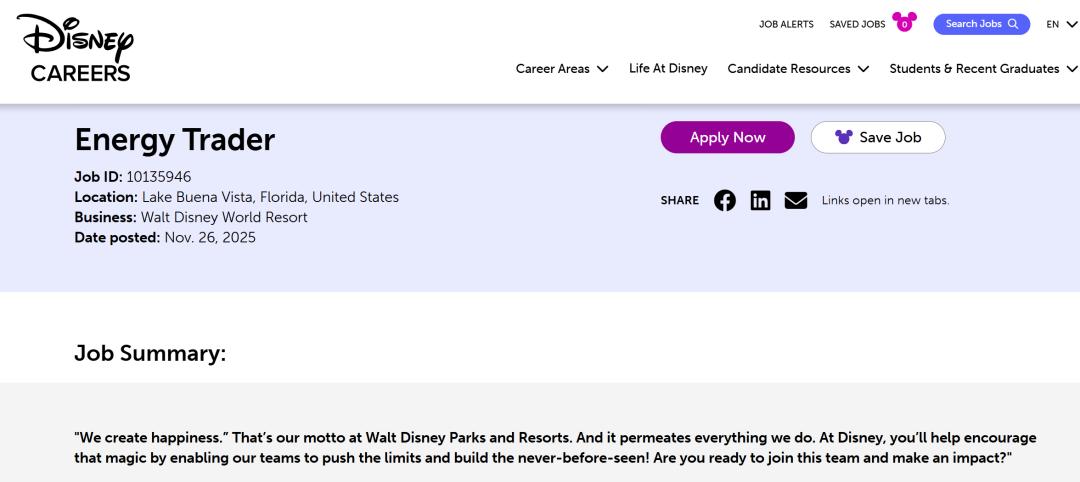
Group 1 - Disney is hiring an energy trader to manage wholesale electricity procurement and analysis, reflecting a trend among large companies to manage energy costs more effectively in the "AI era" [1][4] - The position is based in Orlando, Florida, and requires the trader to provide short-term electricity forecasts and generation resource analysis for the Florida tourism regulatory zone, which includes Walt Disney World [2][3] - The job requires at least 5 years of experience in the wholesale electricity market and familiarity with the local electricity market [3] Group 2 - Disney's recruitment reflects a broader industry trend where companies are building energy trading teams to ensure stable and cost-effective electricity supply, moving away from reliance on intermediaries or long-term fixed-price contracts [4] - Major tech companies like Meta, Google, Microsoft, and Amazon are already active in the wholesale electricity market, leveraging their power purchase agreements to sell excess electricity during price spikes [5] - The backdrop of rising electricity costs is highlighted by a record capacity cost of $16.1 billion in a recent auction by the largest U.S. grid operator, PJM, which will lead to increased electricity bills for consumers and businesses [5]

定档12月6日!集成电路产业人才论坛报名开启!
半导体芯闻· 2025-12-02 10:18
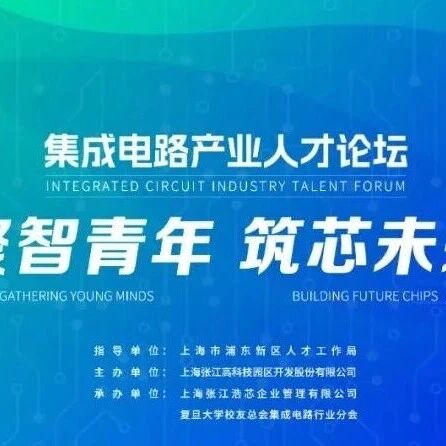
Core Viewpoint - The "2025 Pudong International Talent Port Forum - Integrated Circuit Industry Talent Forum" aims to promote international talent exchange and development in the integrated circuit industry, focusing on high-quality industry growth and innovation opportunities [3][5]. Group 1: Event Details - The forum will take place on December 6, 2025, from 13:30 to 16:00 at Zhangjiang Science Hall, Shanghai [4]. - The event is organized by the Shanghai Pudong New Area Talent Work Bureau and hosted by Shanghai Zhangjiang Hi-Tech Park Development Co., Ltd. [3][14]. Group 2: Forum Themes - The forum will address new trends in attracting and developing industry talent, showcasing exemplary applications of technological achievements and sharing innovative experiences [5]. - It will gather leaders from industry, academia, and research fields to engage in in-depth discussions on cutting-edge technologies and ideas [6]. - A specialized report will analyze talent development in the integrated circuit sector, revealing industry trends and growth paths [7]. Group 3: Exhibition and Agenda - A special exhibition area will focus on the "chip" ecosystem, highlighting representative achievements of leading companies in talent incubation and technological breakthroughs [8]. - The agenda includes guest sign-in, policy introduction, and several keynote speeches on topics such as AI-era integrated circuit materials and talent cultivation [9][10][11]. Group 4: Roundtable Discussion - A roundtable discussion titled "Breaking the Deadlock: Talent Breakthroughs in the Post-Moore Era of the Integrated Circuit Industry" will feature experts from various sectors [12].
但斌:投资要去大海里打鲸鱼 不要在烂泥塘里挖泥鳅
Xin Lang Cai Jing· 2025-11-29 07:49
Core Insights - The importance of global investment allocation is emphasized, highlighting the potential for significant returns through strategic asset selection [1] Group 1: Investment Strategy - The example of managing 100 billion in Japan during its peak in 1990 illustrates that holding onto local assets for an extended period can lead to losses, especially when considering currency depreciation [1] - In contrast, investing in the Nasdaq during the same timeframe, which has experienced three technological revolutions, could theoretically yield over ten thousand times growth [1] - The phrase "Investing should be about catching whales in the ocean, not digging for minnows in a muddy pond" underscores the necessity of seeking larger, more lucrative investment opportunities globally [1] Group 2: Portfolio Composition - The presentation showcased a portfolio heavily invested in companies like Nvidia and Google, indicating a strong alignment with the expectations for the AI era [1] - The investment strategies resonate with those of other prominent institutions such as Berkshire Hathaway and Jinglin, suggesting a collective optimism about the future of AI technologies [1]
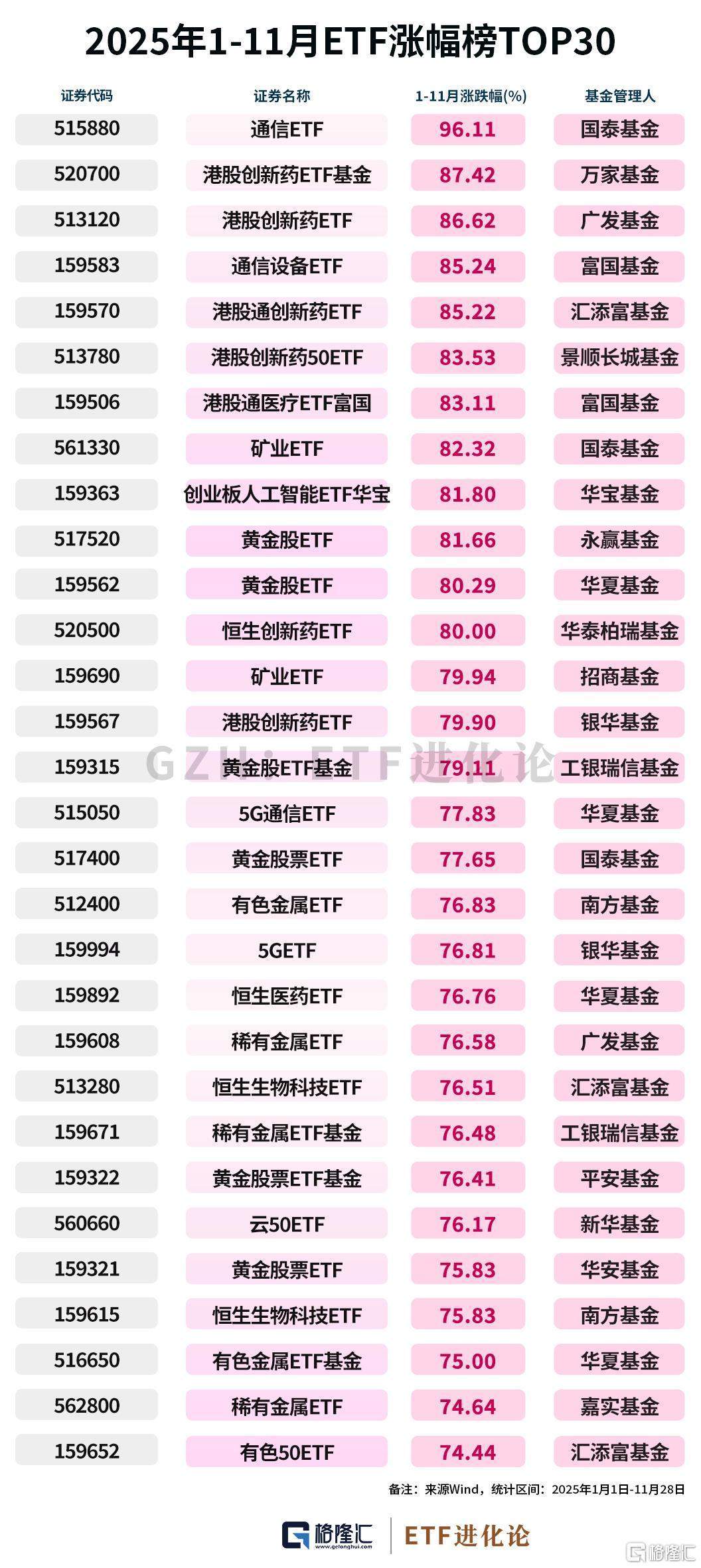
今年以来通信ETF、港股创新药ETF领涨,资金青睐港股通互联网ETF、黄金ETF、证券ETF
Sou Hu Cai Jing· 2025-11-29 07:41
Group 1: Market Performance Overview - In the first eleven months of 2025, the communication ETF led the market with a remarkable increase of 96.11%, showcasing strong momentum in the AI era [1] - The Hong Kong innovative drug sector emerged as a significant winner, with various ETFs in this category showing substantial gains: Hong Kong innovative drug ETF fund up 87.42%, Hong Kong innovative drug ETF up 86.62%, and Hong Kong Stock Connect innovative drug ETF up 85.22% [1] - The resource sector also performed well, with mining ETF up 82.32%, non-ferrous metals ETF up 76.83%, and rare metals ETF up 76.58%, driven by rising global inflation expectations [1] Group 2: ETF Performance Data - The top-performing ETFs from January to November 2025 include: - Communication ETF: 96.11% [2] - Hong Kong innovative drug ETF fund: 87.42% [2] - Hong Kong innovative drug ETF: 86.62% [2] - Communication equipment ETF: 85.24% [2] - Hong Kong Stock Connect innovative drug ETF: 85.22% [2] - The worst-performing ETFs included: - Energy chemical ETF: -14.78% [5] - S&P Consumer ETF: -11.40% [5] - Alcohol ETF: -5.36% [5] Group 3: Fund Flows - The Hong Kong Stock Connect Internet ETF saw the highest net inflow of 553.05 billion yuan, indicating strong market confidence in the Hong Kong tech sector [8] - Other notable net inflows included short-term bond ETF at 436.42 billion yuan and gold ETF at 406.63 billion yuan [8] - Conversely, significant outflows were observed in the Sci-Tech 50 ETF, with a net outflow of 463.46 billion yuan, indicating pressure on growth sectors [12]
告别“流量劫持”,让手机行业竞争更守规矩
Xin Jing Bao· 2025-11-27 15:40
Core Viewpoint - The article highlights the issue of unfair competition in the mobile phone and application platform industry, emphasizing the need for regulatory oversight to ensure fair market practices and protect consumer rights [1][2][3]. Group 1: Unfair Competition Issues - The market regulation authority has identified significant unfair competition practices in the mobile industry, including traffic hijacking, forced redirection, and malicious incompatibility, which harm consumer rights and disrupt fair competition [1][2]. - These practices are driven by mobile manufacturers' desire to dominate market entry points, as they not only sell hardware but also software applications, creating barriers to competitors [1][3]. Group 2: Legal and Regulatory Actions - Legal disputes have arisen from these unfair practices, with cases where companies have sued major mobile manufacturers for maliciously interfering with app downloads, misleading users under the guise of safety [2]. - The regulatory guidance issued by the market authority indicates a shift from merely protecting consumers to ensuring the healthy development of the entire mobile industry and enhancing national industrial competitiveness [2][3]. Group 3: Market Dynamics and Implications - The competitive landscape has shifted, with mobile manufacturers now being included in antitrust regulations due to their control over application distribution, which poses risks of platform-level monopolies [3]. - The mobile industry has evolved into a critical infrastructure for the digital economy, influencing consumer rights, fair competition, data security, and overall innovation capabilities [3][4]. Group 4: Future Considerations - As the era of large models approaches, the distribution rights through mobile devices will become increasingly significant, impacting which innovations gain user access and which are suppressed [4][5]. - It is crucial that the application entry points in the AI era are not monopolized by a few terminal manufacturers to foster innovation and competition in the industry [5].
AI时代・诗歌之道 第十届上海国际诗歌节将拉开帷幕
Jie Fang Ri Bao· 2025-11-26 01:44
Group 1 - The 10th Shanghai International Poetry Festival will commence on December 6, focusing on the theme "The Path of Poetry in the AI Era," exploring the mindset of poets and poetry creation amidst the data flow of AI-generated models [1][2] - The festival is organized under the guidance of the Shanghai People's Association for Friendship with Foreign Countries, with the Shanghai Writers' Association and the Xuhui District Committee of Publicity as the main hosts, featuring over 20 influential poets from around the world [1][2] - A variety of activities will take place during the festival, including poetry recitals, discussions, and literary seminars, inviting participation from individuals across literature, culture, education, and the general public who love literature [1] Group 2 - The opening ceremony and the "Golden Camellia" Poetry Award presentation will be held on the "Shencheng Light" cruise ship in Xuhui Riverside, marking the start of a four-day event [2] - The festival will feature multiple venues for various activities, including the Shanghai Writers' Association, Shanghai Library East, and Shanghai Jiao Tong University, among others, hosting events such as the special issue launch of "Shanghai Literature," poetry recitals, and forums on poetry and media [2] - Notable events include the "Poetry in the Community" initiative, international poetry festival summit forums, and a closing ceremony for the 10th Shanghai International Poetry Festival and the 2025 Shanghai "Sunshine Reading" series for disabled readers [2]
禾盛新材20251124
2025-11-25 01:19
禾盛新材 20251124 和胜新材近期股权变更的具体情况是什么?对公司未来发展有何影响? 和胜新材近期进行了股权变更,两位股东将 18%的股份转让给了摩尔之星,谢 总成为新的实际控制人。公司将加大在芯片领域的布局,但传统主营业务保持 不变,并继续良好经营。在 AI 芯片领域,公司计划未来进行更多投入。摩尔之 星拥有深厚的产业背景,包括慧博云通董事谢总、阿里巴巴集团副总裁黄总等 核心人物,这些资源将为和胜新材提供平台赋能,特别是在 AI 芯片领域的发展。 易知电子采用 CPU 加 NPU(C+N)的二合一技术路线,类似于苹果 M 系列芯片,实现了统一内存技术,避免了爆显存的问题,在对密度有要 求、模型尺度灵活以及数据不能出域等应用场景中具有明显优势。 易知电子与国内主流 40 家软件硬件厂商全部完成互认证,无需专门修 改软件版本即可运行,兼容性得到了操作系统、数据库、中间件等多方 认可,同时在价格方面保持竞争力,使其成为 ARM CPU 体系中的佼佼 者。 和胜新材目前的业务结构和主要客户有哪些? 和胜新材目前主要分为三块业务:家电业务、海希技术以及易事电子。家电业 务涵盖松下、日立、三星、LG 和美的等顶级 ...

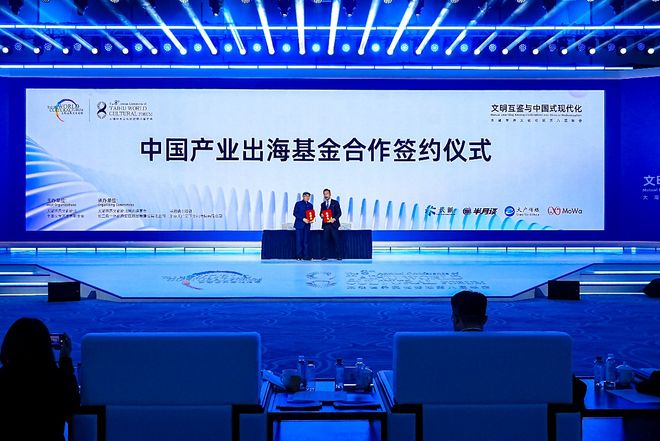
太湖世界文化论坛联手胡润百富 合作设立中国产业出海基金
Zhong Guo Jing Ying Bao· 2025-11-24 06:06
《中国经营报》记者在采访中了解到,在本届年会上,太湖世界文化论坛与上海胡润百富投资管理咨询 有限公司(以下简称"胡润百富")进行合作签约,双方将设立中国产业出海基金,通过产业合作助力中 国企业出海。 胡润百富CEO吕能幸表示,在AI时代浪潮下,胡润百富希望能够和太湖世界文化论坛、中国企业一起 出海,"让全球更多消费者能感受到我们文化的璀璨"。 太湖世界文化论坛执行主席兼秘书长郑传焮表示,博鳌是区域经济的声音,达沃斯是全球资本的声音, 希望太湖世界文化论坛未来成为人类文明的声音。 中经记者 杨让晨 张家振 上海报道 (签约现场。受访者/图) 日前,太湖世界文化论坛第八届年会在有"水乡客厅"之称的方厅水院举行。 来自世界各国的政要、专家学者、国际组织代表、驻华使节、企业界人士及媒体代表等500余位嘉宾齐 聚一堂,围绕年会主题深入交流,凝聚起推动全球文明互鉴、促进人类共同发展的广泛共识,为构建人 类命运共同体注入文化动力。 相关资料显示,太湖世界文化论坛以"促进中外文化交流合作、推动不同文明互学互鉴"为宗旨,聚焦文 化领域的全球性课题,致力于依托文化力量,让中国更加了解世界、让世界更加了解中国。自2008年成 立至 ...
于东来反复踩踏民族情感红线,绑定他是永辉此次改革的最大败笔!
Xin Lang Cai Jing· 2025-11-22 07:25
作者声明:该文章由AI辅助创作 01、我为何敢预判:永辉的改革注定失败? 永辉超市——曾是我国零售行业的一面旗帜,近年来却深陷经营困局,出现巨额亏损。 为了扭转局势,永辉超市邀请"胖东来"创始人于东来及其团队加入,开始了一场企业改革。 今年10月,永辉超市CEO王守诚坦言,永辉目前的发展水平仅相当于10年前的胖东来。 他说,永辉会扎扎实实地往前走: 用2-3年的时间走出"生死线",再用3-5年的时间赢回信任,最后用5-10年,成为让人骄傲、感到幸福的 品牌。 可惜,我不得不泼个冷水——如果继续按现在这种方式搞下去,永辉超市的这次改革注定失败! 肯定会有网友质疑: 何医生,你是个大夫,又不懂超市经营,你凭什么在这里一本正经地胡说八道呢? 人家永辉超市的老板没招你没惹你,也没爆出有精神心理问题,你又没见过他,为什么要说这种话呢? 其实理由很简单: 第一,虽然我不认识永辉的老板,但无论他是谁,他只要是个人,就一定会有人性、三观以及内隐记 忆。 而这些正是我研究的范畴。 尤其我有过6次创业的人生经历,并率先打开了精准高效心理学的大门后,对于很多社会事件和人物, 我能从这3个维度进行深入的剖析,揭开事实背后的真相。 第 ...