
即时零售

Search documents
醉翁之意不在酒 阿里改造即时零售的决心远超预期丨力见
2 1 Shi Ji Jing Ji Bao Dao· 2025-09-01 13:57
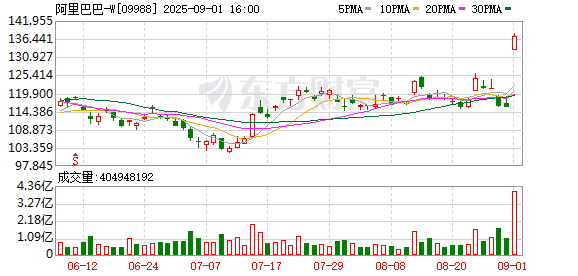
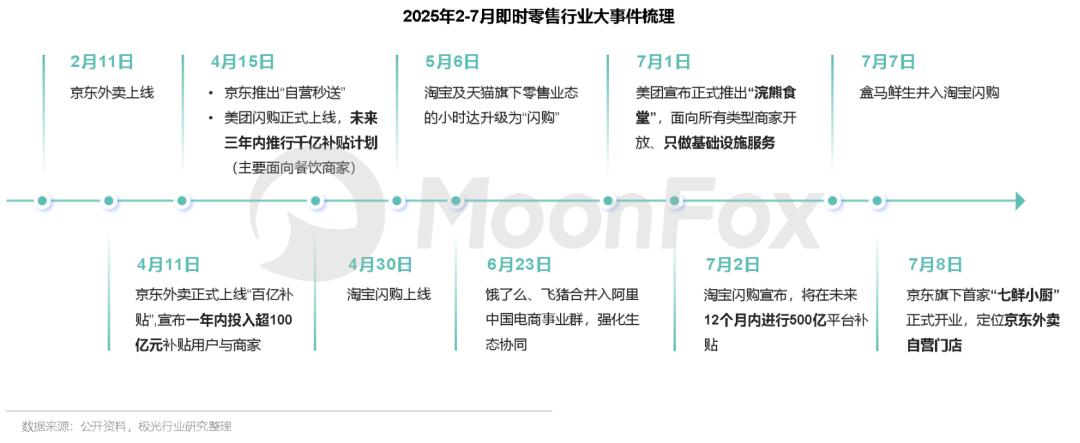
Core Viewpoint - The fierce competition among the three major food delivery giants, Meituan, JD.com, and Alibaba, has led to significant profit declines, with Meituan's net profit down 89%, JD.com's down 50.8%, and Alibaba's down 18% in Q2 2025, resulting in a total profit loss of approximately 20 billion yuan compared to the same period last year [2] Group 1: Financial Performance - Meituan's net profit dropped by 89% year-on-year in Q2 2025, while JD.com and Alibaba saw declines of 50.8% and 18% respectively [2] - The total profit loss for the three companies in this quarter is estimated to be around 20 billion yuan [2] - Alibaba's stock price surged by 18.5% following its earnings report, contrasting with Meituan's nearly 10% drop and JD.com's over 3% decline after their earnings announcements [2] Group 2: Strategic Initiatives - Alibaba's stock performance is bolstered by market expectations surrounding its AI and cloud strategy, with AI contributing 20% to Alibaba Cloud's revenue this quarter [2] - Alibaba's CEO of the China e-commerce division, Jiang Fan, emphasized that the current focus of Taobao Flash Purchase is on user cultivation and scale expansion rather than immediate profitability [2] - Taobao Flash Purchase has achieved a peak daily order volume of 120 million in August, with a weekly average of 80 million, leading to a 200% increase in monthly active buyers compared to April [6] Group 3: Market Dynamics - The competition in the food delivery sector is intensifying, with JD.com preparing substantial funds to challenge Meituan and Ele.me, while Alibaba's commitment to transforming instant retail exceeds JD.com's expectations [3] - Meituan has called for an end to irrational competition, highlighting the need for a more sustainable approach to market practices [7] - The three platforms are expected to increase their subsidy expenditures in the upcoming quarter, with estimates suggesting a potential burn of 92 billion yuan over the next 12 months [5] Group 4: Marketing Strategies - Taobao Flash Purchase has signed 15 celebrity endorsements in the past three months, indicating a significant marketing budget aimed at reaching a broader user base [6] - The marketing strategy includes substantial investments in sports collaborations and events, reflecting a shift towards aggressive promotional tactics [6] - Meituan and JD.com are also investing heavily in celebrity endorsements to enhance their market presence [6] Group 5: Future Outlook - The instant retail business, including Taobao Flash Purchase and Ele.me, has seen a 12% revenue growth, although this is perceived as modest given the significant increase in order volume [6] - Jiang Fan projects that over the next three years, one million stores will join the instant retail ecosystem, potentially generating one trillion yuan in transaction growth [11] - The ongoing development in the instant retail sector is expected to positively impact consumer spending, with a reported 3.4% growth in fast-moving consumer goods sales in Q2 2025 [12]

云计算+AI+即时零售三箭齐发,阿里迎来历史新拐点?
Hua Er Jie Jian Wen· 2025-09-01 13:45
Core Viewpoint - Alibaba's recent quarterly report has led major investment banks to express optimism about the company's future, highlighting accelerated growth in cloud services, synergies from flash sales, and sustainable growth prospects in Customer Management Revenue (CMR) [1] Cloud Computing AI Business - Alibaba's cloud computing revenue reached 33.4 billion RMB, a year-on-year increase of 26%, significantly exceeding market expectations of 20-25% [2] - AI-related revenue has maintained triple-digit growth for eight consecutive quarters, now accounting for over 20% of external cloud revenue [2][3] - The growth is driven by strong demand for AI inference and vertical industry model training, as well as increased penetration of AI in traditional computing and storage services [3] Instant Retail Business - The flash sales business launched in late April has shown substantial synergy effects, with monthly active users increasing by 200% to 300 million and daily order volume reaching 80 million [4] - Analysts note that the flash sales business has begun to generate significant synergies, enhancing user engagement and expanding the supply chain [4][5] CMR Growth - Concerns about a potential slowdown in CMR growth have been alleviated, with analysts noting that advertising demand has been boosted by the integration of new tools and increased traffic from flash sales [6] - CMR is expected to maintain resilience despite high comparative bases, with predictions of high single-digit growth in the coming quarters [6] Profitability and Investment Outlook - While target prices have been raised, earnings forecasts for fiscal year 2026 have been lowered due to initial investment costs in the flash sales business, with adjustments of 14% by HSBC and 13% by JPMorgan [7] - Analysts believe that the short-term profitability pressure is justified, as Alibaba has sufficient financial resources for strategic investments [7] - The long-term outlook remains positive, with expectations of sustainable double-digit profit growth driven by cloud and e-commerce business acceleration [7]

大行评级丨小摩:调高阿里目标价22%至165港元,维持“增持”评级
Ge Long Hui· 2025-09-01 10:58
摩通指出,阿里截至6月底首季业绩表现,增强其中长期盈利前景信心,即时零售及云业务料维持双位 数增长,惟短期在增加投资下,令盈利受压,将2026年财政年度经调整每股盈利预测下调13%,但将 2027财年经调整每股盈利预测调高6%。另调高2026及2027年财年收入预测3%及11%,反映中国零售商 业(CMR)及云业务收入增长。 摩通相信外送和即时零售业务已达到规模化水平,能够提升效率,加上雄厚资金支持订单和骑手密度, 预计饿了么未来数季亏损收窄。管理层指3年内希望实现即时零售GMV达到1万亿元目标,突显其潜在 上升空间;4月底推出的"淘宝闪购",已产生实质协同效益,短期仍会录显著亏损,但管理层预期短期 亏损减半。 摩根大通发表报告,调高阿里巴巴(9988.HK)目标价22%,由135港元上调至165港元,维持"增持"评 级。 ...
即时零售巨头鏖战,抖音旁观?
3 6 Ke· 2025-09-01 08:28
Core Viewpoint - The competition among major players in the instant retail sector, including JD, Alibaba, and Meituan, is intensifying, characterized by aggressive subsidy strategies and a focus on establishing a robust retail infrastructure, while Douyin adopts a more cautious and strategic approach, potentially waiting for the right moment to enter the fray [1][8][12]. Group 1: Instant Retail Market Dynamics - The growth rate of social retail sales has dropped to 3.5% in 2024, while the penetration rate of instant retail has rapidly increased, with GMV growing by 19.5%, three times the growth rate of online retail [1]. - Major platforms are moving beyond simple traffic acquisition to deeper engagement, including building offline infrastructure and enhancing supply chain integration to improve efficiency and reduce costs [7][11]. - The competition has evolved from basic price subsidies to a more complex battle involving supply chain optimization and multi-channel collaboration among platforms [7][12]. Group 2: Major Players' Strategies - Meituan has established a strong ecosystem with 30,000 lightning warehouses, achieving over 150 million daily orders through its "Meituan Flash Purchase" service [4]. - Alibaba has upgraded its "hourly delivery" service to "Taobao Flash Purchase," rapidly increasing daily orders to 80 million through subsidies and strategic placement on the app [4]. - JD focuses on "quality delivery" by leveraging its supply chain and Dada's delivery capabilities, introducing a "second delivery warehouse" model [5]. Group 3: Douyin's Position and Strategy - Douyin has chosen to observe the subsidy war rather than directly participate, indicating a strategic decision based on its strengths and weaknesses [8][11]. - Douyin's instant retail efforts are divided into "hourly delivery" and "next-day delivery," targeting high-demand categories and expanding its service area through partnerships with logistics providers [8][9]. - The platform aims to enhance its logistics capabilities and build a more efficient ecosystem rather than engage in costly subsidy wars, focusing on long-term growth metrics like category penetration and user experience [12][14].




饿了么是时候更名淘宝闪购了
Hu Xiu· 2025-09-01 07:44
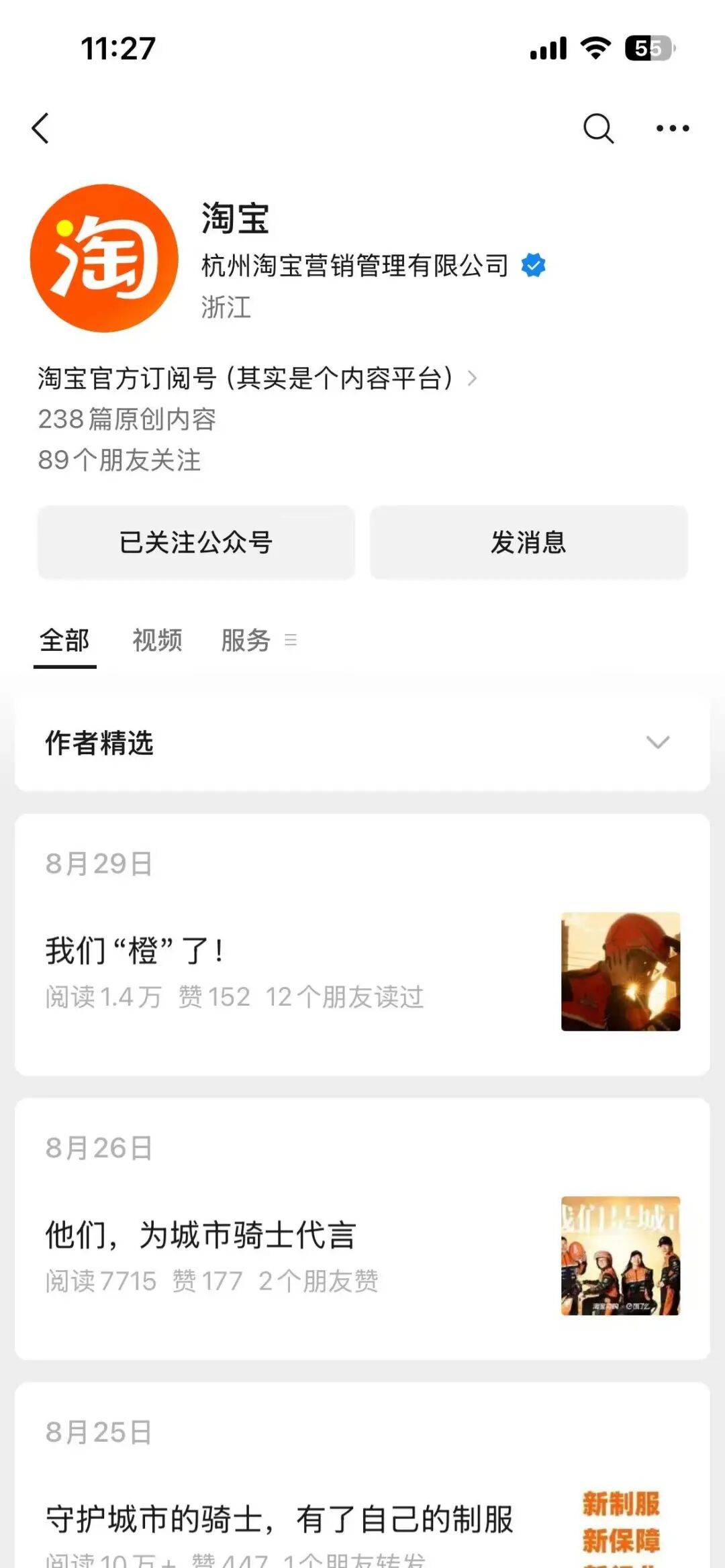
Core Viewpoint - The article discusses the significant changes in the branding and operational integration of Ele.me into Taobao's flash delivery service, highlighting the gradual phasing out of Ele.me's identity within Alibaba's ecosystem. Group 1: Branding Changes - Taobao's new delivery uniforms have been officially released, featuring a modern design primarily in Taobao's orange color, with minimal Ele.me branding [1][3] - The name of the delivery personnel has changed from "Blue Knights" to "City Knights," indicating a shift away from Ele.me's branding [3][4] - Ele.me's branding elements are increasingly being replaced by Taobao's, as seen in their recent social media posts, which predominantly feature Taobao flash delivery content [9][17] Group 2: Financial and Strategic Implications - Alibaba's management has elevated instant retail to a status comparable to AI, yet they have not mentioned Ele.me in their discussions, focusing instead on Taobao flash delivery [5][6] - The article suggests that Ele.me, acquired for $9.5 billion in 2018, may be on the verge of being phased out after seven years of declining performance [8][23] - The integration of Ele.me into Taobao's operations is seen as a strategic move to strengthen Alibaba's overall brand and operational efficiency [18][20] Group 3: Competitive Landscape - The article notes that Ele.me's market share is significantly smaller than its competitor Meituan, with Alibaba's delivery business only capturing one-third of Meituan's scale in some regions [7][26] - The branding of Taobao flash delivery is positioned to compete directly with Meituan's flash delivery service, creating potential confusion among consumers regarding the "flash delivery" term [29][30] - The article highlights the importance of branding in the competitive landscape, suggesting that Ele.me's name is less valuable compared to Taobao flash delivery, which is more aligned with Alibaba's broader retail strategy [26][27]
分众传媒(002027) - 002027分众传媒投资者关系管理信息
2025-09-01 07:30
Group 1: Market Overview - In the first half of 2025, the domestic advertising market increased by 0.6% year-on-year, indicating a mild recovery trend despite a narrowing growth rate compared to the previous year [4] - The overall consumption environment remains healthy, providing stable support for the advertising market [4] - The domestic consumption market is expected to continue its recovery in the second half of 2025, driven by government policies and internal dynamics [4] Group 2: Company Performance - In the first half of 2025, the company achieved a revenue of 611,235.67 million yuan, a 2.43% increase from 596,727.14 million yuan in the same period last year [5] - The net profit attributable to shareholders was 266,477.96 million yuan, up 6.87% from 249,342.78 million yuan year-on-year [5] - The net profit after deducting non-recurring gains and losses was 246,456.45 million yuan, reflecting a 12.17% increase from 219,718.96 million yuan [5] Group 3: Client Structure and Trends - The company's client structure includes various sectors such as daily consumer goods, internet, transportation, commercial services, and entertainment, enhancing operational resilience and stability [6] - Daily consumer goods remain the largest client sector, with cosmetics and apparel showing significant growth [6] - Emerging markets like new-style tea drinks and artificial intelligence are attracting quality clients, indicating high growth potential [6] Group 4: Future Strategies - The company plans to strengthen its core competitiveness and optimize advertising structures to ensure steady growth [7] - The acquisition of New潮传媒 is expected to enhance client resource integration and expand market coverage [10] - The company aims to leverage AI technology across its business lines to improve advertising effectiveness and operational efficiency [14] Group 5: International Expansion - The company has established a presence in 11 countries and regions, with approximately 180,000 media devices overseas [13] - In 2024, the overseas market is projected to achieve double-digit growth in both scale and revenue [13] - Future international strategies will focus on localized services and partnerships to penetrate markets like Brazil, Mexico, and Canada [13] Group 6: Cost Management - Overall rental costs have slightly decreased in the first half of 2025, with expectations for continued optimization of media resources [11] - The company anticipates a sustained trend of declining single-point rental costs across its product lines [11] Group 7: Shareholder Returns - The company has maintained a cash dividend policy with an average payout ratio exceeding 100% over the past three years [17] - For the first half of 2025, the profit distribution plan includes a cash dividend of 1.00 yuan per 10 shares, totaling approximately 1.44 billion yuan [17]

阿里巴巴-W(09988):即时零售打造协同,阿里云望持续提速
GOLDEN SUN SECURITIES· 2025-09-01 07:05
Investment Rating - The report maintains a "Buy" rating for Alibaba Group [3][6]. Core Views - Alibaba's total revenue for FY2026 Q1 reached 247.65 billion RMB, a year-on-year increase of 2%, while non-GAAP net profit was approximately 35.3 billion RMB, a decrease of 12% year-on-year [1]. - The report highlights strong growth in the e-commerce segment, particularly in instant retail, which saw a revenue increase of 12% year-on-year, driven by the growth of "Taobao Flash Purchase" orders [1][2]. - Alibaba Cloud's revenue grew by 26% year-on-year, with AI-related product revenue achieving triple-digit growth for eight consecutive quarters, accounting for over 20% of external revenue [2][3]. Financial Performance Summary - **Revenue**: - FY2026 Q1 total revenue: 247.65 billion RMB, up 2% YoY [1]. - Projected revenues for FY2026, FY2027, and FY2028 are 1,055.36 billion RMB, 1,115.16 billion RMB, and 1,167.26 billion RMB respectively [3][5]. - **Net Profit**: - Non-GAAP net profit for FY2026 Q1: 35.3 billion RMB, down 12% YoY [1]. - Projected non-GAAP net profits for FY2026, FY2027, and FY2028 are 129.40 billion RMB, 171.96 billion RMB, and 216.76 billion RMB respectively [3][5]. - **Earnings Per Share (EPS)**: - Latest diluted EPS for FY2024: 7.8 RMB, projected to be 6.8 RMB for FY2026 and 11.3 RMB for FY2028 [5][12]. - **Valuation Ratios**: - Projected P/E ratios for FY2026, FY2027, and FY2028 are 15.7, 11.8, and 9.3 respectively [5][12]. Business Segment Performance - **E-commerce**: - Revenue from Chinese e-commerce reached 1,401 billion RMB, a 10% increase YoY, with adjusted EBITA of approximately 384 billion RMB, down 21% YoY [1]. - **International Business**: - International business revenue was 347 billion RMB, up 19% YoY, with adjusted EBITA loss narrowing to approximately 0.06 billion RMB [1]. - **Alibaba Cloud**: - Revenue of 334 billion RMB, a 26% increase YoY, with adjusted EBITA of approximately 30 billion RMB, also up 26% YoY [1]. - **Other Businesses**: - Other business segments generated 586 billion RMB in revenue, down 28% YoY, with adjusted EBITA loss widening to 14 billion RMB [1].
阿里巴巴-W(09988):FY26Q1点评:确立AI+即时零售核心地位,云及CAPEX持续加速
Orient Securities· 2025-09-01 05:42
Investment Rating - The report maintains a "Buy" rating for the company with a target price of 200.0 HKD per share [3][11]. Core Insights - The company is focusing on two historical strategic opportunities: cloud computing and AI, with a strong commitment to increasing investments in these areas. The revenue from cloud services reached 334.0 billion CNY, showing a year-on-year growth of 25.8% and a quarter-on-quarter increase of 8.1 percentage points [7][11]. - The integration of the original Taotian Group and the local life group into the China e-commerce group reflects the company's strategy to concentrate on consumer-facing e-commerce and instant retail, as well as AI and cloud services [7][11]. - The company has seen significant improvements in its two main business lines, with AI cloud revenue contributing over 20% to external revenue and experiencing triple-digit growth for eight consecutive quarters [7][11]. Summary by Sections Financial Performance - The company forecasts revenues of 10049 billion CNY, 11256 billion CNY, and 12129 billion CNY for FY2026-2028, with adjusted net profits of 1405 billion CNY, 1866 billion CNY, and 2091 billion CNY respectively [8][11]. - The company reported a CMR of 892.5 billion CNY for FY26Q1, a year-on-year increase of 10.1%, driven by commission adjustments and AI-driven improvements in site penetration [7][12]. Business Segments - The cloud business is expected to continue its rapid growth, with capital expenditures reaching 387.6 billion CNY, a year-on-year increase of 219.8% [7][11]. - The food delivery segment has shown high operational efficiency, with monthly active users exceeding 300 million and weekly orders maintaining above 80 million, indicating a narrowing gap with competitors [7][11]. Valuation - The report estimates the company's market value at 34772 billion CNY, corresponding to a per-share value of 200.00 HKD, based on a comprehensive valuation of its various business segments [8][22].
无人车迎“商业化”拐点,顺丰同城(09699.HK)最新财报里的新风向
Ge Long Hui· 2025-09-01 05:12
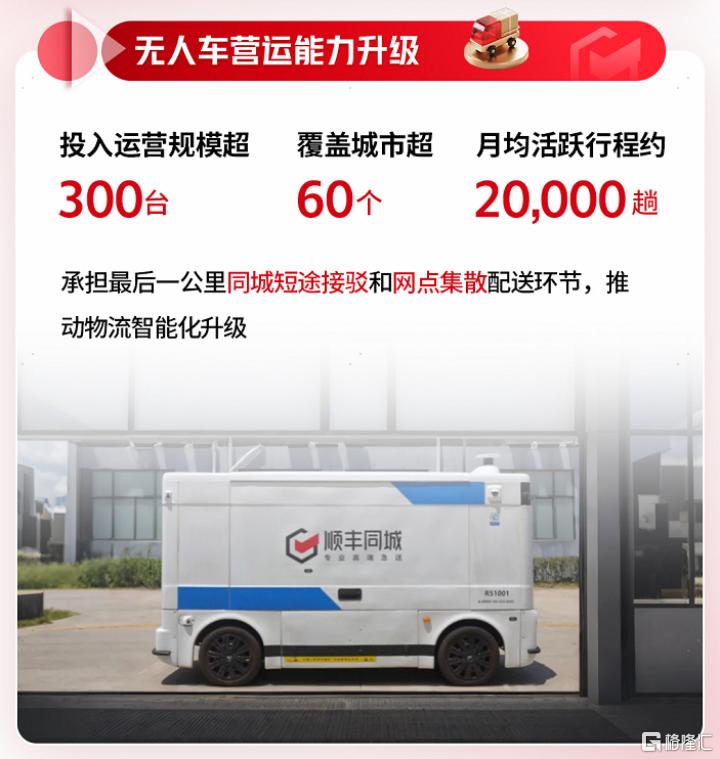
Group 1 - The investment in unmanned logistics stations has become a significant trend in the autonomous driving sector, with a more than 50% increase in the number of unmanned vehicles in the first half of the year, covering over 80% of logistics node cities in China [1] - The industry is reaching a critical point of "scale commercialization," driven by the rise of instant retail and the competition among major e-commerce players, which has significantly boosted demand for last-mile logistics [2] - The "last mile" delivery segment is identified as the most promising application area for unmanned vehicles, accounting for approximately 50%-60% of total logistics costs, making it a key battleground for logistics companies to enhance efficiency [3][5] Group 2 - SF Express's subsidiary, SF Same City, has reported a remarkable performance in the first half of the year, with a more than 50% year-on-year increase in same-city delivery orders and revenue growth of nearly 50% to 10.24 billion yuan [2] - The "unmanned vehicle + rider" collaborative delivery model is being explored by SF Same City to improve efficiency in the last-mile delivery, with significant revenue growth in this segment [3] - The company has expanded its unmanned vehicle fleet to 300 units, with a monthly active journey of approximately 20,000 trips, indicating a strong growth trajectory in the application of unmanned vehicles [3] Group 3 - The transition from traditional logistics to instant retail has highlighted the advantages of third-party delivery platforms like SF Same City, which offers a flexible and comprehensive service model [6] - SF Same City maintains a leading market share by collaborating with major clients and has seen a 55% year-on-year increase in B-end revenue, with significant growth in non-food delivery segments [7] - The company is also expanding its 2B and 2C service offerings, enhancing its ability to meet diverse delivery needs and increasing revenue from specialized services [11] Group 4 - The unmanned delivery industry is entering a critical phase of "model validation" and "scalability," with the potential to reshape the cost structure and experience of last-mile delivery [12] - Companies leveraging AI and unmanned delivery technologies are becoming key providers of new consumer delivery infrastructure, with a focus on flexible and customized service offerings [12] - The rapid integration of unmanned vehicles into daily life signifies a new era for autonomous driving, with significant investment potential in this evolving market [12]
弘则市场:牛市演绎和变迁 - 产业趋势的展望
2025-09-01 02:01
Summary of Key Points from Conference Call Records Industry Overview - The conference call discusses various industries including technology, manufacturing, pharmaceuticals, and internet sectors, highlighting their performance and trends in 2025 [1][2][3][4][6][31]. Core Insights and Arguments General Market Performance - In Q2 2025, A-share market revenue growth was 0.24% and profit growth was 1.3%, nearly flat compared to the previous year [3]. - The defense and electronics sectors showed strong performance, with the electronics sector achieving a revenue growth of 20% [3]. Technology and Manufacturing Trends - Key trends in technology and manufacturing include "going global" and "innovation," with significant contributions from overseas business [1][6]. - The semiconductor sector is experiencing structural changes due to domestic production and product innovation, with companies like Ecovacs showing potential [1][9]. - The A-share semiconductor sector is diverging from the US market, with domestic computing companies seeing rapid growth [1][7]. Internet Sector Dynamics - The internet sector is focusing on instant retail and subsidy strategies, with AI chips becoming a new focal point [1][10]. - Companies like Tencent and Alibaba are showing strong performance in their overseas markets, with Tencent's overseas gaming revenue growing over 70% [10][11]. Pharmaceutical Sector Recovery - The pharmaceutical sector's profit growth has turned positive, indicating a recovery after several years of decline [2][31]. - Internationalization is progressing, with domestic products gaining recognition in overseas markets [32]. New Consumption vs. Traditional Consumption - New consumption companies are outperforming traditional ones due to innovation and exploring new categories and channels [25][26]. - The strongest category currently is IP, which shows significant growth potential [27]. Important but Overlooked Content - The disparity in performance among companies within the same sector is notable, with some companies exceeding expectations while others struggle [6][9]. - The impact of AI technology on various internet businesses is significant, with advertising and gaming sectors showing notable growth due to enhanced data understanding and algorithm optimization [11][12][17]. - The manufacturing sector is seeing a clear trend towards exports, with companies like BYD and CATL reporting substantial overseas revenue growth [19][20][21]. Future Outlook - The outlook for the semiconductor sector includes potential changes in Nvidia's market dynamics due to new demand on the inference side [9]. - The internet sector is expected to continue evolving with AI technology influencing advertising and gaming revenues [14][18]. - The pharmaceutical industry is anticipated to see significant developments in clinical data and BD activities in the upcoming quarters, which will be crucial for its growth [34][36]. Conclusion - The overall sentiment is that various sectors, particularly those with strong overseas business and innovative capabilities, are well-positioned for future growth, reflecting a broader trend of globalization and technological advancement in the Chinese market [38][39].