云计算

Search documents
智通港股早知道 | 阿里巴巴-W(09988)第二季归母净利同比减少52% 商业航天高质量安全发展行动计划印发
Zhi Tong Cai Jing· 2025-11-25 23:47
Group 1: Alibaba's Q2 Performance - Alibaba-W (09988) reported total revenue of RMB 2,477.95 billion for the second quarter, a year-on-year increase of 5% [1] - The net profit attributable to ordinary shareholders was RMB 209.9 billion, a decrease of 52% year-on-year [1] - The adjusted earnings per ADS for the quarter were RMB 4.36, below the estimated RMB 6.34 [1] - Strong growth was observed in core businesses, particularly AI and cloud computing, with Alibaba Cloud's revenue accelerating by 34% year-on-year [1] - The CFO indicated that investments in AI and cloud infrastructure totaled approximately RMB 1,200 billion over the past four quarters [1] Group 2: Market Trends - The Nasdaq China Golden Dragon Index rose by 0.35%, reflecting mixed performance among popular Chinese stocks [2] - Major U.S. indices saw gains, with the Dow Jones Industrial Average up 1.43% and the S&P 500 up 0.91% [2] - Notable movements included Google reaching a historic high, while AMD and Nvidia experienced declines [2] Group 3: Commercial Space Development - The National Space Administration issued a plan for promoting high-quality and safe development in the commercial space sector, aiming for significant growth and enhanced governance by 2027 [3] Group 4: M&A Activity - The European Commission has paused the review timeline for Minmetals Resources' $500 million acquisition of Anglo American's nickel business in Brazil, extending the investigation into the second phase [4] Group 5: Ant Group Acquisition - Yao Cai Securities announced an extension of the acquisition offer period with Ant Group by four months, now set to end on March 25, 2026 [5] Group 6: Haichang Ocean Park Performance - Haichang Ocean Park reported a 35.2% year-on-year increase in revenue for the week of November 10-16, 2025, benefiting from the autumn holiday in Zhejiang Province [6][7] Group 7: Loan Agreement - Guotai Junan International signed loan agreements totaling up to HKD 1.95 billion, with a repayment period of 12 months from the signing date [8] Group 8: Innovative Drug Development - Innovent Biologics announced that its high-dose 9mg injection of Ma Shidu has been accepted for review by the National Medical Products Administration, targeting obesity treatment [9] Group 9: SUTENG's Q3 Performance - SUTENG reported a total revenue of approximately RMB 4.07 billion for Q3 2025, with laser radar sales increasing by 34% year-on-year and robot sales surging by 393% [10] Group 10: NIO's Q3 Results - NIO reported total revenue of RMB 217.939 billion for Q3 2025, a year-on-year increase of 16.7%, with gross profit rising by 50.7% [11] Group 11: Pony.ai's Q3 Performance - Pony.ai reported total revenue of approximately $2.54 million for Q3 2025, a 72% increase year-on-year, driven by strong growth in autonomous driving services [12] Group 12: Chow Tai Fook's Mid-Year Results - Chow Tai Fook reported a revenue of HKD 38.986 billion for the six months ending September 30, 2025, a decrease of 1.07%, with a slight increase in profit attributable to shareholders [13] Group 13: Colorful New Energy's Q3 Results - Colorful New Energy's subsidiary reported a revenue of RMB 404 million for the first nine months of 2025, a year-on-year increase of 16.6%, with net profit rising by 36.94% [14] Group 14: Bilibili's Game Success - Bilibili's new game "Escape from Duckkov" has sold over 3 million copies, with significant online engagement, leading to target price upgrades from several major banks [15][16]


3800亿资本开支“不太够”,阿里AI再迎密集催化,国产模型开启全球扩张
Xuan Gu Bao· 2025-11-25 23:39
Group 1: AI Industry Developments - Singapore's National AI Strategy is making a significant strategic shift by abandoning Meta's model in favor of Alibaba's Qwen open-source architecture, indicating a key expansion of Chinese open-source AI models globally [1] - Alibaba plans to "actively" invest in enhancing its AI capabilities, potentially exceeding its previously committed investment of 380 billion RMB over three years due to strong customer demand [1] - The newly launched AI application "Qwen APP" by Alibaba achieved over 10 million downloads within a week of its public testing, surpassing other AI applications like ChatGPT, marking it as the fastest-growing AI app in history [1] Group 2: Competitive Landscape - Google has officially released its next-generation flagship model Gemini3, which integrates with Search, GeminiApp, and developer platforms, exceeding market expectations for product rollout speed [2] - Google also launched the next-generation image generation model NanoBananaPro, which offers significant upgrades in consistency, controllable text generation, and professional-grade detail for creative design and marketing industries [2] - According to Zhongjin International, the AI industry is transitioning from "tool innovation" to "ecosystem integration," with vertical applications validating business models and revealing profit potential [2] Group 3: Company Collaborations - Hangzhou Steel's subsidiary Zhejiang Cloud Computing has signed a cooperation agreement with Alibaba Cloud for a data center project, with 1,069 powered cabinets and 21,000 operational servers as of August 2024 [3] - Daily Interactive, a local company in Hangzhou, is collaborating with various Alibaba Group products in developer and brand services [3]
阿里(09988)电话会:千问有望成未来AI生活入口 预计闪购Q4投入显著收缩 3800亿资本开支可能偏小
智通财经网· 2025-11-25 22:31
Core Insights - Alibaba's cloud AI business revenue surged by 34% in Q3, driven by significant growth in instant retail, which saw a 60% year-on-year increase in revenue [1][2][3] - The company is focusing on both AI to B and AI to C strategies, with the Qwen3-Max model achieving global leadership in intelligence and tool utilization [1][2] - The management plans to continue investing in AI capabilities, potentially exceeding the previously committed investment of 380 billion RMB over three years due to strong customer demand [2][3] Financial Performance - Total revenue for Alibaba reached 247.8 billion RMB, with a 15% year-on-year growth when excluding certain retail segments [7] - The adjusted EBITDA decreased by 7% primarily due to strategic investments in instant retail, while net profit fell by 56% to 20.6 billion RMB [7][8] - The cloud business revenue growth accelerated to 34%, with external customer revenue increasing by 29%, driven by rising demand for AI-related products [9] AI and Cloud Strategy - Alibaba's flagship model Qwen2.5-Max ranks among the top globally in specific evaluations, enhancing the company's competitive edge in AI [3][4] - The company is a clear leader in the AI cloud market, with a market share greater than the combined total of its next three competitors [3] - AI-related product revenue has seen triple-digit year-on-year growth for nine consecutive quarters, indicating strong market demand [2][9] Instant Retail Growth - Instant retail business revenue increased by 60%, with significant improvements in unit economics and user retention [8][12] - The company aims to integrate instant retail with its broader ecosystem, enhancing customer experience and operational efficiency [5][14] - The goal is to achieve a transaction volume of 1 trillion RMB in three years through the instant retail model [14][15] Future Outlook - The company is committed to investing in its core strategies of "AI + Cloud" and consumer services, aiming to leverage synergies across its business units for long-term growth [5][6] - Management expressed confidence in the sustained demand for AI services, anticipating continued growth in the next three years despite supply chain challenges [10][25] - The company is actively working to optimize its unit economics and improve customer experience in the instant retail sector [12][15]
阿里第二财季实现收入超2477亿元
Zheng Quan Ri Bao· 2025-11-25 16:48
本报记者 梁傲男 本季度,阿里电商客户管理收入同比增长10%,即时零售业务收入同比增长60%,用户留存率提升,平均订单价格提高, 业务规模持续增长,并带动淘宝App的月活跃消费者快速增长。 阿里生态多个业务加速接入即时零售。截至10月31日,约3500个天猫品牌将其线下门店接入即时零售。在协同效应 下,"双11"期间,天猫淘宝App的消费者实现同比双位数增长,近600个品牌成交额破亿元,天猫品牌即时零售日均订单环比9 月份增长198%。 网经社电子商务研究中心分析师陈礼腾认为,阿里正通过技术与商业模式的深度融合,构建一个更具韧性和联动性的大消 费生态,逐步提升用户黏性与活跃度。本季度的业绩体现出其生态协同效应的集中释放。 具体来看,在AI需求推动和公共云收入增长带动下,阿里云本季度收入同比增长34%,AI相关产品收入连续9个季度实现 三位数同比增长。 报告期内,阿里云持续投入全栈AI能力提升。在今年的云栖大会期间,阿里云发布从AI基础模型到高性能AI基础设施的全 栈AI升级。 依托全栈AI能力,阿里云持续引领中国蓬勃发展的AI云市场。Omdia报告显示,2025年上半年,阿里云在中国AI云市场的 份额达35. ...
加大投入核心业务,阿里持续进击
华尔街见闻· 2025-11-25 14:46
Core Viewpoint - Alibaba is at a pivotal moment in 2025, with significant opportunities arising from the convergence of AI and large-scale consumption, leading to renewed attention from the capital markets [1]. Financial Performance - In Q2 of FY2026, Alibaba reported revenues of 247.795 billion yuan, exceeding market expectations, with a year-on-year growth of 15% after excluding the impact of divested businesses [2]. - The cloud computing segment, driven by AI, saw a remarkable revenue growth of 34%, with AI-related product revenues achieving triple-digit growth for the ninth consecutive quarter [2]. - Adjusted net profit for the quarter was 10.352 billion yuan, reflecting a 72% year-on-year decline, as the company invests heavily in future growth [3]. Strategic Investments - Alibaba's management is committed to maintaining high-intensity strategic investments in AI and large consumption, aiming to seize future growth opportunities [3]. - The company plans to enhance its AI and cloud infrastructure investments, with capital expenditures reaching 31.5 billion yuan in Q3 and approximately 120 billion yuan over the past four quarters [7]. - Goldman Sachs projects Alibaba's total capital expenditures from FY2026 to FY2028 to reach 460 billion yuan, significantly higher than the previously set target of 380 billion yuan [8]. AI Development - Alibaba's AI capabilities have gained widespread market recognition, with the self-developed Qwen model achieving global influence and surpassing competitors in open-source model downloads [9][11]. - The Qwen model has been adopted by significant projects, such as Singapore's national AI initiative, further solidifying its global presence [11]. - Alibaba Cloud's revenue from AI-related services grew by 34% to 39.824 billion yuan, driven by increased demand for AI-integrated cloud products [12]. Large Consumption Strategy - Alibaba launched the "Taobao Flash Sale" business in April, integrating various services to create a unified large consumption platform [18]. - By August, the new Taobao membership system was introduced, enhancing cross-business member benefits and achieving a peak of 1.2 billion daily orders for Taobao Flash Sale [22]. - The integration of online and offline services is expected to generate an additional 1 trillion yuan in transactions over the next three years [25]. Market Response - Alibaba's stock price has surged over 90% this year, with a market capitalization nearing 3 trillion HKD, reflecting investor confidence in the company's new strategic direction [5]. - The company's efforts in AI infrastructure and large consumption strategies have resulted in strong internal morale and positive market sentiment [30].

阿里电话会:3800亿Capex可能偏小,千问有望成未来AI生活入口,预计闪购Q4投入显著收缩,
硬AI· 2025-11-25 14:04
Core Viewpoint - Alibaba is actively investing in AI capabilities, with a potential for additional investments beyond the previously committed 380 billion RMB over three years, due to strong customer demand [2][3]. Group 1: AI Strategy and Performance - Alibaba is focusing on both AI to B and AI to C strategies, leveraging its Qwen3-Max model and ecosystem to enhance its offerings [3]. - The company reported a 15% year-over-year revenue growth, with a 34% increase in cloud intelligence revenue, driven by strong demand for AI and public cloud services [4][10]. - AI-related product revenue has seen triple-digit year-over-year growth for nine consecutive quarters, indicating robust market adoption [4][13]. Group 2: Cloud Computing Market Trends - Two major trends in the cloud computing market are emerging: the preference for full-stack AI technology providers and the deepening use of AI by customers, leading to increased demand for traditional cloud services [6]. - Alibaba Cloud has gained market share in various segments, including a 20% year-over-year growth in the hybrid cloud market, positioning itself as a key player [6]. Group 3: Consumer AI and Applications - The launch of the Qwen App has seen over 10 million downloads in its first week, showcasing Alibaba's commitment to both enterprise and consumer AI [7]. - The integration of AI with Alibaba's extensive ecosystem is expected to create a powerful entry point for daily life applications, enhancing user engagement [7]. Group 4: Financial Performance - Total revenue for the quarter was 247.8 billion RMB, with a 15% year-over-year growth when excluding certain retail segments [10]. - The adjusted EBITDA decreased by 7% due to strategic investments in instant retail, while GAAP net profit fell by 56% [10]. - The Chinese e-commerce group's revenue reached 132.6 billion RMB, growing 16%, with a 60% increase in instant retail business revenue [11]. Group 5: Future Outlook and Investment - The company plans to continue investing in its core strategies of "AI + Cloud" and consumer services, aiming to enhance synergies across its business units [8][9]. - Management anticipates a significant reduction in investment in the next quarter as operational efficiencies improve [18]. - The company is committed to achieving a trillion RMB in transaction volume through its instant retail strategy over the next three years [17].

2025年中国在线阅读行业市场研究报告
硕远咨询· 2025-11-25 13:57
Investment Rating - The report does not explicitly state an investment rating for the online reading industry Core Insights - The online reading industry in China has experienced rapid growth, driven by the proliferation of mobile internet and smart devices, with user numbers approaching 500 million by 2024, reflecting a growth of over 50% in five years [17] - The market is diversifying, with significant contributions from literature, education, and comics, while the paid user base is steadily increasing, indicating a growing willingness to pay for quality content [12][13] - The industry is characterized by a competitive landscape dominated by major platforms like Yuewen Group and iReader Technology, which leverage extensive content resources and technological advantages to maintain market share [30][31] Summary by Sections 1. Industry Overview - Online reading refers to the browsing and reading of digital content through internet technology and various digital devices, offering advantages over traditional reading such as portability, instant updates, and interactive features [4][5] - The industry encompasses a wide range of content types, including literature, educational materials, and multimedia formats, enhancing user engagement and experience [6][7] 2. Market Size and Structure Analysis - The online reading market in China has maintained double-digit growth from 2012 to 2020, with the user base expanding from hundreds of millions to nearly 500 million, and paid users exceeding 150 million by 2020 [12][13] - Key growth drivers include digital transformation, increased smartphone penetration, and a rich content ecosystem that meets diverse user needs [14][16] 3. Competitive Landscape Analysis - Major players in the online reading market include Yuewen Group, iReader Technology, Tencent Literature, and Alibaba Literature, which dominate the market through strong content libraries and user engagement strategies [30][31] - Smaller and emerging platforms are also active, focusing on niche markets and innovative business models to attract specific user groups [35] 4. User Behavior and Demand Analysis - The user base is predominantly young, with over 60% aged between 16 and 35, and the proportion of paid users is steadily increasing, surpassing 30% by 2024 [18][48] - Users exhibit diverse content preferences, with a strong inclination towards high-quality, original works, and a growing demand for interactive and community-driven features [43][46] 5. Technological Development and Innovation Trends - The application of artificial intelligence in content creation and recommendation is on the rise, enhancing user satisfaction and content quality [56] - Cloud computing technologies are improving content distribution efficiency, while mobile reading technologies are evolving to provide better user experiences [57][58] 6. Future Development Trends and Recommendations - The online reading industry is expected to continue expanding, with increasing content diversity and personalization becoming key trends [64] - Platforms must innovate their business models and enhance user interfaces to maintain competitiveness in a rapidly evolving market [66]
谷歌:从 “护城河” 保卫战到增长新引擎
美股研究社· 2025-11-25 10:22
Core Viewpoint - Google's AI strategy has made significant progress, alleviating previous market concerns about the impact of generative AI on its core search and advertising business [1] Group 1: Google Cloud Platform (GCP) - Google Cloud Platform (GCP) has emerged as a key beneficiary in the multi-cloud strategy, benefiting from cost-effectiveness and recent outages of competitors like Microsoft Azure and Amazon Web Services (AWS) [3] - The market environment is structurally favorable for GCP, enhancing its relevance and adoption rates [3] Group 2: AI Growth Drivers - The commercialization of AI is currently constrained by insufficient infrastructure supply, despite increased capital expenditures and accelerated server deployments [5] - Google has a significant advantage in addressing this bottleneck, boosting market confidence in the sustainability of its cloud business growth [5] Group 3: Capital Expenditure and TPU - Google has raised its 2025 capital expenditure forecast to between $91 billion and $93 billion, primarily directed towards AI infrastructure [6] - The Tensor Processing Unit (TPU) has become a key growth engine for Google Cloud, with the latest "Gemini 3 model" receiving high praise for its performance [6][9] - The Ironwood TPUv7 has shown a tenfold performance increase over TPUv5, enhancing the efficiency of AI workloads [9] Group 4: AI Commercialization Pathways - Google's AI technology stack is independent and covers a wide range of applications, allowing for vertical integration across its platforms [12] - The integration of AI into core search and advertising functions has alleviated initial concerns about generative AI disrupting these areas, leading to accelerated revenue growth [12][13] Group 5: Financial Outlook - Google's revenue is projected to grow by 14% year-over-year in 2025, reaching $400.1 billion, with Google Cloud expected to be a core growth driver [17] - The profitability of Google Cloud is anticipated to expand alongside its growth, offsetting rising costs associated with AI strategy implementation [18] Group 6: Conclusion - Google's AI strategy has fundamentally reshaped its long-term commercial prospects, introducing new growth engines and enhancing the visibility of its profitability [19] - The ongoing advancements in AI integration are expected to solidify Google's competitive position, even amid potential cyclical downturns in advertising budgets [20]


第十六届IEEE云计算技术与科学国际会议落幕
Zhong Guo Xin Wen Wang· 2025-11-25 09:24
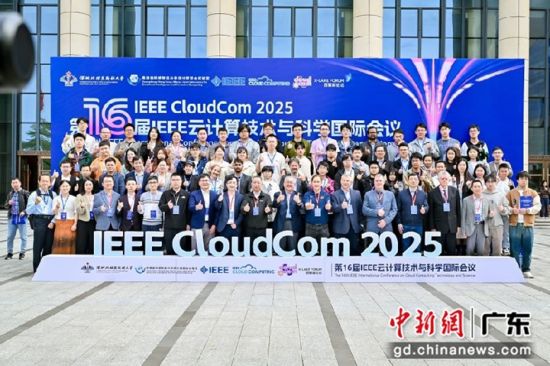
Core Insights - The 16th IEEE Cloud Computing Technology and Science International Conference (CloudCom2025) was recently held in Shenzhen, hosted by Shenzhen North University of Moscow, attracting over 200 top scholars, academicians, and industry experts to discuss advancements in cloud computing, edge computing, big data, and security privacy [1][2] Group 1: Key Presentations - Professor Abdallah Shami from Western University, Canada, delivered a keynote on "Automated Network Intelligence: Driving 5G and Future Development," emphasizing the critical role of artificial intelligence in the evolution of 5G and future networks [1] - Professor Xu Ke from Tsinghua University presented on "Secure Internet Architecture and Key Technologies," sharing forward-looking ideas for building safer and more reliable network architectures [1] - Academician Gong Jianya from Wuhan University discussed "Challenges and Thoughts on Intelligent Interpretation of Remote Sensing," highlighting the application and development trends of remote sensing technology in intelligent interpretation [1] - Academician Weihua Zhuang from the University of Waterloo focused on "6G Intelligent Network Management," exploring new opportunities and challenges in network management in the 6G era [1] Group 2: Additional Expert Contributions - The conference featured presentations from experts such as Professor Li Nan from the National University of Defense Technology, Professor Duan Lingjie from Hong Kong University of Science and Technology (Guangzhou), Professor Chen Jiachao from Sun Yat-sen University, and Professor Xu Ruifeng from Harbin Institute of Technology (Shenzhen), covering topics like 6G semantic communication, human-machine feedback learning, and AI applications in Web3 finance [2] - Over the three-day conference, multiple parallel sessions were held, addressing popular fields such as cloud scheduling optimization, federated edge learning, 5G and AI security, intelligent IoT, and large language models, discussing specific technical issues like emotion recognition, drone resource allocation, digital twins, and task offloading [2]
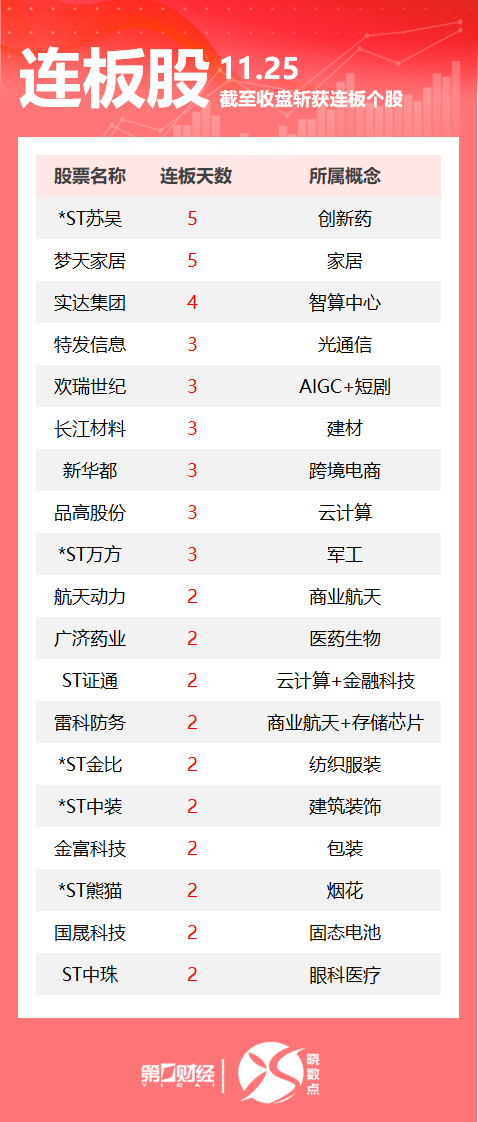
连板股追踪丨A股今日共96只个股涨停 这只光通信概念股3连板
Di Yi Cai Jing· 2025-11-25 08:09
Core Insights - The commercial aerospace sector is experiencing notable stock performance, with Aerospace Power achieving a two-day consecutive limit-up in the A-share market [1] Group 1: Stock Performance - A total of 96 stocks in the A-share market reached their daily limit-up on November 25 [1] - Aerospace Power is highlighted as one of the stocks with a two-day consecutive limit-up in the commercial aerospace sector [1] Group 2: Related Stocks - Other notable stocks include: - *ST Suhao with 5 consecutive limit-ups in the innovative drug sector [1] - Mengtian Home with 5 consecutive limit-ups in the home furnishing sector [1] - Shida Group with 4 consecutive limit-ups in the intelligent computing center sector [1] - Tefa Information with 3 consecutive limit-ups in the optical communication sector [1] - Huanyue Century with 3 consecutive limit-ups in the AIGC and short drama sector [1] - Other sectors represented include cloud computing, cross-border e-commerce, and solid-state batteries [1]