
关税战

Search documents
北水动向|北水成交净买入23.09亿 北水继续加仓科网股 全天抛售小米(01810)超13亿
智通财经网· 2025-04-17 09:57
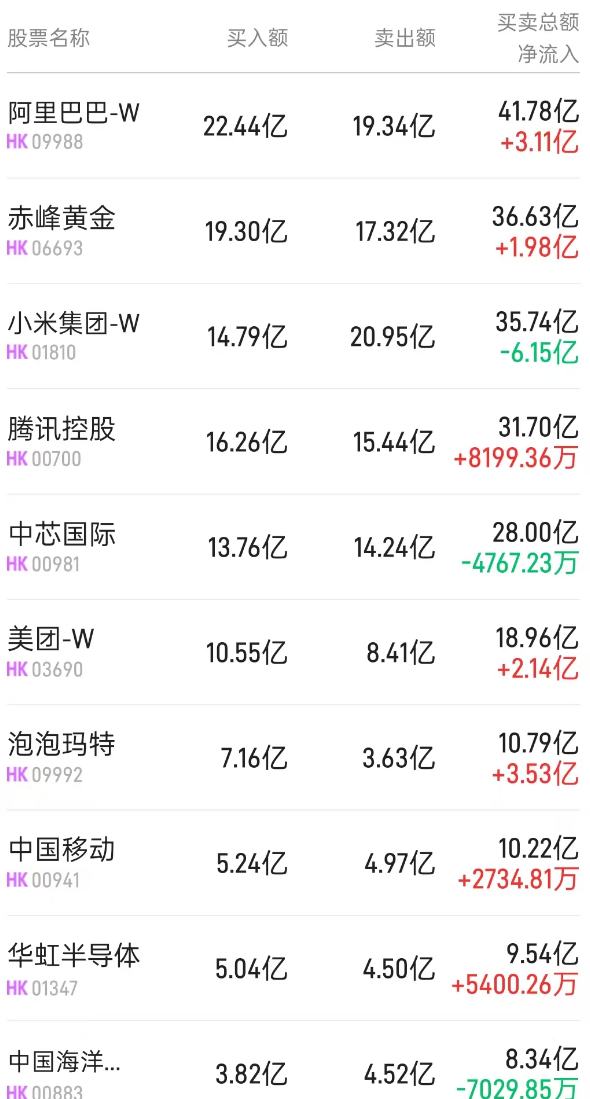
Group 1: Market Overview - Northbound trading recorded a net buy of HKD 23.09 billion, with HK Stock Connect (Shanghai) contributing HKD 5.08 billion and HK Stock Connect (Shenzhen) contributing HKD 18.01 billion [1] - The most net bought stocks included Alibaba-W (09988), Tencent (00700), and Meituan-W (03690) [1][4] - The most net sold stocks were Yingfu Fund (02800), Xiaomi Group-W (01810), and CNOOC (00883) [1] Group 2: Stock Performance - Alibaba-W saw a net inflow of HKD 3.11 billion, with total trading volume of HKD 41.78 billion [2] - Xiaomi Group-W experienced a net outflow of HKD 6.15 billion, with total trading volume of HKD 35.74 billion [2] - Tencent recorded a net inflow of HKD 819.94 million, with total trading volume of HKD 31.70 billion [2] Group 3: Sector Insights - Morgan Stanley's report indicates that the impact of the US-China trade war on Chinese internet companies is mostly indirect, with an estimated effect on online consumption being less than 0.5% [4] - HSBC's research suggests that while the Chinese internet sector may experience volatility due to trade tensions, the direct impact from tariff policies is limited [4] Group 4: Company-Specific Developments - Giant Bio (02367) received a net buy of HKD 4.16 billion, planning to raise approximately HKD 22.94 billion through a discounted share placement for business development and working capital [5] - Pop Mart (09992) saw a net buy of HKD 2.27 billion, with a focus on global organizational restructuring to enhance its international strategy [5] - Xiaomi Group-W's recent financing plans include a HKD 425 billion share placement and a HKD 200 billion bond project, leading to significant net selling [7] Group 5: Commodity and Semiconductor Sector - Semiconductor stocks like Hua Hong Semiconductor (01347) and SMIC (00981) received net buys of HKD 1.97 billion and HKD 615 million respectively, amid favorable domestic policies [6] - The price of gold has reached a historical high of USD 3,350 per ounce, benefiting companies like Chifeng Jilong Gold Mining (06693) which saw a net buy of HKD 1.82 billion [6]







直面困难比拼耐力 中美关税博弈正义者胜
Zhong Guo Fa Zhan Wang· 2025-04-17 04:25
有人说,只有中国硬刚美国,其他国家不谋求反制,获得了喘息的机会和谈判的空间,中国把自己的路 堵死了,巨大的对美出口份额不可能短期内被内需消化掉。事实上,中国没有妥协的余地,因为特朗普 关税战的最终目标是重新实现美国独一无二的优势,彻底削弱中国的经济实力和发展空间,扼杀中国产 业升级的机会。因此,退让还要用更大的退让来弥补,"以地事秦,犹抱薪救火,薪不尽,火不灭",那 是我们不可承受之重。 半个多世纪以来,美国放任国内财富和收入严重失衡,部分地区生活水平下降,并在国内外造成巨大金 融失衡。但美国不从自身寻找原因,也无力调整国内政策,却试图将危机转移给贸易伙伴。 短暂的停顿与观望过后,如果美国政府还没有被自身利益的损害打痛,"靴子"终会落下来。我国政府正 在通过系列"组合拳"化解这一局面,但阵痛期必然存在。涨价、外贸转内销、转向其他海外市场、在海 外开组装厂等,这些应对措施在实际操作中都有难度,调整时间或许要以月计、以年计,甚至更久。个 人要有所准备,努力适应内外环境的变化,探寻新的道路与生机。中长期看,中国必将更加深化与全球 的联系,发展机会绝不会因为美国的阻碍而中断,对于这一点,我们是有自信的。 关税战本质上 ...
宝城期货甲醇早报-20250417
Bao Cheng Qi Huo· 2025-04-17 01:19
Report Summary 1) Report Industry Investment Rating - No specific industry investment rating is provided in the report. 2) Core View - The methanol market is expected to run weakly with bearish factors prevailing. The domestic methanol futures 2509 contract may maintain a weakly oscillating trend on Thursday [1][5]. 3) Summary According to Related Contents Price and Trend - The short - term, medium - term, and intraday views of methanol 2509 are all weakly oscillating, with a reference view of weak operation [1]. - On Wednesday night, the domestic methanol futures 2509 contract showed a weakly oscillating trend, with the futures price closing down 1.27% to 2246 yuan/ton [5]. Driving Logic - The US President Trump's move to reduce the intensity of the tariff war has released positive signals, and the risk appetite of the financial market has risen, which has repaired the bullish sentiment in the methanol market [5]. - However, the domestic methanol supply pressure is relatively large. During the Spring Festival maintenance period, due to the high profit of coal - to - methanol this year, the weekly output and operating rate remain high. Meanwhile, the downstream demand for methanol has only slightly improved [5].
沪锡 维持宽幅波动走势
Qi Huo Ri Bao· 2025-04-16 23:21
Core Viewpoint - Recent fluctuations in tin prices on the Shanghai Futures Exchange have been characterized by significant volatility, with prices rising over 10% in the first quarter and reaching a 34-month high before experiencing a drop of over 20% in just five trading days, driven by macroeconomic shocks and supply-demand mismatches [1][2]. Group 1: Market Dynamics - The sharp decline in tin prices is attributed to two main factors: the U.S. "reciprocal tariff" policy raising concerns about increased global trade costs and demand contraction, and supply expectation adjustments from major producing regions like Myanmar and the Democratic Republic of Congo [2]. - The ongoing trade war and changing tariff policies have led to heightened market risk aversion, significantly impacting tin as a high-volatility commodity [2]. - The tightening of dollar liquidity and geopolitical conflicts have further exacerbated market fluctuations, with LME tin inventories dropping to their lowest point in 2023 [2]. Group 2: Supply and Demand Analysis - Current supply-demand dynamics indicate a "tight but not lacking" supply situation, with demand showing signs of recovery from weakness [6]. - Data shows that China's tin ore imports in January-February 2025 fell nearly 50% year-on-year, with a sharp 81.07% decline in imports from Myanmar, influenced by recent earthquakes affecting supply [6]. - The global mining capital expenditure growth rate for tin-related projects from 2019 to 2024 is only 1.2%, indicating a mismatch between existing project recovery and new project development timelines against demand growth [6]. Group 3: Future Outlook - The demand for tin is expected to significantly improve in the medium to long term, supported by growth in sectors such as semiconductor chips, 5G communications, photovoltaic cells, and AI chip soldering materials [6][8]. - The International Tin Association predicts a "non-linear leap" in tin demand from AI servers, with consumption per server expected to be three times that of traditional devices by 2025 [8]. - Despite the ongoing global trade tensions, tin is recognized as a strategic resource, with its overall value anticipated to rise as macroeconomic concerns are gradually absorbed by the market [8].
北水动向|北水成交净买入78.94亿 内资继续加仓盈富基金(02800) 全天抛售小米(01810)超9亿港元
智通财经网· 2025-04-16 09:55
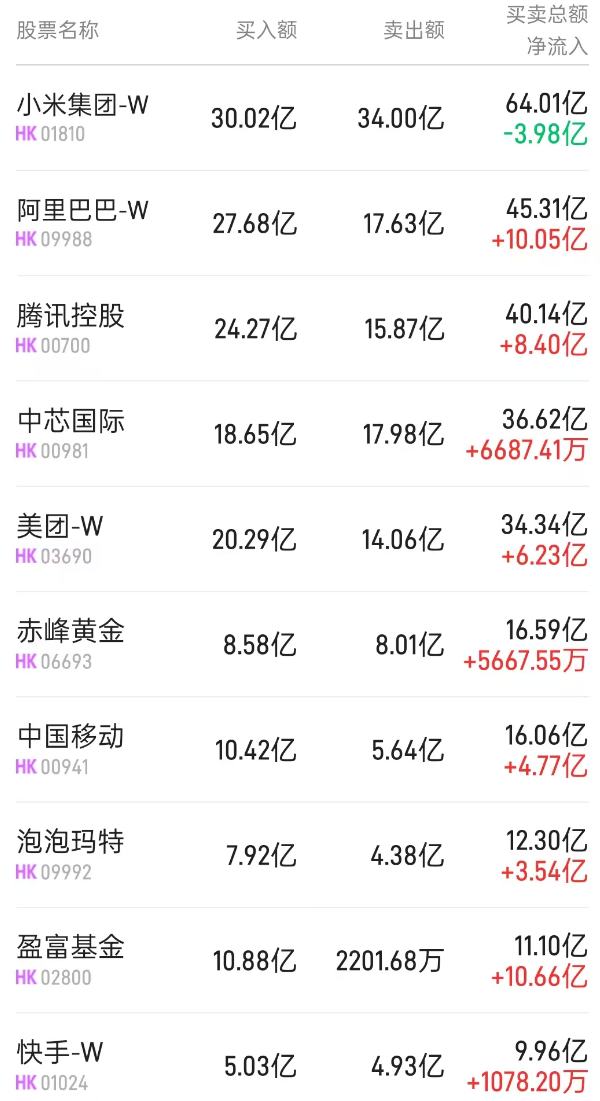
Summary of Key Points Core Viewpoint - The Hong Kong stock market experienced significant net inflows from Northbound trading, with a total net buy of 78.94 billion HKD on April 16, 2023, indicating a positive sentiment towards certain stocks amidst easing trade tensions and potential policy support from the Chinese government [1][4]. Group 1: Northbound Trading Activity - Northbound trading saw a net buy of 80.41 billion HKD through the Shanghai Stock Connect and a net sell of 1.47 billion HKD through the Shenzhen Stock Connect [1]. - The most bought stocks included the Tracker Fund of Hong Kong (02800), Alibaba-W (09988), and China Mobile (00941) [1]. - The most sold stocks were Xiaomi Group-W (01810), SMIC (00981), and Xpeng Motors-W (09868) [1]. Group 2: Stock-Specific Transactions - Xiaomi Group-W had a net sell of 9.46 billion HKD, attributed to its recent fundraising activities and a delay in its investor day [6]. - Alibaba-W saw a net buy of 10.05 billion HKD, reflecting strong investor interest despite market volatility [2]. - Tencent Holdings (00700) and Meituan-W (03690) also received net buys of 8.40 billion HKD and 6.23 billion HKD, respectively, indicating confidence in their business models [2][5]. Group 3: Market Sentiment and Economic Outlook - Analysts suggest that the reduction in trade tensions and potential domestic policy support could bolster the Hong Kong stock market's resilience in the medium to long term [4]. - The impact of the U.S.-China trade war on Chinese internet companies is expected to be limited, with estimates suggesting less than a 0.5% effect on online consumption [5]. - The gold market is also showing strength, with COMEX gold prices surpassing 3,300 USD per ounce, benefiting companies like Chifeng Jilong Gold Mining (06693) [6].

华鑫期货每日晨报-20250416
Hua Xin Qi Huo· 2025-04-16 09:21
Macro and Industry - The first batch of technology-themed funds has revealed their adjustment trends, with fund companies like Yongying, Zhongou, and Changcheng continuing to increase their positions in the AI industry chain in the first quarter, focusing heavily on information technology and manufacturing sectors [3] - Fund managers predict that the commercialization breakthrough of AI agents is accelerating, while the continuous iteration of large models is underestimated, and the mass production and short-term growth capabilities of humanoid robots are overestimated [3] Capital Markets - A-shares rebounded from a low point, with the Shanghai Composite Index closing up 0.15% at 3267.66 points, while the Shenzhen Component Index and the ChiNext Index saw slight declines of 0.27% and 0.13% respectively. The banking sector saw collective gains, and consumer stocks remained active [4] - The Hong Kong Hang Seng Index rose 0.23% to 21466.27 points, marking six consecutive days of gains, while the Hang Seng Technology Index fell 0.67% [4] - The US stock indices experienced slight declines, with the Dow Jones down 0.38% at 40368.96 points, and the S&P 500 down 0.17% at 5396.63 points. Notably, Boeing and Caterpillar led the declines in the Dow [5] Commodity Market - The IEA's monthly report has lowered the global oil demand growth forecast for 2025 to 730,000 barrels per day from a previous estimate of 1,030,000 barrels per day, with further slowdown expected in 2026 [7] - Domestic commodity futures saw most contracts decline in the night session, with energy and chemical products generally down, while black metals showed mixed results [8] - The precious metals market saw gold and silver prices rise, with gold reaching a high of 766.74, up 0.73%, driven by rising expectations of interest rate cuts [10][11] Specific Sectors - In the black metal sector, rebar and hot-rolled coil prices showed slight declines, with current steel demand remaining weak due to ongoing contraction in the real estate sector [11] - The agricultural products market saw fluctuations, with soybean meal prices declining while palm oil prices rebounded due to stable export tax rates [11] - The oil market continued to experience sideways movement, with geopolitical and fundamental factors being closely monitored [12]

关税战下,普通人该怎么办?
3 6 Ke· 2025-04-16 04:28
关税战对普通人的影响是什么?今天与你探讨。 其实,关税战的影响,会一层一层地传导到每一个普通人身上的。 大体上说,这种影响会体现在以下3个方面。 1. 就业风险 关税一加,出口型企业首当其冲。 过去10年,中国制造靠"世界工厂"的定位,占了全球市场的一大块。 关税战一打响,很多企业可能一边要面对订单流失,一边还要面对成本上升和利润压缩。 昨天的文章,我从企业的角度,和大家聊了聊这次"关税战"带来的影响。 是的,特朗普搞"关税战",世界乱糟糟的。 但我同时认为,世界再乱,你自己也不能乱,你既要认清现实,也要做足准备。 今天,我们就来聊聊关税战下,普通人的应对之道。 01 关税战,对普通人的直接影响 很多人听到"关税战",第一反应是国家和国家之间斗法,和老百姓有啥关系? 尤其是那些习惯了"这钱花得起"的人,会发现有些东西开始"花不起了";过去觉得理所当然的消费,可 能要重新衡量。 很多工厂会被迫砍订单、砍产能、减员。可以说,企业是关税战下的第一张多米诺骨牌。 你可能不是工厂工人,但你服务的公司可能是为它做电商平台、品牌营销、物流运输、甚至是供应链金 融的服务。 所以,关税战如果持续下去,慢慢传导下去,有些岗位是不 ...
中美开谈了,特朗普修改征税政策,迈出妥协第一步,已逼日本接盘
Sou Hu Cai Jing· 2025-04-16 03:05
Group 1 - The core viewpoint of the article highlights the dramatic shift in Trump's trade policy, moving from aggressive tariffs to a more conciliatory approach within just ten days, raising questions about the sincerity of this compromise [1][3] - The U.S. Treasury market reacted negatively to the initial tariff announcements, with significant sell-offs leading to rising yields, indicating market concerns about the economic impact of the trade war [3][5] - The trade deficit has worsened during Trump's presidency, reaching a record $1.21 trillion in 2024, which is a 50% increase compared to before he took office, contradicting the intended goals of the tariffs [3] Group 2 - China's response to U.S. tariffs has been strategic, targeting American agricultural products and shifting imports to South American markets, effectively undermining Trump's tariff strategy [5][10] - The internal divisions within Trump's team are causing erratic policy changes, with conflicting factions influencing the direction of trade negotiations, leading to confusion and inconsistency in U.S. trade policy [7] - Japan's reaction to U.S. trade demands has been notably passive, contrasting with other allies who have retaliated, indicating a potential vulnerability in U.S.-Japan trade relations [7][10]
宝城期货甲醇早报-20250416
Bao Cheng Qi Huo· 2025-04-16 01:38
Report Summary 1. Report Industry Investment Rating - No specific investment rating is provided in the report. 2. Core Viewpoint - The methanol market is expected to be in a weak and volatile state. Although the risk - preference in the financial market has increased due to Trump's move to reduce the intensity of the tariff war, the domestic methanol market still faces supply pressure. The 2509 contract of domestic methanol futures may maintain a weak and volatile trend on Wednesday [5]. 3. Summary According to Relevant Contents - **Price and Market Performance** - On Tuesday night, the 2509 contract of domestic methanol futures rebounded weakly, rose and then fell, with the price slightly up 0.04% to 2,279 yuan/ton [5]. - **Market Logic** - Positive factor: Trump's initiative to reduce the intensity of the tariff war has released a positive signal to the market, the risk - preference in the financial market has increased, and the bullish sentiment in the methanol market has been restored [5]. - Negative factors: The domestic methanol supply pressure is large. During the Spring Festival maintenance period, the high profit of coal - to - methanol this year has led to high weekly output and operating rate. Meanwhile, the downstream demand for methanol has only slightly improved [5]. - **Time - cycle Views** - Short - term (within one week): The methanol 2509 contract is in a volatile state [1]. - Medium - term (two weeks to one month): The methanol 2509 contract is in a weak and volatile state [1][5]. - Intraday: The methanol 2509 contract is in a weak and volatile state [1][5].
总量:国内外经济形势展望
2025-04-15 14:30
Summary of Conference Call Notes Industry Overview - The conference primarily discusses the macroeconomic situation, focusing on the impact of tariffs and the U.S. economy on global markets, particularly in the commodities sector [1][2][3][4][5][6][7][8][9][10][11][12][13][14][15][16][17][18][19][20][21][22][23][24][25][26][27][28][29][30][31][32][33][34][35][36][37][38][39][40][41][42][43][44][45][46][47][48][49][50][51][52][53][54][55][56][57][58]. Key Points and Arguments 1. **Tariff Impact**: The U.S. initiated a significant tariff increase of 34% on various imports, which is expected to have a substantial impact on both the U.S. and global economies. The tariffs are seen as a strategic move by the Trump administration to force negotiations with other countries [2][3][4][5][6][7]. 2. **Economic Projections**: If the tariffs are fully implemented, it could lead to a 1.5% reduction in U.S. economic growth, pushing the economy towards a recession [7][8][9][10]. 3. **Tax Reform**: A proposed tax reform plan of approximately $4.5 trillion over ten years is expected to provide a marginal boost to the economy, potentially offsetting some negative impacts of the tariffs [8][9][10][11]. 4. **Debt Ceiling Concerns**: The U.S. government faces a looming debt ceiling crisis, which could impact the timing and implementation of the proposed tax reforms [9][10][11]. 5. **Global Trade Dynamics**: The tariffs are expected to disrupt global trade, with potential retaliatory measures from affected countries, leading to a decrease in global trade volume by 3-5% [26][27]. 6. **Commodity Market Outlook**: The commodities market is experiencing a split performance, with agricultural products and precious metals performing well, while industrial commodities like steel and energy are under pressure due to reduced demand and increased tariffs [35][36][37][38][39][40][41][42][43][44][45][46][47][48][49][50][51][52][53][54][55][56][57][58]. 7. **China's Economic Resilience**: Despite external pressures from U.S. tariffs, China's economy is showing resilience with a 4% growth in social consumer goods revenue, indicating a recovery in domestic consumption [23][24][25][26][27][28][29][30][31][32][33][34]. 8. **Investment Strategies**: The conference suggests that investment strategies should focus on sectors that are likely to benefit from government policies aimed at stimulating the economy, such as infrastructure and technology [28][29][30][31][32][33][34][35][36][37][38][39][40][41][42][43][44][45][46][47][48][49][50][51][52][53][54][55][56][57][58]. Other Important but Overlooked Content - **Inflation Concerns**: The tariffs are expected to increase consumer prices significantly, with estimates suggesting an average annual increase of $3,800 for U.S. households [26][27]. - **Labor Market Impacts**: The tariffs may negatively affect employment in manufacturing sectors, necessitating government intervention to stabilize job markets [17][18][19][20][21][22]. - **Monetary Policy Adjustments**: The People's Bank of China may need to adjust its monetary policy in response to the economic pressures from U.S. tariffs, potentially leading to interest rate cuts [31][32][33][34][35][36][37][38][39][40][41][42][43][44][45][46][47][48][49][50][51][52][53][54][55][56][57][58]. This summary encapsulates the key discussions and insights from the conference call, highlighting the interconnectedness of tariffs, economic performance, and investment strategies in the current global landscape.