
投资于人

Search documents
公积金迎大改革:10万亿“沉睡资金”怎么用
2 1 Shi Ji Jing Ji Bao Dao· 2026-01-13 12:46
Core Viewpoint - The recent discussions around the reform of the housing provident fund system indicate a significant shift aimed at enhancing its effectiveness and expanding its usage, reflecting a broader commitment to improving housing accessibility for residents [1][2]. Group 1: Current Issues with the Provident Fund - The call for reform is driven by several issues, including the narrowing interest rate gap between commercial loans and provident fund loans [2]. - Some cities impose restrictions requiring the provident fund deposit location, home purchase location, and household registration to be the same, complicating cross-city home purchases [2]. - There are limitations on the conditions and amounts for converting commercial loans to provident fund loans [2]. Group 2: Future Directions for Reform - The reform will focus on expanding the usage of the provident fund beyond home purchases to include down payments, property fees, and renovations [3]. - There will be an emphasis on improving fund efficiency to ensure that more money is actively utilized rather than remaining idle in accounts [4]. - The reform aims to support inter-city recognition and lending, allowing the provident fund to follow individuals' work and life changes [5]. - More flexible employment individuals, such as freelancers and self-employed workers, will be encouraged to participate in the provident fund system [5]. - Increased support for affordable housing, urban renewal, and the renovation of old neighborhoods will be prioritized, enhancing urban livability [5].
中央企业落实“投资于人”的实践路径
Xin Hua Cai Jing· 2026-01-13 07:01
Group 1 - The core viewpoint emphasizes the necessity of implementing the "investment in people" strategy by central enterprises to align with national development goals and enhance core competitiveness for sustainable high-quality growth [1] - The strategy aims to integrate human capital enhancement with the fulfillment of strategic missions, improvement of corporate efficiency, and betterment of social welfare [1] Group 2 - The "investment in people" strategy is aligned with national strategic needs, focusing on talent cultivation and social support, particularly in key areas such as technological self-reliance, new infrastructure, energy security, and high-end manufacturing [2] - It involves targeted training of key personnel in strategic sectors and improving public services in regions where major projects are located, benefiting both strategic talent and local communities [2] Group 3 - The strategy aims to activate employment and development momentum through human investment, particularly in underdeveloped regions, by providing practical skills training and establishing employment connection platforms [3] - It includes initiatives for talent sharing and support in rural revitalization, focusing on training for practical skills related to rural industries and infrastructure [3] Group 4 - The strategy extends to optimizing the business environment and industrial ecosystem by leveraging central enterprises' leadership in the industrial chain, promoting talent sharing and skills development among upstream and downstream enterprises [4] - It aims to create a supportive talent service platform for small and medium enterprises, reducing their human resource training costs and enhancing overall workforce quality [4] Group 5 - The strategy establishes a comprehensive empowerment system covering all employee levels, ensuring that every worker has development opportunities through standardized training and career advancement pathways [5] - It emphasizes the cultivation of core talents and the growth of young employees, ensuring a continuous talent pipeline for the enterprise [5] Group 6 - The strategy links human investment with corporate innovation and efficiency upgrades, encouraging employees to engage in innovation and providing digital skills training to meet transformation needs [6] - It promotes a culture of innovation and tolerance for failure, enhancing overall employee engagement in innovation activities [6] Group 7 - The strategy includes a multi-faceted support system for stable investment in talent development and hardware, ensuring balanced growth in both areas [7] - It establishes a comprehensive evaluation mechanism that incorporates human capital into performance assessments, ensuring a holistic approach to talent and resource management [7]
1月资产配置月度报告:跨年行情多点开花,外需韧性超预期
Sou Hu Cai Jing· 2026-01-13 02:57
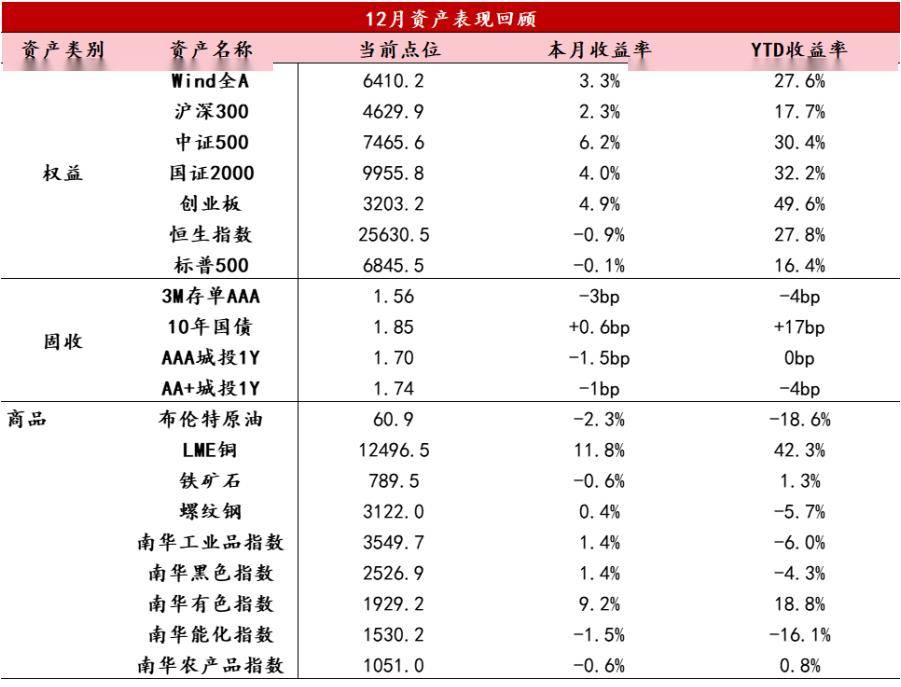
Stock Market Overview - In December, the Federal Reserve's interest rate cut was implemented as expected, leading to fluctuations in future rate cut expectations, while the Nasdaq index experienced volatility [1] - The A-share market showed overall fluctuations, with the Shanghai Composite Index achieving 11 consecutive gains by the end of the month, driven by a positive tone from the Central Economic Work Conference and a declining US dollar index [1] - The Wind All A index recorded a +3.3% increase for the month, with 60% of the Shenwan first-level industries rising, particularly strong performances in defense and military (+17.22%) and non-ferrous metals (+13.68%) [1] Bond Market Overview - The bond market continued to experience wide fluctuations in December, with increased yield volatility and a steeper curve [2] - Despite relatively ample liquidity and the central bank's resumption of bond purchases providing some support, concerns over long-term bond supply and other factors kept the market in a weak oscillation pattern [2] - The 10-year government bond yield ended the month at 1.85%, reflecting an N-shaped trend throughout December [2] Commodity Market Overview - The commodity market showed a bullish atmosphere in December, with precious metals and non-ferrous sectors being the strongest performers [3] - Gold prices fluctuated, with London gold closing at $4318.25 per ounce, up 2.36% from the previous month, while copper prices also saw significant increases [3] - The oil market experienced a downward trend, with Brent crude oil closing at $60.91 per barrel, down 2.26% for the month [3] Macroeconomic Performance - In November, China's exports demonstrated strong resilience, growing by 5.9% year-on-year, driven by a significant increase in machinery and high-tech product exports [5] - However, domestic consumption remained weak, with retail sales growth slowing to 0.3% year-on-year, indicating structural constraints on internal demand [5] - Fixed asset investment continued to decline, with real estate investment adjustments dragging down overall figures, highlighting the challenges in achieving self-sustaining growth [5] Policy Outlook - The Central Economic Work Conference set the tone for macroeconomic policy in 2026, focusing on addressing the structural imbalance of "strong supply and weak demand" [9] - The strategic shift will prioritize investment in human capital and social welfare, aiming to enhance income levels and consumer demand [9] - Fiscal policy is expected to maintain a more active stance, with a nominal deficit rate targeted around 4.0%, while monetary policy will shift focus from total volume to price stability [10][11] Asset Allocation Analysis - In December, net buying in the stock market rebounded to over 2.5 trillion yuan, with significant inflows into equity ETFs [14] - The manufacturing PMI showed a seasonal rebound, indicating improved trade conditions and proactive inventory preparations by companies [15] - Looking ahead to 2026, the market is expected to experience structural trends, with a focus on sectors that demonstrate sustainable performance and profitability [16]

评论员观察|坚持内需主导,熨平消费三道“褶”
Sou Hu Cai Jing· 2026-01-12 10:16
Core Viewpoint - The article emphasizes that understanding and addressing the "wrinkles" in consumer demand is crucial for expanding economic growth in China, highlighting the need for a systematic approach to unlock potential opportunities [1][11]. Group 1: Economic Context - China's manufacturing value-added accounts for nearly 30% of the global total, with a variety of consumer goods reaching 230 million types, yet final consumption has not matched this production capacity [3]. - In the first three quarters of 2025, final consumption expenditure contributed 53.5% to economic growth, which, while improved, still lags behind the over 60% contribution rate seen in developed countries [3]. - The central economic work conference identified the prominent contradiction of "strong supply but weak demand," making the promotion of domestic demand a top priority for economic work [3]. Group 2: Consumer Demand and Income - The first wrinkle in consumption is related to "expected income," as despite per capita GDP reaching $13,000, consumer spending has not increased proportionately [6]. - In 2024, RMB deposits increased by 17.99 trillion yuan, and by 24.73 trillion yuan in the first 11 months of 2025, indicating a rising tendency for residents to save rather than spend [6]. - The need to enhance human capital investment is urgent, as the proportion of skilled workers in China is only 30%, compared to 40% in Japan and 50% in Germany, highlighting a significant gap in advanced manufacturing and strategic emerging industries [6]. Group 3: Supply and Demand Dynamics - The second wrinkle in consumption is the "supply-demand contradiction," illustrated by the rapid sell-out of a high-quality down jacket priced at 499 yuan, indicating that demand exists but quality supply must keep pace with consumption upgrades [8]. - The service consumption sector is growing rapidly, yet issues such as inconsistent quality and lack of standardization remain prevalent, particularly in elder care and childcare services [8]. Group 4: Environmental Constraints - The third wrinkle is "environmental constraints," where systemic issues such as cumbersome processes deter consumer spending, as seen in ticket purchasing and vehicle registration [9]. - Recent measures to remove unreasonable restrictions in consumption, such as easing purchase limits in the automotive and housing sectors, aim to enhance consumer confidence and convenience [9]. - Creating a vibrant consumption ecosystem, as demonstrated by the success of local markets that blend cultural elements with shopping experiences, can significantly boost consumer willingness to spend [9].

【认真学习贯彻党的二十届四中全会精神·高端笔谈】找准工会落实“投资于人”着力点 赋能职工全面发展
Xin Lang Cai Jing· 2026-01-11 19:16
Core Viewpoint - The emphasis on "investment in people" reflects a strategic shift towards high-quality development, focusing on human capital as a key driver for sustainable growth and societal well-being [1][2]. Group 1: Importance of "Investment in People" - "Investment in people" signifies a paradigm shift from traditional "investment in things," prioritizing comprehensive human development and focusing on education, healthcare, employment, and social security [2]. - This approach aims to transform human resources from "production costs" into "sustainable strategic capital," enhancing individual value realization and overall welfare [2]. - Increasing investment in human capital is essential to counteract diminishing returns on existing capital and rising labor compensation rates, thereby fostering a "human capital dividend" and improving total factor productivity [2]. Group 2: Role of Trade Unions - Trade unions are identified as crucial entities in implementing "investment in people," representing workers' interests and ensuring their rights are upheld [3]. - The nature of trade unions as a bridge between the government and workers positions them to prioritize workers' needs and facilitate their development [3]. - Trade unions possess a comprehensive organizational structure that supports the execution of "investment in people" initiatives, addressing the full lifecycle needs of workers [3]. Group 3: Key Focus Areas for Trade Unions - Trade unions should enhance income distribution systems to support common prosperity, focusing on collective bargaining and optimizing wage structures to improve workers' earnings [4]. - Promoting cultural initiatives that resonate with workers is essential, including recognizing labor models and fostering a culture that values labor and craftsmanship [5]. - Trade unions must actively support employment initiatives, particularly for vulnerable groups, and enhance workers' skills through targeted training programs [6]. Group 4: Enhancing Workers' Rights and Quality of Life - Establishing democratic management systems in workplaces is vital for protecting workers' rights and ensuring their voices are heard [6]. - Trade unions should leverage their resources to improve workers' living standards, providing diverse services that address their needs [7]. - Utilizing digital tools to enhance service delivery and integrating various support functions into community hubs will ensure that the benefits of "investment in people" reach all workers equitably [7].
2026年,消费增量在哪里?
Xin Lang Cai Jing· 2026-01-11 10:34
Group 1: Consumer Trends - Service consumption has been a weak link in China's overall consumption, with significant potential for growth in this area [5][22] - Consumers are increasingly prioritizing spending on experiences related to health, fitness, and travel over traditional goods [19][24] - The younger generation (ages 15-25) shows a marked preference for emotional and experiential spending, indicating a shift in consumer behavior [7][24] Group 2: Policy and Economic Outlook - The central economic work conference emphasizes the need to expand domestic consumption and optimize the environment for consumer spending [21][30] - Policies are being developed to enhance service consumption and remove unreasonable restrictions in the consumption sector [6][30] - The focus is shifting from material investment to human investment, aiming to improve quality of life and consumer experience [30][31] Group 3: Technological Integration - Artificial intelligence (AI) is becoming a crucial factor in enhancing consumer products and services, leading to a transformation in consumption patterns [26][28] - The market for smart consumer electronics, such as AI glasses, is expected to grow significantly, with a projected shipment of 290.7 million units by 2025 [26][27] - AI is facilitating a shift from functional experiences to emotional connections in consumer products, creating new market opportunities [28][29] Group 4: Service Sector Growth - The service sector's share of total consumer spending is projected to reach 46.1% by 2024, indicating substantial growth potential in areas like healthcare, education, and personal services [5][22] - The government is focusing on expanding the supply of quality services, particularly in health, elderly care, and childcare sectors [6][23] - There is a consensus among industry experts that the service consumption sector has significant untapped potential that needs to be addressed [8][24]

新型电力系统建设需强化“人物协同”
Zhong Guo Neng Yuan Wang· 2026-01-11 03:37
Core Viewpoint - The integration of "investment in material" and "investment in people" is emphasized as a strategic direction for China's economic development, reflecting a shift in focus towards human capital alongside infrastructure investment [1][2]. Group 1: Investment in People - Investment in people is defined as enhancing capabilities and potential across the entire population and lifecycle, addressing changes in international development, traditional economic dynamics, demographic shifts, and new productivity demands [2]. - The new electric power system serves as a platform for human capital development, creating demand for skilled professionals in high-altitude transmission technology, new energy consumption, and smart operation [3][4]. - The digital infrastructure, such as digital twin grids and IoT in power, provides training platforms for digital talent, facilitating the upgrade of skills towards intelligent and digital capabilities [3]. Group 2: Investment in Material - The new electric power system is identified as a core carrier for material investment, establishing a solid hardware foundation for human capital development [3]. - Major infrastructure projects, including ultra-high voltage transmission and smart grid facilities, are crucial for energy security and provide practical scenarios for human capital investment [3][4]. - Investment in material is linked to the operational efficiency of the electric power system, where technological upgrades and equipment improvements drive the need for skilled labor [7]. Group 3: Synergy Between Investment in People and Material - The new electric power system exemplifies the synergy between material and human investment, enhancing energy security and improving service quality through simultaneous upgrades in infrastructure and workforce capabilities [5][6]. - The integration of talent development into project planning and execution ensures that personnel grow alongside project demands, fostering a skilled workforce that meets industry needs [6]. - Collaborative efforts across the industry chain enhance the quality of talent and technology, promoting a virtuous cycle of development that benefits the entire ecosystem [6][8]. Group 4: Technological and Service Enhancements - Upgrading technology and service capabilities are essential for improving operational efficiency and service quality in the electric power sector [7][8]. - Investment in smart devices and digital platforms must be accompanied by comprehensive training programs to align employee skills with technological advancements [7]. - The focus on service quality and operational excellence is critical for meeting the evolving demands of consumers and businesses, ensuring that infrastructure investments yield tangible benefits [8].
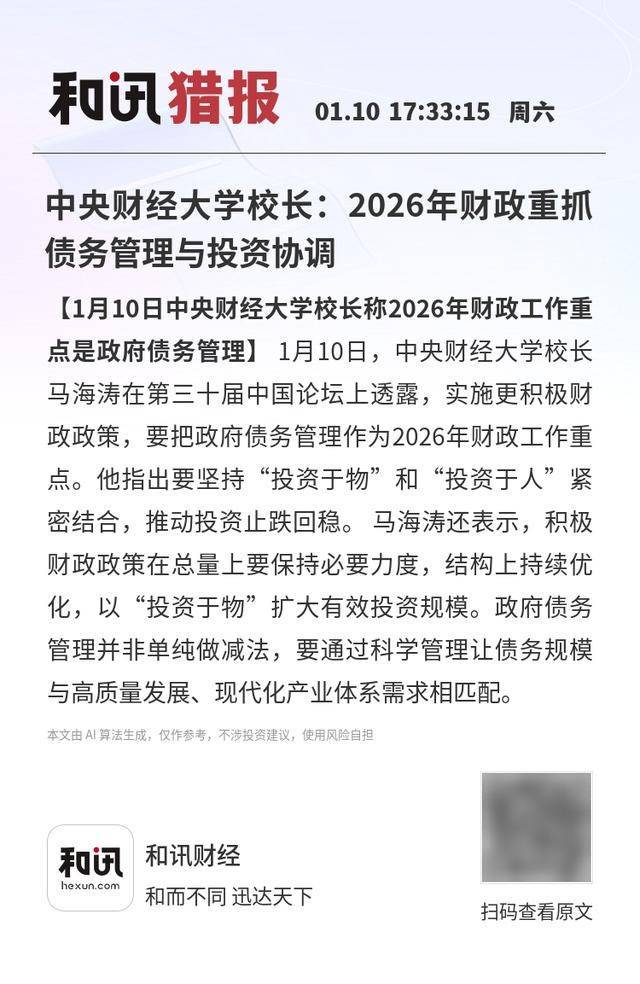
中央财经大学校长:2026年财政重抓债务管理与投资协调
Sou Hu Cai Jing· 2026-01-10 11:05
Group 1 - The core viewpoint is that government debt management will be a key focus of fiscal work in 2026, emphasizing the need for a more proactive fiscal policy [1][2] - The approach will combine "investment in material" and "investment in people" to stabilize and promote investment [1][2] - The proactive fiscal policy should maintain necessary strength in total volume while continuously optimizing its structure to expand effective investment scale through "investment in material" [1][2] Group 2 - Government debt management is not merely about reduction; it requires scientific management to align debt scale with high-quality development and the needs of a modern industrial system [1][2]
金融大家评 | 中国社会科学院学部委员蔡昉:“十五五”时期投资于人的理论范式和实践模式
清华金融评论· 2026-01-10 10:08
Core Viewpoint - The article emphasizes the necessity of integrating "investment in material" and "investment in people" to support high-quality population development and achieve Chinese-style modernization, as highlighted by Xi Jinping during the 20th Central Financial Committee meeting in 2023 [4]. Group 1: Theoretical Paradigm Shift - Achieving shared development and common prosperity requires a specific level of per capita GDP, which does not automatically resolve income distribution issues. Historical experiences show that countries with smaller income gaps often implement significant redistribution policies [5]. - Increasing social investment in government spending and expanding public goods supply are essential for enhancing common prosperity and investing in people [6]. - Investment in people should not diminish the principle of ensuring and improving people's livelihoods but should seek a dynamic balance at a higher level, emphasizing the need for new requirements based on rising income levels and national fiscal capacity [6][7]. Group 2: Practical Mode Transformation - As economic development progresses, the quality of life increasingly relies on the supply of high-quality public goods, revealing a common feature in modernization experiences across countries [9]. - China is expected to cross the high-income threshold by 2035, necessitating a significant increase in public goods supply to address the "Galbraith's paradox" and enhance public welfare [10]. - The decline in investment returns and the shift from supply-side to demand-side constraints highlight the urgency of investing in human capital to boost productivity and economic growth [11][12]. Group 3: Key Areas for Investment in People - Policies should focus on creating a fertility-friendly society to reverse declining birth rates, as evidenced by the total fertility rate dropping to 1.3 in 2020 [18]. - The demographic transition provides an opportunity to optimize human capital development resources, allowing for better allocation of educational resources and support for vocational training [19]. - Addressing structural employment issues, particularly among the youth and elderly, is crucial for creating high-quality job opportunities and ensuring equitable labor market participation [23]. Group 4: Redistribution and Public Service Enhancement - Effective redistribution measures, such as tax and transfer payments, are necessary to narrow income gaps and improve the equalization of basic public services [24]. - Countries with lower Gini coefficients demonstrate the effectiveness of redistribution policies, with significant reductions in income inequality achieved through balanced tax and government spending strategies [25]. - China's current redistribution indicators suggest substantial potential for increasing investment in people and achieving effective outcomes [25].

马海涛:更加积极的财政政策要把政府债务管理作为2026年财政工作的重点,以“投资于物”为抓手扩大有效投资规模
Sou Hu Cai Jing· 2026-01-10 10:02
Core Viewpoint - The central theme emphasizes the need for a more proactive fiscal policy in China, focusing on government debt management as a key priority for 2026, and the integration of "investment in material" and "investment in people" to stabilize and boost investment levels [1] Group 1 - The implementation of a more proactive fiscal policy is essential to maintain necessary overall strength while optimizing the structure of investments [1] - The coordination between "investment in material" and "investment in people" is crucial for expanding effective investment scale [1] - Government debt management should not merely focus on reduction but rather on scientific management to align debt scale with the demands of high-quality development and a modern industrial system [1]