政策不确定性

Search documents
FPG财盛国际:特朗普调高对印度商品关税至50% 美印关系陷入严重对峙
Sou Hu Cai Jing· 2025-08-07 02:36
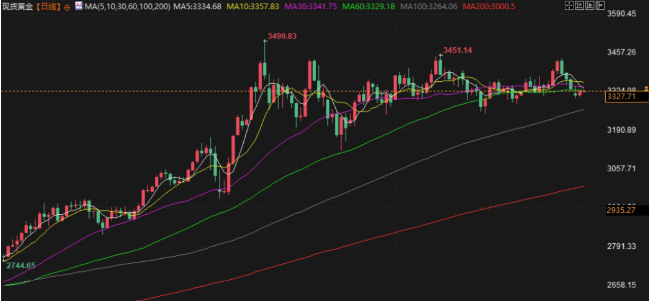
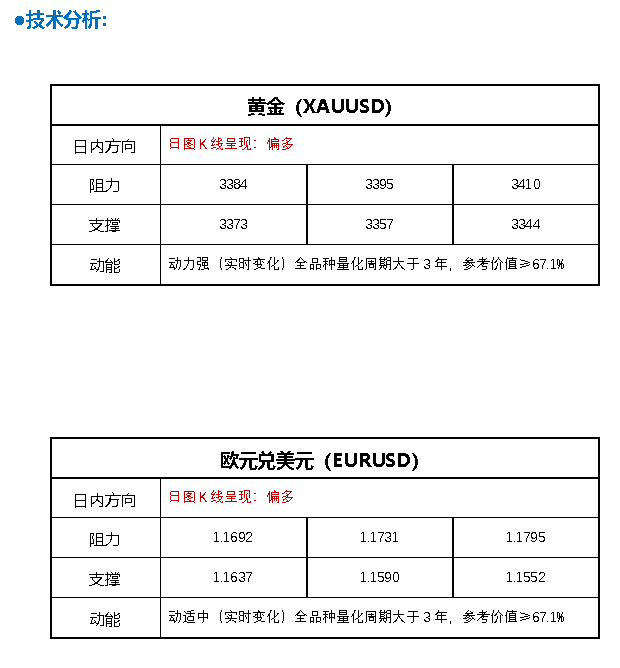
Group 1 - The U.S. President Trump has imposed an additional 25% tariff on Indian goods due to India's continued purchase of Russian energy, raising the total tariff rate to 50% [1] - Following the announcement, the iShares MSCI India ETF dropped to an intraday low, while oil prices increased, and the Indian Rupee stabilized at 87.91 against the U.S. dollar [1] - This tariff increase is part of Trump's strategy to reduce trade deficits, revitalize domestic manufacturing, and increase federal revenue, which poses risks to the global economy, including rising costs and potential supply chain disruptions [1] Group 2 - Market expectations for a rate cut in September have surged, with the CME FedWatch tool indicating an 87% probability following a weak employment report [2] - The dismissal of the U.S. Bureau of Labor Statistics chief by Trump has further heightened policy uncertainty [2] - Gold, as a traditional safe-haven asset, is expected to perform strongly in the context of increased political and economic uncertainty and a low-interest-rate environment [2] Group 3 - Gold prices are projected to have room for growth, with a short-term target of $3,400, supported by ongoing tariff tensions, economic slowdown, and inflation concerns, as well as a weak dollar [3] Group 4 - The daily direction for gold (XAUUSD) is showing a bullish trend, with resistance levels at 3384, 3362, and 3410, and support levels at 3373, 3357, and 3344 [4] - The momentum for gold is strong, with a quantitative cycle exceeding three years and a reference value of at least 67.1% [4] Group 5 - The daily direction for the Euro against the U.S. dollar (EURUSD) is also showing a bullish trend, with resistance levels at 1.1692, 1.1731, and 1.1795, and support levels at 1.1637, 1.1590, and 1.1552 [5] - The momentum for EURUSD is moderate, with a quantitative cycle exceeding three years and a reference value of at least 67.1% [5]

美国非制造业PMI下滑 关税及政策不确定性影响显现
Zhong Guo Xin Wen Wang· 2025-08-06 02:29
Core Viewpoint - The ISM reported that the July non-manufacturing PMI in the U.S. was 50.1, indicating a slowdown in the service sector and falling below expectations [1] Economic Indicators - The July non-manufacturing PMI decreased from 50.8 in the previous month to 50.1, reflecting a near stagnation in the service economy [1] - Employment index fell to 46.4, marking the fourth contraction in five months and reaching one of the lowest levels since the pandemic [1] - Input cost index rose to the highest level since October 2022, indicating increasing inflationary pressures [1] Market Reaction - Following the release of the ISM data, all three major U.S. stock indices closed lower, with the Dow Jones down 0.14%, Nasdaq down 0.65%, and S&P 500 down 0.49% [1] Industry Insights - Comments from the ISM highlighted concerns over tariffs and uncertainty affecting procurement planning in the accommodation and food services sector, leading to delays in the next fiscal year's purchasing plans [1] - The construction industry noted that trade uncertainties are causing clients to reassess project feasibility, resulting in delays or cancellations [1] - Steve Miller, chairman of the ISM Services Business Survey Committee, indicated that tariffs are driving up payment prices, potentially fueling inflation [1]
8月5日上期所沪银期货仓单较上一日减少16982千克
Jin Tou Wang· 2025-08-05 09:54
Group 1 - The total silver futures in Shanghai Futures Exchange is 1,157,291 kilograms, with a decrease of 16,982 kilograms compared to the previous day [1][3] - The main silver futures opened at 9,040 yuan per kilogram, reached a high of 9,105 yuan, and a low of 9,030 yuan, closing at 9,075 yuan, an increase of 0.82% [1] Group 2 - The credibility of independent institutions in the U.S. is crucial for the "exceptionalism" narrative, with recent attacks on these institutions by Trump raising concerns [2] - If skepticism towards independent institutions persists, investors may demand higher risk premiums for holding U.S. assets, potentially limiting market returns and putting pressure on asset valuations [2] - The rise in policy uncertainty has shifted investor focus back to the actions of the Trump administration, particularly following the "liberation day" tariff controversy [2]
经合组织警告:商业投资疲软正拖累全球经济增长
Hua Er Jie Jian Wen· 2025-08-05 08:01
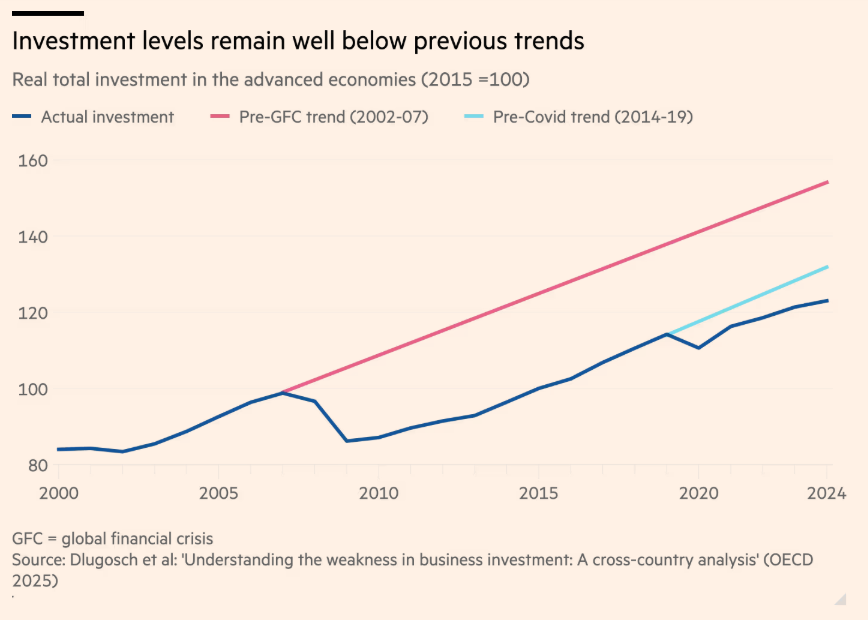
Group 1 - The core issue affecting global economic growth is the long-term decline in corporate investment, which has not recovered to pre-crisis levels after the financial crisis and COVID-19 pandemic [1] - OECD data shows that the median net investment of OECD countries as a percentage of GDP has dropped from approximately 2.5% before the 2008 financial crisis to 1.6% currently, with the pandemic further exacerbating this decline [1][2] - Only Israel and Portugal have exceeded pre-financial crisis investment levels, while only six countries, including Canada, Italy, and Australia, have higher investment levels than before the pandemic [2] Group 2 - Policy uncertainty is identified as a major factor discouraging corporate investment, with various global events such as trade policies, the pandemic, and geopolitical conflicts contributing to this uncertainty [2] - A study by OECD indicates that a one standard deviation increase in policy uncertainty could lead to a 1 percentage point decrease in corporate investment growth within a year [2] - If the current high level of uncertainty persists, global actual investment is projected to shrink by an additional 1.4 percentage points by the end of next year [2] Group 3 - Despite strong growth in digital and knowledge-based investments, there is a concerning trend of weak physical asset investment, leading to a continuous decline in the ratio of net investment to GDP [3] - Many companies are prioritizing shareholder returns, such as dividends and stock buybacks, over capital investments, which is evident in various countries [3] - A notable example is the UK water industry, where over one-third of the funds were distributed as dividends instead of being reinvested in infrastructure improvements [3]
经合组织拉响全球增长警报:企业投资“掉档”,特朗普关税添乱
Jin Shi Shu Ju· 2025-08-05 05:56
Group 1 - OECD warns that weak corporate investment threatens global growth, with net investment in member countries dropping from 2.5% of GDP in 2008 to 1.6% in medium-level countries, exacerbated by the pandemic [1][5] - Only two countries, Israel and Portugal, have net investments exceeding pre-financial crisis trend levels, while only six countries, including Canada, Italy, and Australia, have investments above pre-pandemic trends [3][4] - Current average investment levels in OECD countries are 20% lower than expected based on pre-financial crisis trends and 6.7% lower than pre-pandemic levels [5][6] Group 2 - The weak corporate investment is attributed to multiple factors, with widespread policy uncertainty being a key reason, as companies face repeated shocks [6] - The chaotic tariff policies introduced by former President Trump have added hesitation for companies in making large expenditure decisions, leading to declines in investment across all major industries [6][7] - Despite lower capital costs post-financial crisis, companies have not pursued profitable marginal investments, instead opting to increase shareholder dividends, with UK water companies paying £83 billion in dividends, exceeding one-third of their £230 billion infrastructure spending over 30 years [6][7]
特朗普对欧洲不客气,华尔街银行丢生意!
Hua Er Jie Jian Wen· 2025-08-04 13:28
Group 1 - The core viewpoint is that European companies are increasingly shifting their business from large American banks to local European banks due to rising trade pressures from the Trump administration [1] - Approximately half of the euro-denominated bond issuance cases by non-US companies no longer involve the top five American investment banks, indicating a significant reduction in reliance on US financial institutions [1] - In the UK bond market, the exclusion rate of American banks has surged from 47% last year to 64% this year, reflecting a broader trend of European companies decreasing dependence on US banks [1] Group 2 - Local European banks, such as Deutsche Bank and BNP Paribas, are actively capturing market share from American banks, receiving an increasing number of new project inquiries and business mandates [2] - Zurich Insurance's issuance of a renminbi offshore bond was underwritten by Standard Chartered, highlighting a preference for regional banks over global giants [2] - UBS's CEO noted that some European banks now possess the capability to offer competitive services and advice, encouraging clients to consider switching their banking partnerships [2]
美联储威廉姆斯:预计2026年经济将反弹,政策不确定性及其他逆风将消退。
news flash· 2025-08-02 01:06
Core Viewpoint - The Federal Reserve's Williams anticipates an economic rebound by 2026, with a reduction in policy uncertainty and other headwinds [1] Economic Outlook - Williams projects that the economy will recover by 2026, suggesting a positive long-term outlook for economic growth [1] - The expectation is that current challenges, including policy uncertainty, will diminish over time, contributing to a more stable economic environment [1]
惠誉:美元在政策不确定性缓解后显示出稳定迹象。
news flash· 2025-07-31 16:58
Core Insights - The article highlights that the US dollar is showing signs of stability following a reduction in policy uncertainty [1] Group 1 - The US dollar's stability is attributed to easing concerns regarding policy uncertainty, which has positively impacted investor sentiment [1] - The article suggests that this stabilization may lead to a more favorable environment for investments in dollar-denominated assets [1] - The analysis indicates that the dollar's performance could influence global markets, particularly in emerging economies that are sensitive to currency fluctuations [1]
金老虎:美联储鹰鸽分歧加剧,黄金成替罪羔羊,反弹3328弱势空
Sou Hu Cai Jing· 2025-07-31 09:00
Core Viewpoint - The divergence between hawkish and dovish views within the Federal Reserve is intensifying, leading to a weak performance in gold prices, which are currently fluctuating between 3300 and 3350 [3][4]. Group 1: Federal Reserve's Divergence - The Federal Reserve's July meeting maintained interest rates, but notable internal dissent emerged, with two members advocating for a 25 basis point cut, while Powell emphasized no decisions had been made regarding September rates [3]. - The core disagreement stems from differing economic outlooks: hawks are concerned about inflation persistence due to tariffs, while doves focus on marginal deterioration in the job market [3]. Group 2: Market Expectations - The probability of a rate cut in September has decreased from 68% in June to 45%, although the market still anticipates at least one cut this year [4]. - Fluctuations in market expectations have caused gold to be influenced by both "policy expectation trading" and "actual data validation," leading to significant price movements [4]. Group 3: Commodity Market Interactions - A stronger dollar and increased risk appetite have impacted other commodity prices, with oil prices rising over 3% and drawing funds away from precious metals [6]. - The decline in U.S. Treasury yields has diminished gold's appeal as an inflation hedge [6]. Group 4: Technical Analysis of Gold - Gold's price has shown a downward trend, breaking below the previous support level of 3345, with a focus on the 3250 support level [8]. - Technical indicators suggest a bearish outlook, with moving averages indicating downward momentum and Bollinger Bands showing a downward trend [8].
DLSM外汇:黄金再度走高,这轮上涨是昙花一现还是转势信号?
Sou Hu Cai Jing· 2025-07-30 10:19
需要注意的是,黄金在避险与抗通胀双重角色之间频繁切换。当贸易协议有所进展,避险情绪降温,价 格往往承压;但一旦政策前景或经济预期出现松动,黄金便迅速获得资金关注。因此,当前的上涨是否 能持续,关键还在于美联储声明中是否透露出比预期更温和的政策基调。 不少交易者也在密切观察全球央行的黄金储备动向,近期部分新兴经济体央行持续购金,为金价提供了 中长期支撑。从结构性资金流角度看,ETF资金净流入是否恢复,也是判断金价能否走出反弹行情的重 要依据。 DLSM外汇认为金价本轮上涨更多地反映了市场对政策不确定性的前瞻性反应,而非单一事件驱动。在 美联储正式释放信号前,价格波动仍将频繁。对投资者而言,保持灵活、注重风险控制,或是当前贵金 属市场操作的核心要义。毕竟,这波反弹究竟是转势的前奏,还是昙花一现的技术修复,仍待观察更具 分量的消息落地之后才能真正定调。 投资者对即将出炉的美联储政策会议结果保持高度关注。尽管市场普遍预期本次会议将按兵不动,但焦 点早已从利率水平本身,转向美联储对未来利率路径的表态。如果决策者对通胀回落和就业增长持 更"鸽派"的看法,不排除年底前启动降息的可能性。这一预期构成了金价反弹的重要支撑。 从 ...