
数字经济

Search documents
优化新就业群体服务保障
Xin Lang Cai Jing· 2026-02-25 22:05
Group 1 - The rise of new employment forms, such as delivery riders, ride-hailing drivers, and online streamers, is significantly contributing to urban operations and economic circulation in China, driven by digital technology and changes in labor supply and demand structures [1][2] - New employment forms are increasing employment flexibility and market vitality, but they also present new demands on existing service guarantee systems, which are still in the process of improvement [2][3] - A significant portion of the new employment group consists of rural laborers who face challenges in accessing public services, social security continuity, and urban integration, necessitating a comprehensive service guarantee system [2][4] Group 2 - Optimizing labor processes and addressing bottlenecks in new employment forms is crucial, as income for these workers heavily relies on the smoothness of their labor processes [3][4] - Establishing a robust rule system and enhancing dispute resolution mechanisms are essential to protect the rights of new employment groups and maintain market trust [3][4] - There is a need to improve risk-sharing and compensation mechanisms for new employment groups, addressing risks such as traffic accidents and income fluctuations, while promoting a more adaptable social security system [4]
以高质量法治供给保障高水平科技自立自强
Xin Lang Cai Jing· 2026-02-25 18:57
(来源:内蒙古日报) 转自:内蒙古日报 □龚芳婧 核心提示 ●充分发挥立法职能作用,构建支撑和引领科技创新的制度框架,始终坚持前瞻性、系统性原则,突出 区域特色,实现从"填补空白"到"科学引领"的跃升 ●以高水平司法服务保障高水平科技自立自强,推动司法工作从传统的个案裁判向系统性的法治生态建 设转型,着力营造稳定、可预期的法治环境 ●打造服务精准、监管有力、协同高效的现代化行政执法体系,使之成为维护公平竞争市场环境、激发 各类主体创新活力的坚实"守护网" "十五五"时期是我国基本实现社会主义现代化夯实基础、全面发力的关键时期,也是内蒙古高质量发 展、加快闯新路的关键时期。内蒙古"十五五"规划建议提出,要"加快高水平科技自立自强,因地制宜 发展新质生产力",指明了依靠科技创新实现动能转换的实践路径。在深刻转型期的资源型地区,构建 稳定、透明、可预期的创新生态环境,关键在于强化法治保障。新征程上,我们必须将法治思维与法治 方式贯穿科技创新工作全过程、各环节,以高质量法治供给为经济社会高质量发展保驾护航。 立法先行 以良法构建创新体系的"四梁八柱" 法律是治国之重器,良法是善治之前提。推进高水平科技自立自强,要充分 ...
智慧城市算网攻坚战打响:1毫秒时延照进现实
Zheng Quan Ri Bao Zhi Sheng· 2026-02-25 16:08
Core Insights - The construction of a 1-millisecond (ms) urban computing network is becoming a national strategy in China, aimed at supporting the development of artificial intelligence and smart cities [5][9][10] - Companies are leveraging low-latency networks to enhance production efficiency and quality control, with significant improvements in manufacturing processes [2][3][4] Group 1: Industry Developments - Budweiser Snow Beer and Lantu Automotive are examples of companies utilizing advanced manufacturing technologies supported by 5G and AI, achieving high production capacities and efficiency [1][2] - The Sichuan Lingke Automotive manufacturing facility has a production capacity of 300,000 vehicles per year and employs AI for quality management and real-time data processing [2][3] - Sichuan Changhong's smart manufacturing plant has reduced order delivery times from 49 days to 11 days, showcasing the impact of AI and low-latency networks on operational efficiency [4] Group 2: Technological Advancements - The 1-ms urban computing network is designed to provide low-latency, broad scheduling, and inclusive computing services, facilitating high-end industrial development [5][6] - Over 100 cities in China are actively promoting the construction of 1-ms urban computing networks, which are expected to enhance various sectors including finance, governance, and manufacturing [5][9] Group 3: Investment and Economic Impact - The investment in 1-ms urban computing networks is projected to reach between 800 billion to 1 trillion yuan from 2025 to 2027, indicating strong market demand for high-speed, low-latency network equipment [9] - The development of the 1-ms urban computing network is seen as a strategic infrastructure that will reshape regional economic competitiveness and attract long-term capital investment [9][10]


增速居副省级城市第三!打造“消费之城”,西安提速!
Sou Hu Cai Jing· 2026-02-25 14:40
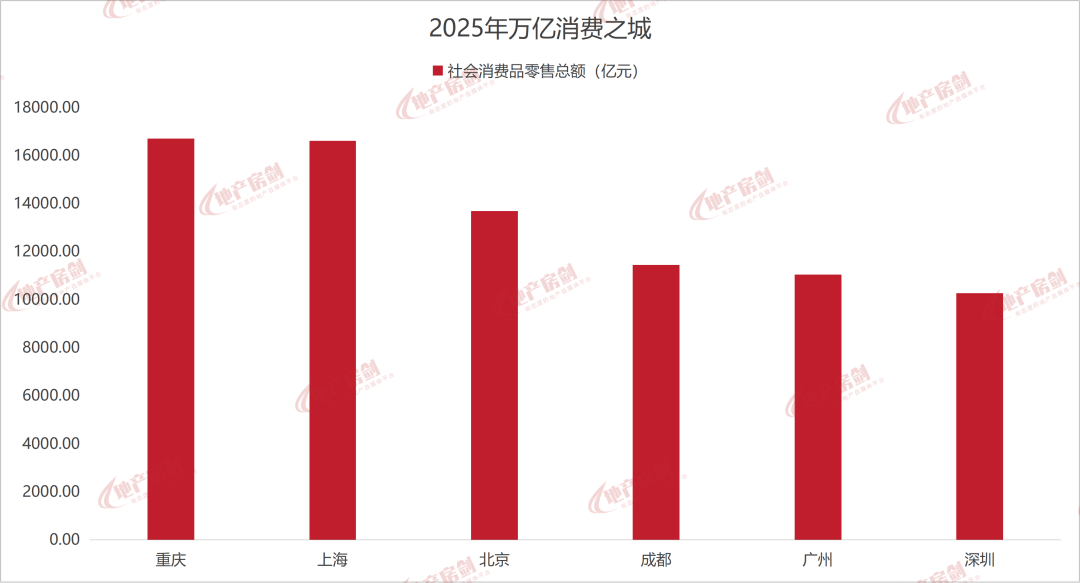
Economic Overview - In 2025, the number of "trillion-yuan cities" increased from 27 to 29, with Dalian and Xuzhou joining the ranks [1] - Fuzhou emerged as a dark horse among the "trillion-yuan cities" over the past five years [1] Retail Sales Performance - In 2025, six cities surpassed one trillion yuan in social retail sales, namely Shanghai, Chongqing, Beijing, Chengdu, Guangzhou, and Shenzhen, down from seven in 2024 due to Suzhou's adjustment to 909.22 billion yuan with a growth rate of 2% [2][4] - Chongqing surpassed Shanghai in 2025 with a retail sales total of 1,670 billion yuan, while the gap between them was less than 100 million yuan [4] Key Cities and Growth Rates - Fuzhou's retail sales reached 596.91 billion yuan with a growth rate of 6%, while Yantai and Chengdu followed with 5.8% and 5.5% respectively [5] - Xi'an's retail sales totaled 572.12 billion yuan, marking a 5.3% growth, ranking it fifth among the 29 trillion-yuan GDP cities [10][11] Future Prospects - Hangzhou aims to become the seventh trillion-yuan consumption city by targeting a retail sales growth of around 5% in 2026, with a focus on service industry and digital economy [7] - Wuhan's retail sales reached 901.40 billion yuan with a growth rate of 4.8%, positioning it as a potential candidate for future growth in the central region [8] Consumption Trends - The "old-for-new" policy significantly contributed to Xi'an's retail sales growth, with notable increases in categories like new energy vehicles and home appliances [14] - The integration of cultural, tourism, and sports events has stimulated consumption in Xi'an, enhancing its economic vitality [16]

沙特数字经济价值达到1400亿美元
Shang Wu Bu Wang Zhan· 2026-02-25 13:34
他指出,沙特数据中心容量已从不足80兆瓦增至超过440兆瓦,迄今为止已有8家科技初创企业达到 独角兽级别,科技专业人才数量已从15万增至超过40.6万,增强了沙特的引领能力。 (原标题:沙特数字经济价值达到1400亿美元) 沙特公报2月11日报道,沙特通信和信息技术大臣阿卜杜拉·阿尔斯瓦哈在出席微软人工智能巡回展 利雅得站的小组讨论会时表示,沙特阿拉伯数字经济的价值已增长至近1400亿美元。 ...
顺灏股份:太空数据中心凭借独特优势成为全球算力竞争的新焦点
Zheng Quan Ri Bao· 2026-02-25 13:34
Core Insights - The current core dilemma in global computing power development is the dual bottleneck of energy and heat dissipation faced by ground data centers due to the explosive growth of AI models and the digital economy [2] Group 1: Energy Consumption and Challenges - According to the International Energy Agency (IEA), global electricity consumption by data centers and artificial intelligence is expected to double by 2026, reaching 1000 terawatt-hours, equivalent to Japan's annual electricity consumption [2] - In some computing hub regions, energy consumption from data centers already accounts for over 20% of local electricity supply [2] Group 2: Environmental Concerns - The issues of water resource consumption and carbon emissions from ground data centers are becoming increasingly prominent, with the rate of energy efficiency improvement lagging behind climate goals [2] Group 3: Space Data Centers - Space data centers are emerging as a new focus in global computing power competition due to their unique advantages, such as the ability to achieve uninterrupted solar power supply 24/7 [2] - The solar energy utilization efficiency in a morning and evening orbit is 4-5 times that of ground facilities, combined with the natural radiation cooling in deep space, allowing for complete independence from ground data centers' reliance on power grids and water resources [2]

粤企出海 广东“十四五”服务贸易实现翻番
2 1 Shi Ji Jing Ji Bao Dao· 2026-02-25 12:24
Group 1 - The conference focused on the theme of "Digital Economy and New Business Models in Trade," aiming to gather various forces to inject new momentum into the coordinated development of manufacturing and service industries [1]
别只盯着国内“卷”!跨境电商3.0来了,粤企剑指全球市场|双轮协进 制胜广东
Sou Hu Cai Jing· 2026-02-25 12:16
从产品"出海"到品牌"扬帆",广东企业正以硬核实力破浪前行。会议现场,来自政府机构、国际商会、 行业协会、高校以及腾讯、亚马逊、网易、希音等企业代表共同探讨粤企"出海"的未来路径。正如受访 企业家所言:"在跨境电商3.0时代,我们做的不再是一国生意,而是全球市场。" 当然,"出海"之路并非坦途。面对复杂的国际环境,广东省商务厅精准施策,打造线上线下相结合 的"粤企'出海'服务资源库",提供一站式解决方案,为企业排忧解难。 2026年是"十五五"规划的开局之年,也是广东高质量发展的关键之年。广东正以更开放的姿态、更完善 的生态,助力万千企业扬帆远航。 2月24日,在春节假期后的第一个工作日,2026年广东省高质量发展大会隆重召开,今年会议聚焦制造 业与服务业协同发展。 在"数字经济与贸易新业态"分会场,一个鲜明的信号正在释放:跨境贸易已成为新增长极,企业"出 海"的需求还在不断提升。 数据是最有力的证明。当前,广东数字经济规模已突破8万亿元,连续9年位居全国第一;货物进出口更 连续40年稳居全国首位。这宏大的数字背后,是无数粤企勇闯全球市场的决心与智慧。 ...
聚焦生产性服务业增长,广东锚定价值链更高处
Di Yi Cai Jing· 2026-02-25 11:22
Core Insights - The production service industry plays a dominant role in Guangdong's modern service sector, with finance, information transmission, software, and IT services as core engines [1][3] Group 1: Industry Development - Guangdong's provincial conference emphasized the cultivation of the production service industry to achieve high-quality development through the synergy of manufacturing and services [1][3] - The production service industry is defined as services that support production activities, including R&D, logistics, financial services, and more [2] - From 2020 to 2025, the value added of China's production service industry is projected to increase from 30.3% to 34.4% of GDP, indicating significant growth potential compared to developed countries [2] Group 2: Economic Contribution - By 2025, the value added of modern services in Guangdong is expected to reach approximately 55,139.99 billion yuan, accounting for nearly 37.84% of GDP, with the production service industry being a key contributor [3] - Shenzhen's service industry added value reached 2.42 trillion yuan last year, with modern services accounting for 77%, highlighting the city's focus on enhancing the production service sector [3] Group 3: Challenges and Recommendations - The report identifies shortcomings in Guangdong's production service industry, including insufficient high-end service supply and the need for improved quality and capability in serving manufacturing [3][4] - Recommendations include accelerating the development of high-end industries such as industrial software, artificial intelligence, and big data services, as well as enhancing innovation capabilities [4] Group 4: Strategic Vision - The provincial leadership emphasizes the dual advancement of manufacturing and services as crucial for Guangdong's high-quality development and modernization [5] - The integration of artificial intelligence is seen as a key factor in enhancing the collaborative development of both sectors, aiming to create a new form of intelligent economy [5]
顺灏股份(002565) - 顺灏股份投资者关系活动记录表--2026年2月25日
2026-02-25 11:20
Group 1: Company Overview and Business Strategy - The company focuses on a dual development strategy of "environmentally friendly low-carbon new materials + biological health" [2] - It specializes in the research, production, and sales of special environmentally friendly paper, printing products, and industrial hemp processing [2][3] - The special anti-counterfeiting environmentally friendly paper business includes products like aluminum foil paper and laser anti-counterfeiting materials, primarily used in specific consumer goods [2] Group 2: Industrial Hemp Business - The company’s subsidiary, Yunnan Green New, is engaged in the extraction and processing of CBD and other rare cannabinoids [3] - A subsidiary, E10 Labs, was established in the U.S. to support the development of the industrial hemp business and has been granted legal qualifications for manufacturing and sales [3] Group 3: Space Computing Industry Insights - The global power consumption of data centers and AI is projected to double by 2026, reaching 1,000 terawatt-hours, equivalent to Japan's annual electricity consumption [4] - Space data centers are emerging as a solution to the energy and cooling challenges faced by ground data centers, utilizing solar power and natural radiation cooling [4] Group 4: Investment and Shareholding - The company holds a 27.8174% stake in Beijing Orbit Chuangguang Technology Co., Ltd. following a recent capital increase [5] Group 5: "Computing Star Network" Initiative - The initiative focuses on efficient scheduling of space computing resources, secure data transmission, and application exploration [6] - Beijing Orbit Chuangguang actively participates in this initiative, contributing to technology development and industry standards [6] Group 6: Future Plans for Space Data Center - The construction of the space data center will occur in three phases: - 2025-2027: Breakthroughs in energy and cooling technologies, initial constellation development [7] - 2028-2030: Further technological advancements and cost reductions for the second phase [7] - 2031-2035: Large-scale satellite production and network deployment [7] Group 7: Patent Applications - The company is applying for core patents related to space computing technologies, including a large planar array space computing center and energy systems for satellites [9]