
新基建

Search documents
研判2025!中国铝合金通信塔行业产业链上下游、发展现状、竞争格局及发展趋势分析:5G基站的深入覆盖,铝合金通信塔行业需求不断上升[图]
Chan Ye Xin Xi Wang· 2025-12-26 01:17
Core Insights - The aluminum alloy communication tower industry in China is experiencing significant growth, with the market size expected to increase from 2.248 billion yuan in 2015 to 9.534 billion yuan in 2024, driven by the deployment of 5G networks, the gradual advancement of 6G technology, and strong support from national infrastructure policies [1][7][8] Industry Overview - Aluminum alloy communication towers are primarily made from aluminum alloy, which provides advantages such as lightweight, corrosion resistance, and durability, making them suitable for supporting mobile communication base station antennas [3][5] - The structure of aluminum alloy communication towers typically includes the tower body, foundation, and antenna bracket, with the tower body height adjustable to cover wider areas [3] Industry Chain - The industry chain consists of upstream raw materials (aluminum alloy), midstream production and manufacturing, and downstream application in the communication sector [3] Market Trends - The demand for aluminum alloy communication towers is increasing due to the growing number of 5G base stations, which are projected to reach 4.758 million by October 2025, with a net increase of 507,000 from the previous year [5][6] - The market for communication towers in China is expected to reach 47.671 billion yuan in 2024, reflecting an 11.9% year-on-year increase [6][7] Competitive Landscape - Leading companies in the aluminum alloy communication tower industry dominate the market due to their large production capacity, comprehensive industry chain layout, and stable relationships with major clients, while smaller companies face challenges such as low technical levels and product homogeneity [8][9] Future Development Trends - The industry is moving towards intelligent development, with leading companies adopting digital manufacturing technologies for better monitoring and maintenance [13] - There is a trend towards multifunctionality and resource sharing, such as integrating aluminum alloy communication towers with wind power generation to optimize resource use [14] - The industry concentration is expected to increase as leading companies expand their market share, potentially leading to the consolidation of weaker players [15]


国开行甘肃分行服务加快建设现代化基础设施体系
Jin Rong Shi Bao· 2025-12-25 04:18
Core Viewpoint - The Gansu Branch of the China Development Bank has been actively integrating financial services into the development blueprint of Gansu, focusing on infrastructure investment to support high-quality economic growth in the region [1] Group 1: Traditional Infrastructure Investment - The construction of three new highway corridors across Gansu is a key project aimed at improving transportation and supporting urban-rural development, with the bank providing comprehensive financial services [2] - As of early December, 28 sub-projects of the new highway corridors have commenced, with the bank having invested nearly 100 billion yuan in infrastructure during the 14th Five-Year Plan period [2] - The bank has supported the construction of over 2,200 kilometers of new highways and railways, and facilitated a green energy transition with renewable energy installations exceeding 35 million kilowatts [2][3] Group 2: Financing and Project Support - The bank has developed a differentiated credit product system covering the entire project lifecycle for major infrastructure projects, including the three new highway corridors and the expansion of Lanzhou Zhongchuan International Airport [3] - During the 14th Five-Year Plan, the bank has led the organization of syndicated loans exceeding 120 billion yuan, effectively gathering financial resources for project implementation [3] - The bank has utilized policy financial tools to invest over 13 billion yuan, effectively supplementing project capital and stimulating larger-scale social investments [3] Group 3: New Infrastructure Development - The Gansu Branch has recognized the importance of new infrastructure, aligning with national strategies to modernize transportation systems and support digital economy initiatives [4] - The bank has issued over 8 billion yuan in loans to support the development of 5G, big data centers, and industrial internet projects, facilitating a transition from physical to smart connectivity [4] - A notable project includes the first "5G+" smart highway in Gansu, supported by a 6.5 billion yuan long-term loan, which enables automated driving through intelligent roadside systems [4] Group 4: Innovative Projects and Green Energy - The bank is supporting the construction of the first national pilot project for a green electricity aggregation data center in Qingyang, which aims to achieve a green electricity ratio of 55% and reduce electricity costs [5][6] - The bank's financing has also enabled the establishment of an intelligent copper factory, enhancing production efficiency and safety through automation and digital integration [6] - The ongoing development of a comprehensive and efficient infrastructure network in Gansu is expected to significantly boost the flow of people, goods, and information, contributing to the region's economic growth [6]

2025年终经济观察|激活有效投资 打开经济发展新空间
Xin Hua She· 2025-12-25 02:55
Core Viewpoint - The article emphasizes the importance of activating effective investment to open new spaces for economic development, highlighting the strategic role of both material and human investment in promoting high-quality growth [2][11]. Group 1: Investment in Material - The construction of significant projects, such as the Huatanzi Reservoir in Guizhou, is progressing well, with over half of the total investment already completed [3]. - Major projects like the world's largest green hydrogen ammonia integration project and the completion of the Hubei ±800 kV UHVDC project indicate ongoing advancements in investment stability [3]. - In the first eleven months of the year, fixed asset investment in China decreased by 2.6%, but project investment excluding real estate grew by 0.8%, indicating stability in key sectors [4]. - The "Two Heavy" construction initiative allocated 800 billion yuan to support 1,459 projects, effectively driving investment growth in various infrastructure sectors [4]. Group 2: New Infrastructure Investment - New infrastructure is identified as a strategic foundation for developing new industries and services, with projects like the digital industrial park in Xiamen expected to generate significant revenue [5]. - The manufacturing value added in smart consumer equipment increased by 7.6% year-on-year, with substantial growth in industrial robots and control systems [6]. Group 3: Investment in Human Capital - Various educational and healthcare projects are underway, such as the new school in Huaihua and regional medical centers, aimed at enhancing human capital and improving living standards [7]. - Investment in public services, including education and healthcare, is expected to drive economic growth by enhancing human capital and releasing consumption potential [9]. - The demand for investment in elderly and childcare services is projected to grow significantly, with the silver economy expected to exceed 30 trillion yuan by 2035 [9]. Group 4: Policy and Future Outlook - The Central Economic Work Conference outlined key tasks for the upcoming year, emphasizing the need to increase central budget investment and optimize project implementation [11]. - Local governments are actively developing strategies to enhance investment in both material and human capital, with a focus on improving the investment environment for private enterprises [12].
牵头建设!广东联通实现广湛高铁干线光缆全程通光
2 1 Shi Ji Jing Ji Bao Dao· 2025-12-24 10:06
Core Viewpoint - The successful completion of the Guangzhan high-speed railway backbone optical cable project marks a significant advancement in communication infrastructure, enhancing connectivity between the Guangdong-Hong Kong-Macao Greater Bay Area and Hainan Free Trade Port, while demonstrating China Unicom's commitment to high-quality economic development and major infrastructure construction [1][2]. Group 1: Project Overview - The Guangzhan high-speed railway optical cable project, led by Guangdong Unicom, achieved full optical connectivity over a distance of 401 kilometers in just 93 days, overcoming technical challenges posed by a bridge-tunnel ratio exceeding 79% [1]. - This project is a crucial part of the national "Eight Vertical and Eight Horizontal" high-speed railway network, serving as a vital link for domestic and international business transmission among Guangdong, Guangxi, and Hainan provinces [1][2]. Group 2: Strategic Importance - The project strengthens China Unicom's position in the inter-provincial trunk communication market and supports the digital economy's collaborative development in the Guangdong, Guangxi, and Hainan regions [2]. - Guangdong Unicom has completed over 4,000 kilometers of high-speed/high-speed railway backbone optical cable deployment, establishing a full optical transmission network characterized by ultra-large bandwidth, ultra-low latency, and ultra-high reliability [2]. Group 3: Future Plans - Guangdong Unicom aims to continue supporting national strategies through technological innovation and quality service, enhancing communication network layout and computational network support capabilities to facilitate high-quality regional economic development [3].

港股概念追踪|钨价全年大涨2倍 引领有色金属板块全线走牛(附概念股)
智通财经网· 2025-12-24 00:37
Group 1: Market Dynamics - The tungsten market is experiencing significant price increases driven by major tungsten companies raising long-term procurement prices and production cuts from key tungsten raw material producers [1][2] - As of December 18, tungsten concentrate and ammonium paratungstate prices have risen, with tungsten powder (≥99.7%) reaching 1.01 million CNY/ton, a 219.6% increase since the beginning of the year [1] - Domestic tungsten powder prices have also surged to 1.045 million CNY/ton, with a notable acceleration in the price increase rate compared to November [1] Group 2: Supply and Demand Outlook - Analysts suggest that the recent rapid increase in tungsten prices is linked to supply constraints and rising long-term prices as the year-end approaches [2] - CICC forecasts that the global tungsten supply-demand relationship will remain tight, driving prices higher, with a long-term price center expected to rise to 450,000-500,000 CNY/ton by 2028 [2] - From 2025 to 2028, global tungsten production is projected to increase from 82,800 tons to 89,900 tons, while demand is expected to rise from 102,100 tons to 110,000 tons, indicating a persistent supply-demand gap [2] Group 3: Company Insights - Jiexin International Resources (03858) is set to begin commercial production at the Bakuta tungsten mine project in April 2025, with a target mining and processing capacity of 3.3 million tons of tungsten ore [3] - In the first half of 2025, Jiexin International processed 945,000 tons of ore, achieving a tungsten concentrate output of 1,205 tons, with a target for the second half of the year set at 1.65 million tons of ore and 3,638 tons of concentrate, tripling the first half's output [3] - By 2027, Jiexin International's second-phase project is expected to increase annual mining and processing capacity to 4.95 million tons, with projected concentrate output of 13,700 tons and a potential cost of 49,000 CNY per ton by 2027 [3]
钨价全年大涨2倍 引领有色金属板块全线走牛(附概念股)
Zhi Tong Cai Jing· 2025-12-24 00:34
Group 1 - The tungsten market is experiencing significant price increases driven by major tungsten companies raising long-term purchase prices and production cuts from key tungsten raw material producers [1] - As of December 18, tungsten concentrate and ammonium paratungstate prices have risen, with tungsten powder (≥99.7%) reaching 1.01 million yuan/ton, a 219.6% increase since the beginning of the year [1] - CICC predicts that due to supply-side pressures and geopolitical conflicts, global tungsten supply will require higher incentive prices, suggesting that tungsten prices may continue to rise in the short term [1] Group 2 - CICC believes that the global tungsten supply-demand relationship will remain tight, driving the long-term price center to rise to 450,000-500,000 yuan/ton, expected to last until 2028 [2] - From 2025 to 2028, global tungsten production is projected to increase from 82,800 tons to 89,900 tons, while demand will rise from 102,100 tons to 110,000 tons, indicating a persistent supply-demand gap [2] - The demand for tungsten-based new materials in emerging fields such as AI and new infrastructure will provide long-term support for tungsten prices [2] Group 3 - Jiaxin International Resources (03858) has commenced commercial production at the Bakuta tungsten mine project, targeting a mining and processing capacity of 3.3 million tons of tungsten ore by 2025 [3] - In the first half of 2025, Jiaxin International processed 945,000 tons of ore, achieving a tungsten concentrate output of 1,205 tons, with a target of 1.65 million tons of ore and 3,638 tons of concentrate in the second half [3] - By 2027, the second phase of the project is expected to increase annual mining and processing capacity to 4.95 million tons, with a projected concentrate output of 13,700 tons and a long-term price center of 450,000-500,000 yuan/ton [3]

2026年宏观经济十大趋势展望
KPMG· 2025-12-23 01:08
Economic Growth Projections - China's GDP growth is expected to reach approximately 4.8% in 2026, with nominal GDP growth projected at around 4.6%[10] - The economic recovery is supported by a stable external environment and improved domestic consumption driven by policies promoting consumer spending[9] Macroeconomic Policy - The fiscal deficit rate is anticipated to remain around 4.0%, while the broad fiscal deficit rate is expected to rise slightly to 8.9%[13] - Monetary policy will continue to be moderately accommodative, with expected interest rate cuts of 10-20 basis points and a reserve requirement ratio reduction of 50 basis points[14] Consumption Trends - Service consumption is projected to be a significant driver of economic growth, supported by policies promoting consumption upgrades and the introduction of new consumption categories[22] - Digital consumption showed strong growth, with online retail sales increasing by 9.1% year-on-year in the first eleven months of 2025[22] Manufacturing Investment - Manufacturing investment is expected to rebound in 2026, driven by improved corporate expectations and ongoing industrial upgrades[26] - The focus on high-end manufacturing and technological innovation will be crucial for economic transformation during the 14th Five-Year Plan[27] Infrastructure Investment - Infrastructure investment is set to recover, with new projects under the 14th Five-Year Plan expected to commence in 2026[39] - The share of new infrastructure projects is anticipated to increase, particularly in areas like artificial intelligence and high-end computing[40] Real Estate Market - The real estate market is transitioning to a new stable state, with government policies aimed at stabilizing the market and improving housing quality[46] - The government is expected to initiate a new round of stockpiling of existing housing to enhance housing welfare[48] Cross-Border Trade and Investment - China's export share reached a historical high of 14.2% in the first half of 2025, with expectations for continued resilience in exports due to improved trade relations and demand for high-tech products[50] - The trend of Chinese enterprises enhancing their international operations is expected to continue, with a focus on high-value sectors and cross-border collaboration[52] Hong Kong's Strategic Position - Hong Kong's role as a strategic hub is expected to strengthen, with increased participation in high-value services and enhanced connectivity with mainland China[54] - The region is set to attract more multinational companies and professional services, bolstering its position in the Asia-Pacific trade and finance network[57]
钨价飙涨,这些概念股业绩有望向好
Zheng Quan Shi Bao Wang· 2025-12-23 00:04
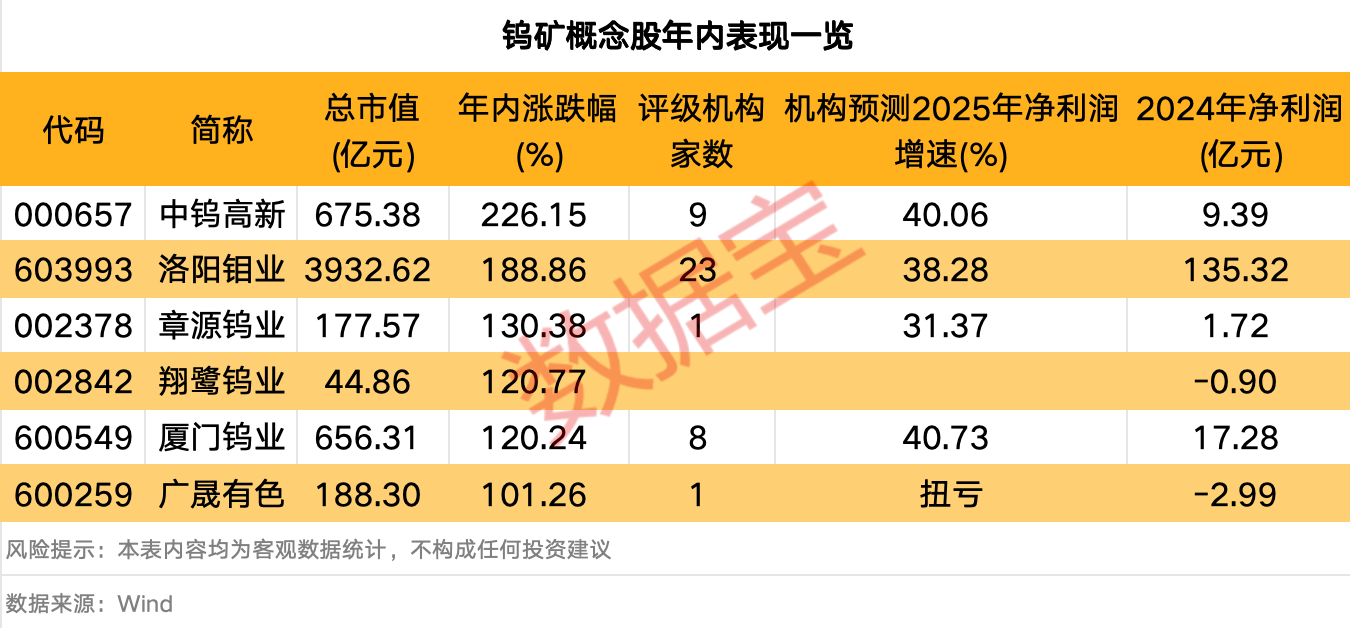
Group 1 - The price of Chinese black tungsten concentrate (≥65% domestic) has risen to 449,600 CNY per ton, with a daily increase of 19,900 CNY, representing a growth of approximately 4.63%, and a year-to-date increase of 214.87% [1] - Tungsten powder spot average price reported at 1,090,000 CNY per ton, with a significant daily increase of 72,500 CNY, reflecting a rise of about 7.1%, continuing the strong price trend observed throughout the year [1] - From 2025 to 2028, global tungsten production is expected to increase from 82,800 tons to 89,900 tons, while demand is projected to rise from 102,100 tons to 110,000 tons, indicating a persistent supply-demand gap [1] Group 2 - Companies such as Xiamen Tungsten (600549) and China Tungsten High-Tech (000657) are forecasted to see a year-on-year net profit increase of over 40% in 2025, while Luoyang Molybdenum (603993) and Zhangyuan Tungsten (002378) are expected to have net profit growth exceeding 30% [1] - Guangsheng Nonferrous (600259) is anticipated to achieve a turnaround from loss to profit [1] - The marginal demand for tungsten-based new materials in new application fields such as AI, controllable nuclear fusion, and new infrastructure will provide long-term support for tungsten prices [1]





2026年银行板块投资策略:从业务与业绩角度看稳健性; 两条选股主线
2025-12-22 15:47
2026 年银行板块投资策略:从业务与业绩角度看稳健性; 两条选股主线 20251222 摘要 银行业整体盈利预计保持小幅增长,2028 年 ROE 仍有望维持在 8%- 9%区间,年底年初是较佳投资窗口期,险资增量资金配置确定性高,明 年营收边际改善确定性较高,息差降幅收窄将支撑净利息收入。 选股逻辑聚焦高 ROE 优质城商行(如江苏银行、南京银行等)和高股息 品种(如招商银行、中信银行等),前者规模增长确定性强且营收弹性 大,后者适合阶段性防御策略。 2026 年信贷动能依赖新型工业化、科技创新、新基建及传统产业升级, 绿色信贷和科创贷款占比提升空间大,科技型中小企业贷款同比增速保 持较高水平。 地产和消费对银行业绩贡献有限,地产需超预期政策才能企稳,消费主 要依靠政策托底,内生动力仍需加强,零售相关需求偏弱。 预计 2026 年净息差将在个位数区间内波动,降幅小于今年,净利息收 入有望实现小幅正增长,优质区域城农商行可能超预期。 对于地产和消费领域,您怎么看待其对银行业绩的影响? Q&A 2026 年银行板块的总体投资策略和选股逻辑是什么? 总体来看,2026 年银行板块的投资策略主要关注绝对收益,预计 ...

这个板块指数罕见涨停,背后隐藏着一条年度重磅主线!
Sou Hu Cai Jing· 2025-12-22 07:46
Core Viewpoint - The A-share market is experiencing a structural opportunity with significant capital inflow, particularly in the technology and Hainan sectors, indicating a clear direction for investors [1][2]. Market Performance - The total trading volume in the A-share market reached 1.36 trillion, with a daily turnover of 18.619 trillion, reflecting increased investor interest [1]. - The Shanghai Composite Index rose by 0.69% to 3917.36 points, while the Shenzhen Component Index surged by 1.47% to 13332.73 points, and the ChiNext Index increased by 2.23% to 3191.98 points [1]. - In contrast, the Hong Kong market showed minimal movement, with the Hang Seng Index up by only 0.11% [1]. Key Investment Directions - **Technology Growth Sector**: The communication sector led the market with a 4.28% increase, and the electronics sector rose by 2.62%, driven by favorable policies and technological advancements [1][2]. - **Hainan Sector**: The Hainan provincial state-owned enterprise index surged by 10.01%, and the Hainan Free Trade Port index increased by 9.28%, indicating strong market anticipation of policy benefits [2]. Investment Strategy - Investors are advised to focus on sectors with solid policy and technological support, particularly in communications and electronics, while avoiding speculative small-cap stocks [3]. - Long-term outlook remains positive due to continuous foreign capital inflow and government support for technological innovation and consumption recovery [3].