生成式AI

Search documents
AI如何冲击就业市场?
Hu Xiu· 2025-10-14 00:29
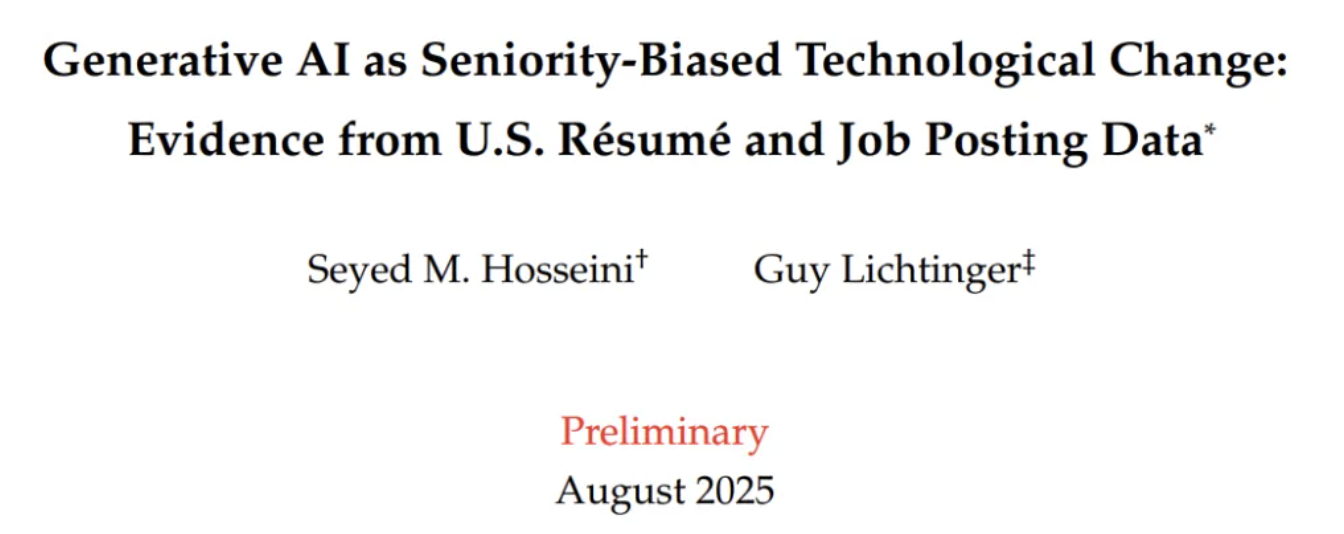
Core Insights - The article discusses a structural shift in the global white-collar labor market due to the rise of generative AI, leading to a preference for experienced employees over entry-level positions [2][7]. Group 1: Impact of AI on Employment - A study by Harvard scholars Seyed M. Hosseini and Guy Lichtinger provides evidence that generative AI is causing companies to favor experienced employees, significantly impacting entry-level job availability [3][7]. - The research utilized a large database of approximately 62 million LinkedIn profiles and 198 million job postings from 2015 to 2025 to analyze the effects of generative AI on job demand [6]. Group 2: Identification of AI-Adopting Companies - The researchers developed a two-step identification method to pinpoint companies actively adopting generative AI, focusing on those posting "AI integrator" job listings [10][14]. - Approximately 10,599 companies, representing 3.7% of the sample, were identified as "AI adopters," indicating a significant shift in hiring practices [16][19]. Group 3: Changes in Job Structure - From mid-2022 onwards, the growth rate of entry-level positions began to decline sharply, while senior positions continued to rise, suggesting a causal relationship between AI adoption and the reduction of entry-level jobs [25][26]. - By the first quarter of 2023, entry-level positions in AI-adopting companies decreased by approximately 7.7% compared to non-adopting companies [32][36]. Group 4: Recruitment Trends - AI-adopting companies reduced their external hiring of entry-level employees by an average of 3.7 per quarter, equating to a 22% decrease in their previous hiring rates [37]. - Interestingly, the turnover rate for entry-level employees in these companies decreased, while internal promotions accelerated [38]. Group 5: Industry and Educational Background Impact - The wholesale and retail sectors experienced the most significant decline in entry-level job postings, with a nearly 40% drop in AI-adopting companies compared to non-adopters [44]. - Graduates from mid-tier universities (Tier 2 and Tier 3) faced the most substantial employment impacts, while those from top-tier and lower-tier institutions were less affected [46][49]. Group 6: Recommendations for Job Seekers - Job seekers should focus on developing skills that are difficult for AI to replace, such as complex problem-solving, creativity, and effective communication [55]. - Understanding how to leverage AI as a complementary tool rather than viewing it as a threat is crucial for both entry-level and mid-career professionals [57].

西安geo营销策略,如何有效实施与优化?
Sou Hu Cai Jing· 2025-10-13 20:10
Group 1: Core Insights - The rise of AI technology, particularly generative AI, is transforming traditional marketing methods in Xi'an, prompting businesses to focus on effective GEO (Generative Engine Optimization) strategies to stand out in an AI-driven market [1][8] - GEO aims to enhance brand visibility and authority in AI-generated responses, influencing user decisions by ensuring brand information naturally appears during AI's "thought" process [4][10] Group 2: GEO Fundamentals and Mechanisms - Understanding the basics and operational mechanisms of GEO is essential for developing effective strategies, as it focuses on ensuring content achieves high click-through rates in generative engines [3] - Generative AI engines utilize data training and natural language processing to simulate human conversation, necessitating that GEO strategies align with AI technology advancements [5] Group 3: Importance and Necessity of GEO - GEO serves as a catalyst for changing user behavior, as users increasingly prefer direct answers from AI over browsing multiple web pages, allowing businesses to secure a position in AI responses [8] - Industries such as technology, finance, and healthcare, which rely heavily on generative AI for decision-making, find GEO crucial for enhancing brand visibility and credibility [9] Group 4: Implementation and Optimization Suggestions for GEO - Businesses should segment keywords and deepen content to align with user needs, enhancing authority and relevance in AI responses [12] - Content optimization should include structured and multimedia elements to improve engagement and authority, such as integrating images and videos in tourism-related content [13] - Understanding the operational mechanisms of different AI search engines and implementing differentiated optimizations is vital for effective GEO strategies [14] Group 5: Collaboration and Differences Between GEO and Traditional SEO - GEO and SEO share common goals in visibility, keyword strategy, and user experience, and can work together to enhance brand visibility across search engines and AI-generated responses [16] - Despite similarities, GEO focuses more on adapting to AI models and content formatting, while SEO emphasizes search engine algorithm optimization [17] Group 6: Evaluation and Continuous Optimization of GEO - Success in GEO can be assessed through metrics such as brand mentions, contextual references, search volume increases, and AI citation frequency [20] - Continuous optimization of GEO strategies is essential, involving regular content updates and adjustments based on AI algorithm changes [22] - Collaboration with industry experts can enhance content authority and credibility, further supporting effective GEO implementation [22] Group 7: Conclusion - In the AI era, GEO strategies are critical for Xi'an businesses to enhance brand visibility and credibility, enabling them to effectively navigate challenges and improve market competitiveness [23]

腾讯研究院AI速递 20251014
腾讯研究院· 2025-10-13 17:53
Group 1: OpenAI and Chip Partnerships - OpenAI has announced a strategic partnership with Broadcom to deploy 100 billion watts of custom AI chips designed by OpenAI, with deployment starting in the second half of 2026 and completion by the end of 2029 [1] - This marks OpenAI's third significant deal with a chip giant in a month, following a $100 billion investment from NVIDIA and a $60 billion GPU deployment agreement with AMD [1] - Sam Altman revealed that both companies have been designing the new chip over the past 18 months, utilizing OpenAI's own models in the design process, leading to a significant increase in Broadcom's stock price by over 10% after the announcement [1] Group 2: Google Gemini 3.0 Update - Google is set to release Gemini 3.0 on October 22, showcasing impressive front-end development capabilities that can generate web pages, games, and original music with a single click [2] - Gemini 3.0 employs a MoE architecture with over a trillion parameters, activating 15-20 billion parameters per query, and can handle context from 1 million to several million tokens, enabling it to process entire books and codebases [2] - Internal tests indicate that Gemini 3.0 outperformed in front-end tests, including generating 3D pixel art, with a year-on-year growth rate of 46.24% expected by September 2025 [2] Group 3: LiblibAI 2.0 Upgrade - LiblibAI 2.0 has integrated over 10 popular video models and numerous image models, allowing users to complete all AI creative tasks within the platform [3] - The upgrade includes a one-click video effect feature and seamless switching between image generation and video creation, incorporating models like Midjourney V7 and Qwen-image [3] - New asset management and AI toolbox features have been added, providing a comprehensive AI experience for both new and existing users [3] Group 4: Mamba-3 Development - The third generation of Mamba, Mamba-3, has entered blind review for ICLR 2026, featuring innovations such as trapezoidal rule discretization, complex state spaces, and multi-input multi-output design [4][5] - Mamba-3 introduces complex hidden states to handle periodic patterns and parity checks, significantly enhancing arithmetic intensity to fully utilize GPU capabilities [5] - It has shown excellent performance in long-context information retrieval tests, with reduced inference latency, making it suitable for long text processing, real-time interaction, and edge computing applications [5] Group 5: SAM 3 Concept Segmentation - The suspected Meta-developed SAM 3 paper has been submitted to ICLR 2026, achieving prompt concept segmentation (PCS) that allows users to segment matching instances using simple noun phrases or image examples [6] - SAM 3 has demonstrated at least a twofold performance improvement on the SA-Co benchmark, achieving an average precision of 47.0 on the LVIS dataset, surpassing the previous record of 38.5 [6] - It utilizes a dual encoder-decoder transformer architecture, built on a high-quality training dataset containing 4 million unique phrases and 52 million masks, processing over 100 object images in just 30 milliseconds on a single H200 GPU [6] Group 6: Google's ReasoningBank Framework - Google has introduced the ReasoningBank memory framework, which extracts memory items from the successes and failures of agents to form a closed-loop self-evolution system that learns without real labels [7] - The framework incorporates memory-aware testing time expansion (MaTTS) to generate diverse explorations through parallel and sequential setups, enhancing the synthesis of more universal memories [7] - ReasoningBank has shown a 34.2% improvement in effectiveness and a 16.0% reduction in interaction steps in benchmark tests such as WebArena, Mind2Web, and SWE-Bench-Verified [7] Group 7: AI Performance in Astronomy - Recent studies indicate that GPT-5 and Gemini 2.5 Pro achieved gold medal results in the International Olympiad on Astronomy and Astrophysics (IOAA), with GPT-5 scoring an average of 84.2% in theoretical exams [8] - Both models outperformed the best students in theoretical exams, although their accuracy in geometric/spatial problems (49-78%) was notably lower than in physics/mathematics problems (67-91%) [8] - This highlights AI's strong reasoning capabilities not only in mathematics but also in astronomy and astrophysics, approaching top human-level performance across multiple scientific domains [8] Group 8: Unitree G1 Robot Developments - The Unitree G1 robot has demonstrated advanced movements such as aerial flips and kung fu techniques, showcasing its agility and capabilities [10] - Unitree plans to launch a humanoid robot standing 1.8 meters tall in the second half of this year, having applied for nearly 10 patents related to humanoid robots [10] - The domestic robotics industry has seen an average growth rate of 50%-100% in the first half of this year, with algorithm upgrades enabling robots to theoretically perform various dance and martial arts movements [10] Group 9: Apple AI Glasses - Bloomberg reports that Apple's smart glasses may run a full version of visionOS when paired with a Mac and switch to a lightweight mobile interface when connected to an iPhone, with a planned release between 2026 and 2027 [11] - Apple has shifted focus from developing a lighter "Vision Air" headset to smart glasses, directly competing with Meta's Ray-Ban Display [11] - The first generation of the product will not feature a display but will include audio speakers, cameras, voice control, and potential health functionalities, with plans for a multi-tiered product line in the future [11] Group 10: Sam Altman's Insights on AI and Work - Sam Altman stated in a recent interview that AI will change the nature of work but will not eliminate true jobs, suggesting that future work may become easier while human intrinsic motivation remains [12] - Regarding the development of GPT-6, the focus will be on creating smarter models with longer context and better memory capabilities, with Codex already capable of completing full-day tasks [12] - OpenAI currently has 800 million active users weekly, and Altman believes that voice will not be the ultimate form of AI interaction, with the team working on a new voice interaction device that will not be revealed in the short term [12]





赛富时(CRM.US)欲摆脱“AI落后者”标签 豪掷150亿美元加码布局AI智能体
智通财经网· 2025-10-13 14:13
Core Insights - Salesforce (CRM.US) announced a significant investment plan of up to $15 billion over the next five years in San Francisco, focusing on artificial intelligence (AI) initiatives to enhance its position in the CRM market [1] - The company aims to develop generative AI applications and AI agents, striving to become a leader in AI applications, similar to OpenAI and Microsoft [2] - Salesforce's recent acquisitions, including Informatica for approximately $8 billion and Apromore, are part of its strategy to integrate AI capabilities into its offerings [2] Investment and Development Plans - The AI Incubator Hub will be launched in San Francisco to support workforce development and AI training programs, facilitating the adoption of AI-driven enterprise models [1] - The Dreamforce event is expected to generate $130 million in revenue for San Francisco and create 35,000 local jobs, highlighting the company's commitment to local economic impact [1] Market Position and Challenges - Despite the ambitious plans, Salesforce's stock has declined over 30% this year, indicating market skepticism regarding its ability to monetize AI applications effectively [2] - The company’s future success in becoming an AI application leader will depend on its ability to convert large-scale enterprise adoption into verifiable revenue and operational efficiency within the next 12-24 months [2] Industry Trends - The demand for generative AI applications and AI agents is expected to surge, driven by businesses' needs to improve efficiency and reduce operational costs [3] - Companies like APPlovin and Palantir have reported strong performance and outlooks, reflecting robust demand for AI software applications across various industries [4]

WPS附件,与A股风口前后事
2 1 Shi Ji Jing Ji Bao Dao· 2025-10-13 12:44
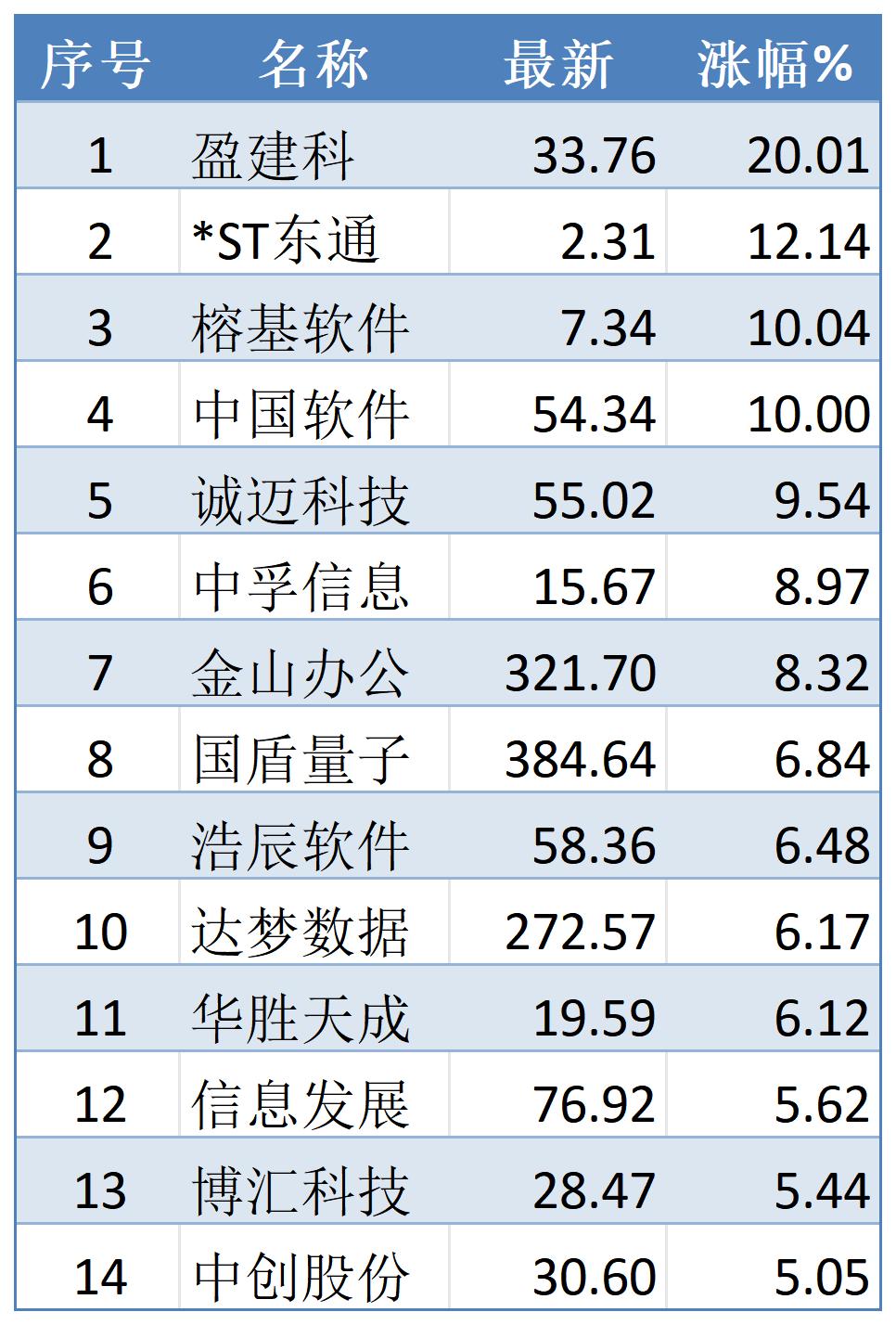
Core Viewpoint - The recent announcement by the Ministry of Commerce, which utilized the WPS format for the first time, is interpreted as a signal for accelerated domestic software replacement, leading to a strong performance in the A-share domestic software sector [1][3][6]. Market Performance - On October 13, the overall A-share market showed volatility, while the domestic software sector surged, with stocks like Yingjian Technology and China Software hitting the daily limit, and several others, including Rongji Software and Chengmai Technology, rising over 8% [1][4]. - The software ETF (159852) increased by 1.07% on the same day, with a high turnover rate of 18.36% and a transaction amount of 1 billion yuan, reflecting growing market enthusiasm for the software sector [3]. Sector Analysis - The software sector's rise exhibited significant structural characteristics, with different segments performing distinctly. China Software, a core operating system provider, closed at the daily limit, boosting the domestic operating system supply chain [4]. - In the office software segment, Kingsoft Office saw an 8.32% increase, ranking as the second-highest gainer among the top ten weighted stocks in the CSI Software Service Index [4]. - Other segments like industrial software and cybersecurity also showed positive performance, with companies like Haocen Software and Zhongfu Information recording gains [4]. Fundamental Support - The software and information technology service industry has shown a positive operational trend, with software business revenue reaching 96,409 billion yuan, a year-on-year increase of 12.6%, and total profits growing by 13.0% [8]. - The Ministry of Industry and Information Technology reported that software business exports reached 404.4 billion USD, reflecting a 6.4% year-on-year growth [8]. Strategic Implications - The use of WPS format in official documents is seen as a significant endorsement for domestic office software, indicating a shift towards self-sufficiency and technological breakthroughs in the industry [6][7]. - The domestic software industry is experiencing a historical transition from "usable" to "user-friendly," with local vendors becoming competitive against international giants in terms of capability and cost [9]. Future Outlook - The policy environment is favorable for the development of domestic software, with increasing demand for self-sufficiency and security driving growth in industrial software and computing power sectors [12]. - The upcoming bidding opportunities in the domestic software market are expected to accelerate development, particularly in light of potential increased technology sanctions from the U.S. [12].


所有AI的馈赠,早已在暗中标好了价格
腾讯研究院· 2025-10-13 10:00
Core Insights - Generative AI is reshaping various industries and fundamentally altering human writing, cognition, and thinking processes. Initial optimism suggested that AI would promote "work equity," particularly benefiting low-performing employees by bridging the performance gap with high-performing peers [5][9] - However, recent studies indicate that generative AI is reinforcing a "seniority bias" in the labor market, leading to a divergence in job growth between junior and senior positions, with junior roles declining significantly in AI-adopting companies [9][11] Group 1: Impact on Labor Market - From 2023, job growth for junior positions has started to decline, while senior positions continue to rise, indicating a widening gap in employment opportunities [11] - Companies that have embraced AI have seen a 7.7% decrease in junior positions over six quarters, while senior roles remain stable or slightly increase, suggesting that AI is exacerbating the "Matthew effect" where the rich get richer [11][12] - The CEO of Ctrip commented that AI is likely to replace entry-level intellectual labor, intensifying challenges faced by younger individuals in education, marriage, and early career stages [11] Group 2: Effects on Knowledge Production - A large-scale natural experiment analyzed over 419,000 academic papers across 21 disciplines before and after the release of ChatGPT-3.5, revealing a dual effect of generative AI on knowledge production [12][15] - Post-release, there was a significant acceleration in academic output (creativity) and a simultaneous increase in content homogeneity, indicating a "double-edged sword" effect of generative AI [16][25] - The average annual publication rate per scholar increased by 0.9 papers, and the quality of published journals improved by 6%, particularly in technical and physical sciences [22][25] Group 3: Long-term Cognitive Effects - A follow-up longitudinal study tracked the long-term effects of AI on individual cognitive abilities, revealing that the creativity boost from AI is short-lived and does not translate into sustained cognitive growth [38][40] - Participants who used AI showed a significant drop in creativity performance after the AI was removed, indicating that reliance on AI may lead to a "creativity illusion" rather than genuine skill enhancement [38][40] - The study highlighted that while AI can enhance productivity, it may also lead to a homogenization of thought, with participants' outputs remaining similar even after a two-month period without AI use [40][44] Group 4: Recommendations for Individuals - To mitigate the negative impacts of AI on creativity, individuals are encouraged to engage in "cognitive friction" by questioning AI outputs and avoiding reliance on initial AI-generated answers [46] - Setting aside "no AI time" for independent thought and creativity is recommended to prevent cognitive decline and maintain original thinking abilities [46][47] - Utilizing AI as a "thought partner" rather than a crutch can help individuals explore diverse perspectives while ensuring that the final decisions and creative processes remain their own [46][47]

大行评级丨花旗:重申Alphabet“买入”评级 生成式AI策略正加速推进
Ge Long Hui· 2025-10-13 08:55
纳指高开0.86%,谷歌A大涨超7%创新高,苹果涨超3% 美股异动|谷歌A涨超1.3% 获美国批准加入联 邦AI供应商名单 花旗报告指,重申对Alphabet"买入"评级及280美元目标价,认为其生成式AI策略正加速推进,营运效 率可带来盈利能力改善。Alphabet将于本月29日盘后公布第三季度业绩。基于与广告主、平台和代理机 构渠道讨论就广告业务的正面信息,以及谷歌云需求持续强劲,相信业绩很可能超过市场共识的收入和 通用会计准则(GAAP)每股盈测,即分别997亿美元及2.3美元。该行预测,谷歌生成式AI产品策略很可 能成为财报关键焦点,认为该产品推进速度正在加速。 相关事件 ...
大行评级丨花旗:重申亚马逊“买入”评级 第三季业绩很可能超市场预期
Ge Long Hui· 2025-10-13 08:48
Core Viewpoint - Citigroup expects Amazon's Q3 revenue and operating profit to likely exceed market consensus, with predictions of $179.53 billion and $20.176 billion respectively, compared to market forecasts of $177.745 billion and $19.708 billion [1] Group 1: Cloud Services - Amazon Web Services (AWS) revenue growth and infrastructure capacity expansion are highlighted as key focus areas, with expectations for improvement as Project Rainier approaches and demand for generative AI remains strong [1] - Despite competitive concerns in cloud services, Amazon is still viewed as the preferred choice in the network industry due to its retail strength, sustained demand for cloud services, and margin expansion [1] Group 2: Retail Performance - Credit card data indicates a continuous growth in online wallet share, which is seen as positive data for Amazon, with attention on its impact on the agency-based business strategy [1] - The launch of ChatGPT is noted to facilitate instant checkout, further enhancing the retail experience [1] Group 3: Investment Rating - Citigroup reaffirms a "Buy" rating for Amazon with a target price of $270 [1]

全球云服务厂商分析系列报告(一):AI浪潮重塑云计算增长,亚马逊打造从芯片到应用整体解决方案
NORTHEAST SECURITIES· 2025-10-13 08:44
Investment Rating - The report rates the industry as "Outperforming the Market" [5] Core Insights - The generative AI wave is reshaping the growth logic of cloud computing, leading the industry into a new high-growth cycle. The global cloud services market is expected to see a year-on-year growth of over 20% for four consecutive quarters from Q3 2024 to Q2 2025 [1][30] - The market concentration is likely to increase further, with the three major players—Amazon AWS, Microsoft Azure, and Google Cloud—controlling over two-thirds of the global market share. Their competitive focus is shifting from basic infrastructure services to AI platform services [2][31] Summary by Sections 1. Generative AI's Impact on Cloud Computing - The explosion of generative AI is injecting new momentum into the cloud computing industry, transitioning the focus from IT cost optimization to enabling enterprise innovation [1][28] - The global cloud infrastructure service spending is projected to exceed $95.3 billion in Q2 2025, with a year-on-year growth of 22% [30] 2. Market Concentration and Competitive Landscape - Amazon AWS, Microsoft Azure, and Google Cloud together hold approximately 66% of the global cloud infrastructure market share, with AWS maintaining a stable market share of 31-33% since 2018 [2][31] - Microsoft Azure has increased its market share from 14% in 2018 to 22% in Q2 2025, while Google Cloud has grown from 4.2% to 11% in the same period [31][34] 3. Amazon's Strategic Positioning - Amazon AWS is the global leader in cloud services, leveraging its first-mover advantage and a strong ecosystem to maintain a market share of 31-33% [2][43] - The company is investing up to $8 billion in AI startup Anthropic, creating a comprehensive solution from underlying chips to top-level applications [3][39] - AWS's revenue growth is primarily driven by the demand for AI capabilities, with projected revenue growth rates of 13.31%, 18.51%, and 17.19% for 2023, 2024, and H1 2025, respectively [45][47]
IDC:AI应用指数级裂变 新型云厂商重构Agentic基础设施
智通财经网· 2025-10-13 06:27
Core Insights - The adoption of generative AI and agents is driving significant growth in AI infrastructure, transforming the technology stack into a dynamic, interconnected ecosystem [1] - By the end of 2029, the number of consumers using generative AI applications is expected to exceed 5.7 billion, with a compound annual growth rate (CAGR) of 13.2% from 2024 [2][3] - The enterprise market is expanding generative AI across various departments, necessitating high-performance infrastructure to support diverse application scenarios [3] AI Infrastructure Market Dynamics - New entrants are increasingly entering the AI infrastructure market, with public cloud providers offering scalable, integrated AI services, while edge and hybrid cloud providers facilitate real-time processing [4] - AI-native cloud providers focus on high-performance GPU clusters to meet training and inference needs, while telecom companies leverage their network infrastructure to support edge AI deployments [4] Recommendations for AI Infrastructure Buyers - Buyers should prioritize geographically proximate dedicated AI infrastructure to handle latency-sensitive workloads and ensure compliance with data sovereignty laws [7] - Careful vendor selection is crucial, emphasizing flexibility in deployment models and the ability to dynamically scale services based on business needs [7] - Strong security and compliance practices should be a core consideration when choosing suppliers, ensuring they meet industry and regional requirements for sensitive AI data [7] Recommended Vendors - Major full-stack cloud providers like Amazon Web Services and Google Cloud have gained favor among AI application companies in the Asia-Pacific market [8] - IDC highlights CoreWeave and GMI Cloud as recommended new cloud and AI-native cloud vendors [8]