全国统一大市场

Search documents
【图解全国统一大市场】“五统一、一开放”是什么?
Zhong Guo Jing Ji Wang· 2025-08-07 11:40
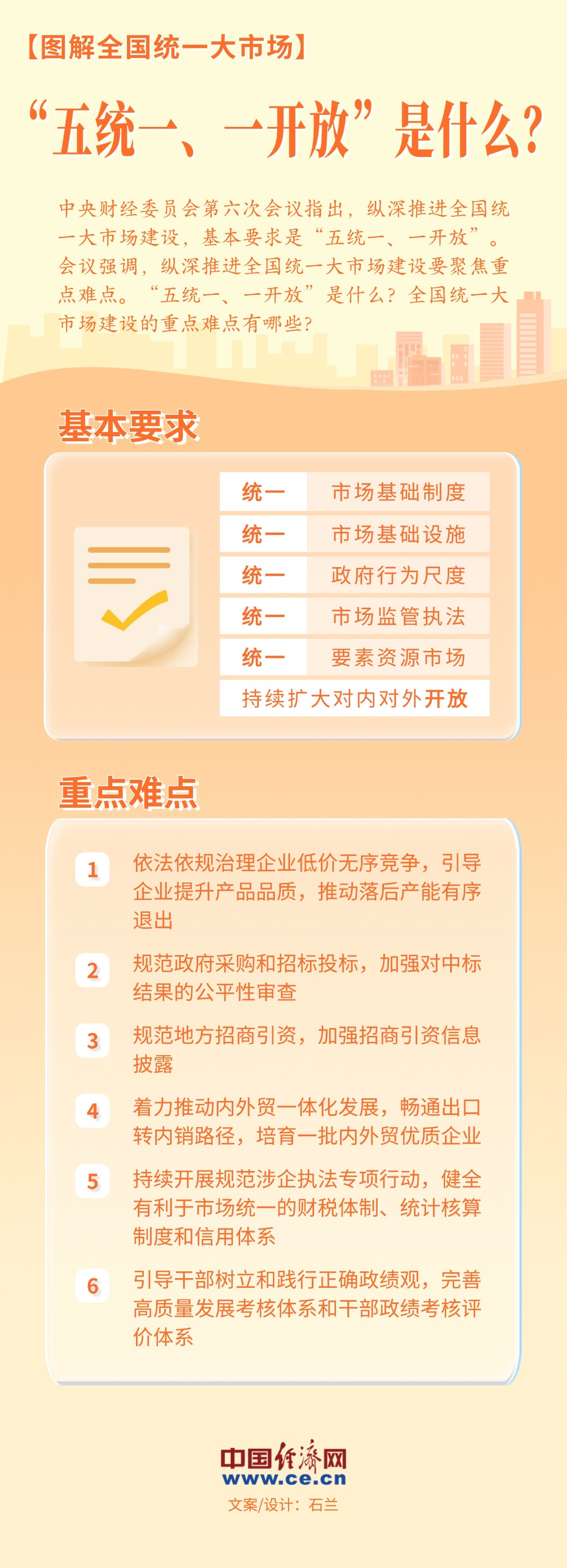
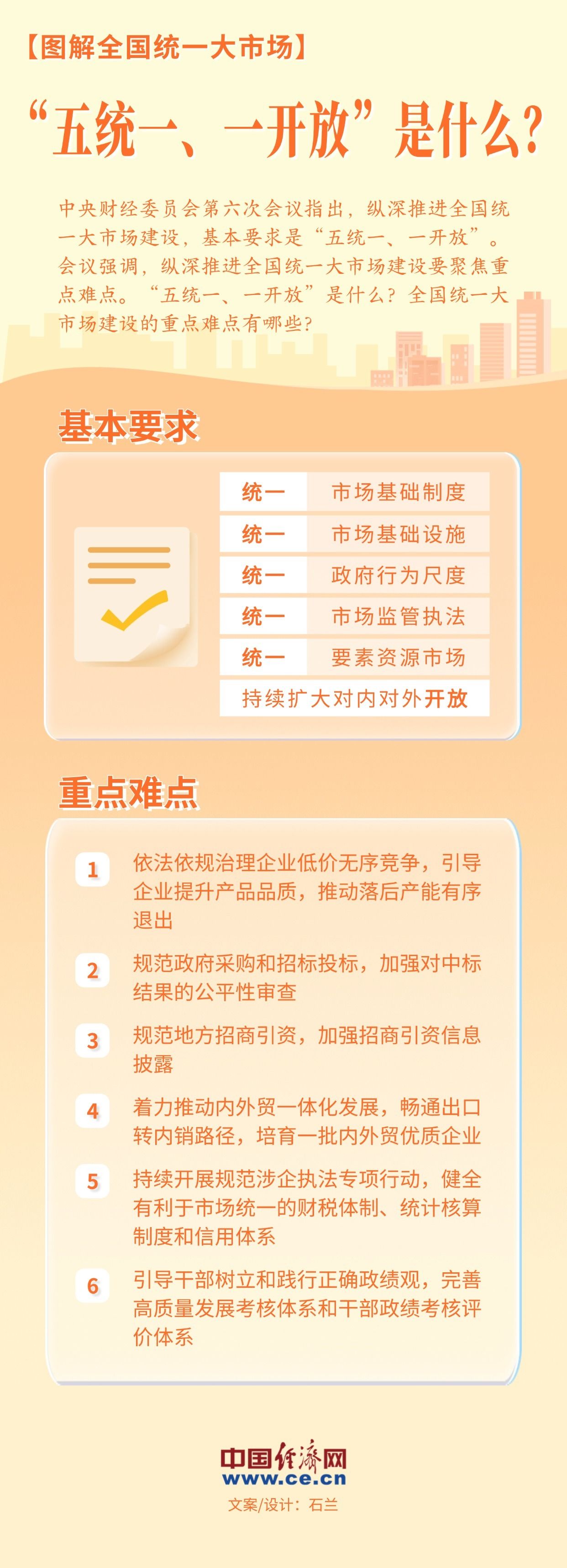
【图解全国统一大市场】 "五统一、一开放"是什么 中央财经委员会第六次会议指出,纵深推进全国乡 一大市场建设,基本要求是"五统一、一开放"。 会议强调,纵深推进全国统一大市场建设要聚焦雪 点难点。"五统一、一开放"是什么?全国统一大 市场建设的重点难点有哪些? 基本要求 内容来源:新华社 | 统· | 市场基础制度 | | --- | --- | | 统· | 市场基础设施 | | 统· | 政府行为尺度 | | 统· | 市场监管执法 | | 统- | 要素资源市场 | | | 持续扩大对内对外开放 | 重点难点 依法依规治理企业低价无序竞争,引导 1 企业提升产品品质,推动落后产能有序 退出 规范政府采购和招标投标,加强对中标 2 结果的公平性审查 规范地方招商引资,加强招商引资信息 B 披露 着力推动内外贸一体化发展,畅通出口 4 转内销路径,培育一批内外贸优质企业 持续开展规范涉企执法专项行动,健全 5 有利于市场统一的财税体制、统计核算 制度和信用体系 引导干部树立和践行正确政绩观,完善 6 高质量发展考核体系和干部政绩考核评 价体系 ...

“五统一、一开放”是什么?
Zhong Guo Jing Ji Wang· 2025-08-07 11:15
Core Points - The central viewpoint emphasizes the importance of advancing the construction of a unified national market, focusing on the principle of "Five Unifications and One Opening" [1] Group 1: Basic Requirements - The "Five Unifications" include unifying market basic systems, infrastructure, government behavior standards, market regulatory enforcement, and resource factor markets [1] - The "One Opening" refers to the continuous expansion of both domestic and foreign openness [1] Group 2: Key Challenges - The article outlines several key challenges in promoting the unified national market, including: 1. Legally and orderly governing low-price disorderly competition among enterprises, guiding them to enhance product quality and promoting the orderly exit of backward production capacity [4] 2. Regulating government procurement and bidding processes, strengthening fairness reviews of bidding results [4] 3. Standardizing local investment attraction and enhancing the disclosure of investment attraction information [4] 4. Promoting the integration of domestic and foreign trade, facilitating the transition of exports to domestic sales, and cultivating a group of high-quality enterprises in both domestic and foreign trade [4] 5. Continuously carrying out special actions to standardize enterprise-related law enforcement, improving the fiscal and tax system, statistical accounting system, and credit system conducive to market unification [4] 6. Guiding officials to establish and practice a correct view of performance, improving the high-quality development assessment system and the performance evaluation system for officials [4]
郑州市融入服务全国统一大市场建设工作推进会召开
Zheng Quan Shi Bao Wang· 2025-08-07 10:29
Core Viewpoint - Zhengzhou is focusing on strengthening its platform economy, headquarters economy, industrial chain economy, leading enterprises, and digital economy to support the construction of a unified national market and enhance its core competitiveness [1] Group 1 - The meeting emphasized the acceleration of the development of the urban agglomeration in Zhengzhou [1] - The goal is to consolidate, expand, and create advantages in the local economy [1] - Zhengzhou aims to become a key hub for both domestic and international market circulation [1]
上半年我国制造业“高端化”稳步推进
Ke Ji Ri Bao· 2025-08-07 01:25
Group 1 - The core viewpoint of the articles highlights the steady growth in sales revenue of enterprises in China during the first half of the year, driven by favorable tax policies and the development of the manufacturing sector [1][2] - Manufacturing sales revenue growth outpaced the overall growth of enterprises by 1.5 percentage points, indicating its crucial role in stabilizing economic growth [1] - High-end manufacturing is progressing steadily, with sales revenue in equipment manufacturing and high-tech manufacturing increasing by 8.9% and 11.9% year-on-year, respectively [1] - The high-tech industry continues to expand, with sales revenue growing by 14.3% year-on-year, reflecting rapid growth in this sector [1] - The digital economy's core industries saw a sales revenue increase of 10.1%, with enterprise procurement of digital technology rising by 9.9%, indicating a continuous acceleration in digital transformation [1] - Driven by large-scale equipment renewal policies, the procurement of machinery and equipment by enterprises increased by 11.1% year-on-year, maintaining a strong growth trend [1] - Consumer demand is being released more rapidly, with significant year-on-year retail growth in home appliances, such as a 45.3% increase in television sales and a 56.6% increase in refrigerator sales [1] Group 2 - The construction of a unified national market is progressing smoothly, with inter-provincial sales accounting for 40.7% of total enterprise sales revenue, an increase of 0.6 percentage points from the previous year [2]
暑期文旅里的“融”字诀——从夏日经济看统一大市场建设①
Ren Min Ri Bao· 2025-08-06 04:33
Core Viewpoint - The construction of a unified national market is essential for building a new development pattern and promoting high-quality development, as emphasized in the Central Political Bureau meeting on July 30, which highlighted the need to deepen the construction of a unified national market and optimize market competition order [1] Group 1: Market Integration and Development - The establishment of a unified market requires breaking down isolated "small circles" and fostering deep integration for common development, as seen in the tourism sector where e-commerce platforms provide integrated services like ticket and hotel bookings [2][4] - The integration of various resources, such as transportation and technology, enhances the flow of elements and boosts consumption potential in the cultural and tourism market [4][5] Group 2: Resource Utilization and Innovation - Revitalizing idle resources and transforming them into "active assets" is crucial, as demonstrated by the systematic renovation of old houses in rural areas, which has led to new economic opportunities through cultural tourism [5] - Utilizing digital technology to break physical barriers and improve resource allocation efficiency can create a fertile ground for enterprise growth and market development [5][6] Group 3: Collaborative Ecosystem - Building a collaborative ecosystem that promotes value co-creation and mutual benefits is vital, as seen in the successful integration of tourism resources in the Yangtze River Delta, which facilitates easier travel and enhances regional cooperation [6][7] - The implementation of policies such as visa exemptions and instant tax refunds has increased the attractiveness of destinations like Beijing, further supporting the growth of the tourism sector [6][7]
风电周报(2025.7.28-2025.8.3):25H1海风新增并网同比+200%,破内卷推进招投标制度改革-20250806
Great Wall Securities· 2025-08-06 03:04
Investment Rating - The report maintains a "Buy" rating for several companies including Jin Feng Technology, Daikin Heavy Industries, and Yun Da Co., while recommending "Hold" for others like Tai Sheng Wind Energy and Jin Lei Co. [1][4] Core Insights - The report highlights a significant increase in offshore wind power grid connections, with a year-on-year growth of 200% in the first half of 2025, indicating a positive trend in the industry [2][3][4] - The National Development and Reform Commission emphasizes the need to eliminate "involution" competition and promote reforms in the bidding system, which is expected to stabilize and potentially increase wind turbine prices [2][4] - The report notes that the wind power sector is experiencing accelerated construction and a strong demand for large-scale products, which is expected to enhance profitability for key players [4][7] Industry Dynamics - The report outlines that in the first half of 2025, the total installed capacity of wind power reached 572.60 million kW, with a year-on-year increase of 22.70% [25][30] - The total new installed capacity for wind power in the first half of 2025 was 51.39 GW, representing a 98.88% increase compared to the same period in 2024 [25][28] - The average bidding price for offshore wind turbines has shown a downward trend, currently averaging 3266.17 yuan/kW [3][53] Market Performance - The wind power equipment index reported a TTM price-to-earnings ratio of 33.17 and a market-to-book ratio of 1.69 [14][21] - The wind power equipment sector outperformed the broader market, with a weekly increase of 1.86%, ranking 12th among 124 sub-sectors [14][17] Company Performance - Key companies such as Jin Feng Technology and Yun Da Co. are highlighted for their strong market positions and expected benefits from the ongoing industry trends [4][7] - The report identifies specific companies for investment based on their market advantages and growth potential, including Daikin Heavy Industries and Tai Sheng Wind Energy [7]




螺纹钢:板块情绪共振,宽幅震荡
Guo Tai Jun An Qi Huo· 2025-08-06 01:33
2025 年 8 月 6 日 螺纹钢:板块情绪共振,宽幅震荡 热轧卷板:板块情绪共振,宽幅震荡 李亚飞 投资咨询从业资格号:Z0021184 liyafei2@gtht.com 来源:Mysteel,同花顺,国泰君安期货研究所 【宏观及行业新闻】 7 月 31 日钢联周度数据:产量方面,螺纹-0.9 万吨,热卷+5.3 万吨,五大品种合计+0.65 万吨;总 库存方面,螺纹+7.65 万吨,热卷+2.79 万吨,五大品种合计+15.39 万吨;表需方面,螺-13.17 万吨,热 卷-8.31 万吨,五大品种合计-15.9 万吨。(数据来源:上海钢联) 【中共中央政治局:依法依规治理企业无房竞争。推进重点行业产能治理】会议指出要坚定不移深化改 请务必阅读正文之后的免责条款部分 1 金园园(联系人) 期货从业资格号:F03134630 jinyuanyuan2@gtht.com 【基本面跟踪】 螺纹钢、热轧卷板基本面数据 | | | 昨日收盘价 (元/吨) | 涨跌 (元/吨) | 涨跌幅 (%) | | --- | --- | --- | --- | --- | | | RB2510 | 3,233 | 44 ...
市场监管总局:规范网络交易平台收费行为|营商环境周报
2 1 Shi Ji Jing Ji Bao Dao· 2025-08-05 14:26
Group 1: Artificial Intelligence Development - The State Council has approved the implementation of the "Artificial Intelligence+" initiative to promote large-scale commercial applications of AI, leveraging China's complete industrial system and large market scale [1] - The initiative aims to create a virtuous cycle of innovation and application, enhancing the integration of AI across various sectors of the economy and society [1] - Government departments and state-owned enterprises are encouraged to lead by example and support the practical application of AI technologies [1] Group 2: Regulation of Online Trading Platforms - The State Administration for Market Regulation has issued the "Compliance Guidelines for Charging Behavior of Online Trading Platforms" to standardize the fees charged to platform operators [2] - The guidelines emphasize reducing the burden on platform operators and enhancing compliance self-discipline among platforms [2][3] - Platforms are required to publicly disclose their charging rules and maintain historical records of fee changes for transparency [3] Group 3: Government Investment Fund Guidelines - The National Development and Reform Commission has released a draft guideline to prevent homogeneous competition among government investment funds and promote high-quality development [4] - The guidelines prohibit investment in restricted or eliminated industries and discourage blind following in emerging sectors [4][5] - It is mandated that the same government should not establish multiple funds in the same industry to avoid overlap and redundancy [5] Group 4: Data Enterprise Support in Fujian - Fujian Province has initiated a regular data enterprise registration process to provide support in data usage, cloud services, computing power, and talent [6] - The province aims to create a dynamic management mechanism for data enterprises, ensuring accurate and timely information [6] - Policies will be developed to support data enterprises, prioritizing them for national and provincial pilot projects [6] Group 5: Entrepreneurship Support in Guizhou - Guizhou Province has launched the "Source of Good Entrepreneurship" resource matching service to enhance entrepreneurship support [7][8] - The initiative focuses on improving the entrepreneurial environment and providing comprehensive services, including policy guidance and financing support [8] - The program aims to streamline the process for entrepreneurs to access resources and support [8] Group 6: Transparent Bidding Process in Hunan - Hunan Province has implemented the "Machine-Managed Bidding" system to enhance transparency and reduce corruption in the bidding process [9][10] - The system automates key stages of the bidding process, significantly reducing the time required for document preparation and evaluation [10] - The participation rate of private enterprises in bidding has increased from 88.27% to 90.49%, with the winning rate rising from 73.65% to 88.25% since the system's implementation [10][11]
破除内卷,建设全国统一大市场成重要抓手?
Sou Hu Cai Jing· 2025-08-05 10:50
Core Viewpoint - The construction of a national unified market in China is accelerating, with the National Development and Reform Commission planning to develop an action plan to deepen this initiative [2][3]. Group 1: Progress and Achievements - The national unified market has shown significant results, with inter-provincial trade sales accounting for 40.4% of total sales from January to April, an increase of 0.6 percentage points year-on-year [2]. - The electricity traded across provinces increased by 18.2% year-on-year in the first half of the year, with its market-based trading proportion rising by 2.6 percentage points [2]. - The logistics cost to GDP ratio is projected to decrease to 14.1% in 2024, down by 0.3 percentage points from 2023, indicating improved market circulation efficiency [3]. Group 2: Strategic Framework - The basic requirements for advancing the national unified market are summarized as "Five Unifications and One Opening," which includes unifying market systems, infrastructure, government behavior, regulatory enforcement, and resource markets, while expanding both domestic and international openness [4][5]. - The "unified government behavior scale" is a new concept aimed at creating a fairer competitive environment by eliminating local protectionism and market segmentation [6][8]. Group 3: Challenges and Solutions - The construction of a national unified market faces challenges such as local protectionism, inconsistent regulatory standards, and barriers to resource flow [4][7]. - Recent policies prohibit local governments from implementing preferential policies that violate national regulations, ensuring a level playing field for all market participants [8]. Group 4: Future Outlook - The implementation of the action plan for the national unified market is expected to enhance market efficiency and competitiveness, supporting high-quality economic development in China [9].

“反内卷”背景下,各地招商引资有了新打法
母基金研究中心· 2025-08-05 09:15
Core Viewpoint - The article discusses the transformation of investment attraction strategies in China, emphasizing the shift from traditional tax incentives and subsidies to more regulated and innovative approaches such as government investment funds and merger acquisitions [1][2][6]. Group 1: Regulatory Changes - The implementation of the Fair Competition Review Regulations (Order 783) prohibits preferential tax treatments and selective financial rewards for specific operators without legal basis or government approval [1]. - The Central Committee's decision to further deepen reforms emphasizes the need to standardize local investment attraction regulations and prohibits illegal policy incentives [1][5]. - Many regions have begun to dissolve their investment promotion offices, replacing them with platform companies aimed at industrial development and economic growth [1][2]. Group 2: Emergence of New Investment Models - The traditional "tax incentive" and "reward-subsidy" models are being replaced by a "fund investment" model, where government investment funds are increasingly linked to investment and attraction efforts [2]. - The State Council issued guidelines to promote high-quality development of government investment funds, explicitly stating that these funds should not be established solely for investment attraction purposes [2][5]. - The "first investment, then equity" model is gaining traction, allowing fiscal funds to support R&D and later convert to equity based on pre-agreed conditions, enhancing the efficiency of fiscal fund usage [4][6]. Group 3: Investment Trends and Data - In Q2 2025, the total capital contribution from Limited Partners (LPs) reached 4270.2 million RMB, with state-owned capital contributing 2317.2 million RMB, accounting for 54.26% of the total [3]. - Government-guided funds accounted for 714.6 million RMB, representing 16.73% of the total contributions [3]. - The focus of investment attraction is shifting from external project recruitment to nurturing local industries, reflecting a more sustainable and localized approach to economic development [7]. Group 4: Mergers and Acquisitions as a New Strategy - The rise of "merger investment" is noted as a new strategy for state-owned enterprises to acquire listed companies, particularly in local specialty industries [8]. - This approach is seen as a way to discover new opportunities while ensuring more certainty in investment attraction [8]. - The emphasis on standardizing and increasing transparency in local investment attraction efforts is expected to continue [8].