
量子计算

Search documents
一天两发,商业航天高景气延续,卫星互联网建设与发射节奏全面提速;智元机器人OmniHand2025系列灵巧手上线销售——《投资早参》
Mei Ri Jing Ji Xin Wen· 2025-08-17 23:21
Monetary Policy - The People's Bank of China released the monetary policy implementation report for Q2 2025, emphasizing the need for a moderately loose monetary policy to match economic growth and price level expectations [1] - The report highlights the importance of maintaining ample liquidity and using structural monetary policy tools to support technology innovation, consumption, small and micro enterprises, and stabilize foreign trade [1] - The policy aims to avoid systemic financial risks while adjusting based on market supply and demand and a managed floating exchange rate system [1] Aerospace Industry - China's aerospace sector has seen a surge in activity, with multiple successful satellite launches in August 2025, indicating accelerated development in satellite internet construction [2] - The commercial space launch market in China is projected to grow from 9.2 billion yuan in 2020 to 310 billion yuan by 2024, with a compound annual growth rate exceeding 100%, five times the global average [3] - Key players in the satellite internet sector include Shanghai Hanxun, Tianyin Electromechanical, and Huali Chuantong [3] Quantum Computing - Significant advancements in quantum computing have been made by research teams from Tsinghua University and Peking University, achieving a programmable instruction set architecture for quantum gates [4] - The quantum computing industry is expected to transition from experimental to commercial applications, with a potential market size reaching hundreds of billions of dollars by 2030 [4] - Notable companies in the quantum computing space include Keda Guochuang, Sanwei Xinan, and Guodun Quantum [4] Gene Editing - A groundbreaking gene editing clinical trial successfully restored insulin production in a patient with type 1 diabetes using genetically modified islet cells, marking a significant advancement in gene therapy [5] - The CRISPR gene editing technology is rapidly evolving, expanding its applicability to over 6,000 diseases, and is expected to reshape the diabetes treatment market [6] - Companies involved in gene therapy include Berry Genomics, Novogene, and Guanhao Biology [6] Stock Market Movements - Medike announced plans for a share reduction by a major shareholder, potentially affecting 12.2 million shares, or 3% of total shares [7] - Nanwei Medical's major shareholder intends to reduce holdings by up to 3,756,948 shares, representing 2% of total shares, due to funding needs [7] - Guotai Environmental received a notice regarding the investigation of its chairman, but the company asserts that its operations remain unaffected [7]

华尔街见闻早餐FM-Radio | 2025年8月18日
Hua Er Jie Jian Wen· 2025-08-17 23:01
Market Overview - US economic data suppresses stock market gains, with Trump threatening high tariffs leading to a drop in chip index by over 2% [2] - Intel shares rose nearly 3%, with a 10% increase over two days after reports of potential government investment [2] - UnitedHealth, favored by Buffett and others, saw a 12% rise, marking its largest gain in five years, supporting the Dow near record highs [2] - Bitcoin fell over $2000, dropping below $117,000, while gold experienced its first weekly decline in three weeks, with a drop of over 3% [2][6] - A-shares rose across the board, with over 4600 stocks in the green, while Hong Kong stocks fell, with JD and Alibaba both down over 3% [2] Key Economic Indicators - China's central bank emphasizes the implementation of moderately loose monetary policy [3][11] - July economic data from China shows retail sales, industrial output, fixed asset investment, and real estate sales all underperforming compared to previous values [13][19] - The consumer confidence index in the US unexpectedly declined in August, with inflation expectations rising [15] Semiconductor Sector - Trump announced plans to impose new semiconductor tariffs within two weeks, potentially reaching rates of 200%-300%, causing most chip stocks to decline [15][20] - Intel's stock performance stands out amidst the overall downturn in the semiconductor sector [15] Foreign Investment in US Debt - Foreign investors held a record amount of US debt in June, with significant increases from the UK and Japan, while holdings from India and Ireland decreased [16] - The demand for US debt remains strong despite concerns over a weakening dollar [16] AI and Technology Investments - OpenAI's CEO Altman plans to invest "trillions" in AI infrastructure, acknowledging challenges with the GPT-5 release [16][20] - Hedge funds showed significant interest in technology stocks, with Microsoft being the most favored, while Alibaba faced substantial reductions in holdings [17][21] Real Estate and Consumer Spending - China's real estate market continues to struggle, with new housing sales down 4% year-on-year, and fixed asset investment growth slowing [19] - US retail sales increased by 0.5% in July, marking the tenth consecutive month of growth, indicating resilient consumer spending [15] Corporate Developments - Tencent's stock price target raised significantly following strong earnings, with analysts optimistic about its AI growth potential [23] - China Shenhua plans a major acquisition worth over 250 billion yuan to enhance its resource reserves and profitability [23] - Circle completed a $1.3 billion stock issuance, indicating strong investor interest [27]


周末重磅要闻出炉!数家光伏企业接到通知,参与下周二举办的座谈会 OpenAI筹划万亿级AI基建
Sou Hu Cai Jing· 2025-08-17 10:35
Domestic Finance - The People's Bank of China emphasizes promoting reasonable price recovery as a key consideration for monetary policy, focusing on supply-side efforts to create effective demand [2] - A significant breakthrough has been achieved in the "Deep Earth Engineering: Sichuan-Chongqing Natural Gas Base," with the newly confirmed geological reserves of the Yongchuan shale gas field amounting to 124.588 billion cubic meters [3] - The first batch of rare earth mining and smelting separation control indicators for 2025 has been issued, although not publicly disclosed [4] - Several photovoltaic companies have been notified to participate in a discussion organized by relevant departments [7] Capital Market - Yang Jiaohong, former director of the Regulatory Division of the China Securities Regulatory Commission, has been expelled from the Party due to serious violations of discipline and law [9][10] - As of August 15, 33 securities firms have reported positive performance for the first half of the year, with 21 firms achieving net profits exceeding 500 million yuan, led by Guotai Junan, China Galaxy, and Guosen Securities [10] - In August, nearly 180 companies have been surveyed by securities firms, with a focus on consumer and technology sectors, indicating a positive market sentiment [11] International Finance - OpenAI plans to invest trillions in AI infrastructure development, as stated by CEO Sam Altman [12] - The U.S. has expanded the scope of a 50% tariff on steel and aluminum imports, adding hundreds of derivative products to the tariff list, effective August 18 [12] - The EU and several European countries have issued a joint statement to prepare for a trilateral meeting involving the U.S. and Russia [12][13]
高盛:散户资金涌入大盘科技股,25只热门股或迎“伽马挤压”行情
Huan Qiu Wang· 2025-08-17 02:55
Core Viewpoint - Goldman Sachs reports that retail investors in the U.S. are shifting their trading activities from niche stocks in cryptocurrency, AI, retail, and quantum computing to more influential large-cap stocks like Palantir, AMD, and TransDigm [1][3] Group 1: Retail Investor Activity - Retail trading volume accounted for over 28% of the total trading volume in the S&P 500 index over the past year, highlighting the significant influence of retail investors in the market [3] - The speculative trading sentiment among retail investors is increasing, as indicated by Goldman Sachs' Speculative Trading Indicator rising to 114 [3] Group 2: Focus Stocks - The 25 S&P 500 stocks with the highest net buying volume from retail investors in the past month are expected to become market focal points, with Palantir, AMD, and TransDigm being specifically mentioned [3] - The report suggests that investors should pay attention to call options on these stocks, as concentrated buying by retail investors may trigger a Gamma Squeeze, leading to further price increases [3] Group 3: Market Trends - Retail investors show a clear preference for technology and consumer discretionary stocks, while real estate and utilities sectors are being neglected [4] - Approximately 20% of the trading volume in the Technology Select Sector SPDR Fund (XLK) comes from retail investors, significantly above historical levels [4] Group 4: Professional Investor Behavior - Professional investors are increasing their positions driven by fear of missing out (FOMO), utilizing futures, swaps, and options [3] - Expectations of a potential interest rate cut by the Federal Reserve in September and a moderate rise in financing spreads are seen as additional catalysts for further gains in U.S. equities [3]

A股晚间热点 | 高层发声!事关民营经济发展
智通财经网· 2025-08-15 15:08
Group 1 - Xi Jinping emphasizes the need to promote the healthy and high-quality development of the private economy, addressing prominent issues faced by private enterprises and encouraging entrepreneurs to remain resilient [1] - The People's Bank of China plans to implement a moderately loose monetary policy, ensuring liquidity remains ample and aligning social financing and money supply growth with economic growth and price level expectations [1] Group 2 - Li Qiang calls for a robust push towards green and low-carbon industrial transformation, focusing on enhancing ecological diversity and stability while optimizing land development and protection [2] Group 3 - Southbound funds recorded a net purchase of HKD 35.876 billion on August 15, marking a historical high for single-day net purchases, with Xiaomi Group and Alibaba leading the inflows [3][4] - The top ten stocks with the highest net inflows from southbound funds include Xiaomi Group (HKD 31.43 billion) and Alibaba (HKD 27.26 billion) [3] Group 4 - The first batch of total control indicators for rare earth mining and separation for 2025 has been issued to China Rare Earth Group and Northern Rare Earth, although not publicly disclosed [4] Group 5 - The Shanghai Composite Index reached a peak of 3704.77 points, approaching the 3731.69 points high from February 18, 2021, marking a significant ten-year high [5][6] - Historical analysis shows that after reaching a ten-year high, the Shanghai Composite Index typically maintains a trend of oscillating upward over an extended period [6] Group 6 - Reports suggest that polysilicon companies may implement monthly production and sales restrictions starting in September, with a total annual capacity control of 2 million tons for 2026 [7] - The average transaction price for n-type polysilicon has increased from CNY 34,400 per ton in late June to CNY 47,400 per ton, reflecting a nearly 37.8% increase [7] Group 7 - The Shanghai Electric Power Company successfully executed a demand response call for virtual power plants, achieving a maximum response load of 1.1627 million kilowatts, setting a new record [13] - Analysts recommend focusing on hydropower and thermal power stocks that are expected to benefit from the ongoing construction of a unified national electricity market [13]

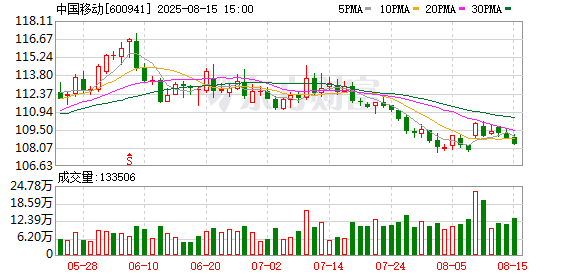
三大运营商A股半年报出炉,中国移动日均狂赚4.65亿元
2 1 Shi Ji Jing Ji Bao Dao· 2025-08-15 15:02
Core Viewpoint - The financial performance of China's three major telecom operators shows mixed results, with China Mobile experiencing a revenue decline while China Telecom and China Unicom report growth. The operators are focusing on new technologies and strategic industries to drive future growth amidst increasing competition [2][4][6]. Revenue Performance - As of August 15, 2025, China Mobile's revenue was 543.8 billion yuan, a decrease of 0.5% year-on-year; China Telecom's revenue reached 269.4 billion yuan, an increase of 1.3%; and China Unicom's revenue surpassed 200 billion yuan, reaching 200.2 billion yuan, with a growth of 1.5% [2]. - China Mobile's revenue scale is approximately double that of China Telecom and China Unicom, despite its negative growth [2]. Profitability - In terms of net profit, China Mobile reported 84.2 billion yuan, a growth of 5.0% year-on-year; China Telecom's net profit was 23.0 billion yuan, up 5.5%; and China Unicom's net profit reached 6.349 billion yuan, increasing by 5.1% [3][4]. Business Performance - China Telecom's mobile communication service revenue grew to 106.6 billion yuan, a 1.3% increase, while its digital industry revenue reached 74.9 billion yuan [4]. - China Mobile's wireless internet revenue was 195.5 billion yuan, down 4.7%, while its application and information service revenue grew by 5.9% to 136.7 billion yuan [4]. - China Unicom's network communication revenue was 131.9 billion yuan, with its digital intelligence revenue reaching 45.4 billion yuan, accounting for 26% of its total revenue, marking the highest growth rate in the industry [4]. Strategic Focus - The three operators are actively investing in emerging industries such as artificial intelligence, low-altitude economy, and quantum computing to create new growth opportunities [4][5]. - China Telecom's AI revenue reached 6.3 billion yuan, growing by 89.4%, while China Mobile's AI-related income also saw significant growth [5]. - China Unicom's strategic emerging industry revenue accounted for 86% of its total revenue, indicating a shift towards new business models [5]. R&D Investment - China Unicom increased its R&D expenditure by 16%, focusing on next-generation internet and AI technologies, while China Telecom's R&D spending rose by 2.6% to 4.78 billion yuan [6]. - In contrast, China Mobile's R&D expenses decreased by 13.3% to 10.4 billion yuan, representing 1.9% of its revenue [6]. Competitive Landscape - The operators are facing intensified competition, with China Mobile's chairman criticizing the "malicious competition" in the market, particularly regarding low-priced data plans [6][7]. - Analysts suggest that companies should focus on enhancing core capabilities and creating differentiated competitive advantages to achieve mutual benefits in the industry [7].



量子计算,我国取得重要突破
财联社· 2025-08-15 12:01
Core Viewpoint - The collaboration between Tsinghua University's Quantum Software Research Center and Beijing Quantum Information Science Research Institute has led to significant advancements in quantum computing architecture, specifically the development of the AshN instruction set architecture for direct programming of arbitrary two-qubit gates [1][3]. Group 1: Research Achievements - The research team has achieved the first international implementation of the AshN instruction set architecture, which allows for direct programming of arbitrary two-qubit gates [3]. - The study titled "Efficient Implementation of Arbitrary Two-Qubit Gates Based on a Unified Control Scheme" was published in Nature Physics, highlighting the innovative approach to quantum gate operations [3]. - Traditional quantum computing methods require complex operations to be decomposed into combinations of CNOT gates and single-qubit gates, which are less efficient and prone to operational errors [3]. Group 2: Technical Innovations - The AshN architecture utilizes a cooperative control mechanism involving magnetic flux modulation and microwave driving, enabling multi-parameter coordinated control under a unified control scheme [3]. - This architecture covers all equivalence classes of two-qubit unitary matrices, significantly reducing the number of gate operations required and minimizing error accumulation [3]. - Under reasonable assumptions, the architecture ensures the shortest evolution time, facilitating high-precision physical implementations [3]. Group 3: Practical Applications - The AshN architecture has been successfully implemented and validated on a mainstream superconducting qubit platform at the Beijing Quantum Information Science Research Institute [3]. - The innovative instruction set architecture is expected to directly enhance the performance of existing superconducting quantum chips [3].
36氪晚报|快手高级副总裁盖坤兼任可灵AI技术部负责人;360官宣“All in Agent”战略;清华团队在量子计算领域取得重要突破
3 6 Ke· 2025-08-15 11:47
Group 1: Company Developments - Mafengwo showcased its AI itinerary planning feature at the Suzhou Grand Canal Cultural Tourism Expo, which generates personalized travel plans based on user preferences, including routes, cultural activities, dining recommendations, and budget [1] - Kuaishou announced organizational restructuring, appointing senior vice president Gai Kun as the head of the Keling AI Technology Department, continuing to report to the CEO Cheng Yixiao [2] - Tuniu reported a net income of 134.9 million yuan for Q2 2025, a year-on-year increase of 15.3%, with packaged travel product revenue up 26.3% and a net profit of 14.1 million yuan [3] - 360 Group announced its "All in Agent" strategy, revealing significant advancements in its nano AI technology, achieving a 98.2% success rate in executing 100-step tasks [4] - Amazon aims to expand its grocery delivery service to 2,300 cities by the end of 2025, currently available in 1,000 cities, targeting a market where groceries account for 43% of U.S. retail sales [5] - Eli Lilly signed a $1.3 billion deal with AI drug company Superluminal to accelerate AI drug development, particularly for obesity and other cardiometabolic diseases [5] - Zhejiang Hanchai Guozi Intelligent Technology Co., Ltd. underwent a name change and welcomed new shareholders, including Zhejiang Chint New Energy Development Co., Ltd. [5] - Samsung is set to receive incentives from the Philippine government for a $1 billion project, with plans to finalize the incentive scheme in the current quarter [6][7] - WeRide received a multi-million dollar investment from Grab to accelerate the deployment of L4 Robotaxis in Southeast Asia [8] Group 2: Product and Technology Innovations - Tencent launched the open-source version of its mixed Yuan 3D world model, optimized to reduce memory usage by 35%, making it compatible with consumer-grade hardware [8] - Zhongke Shuguang released the Nebula 800, the first standardized super-intelligent computing platform in China, which has been implemented in over 30 industries [9] - Tsinghua University achieved a significant breakthrough in quantum computing, developing a programming instruction set architecture for arbitrary two-qubit gates, published in Nature Physics [10]

清华团队在量子计算领域取得重要突破
Zheng Quan Shi Bao Wang· 2025-08-15 09:33
人民财讯8月15日电,据清华大学官微消息,近日,清华大学计算机系量子软件研究中心陈建鑫课题组 与北京量子信息科学研究院燕飞团队合作,在量子计算机体系结构领域,取得重要进展。研究团队在国 际上首次实现了,支持任意两比特量子门直接编程的指令集架构AshN,相关研究成果以"基于统一控制 方案的任意两比特门的高效实现"为题发表于《自然.物理》(Nature Physics)。 ...
城记 | 一周聚焦:中国科创硕果频出,长三角扮演什么角色?
Xin Hua Cai Jing· 2025-08-15 05:32
Core Insights - China is transitioning from a major technology power to a strong technology power, leading in global technology competition with the highest number of top 100 technology innovation clusters and manufacturing value added for 14 consecutive years [1] - The Yangtze River Delta region is at the forefront of technological innovation due to its unique regional advantages, strong economic foundation, rich talent pool, and complete research system [1] Group 1: Technological Innovations - A team from the Chinese Academy of Sciences has developed the world's first intelligent breeding robot "GEAIR," which can automatically perform hybrid pollination, breaking through bottlenecks in hybrid breeding [2] - The "GEAIR" system has been applied to soybean breeding, achieving rapid creation of male-sterile soybean lines, which is expected to significantly increase yield and provide new intelligent breeding technologies [2] Group 2: Quantum Computing Advances - A new world record for defect-free atomic arrays in neutral atom systems has been established, laying a crucial technological foundation for large-scale neutral atom quantum computing [3] - The Shanghai Quantum Science Research Center and its partners successfully constructed a defect-free two-dimensional and three-dimensional atomic array with 2024 atoms in just 60 milliseconds, showcasing the potential for future applications [3][4] Group 3: Electric Motor Controller Development - The Ningbo Yongjiang Laboratory has unveiled a new generation of motor controllers with a power density of 70 kW/kg, significantly surpassing the industry record of 40 kW/kg [5] - This new controller achieves a volume power density of 57.6 kW/L and represents a nearly threefold increase in power density compared to the previous generation released in June 2024 [5][6]