国产替代

Search documents
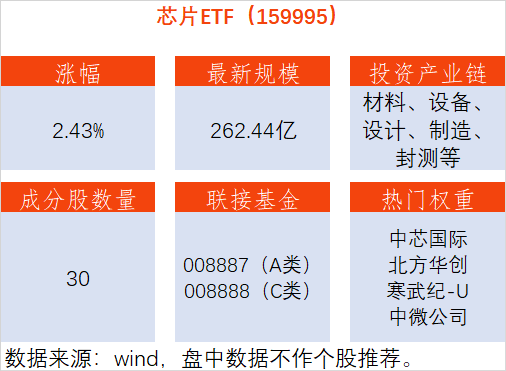
国产替代加速!芯片ETF(159995)上涨2.43%,华海清科上涨7.88%
Mei Ri Jing Ji Xin Wen· 2026-01-06 02:29
Group 1 - The A-share market saw a collective rise on January 6, with the Shanghai Composite Index increasing by 0.73%, driven by gains in precious metals, brokerage, and basic metals sectors [1] - The chip technology sector continued to strengthen, with the chip ETF (159995) rising by 2.43% as of 10:04 AM, and notable increases in constituent stocks such as Huahai Qingke (+7.88%), Zhongwei Company (+6.80%), and others [1] Group 2 - Changxin announced plans to raise 29.5 billion, allocating 7.5 billion for upgrading the manufacturing line for memory chips, 13 billion for DRAM technology upgrades, and 9 billion for R&D in dynamic random-access memory [3] - SMIC plans to issue 547 million shares at 74.20 yuan per share to acquire a 49% stake in SMIC North, while Huahong Semiconductor intends to issue 191 million shares at 43.34 yuan per share to acquire a 97.4988% stake in Huali Micro [3] - According to Zhongshan Securities, the AI-related industry is expected to maintain a favorable outlook through 2026, with domestic semiconductor opportunities arising from accelerated localization [3] - Predictions indicate that capital expenditure by cloud computing giants may sustain over 40% growth by 2026, with the AI sector remaining robust [3] - The chip ETF (159995) tracks the National Chip Index, comprising 30 leading companies in the A-share chip industry, including SMIC, Cambricon, Changdian Technology, and Northern Huachuang [3]






全年涨幅高达1800%!存储涨价周期持续,上游半导体设备需求明确
Jin Rong Jie· 2026-01-06 02:17
2026年开年第一个交易日,A股放量普涨迎开门红,沪指12连阳重返4000点。板块来看,医药、半导体方向领涨市场,受益于产业链涨价趋势 延续,上游半导体设备ETF(561980)全天大涨5.64%,五个交易日内获资金净流入超2亿元。 一方面,行业并购重组动作频频成为半导体产业链重要催化。 半导体设备ETF(561980)第一权重股中微公司近期发布重大资产重组预案,拟以发行股份及支付现金方式购买杭州众硅64.69%股权,并募集 配套资金,股票于1月5日复牌。 中微表示,交易完成后公司将形成"刻蚀+薄膜+量测+湿法"四大前道工艺设备矩阵,业务版图将首次覆盖芯片制造80%的关键工序,与国际巨 头业务结构趋同。 数据显示,自"科八条"发布以来,科创板半导体公司已合计新增49单并购重组,其中有25单已经完成,有14单在流程中,重大资产重组是23 单,此外还有多单并购交易正在积极推进中。 42.16% 18.06% 58.38% 沪深300 中证未言 中证全指半导体 数据来源:iFinD,截至2025.12.31 多 市场热点 存储芯片全年涨幅最高达1800% 另一方面,存储涨价超级周期对半导体设备需求形成明确利好。 据 ...



沪指12连阳重返4000点,A股2026“开门红”或将引爆春季行情
Sou Hu Cai Jing· 2026-01-06 02:14
2026年首个交易日,A股市场取得"开门红",上证指数延续强势走出12连阳罕见走势,一举突破并站稳4000点整数关口,为全年行情奠定坚实基础。 沪指重上4000点 指数表现方面,三大股指全天高开高走,震荡上行。截至收盘,上证指数报4023.42点,上涨1.38%,涨幅54.58点,成功重返4000点上方,日线12连阳的走 势创下近期市场强势纪录;深证成指表现更为强劲,收于13828.63点,大涨2.24%,涨幅303.61点,突破阶段新高;创业板指涨幅领先,收报3294.55点,大 涨2.85%,尽显成长股活力。全市场呈现普涨格局,沪深京三市超4100只个股飘红,3959只个股实现上涨,126只个股强势涨停,仅1111只个股下跌。 从板块表现来看,热点赛道全面开花,主线特征鲜明。脑机接口概念成为今日最耀眼的明星板块,受益于马斯克旗下神经连接公司2026年大规模量产脑机接 口设备的消息催化,三博脑科、创新医疗等20余只相关个股集体封板,板块内近40股涨幅超10%;半导体产业链同步走强;存储芯片方向凭借美股相关板块 大涨的联动效应及国产替代逻辑,香农芯创、江波龙等个股强势拉升,中芯国际涨近5%,进一步夯实科技主线 ...

电子材料行业2026年度策略:看好下游快速发展、先进技术迭代以及国产替代带来的材料需求增长
Bank of China Securities· 2026-01-06 02:11
Core Insights - The report emphasizes the growth opportunities in the electronic materials sector driven by rapid downstream development, technological advancements, and domestic substitution [3][5] - The semiconductor materials market is projected to grow significantly, with a forecasted sales revenue of USD 67.5 billion in 2024, reflecting a year-on-year increase of 3.8% [7][34] - The report maintains a "stronger than market" rating for the industry, indicating a positive outlook for investments in electronic materials [3][5] Semiconductor Materials - The global semiconductor materials market is expected to exceed USD 87 billion by 2029, with a compound annual growth rate (CAGR) of 4.5% from 2024 to 2029 [7][34] - China's semiconductor materials domestic substitution rate is currently around 15%, with significant reliance on imports for high-end materials [38][42] - Key materials such as CMP polishing materials, photoresists, and electronic specialty gases are seeing increased domestic production efforts, which are expected to enhance the domestic substitution rate [38][42] PCB Materials - The PCB industry is evolving towards high-frequency and high-speed applications, with increasing demand for electronic resins and fabrics [7][34] - The global market for electronic resins and fabrics used in PCB production is estimated at approximately USD 33.02 billion and USD 24.13 billion, respectively, in 2023 [7][34] - The transition to high-frequency and high-speed PCBs is driven by advancements in 5G technology and the rapid growth of data centers and cloud computing [7][34] OLED Materials - The demand for OLED materials is expected to grow rapidly due to increasing terminal application needs and the acceleration of high-generation line capacity release [7][34] - The global OLED display materials market is projected to reach USD 2.44 billion in 2024, with a CAGR of 19.8% expected from 2025 to 2031 [7][34] - Domestic OLED organic materials currently have a low substitution rate of around 12%, indicating significant growth potential as local manufacturers expand their capabilities [7][34] Investment Recommendations - The report recommends investing in companies benefiting from the semiconductor market recovery, such as Anji Technology, Yake Technology, and Jiangfeng Electronics, among others [5][34] - For AI server demand, companies like Shengquan Group and Dongcai Technology are highlighted as key players in the electronic resin market [5][34] - In the OLED sector, companies like Lite-On Optoelectronics and Wanrun Co., Ltd. are recommended due to their strong market positions [5][34] Industry Performance - The semiconductor materials index has shown a cumulative increase of 37.87% in 2025, outperforming the CSI 300 index by 18.72 percentage points [26] - The electronic chemicals index has increased by 54.98% in the same period, surpassing the CSI 300 index by 35.83 percentage points [26] - Overall, the electronic materials industry is experiencing stable growth, with significant improvements in revenue and profitability metrics [16][26]



单日净申购超5亿!资金疯狂涌入全市场高脑机含量且规模最大医疗器械ETF
Xin Lang Cai Jing· 2026-01-06 02:04
Core Insights - The medical device sector is experiencing a strong upward trend, with the CSI All Index Medical Device Index rising by 1.25% and significant gains in key stocks such as Meihua Medical and Xiangyu Medical reaching the daily limit of 20% [1] - Neuralink, owned by Elon Musk, plans to begin large-scale production of brain-machine interface devices in 2026, aiming for a streamlined and automated surgical process, with the goal of helping paralyzed individuals regain full body function [1] - The brain-machine interface has been included in China's 14th Five-Year Plan, with specific targets set for technological breakthroughs by 2027 and industry strength to rank among the world's top by 2030 [1] Industry Developments - Domestic high-end medical device market share is increasing, with over 70% penetration of domestic DR and ultrasound diagnostic equipment in grassroots medical institutions, and rising application rates of high-end CT and MRI in tertiary hospitals [2] - The brain-machine interface industry is expected to enter a growth phase due to policy support, accelerating the transition from research to commercialization [2] - The brain-machine interface market is projected to grow at a CAGR of 17% from 2025 to 2034, reaching an estimated market size of $12.4 billion by 2034 [2] ETF Insights - The medical device ETF (159883) has the highest exposure to brain-machine interfaces, accounting for over 23% of its holdings, and is the largest ETF focused on the medical device sector [3] - The Hong Kong medical ETF (159366) tracks the CSI Hong Kong Stock Connect Medical Theme Index, providing access to high-quality assets in the medical device and biotechnology sectors [3] - Both ETFs are positioned to benefit from the growth in domestic innovation, export acceleration, and new technology advancements in the medical device industry [3]
单日净申购超5亿!资金疯狂涌入全市场高脑机含量且规模最大医疗器械ETF(159883)
Sou Hu Cai Jing· 2026-01-06 02:03
Core Insights - The medical device sector is experiencing a strong upward trend, with the CSI All Index Medical Device Index rising by 1.25% and significant gains in key stocks such as Meihua Medical and Xiangyu Medical [1] - Neuralink, owned by Elon Musk, plans to begin large-scale production of brain-machine interface devices in 2026, aiming for a streamlined and automated surgical process [1] - The brain-machine interface has been included in China's 14th Five-Year Plan, with specific goals for technological breakthroughs by 2027 and industry strength by 2030 [1] Market Performance - The medical device ETF (159883) has seen a 1.16% increase, with net subscriptions exceeding 400 million units [1] - The latest net inflow into the medical device ETF is 274 million yuan [1] Industry Developments - Domestic high-end medical device market share is increasing, with over 70% penetration of domestic DR and ultrasound diagnostic equipment in grassroots medical institutions [2] - The brain-machine interface industry is expected to enter a growth phase, transitioning from research to commercialization, supported by policy and technological advancements [2] - The brain-machine interface market is projected to grow at a CAGR of 17% from 2025 to 2034, reaching an estimated $12.4 billion by 2034 [2] ETF Insights - The medical device ETF (159883) has the highest brain-machine interface content in the market, accounting for over 23% of its holdings, and focuses on innovative domestic companies [3] - The Hong Kong medical ETF (159366) tracks a medical theme index, providing exposure to high-quality assets in the medical device sector, including minimally invasive brain science and robotics [3]


4500点?
Xin Lang Cai Jing· 2026-01-06 01:17
MACD金叉信号形成,这些股涨势不错! 责任编辑:石秀珍 SF183 2026年真是起个好头啊,假期发酵的脑机题材直接起飞,带飞了医药;存储又带飞了半导体。基本上算 全线起飞,尤其是港股,撑住了获利跑的资金,生物科技更是大涨4%,港股信息技术 ETF(159131) 大涨3.2%~ 港股信息技术 ETF(159131)是一只非常有特色且稀缺的ETF品种,也是目前全市场唯一一只跟踪中证 港股通信息技术综合指数的 ETF,其标的指数创新性地采用 "70% 硬件 + 30% 软件" 的配置结构,剔除 大市值互联网企业,聚焦 "半导体 + 电子 + 计算机软件" 三大核心领域。 从成分股构成看,该指数涵盖 42 家港股硬科技龙头,前十大权重股合计占比达 70.71%,龙头效应显 著,其中中芯国际以 20.48% 的权重稳居第一,华虹半导体、小米等芯片与电子制造龙头紧随其后,形 成 "国产替代核心 + 终端应用龙头" 的立体布局。港股信息技术 ETF(159131)不受 QDII 额度限制, 支持日内 T+0 交易。 2026年大家要重视港股行情,尤其是港股的稀缺资产,通过ETF投资港股应该是普通人最好的选择,没 有之 ...


中信证券:予PCB功能性湿电子化学品行业“强于大市”评级 本土厂商突围空间广阔
Zhi Tong Cai Jing· 2026-01-06 00:48
Core Viewpoint - The PCB functional wet chemical industry is entering a phase of "structural upturn driven by AI" and "accelerated domestic substitution" from 2025 to 2026, marking a period of simultaneous quantity and quality improvement [1] Group 1: Industry Dynamics - Functional wet chemicals are critical for high-end PCB manufacturing, with low domestic substitution rates in key processes like hole metallization and electroplating [2] - Hole metallization and electroplating contribute approximately 60% of the value in PCB manufacturing, making them core value segments [2] - The cost share of functional wet chemicals in high-end PCBs has risen to 5-10% as the industry moves towards high-frequency, high-speed boards and advanced packaging [2] Group 2: AI and Technology Impact - AI is driving the upgrade of PCB processes, significantly increasing the demand for high-end functional wet chemicals [2] - The transition to finer line widths (from 40μm to 15μm) under mSAP/SAP processes is expected to increase the demand for horizontal copper plating solutions by about 30% and nearly double the need for electroplating additives [2] Group 3: Market Growth Projections - The global market for PCB functional wet chemicals is projected to grow from $3.54 billion in 2025 to $4.46 billion by 2029, with core growth driven by hole metallization and electroplating [3] - The market for horizontal copper plating and electroplating specialty chemicals is expected to reach $700 million and $930 million respectively by 2029, with a CAGR of 7.0% from 2025 to 2029 [3] Group 4: Domestic Manufacturer Opportunities - Domestic manufacturers are accelerating breakthroughs in high-end segments and have achieved domestic substitution in certain niche markets [3]

结构性机会陆续涌现
Jing Ji Ri Bao· 2026-01-05 22:16
Group 1 - The 2025 Central Economic Work Conference prioritizes "domestic demand as the main driver, building a strong domestic market," signaling positive expectations in the capital market, particularly in the retail and food and beverage sectors [1] - Analysts note that the current domestic demand expansion policy features "income enhancement, supply optimization, and precise investment," presenting a dual opportunity for valuation recovery and performance growth in related sectors [1] - The focus of policies is shifting from traditional "stimulating consumption" to a deeper logic of "income enhancement and supply optimization," indicating that consumption opportunities will exhibit structural characteristics [1] Group 2 - The growth of service consumption is evidenced by data, with the core CPI rising by 1.2% year-on-year in November 2025, and service retail sales increasing by 5.4% in the first eleven months of 2025, outpacing goods retail sales [1] - From the perspective of consumption upgrades, domestic brands, health care, and cultural tourism are entering a rapid development phase due to rising incomes and changing consumer attitudes [2] - The investment opportunities arising from domestic demand expansion should be closely aligned with policy directions, focusing on industry fundamentals and market trends [2]
最后48小时,特朗普终于下令批准,王毅通告全球,给中美交情定调
Sou Hu Cai Jing· 2026-01-05 16:02
Group 1 - The U.S. government has granted Samsung and SK Hynix a license to export semiconductor manufacturing equipment to China, signaling a new phase in U.S.-China relations amidst ongoing geopolitical tensions [1][3] - The approval is not a straightforward concession; it comes with strict conditions, including annual reviews and limitations on the technology that can be exported, particularly excluding advanced AI-related tools [5][9] - The U.S. aims to maintain control over the semiconductor supply chain while allowing South Korean companies to operate in China, which could intensify competition in the mature process technology market [11][13] Group 2 - The response from Chinese companies has been muted, as they are already advancing in the mature technology sector and are not reliant on U.S. approvals [17][26] - China's diplomatic stance remains cautious, emphasizing mutual respect and cooperation, while recognizing that U.S. actions are part of a broader strategy to manage competition [19][22] - The ongoing situation reflects a complex interplay of interests, with the U.S. seeking to stabilize its supply chain and support allies while China continues to build its capabilities independently [30][34]