
春季躁动行情

Search documents
大盘七连阳:“躁动”行情来了吗?
Sou Hu Cai Jing· 2025-12-25 12:18
Core Conclusion - The market is closely watching whether the spring rally (including the year-end rally) has started, with the traditional definition requiring a rise of over 10% from the market low, a clear structural main line, and a solid support logic [1][2]. Group 1: Spring Rally Indicators - The A-share "Rally" Index, constructed by the company, is used to track the initiation of the spring rally, with a significant signal being when the index crosses above the zero line from negative territory [2][8]. - As of now, the index has risen from a low of -9.67% on December 17 to around -6%, indicating that the spring rally has not yet clearly started and is still in a consolidation phase [1][2][8]. Group 2: Market Conditions and Expectations - The current market environment is characterized by a lack of clear main lines despite the presence of various hotspots, suggesting a state of rapid structural rotation [4]. - The company emphasizes the need for the market index to stabilize above 4000 points, transitioning from a liquidity-driven market to a fundamentally driven one before a clear upward trend can be established [3][4]. Group 3: Historical Context and Patterns - Historically, the spring rally typically occurs between December and February, with an average return of 10-15% during this period [14][21]. - The company notes that the majority of core indices have recovered to over 70% of their historical PE valuation percentiles, which constrains the potential for a significant year-end rally [19][21]. Group 4: Sector Performance and Rotation - The historical pattern shows that large-cap stocks tend to rise first during the spring rally, followed by small-cap stocks, with a rotation from cyclical value to technology and broader manufacturing and growth sectors [22][24]. - The company identifies that the cyclical value style has historically performed strongly in December to January, with a win rate of 70% since 2003, while growth styles tend to perform better in January [24].


建信沪深300红利ETF(512530)所跟踪指数翻红上扬,A股季度现金分红趋势强化,防御性板块配置机会备受关注
Xin Lang Cai Jing· 2025-12-25 05:03
Group 1 - The core viewpoint of the articles highlights the increasing trend of cash dividends among A-share companies, with 270 companies having announced cash dividends for Q3 2025, indicating a growing number and coverage of companies participating in cash dividends [1] - The A-share market has seen a gradual increase in the number of companies issuing cash dividends and the total amount, with a notable acceleration in this trend since 2024, reflecting a shift from a "heavy financing, light returns" model to a more balanced investment ecosystem [1] - Yin Tai Securities emphasizes that encouraging high-quality listed companies to increase dividend payouts is a key aspect of the new round of capital market reforms, which will promote long-term healthy development of the A-share market [1] Group 2 - Galaxy Securities points out that as 2026 approaches, the A-share market is entering a critical window for cross-year layout, with expectations for policy benefits to be released early in the year, creating structural opportunities in sectors aligned with policy guidance and industry prosperity [2] - The upcoming spring market rally is anticipated, with a focus on defensive sector allocation in the short term while preparing for next year's policy benefits and industry trends [2] - The Jianxin CSI 300 Dividend ETF (512530) closely tracks the CSI 300 Dividend Index, which selects 50 high-dividend stocks from the CSI 300 Index, reflecting the overall performance of high-dividend securities within the index [2]





ETF盘中资讯|A股融资余额首破2.5万亿!滞涨券商迎来估值修复窗口,机构:关注左侧布局机会
Jin Rong Jie· 2025-12-25 03:16
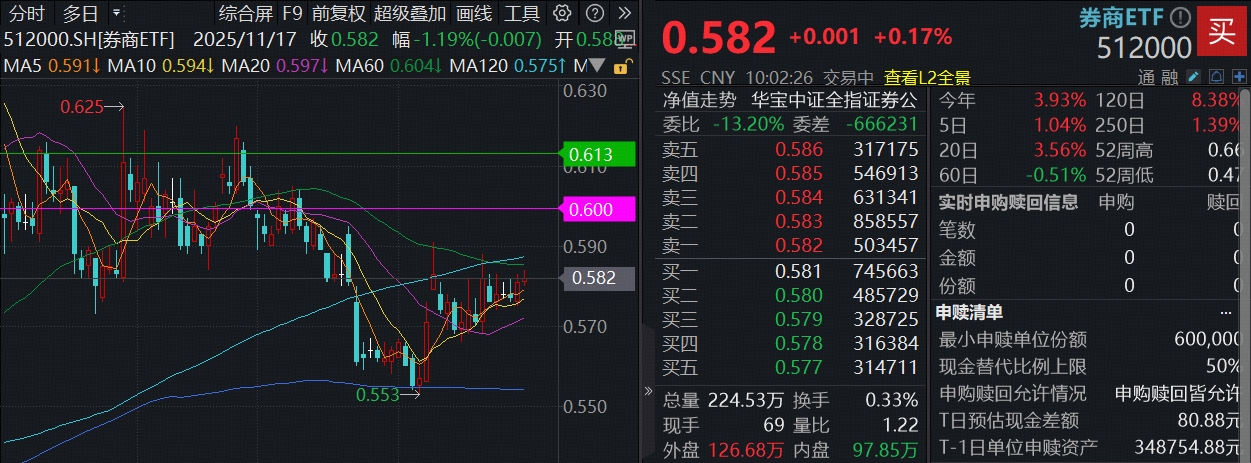
Core Viewpoint - The brokerage sector is experiencing a slight upward trend, with individual stocks showing positive performance, indicating a potential recovery and growth in the industry [1][3]. Group 1: Market Performance - As of December 25, the brokerage sector maintained a slight upward movement, with Northeast Securities rising over 3% and others like Caitong Securities and Jinlong Co. increasing by over 1% [1]. - The brokerage ETF (512000) saw a minor increase of 0.17%, reflecting a gradual upward trend along the 5-day moving average [1]. - The financing balance in the A-share market reached a record high of 25,145.96 billion yuan, marking an increase of 148.59 billion yuan, the first time it has surpassed 25 trillion yuan since the establishment of the margin trading market [2]. Group 2: Industry Outlook - Analysts suggest that as the "14th Five-Year Plan" approaches, the A-share market is entering a critical window for early positioning, with expectations for a spring rally driven by policy expectations and profit recovery [3]. - The brokerage sector is expected to benefit from high market trading volumes and margin financing, supported by policies aimed at stabilizing growth and boosting the capital market [3]. - Despite the current bull market, the brokerage sector has underperformed, with the brokerage ETF only rising 2.88% year-to-date compared to significant gains in major indices like the Shanghai Composite Index (17.58%) and the Shenzhen Component Index (29.5%) [3]. Group 3: Investment Recommendations - Xiangcai Securities indicates that the brokerage industry's performance is recovering, with long-term benefits expected from increased market participation and international business opportunities [4]. - The brokerage sector is currently viewed as having a high safety margin due to its price-to-book ratio falling to a low level over the past decade, suggesting opportunities for left-side positioning [4]. - The brokerage ETF (512000) is highlighted as an efficient investment tool that encompasses 49 listed brokerage stocks, providing a concentrated exposure to both leading and smaller brokerages [4].
A股开盘速递 | A股三大指数开盘涨跌不一 沪指跌0.08% 商业航天等板块领涨
智通财经网· 2025-12-25 01:50
Market Overview - The three major A-share indices opened mixed, with the Shanghai Composite Index down 0.08% and the ChiNext Index up 0.1% [1] - Sectors such as commercial aerospace, Hainan free trade, and real estate saw significant gains, while lithium mining, precious metals, and nuclear fusion sectors experienced declines [1] Institutional Insights - Galaxy Securities anticipates a promising spring market, emphasizing short-term defensive strategies and a focus on policy benefits and industry prosperity for 2026 [1] - The firm expects structural opportunities to arise from the resonance of policy guidance and industry conditions, suggesting that the upcoming spring rally is worth looking forward to [1] New Market Narratives - Huaxi Securities notes that the current market rally may not be a fleeting surge, as the market's height will depend on the acceptance of new narratives [2] - Historical context is provided, indicating that new narratives emerged at the end of 2014 and 2020, leading to significant market shifts [2] - The firm highlights that while some new momentum is developing in sectors like consumer electronics and finance, the market is still largely engaged in older narratives, potentially delaying the discovery of new opportunities [2] Technology Sector Outlook - Dongfang Securities predicts that the market will continue to rebound towards the end of the year, with technology themes remaining the primary investment focus for the upcoming year [3] - The firm identifies three leading sectors: aerospace concepts, computing hardware, and the semiconductor industry chain, all of which are strong representatives of the technology sector [3] - The recent strong performance of aerospace themes has attracted significant capital, reinforcing the expectation that technology will dominate the investment landscape in the coming year [3]
【机构策略】A股市场有望逐步演绎“春季躁动”行情
Zheng Quan Shi Bao Wang· 2025-12-25 01:14
Group 1 - The A-share market experienced a slight upward trend after initial declines, with sectors like consumer electronics, power equipment, semiconductors, and aerospace performing well, while precious metals, insurance, commercial retail, and food and beverage sectors lagged [1] - The Shanghai Composite Index is expected to consolidate around the 4000-point mark due to factors such as funding disturbances, policy expectations, and fluctuations in overseas liquidity [1] - Investment strategies should focus on structural opportunities in the market, with an emphasis on monitoring macroeconomic data, changes in overseas liquidity, and domestic policy developments [1] Group 2 - The A-share market is projected to maintain a slow bull market through 2026, driven by a gradual recovery in the economic fundamentals [2] - The market is expected to shift from valuation enhancement to performance improvement, providing sustained upward momentum for valuations [2] - Investors are encouraged to maintain confidence in the bull market narrative and focus on selecting stocks based on industry growth and economic conditions, rather than being distracted by short-term fluctuations [2]
财信证券晨会纪要-20251225
Caixin Securities· 2025-12-24 23:30
Market Strategy - The market continues to rebound, with the commercial aerospace sector showing renewed strength [5][11] - The overall A-share market index rose by 0.89%, closing at 6371.69 points, while the Shanghai Composite Index increased by 0.53% to 3940.95 points [8] - The commercial aerospace sector is highlighted as a key area of focus, with a new fund launched to support projects in low-orbit satellite constellations and reusable launch vehicles [10][27] Economic Insights - In November, China's total electricity consumption reached 835.6 billion kilowatt-hours, a year-on-year increase of 6.2% [19][20] - The People's Bank of China conducted a 26 billion yuan reverse repurchase operation, indicating ongoing liquidity management in the market [17][18] - The "Encouragement Directory for Foreign Investment Industries (2025 Edition)" was released, expanding the list of encouraged sectors for foreign investment [21][22] Industry Dynamics - LED display exports from mainland China decreased by 4.1% year-on-year in the first 11 months of 2025, totaling 9.06 billion yuan [28][29] - The pace of mergers and acquisitions among village banks is accelerating, with 226 banks exiting the market in 2025, significantly higher than in 2024 [30][31] Company Updates - Sunshine Nuohong (688621.SH) signed a technical development contract for the STC008 injection solution, with a total payment of 500 million yuan expected [33] - Jiukang Bio (300406.SZ) received three medical device registration certificates, including for D-dimer calibration products [35] - Spring Wind Power (603129.SH) announced the acquisition of land use rights for expansion in electric two-wheeler production [37] - Zhenyu Technology (300953.SZ) plans to raise up to 1.88 billion yuan for projects including humanoid robots [39]
A股今年站上4000点概率大 明年春季行情蓄势待发
Di Yi Cai Jing· 2025-12-24 13:19
A股四大指数12月23日继续飘红,沪指已走出五连阳。2025年最后6个交易日,A股能否站上4000点备受 关注。 沪指连续上涨之际,两融余额再度刷新历史纪录。截至12月22日已达2.5166万亿元,较前一交易日增加 128.12亿元。这是今年9月1日两融余额创出历史新高后,第70次刷新历史纪录。 随着"十五五"开局之年临近,A股进入提前布局的关键窗口。"最后6个交易日中,沪指具备站上4000点 的潜在动能,但需放量突破关键位置。"银河证券首席策略分析师杨超对第一财经表示,一方面,当前 市场有增量资金在持续入场;另一方面,市场呈现出"权重搭台、主线唱戏"的典型分化格局,结构性特 征与板块驱动对市场形成支撑。 对于跨年前后的行情,多位券商分析师认为,A股春季躁动行情或将开启。杨超认为,2026年"十五 五"开局至春节前,A股有望走出"开门红"行情,但需以结构性机会为主,全面走升仍需内外合力助 推。一季度行情预计呈现"政策预期驱动+盈利修复验证"双轮驱动特征,可对科技与高股息板块进行"哑 铃配置策略",但需警惕流动性边际收敛与业绩预告扰动。 融资客青睐哪些板块 12月23日,A股市场持续上涨,四大指数集体收涨,沪指 ...
12月24日盘后播报:高弹性板块涨幅居前,贵金属涨势如虹
Mei Ri Jing Ji Xin Wen· 2025-12-24 12:01
Market Performance - A-shares showed strong performance today, with the Shanghai Composite Index rising by 0.53% to 3940.95 points, the Shenzhen Component Index increasing by 0.88%, and the ChiNext Index up by 0.77% [1] - The total trading volume in the Shanghai and Shenzhen markets was 1.88 trillion yuan, a decrease of 19.6 billion yuan compared to the previous trading day [1] - High-volatility sectors such as military, consumer electronics, photovoltaic, and telecommunications performed well, while sectors like aquaculture, coal, and dividend stocks lagged behind [1] Investment Outlook - The long-term outlook for the equity market remains optimistic, driven by policies aimed at "expanding domestic demand," which includes support for income-driven demand, reasonable investment returns, and financial demand constrained by capital and debt [2] - The current bottleneck in the A-share market is attributed to the K-shaped economic recovery, with high-growth sectors like AI and export chains facing uncertainty, while low-growth sectors such as consumption and real estate may require policy support to recover [2] - The trade surplus has exceeded 1.2 trillion USD, indicating strong competitiveness in Chinese manufacturing, but rising protectionism poses risks to export growth [2] Sector Recommendations - Investors are advised to focus on sectors with more certainty, such as those related to power infrastructure, including mining ETFs, non-ferrous metal ETFs, and grid ETFs [3] - The economic structure remains unchanged, but if risks in AI and related fields materialize, cash flow ETFs may present significant value [3] - Precious metals are experiencing a strong upward trend, with gold prices surpassing 4500 USD per ounce for the first time, driven by geopolitical risks, supply shortages, and strong investment demand [3]
上证指数录得六连阳,市场超4100股上涨 | 华宝3A日报(2025.12.24)
Xin Lang Cai Jing· 2025-12-24 10:59
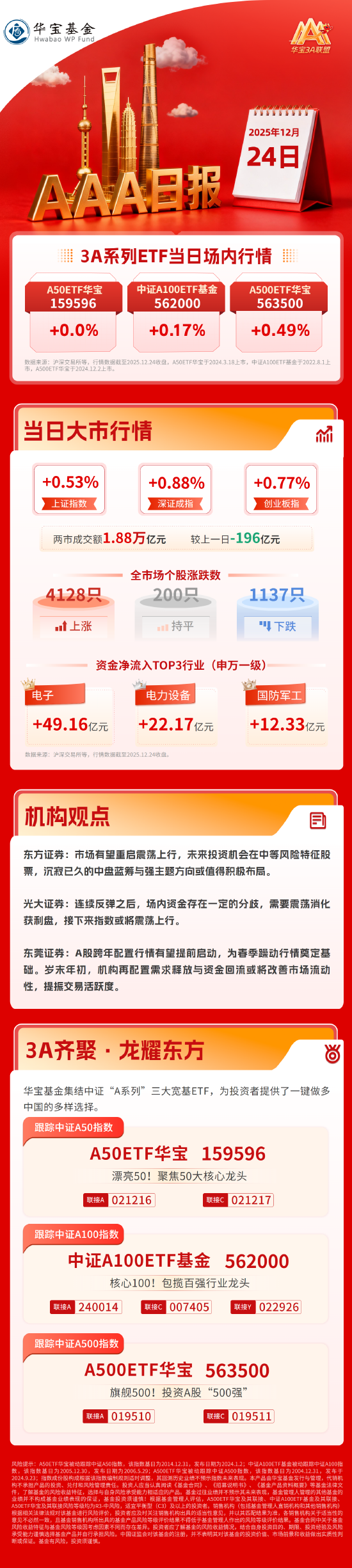
Core Viewpoint - The market is expected to restart a fluctuating upward trend, with investment opportunities in medium-risk stocks, particularly mid-cap blue chips and strong thematic directions [2][6]. Market Performance - The total trading volume in the two markets reached 1.88 trillion yuan, a decrease of 196 billion yuan from the previous day [6]. - The number of stocks that rose and fell in the market was 4,128 and 1,137 respectively, indicating a mixed performance [6]. Sector Analysis - The top three sectors for net capital inflow were Electronics (+4.916 billion yuan), Electric Equipment (+2.217 billion yuan), and National Defense and Military Industry (+1.233 billion yuan) [2][6]. Institutional Insights - Dongguan Securities anticipates an early start to the A-share cross-year allocation trend, laying the groundwork for a spring rally, with institutional reallocation and capital inflow expected to improve market liquidity and trading activity [2][6]. - Oriental Securities suggests that the market may experience a rebound, with future investment opportunities in medium-risk stocks [2][6]. - Everbright Securities notes that after consecutive rebounds, there is some divergence in market funds, indicating a need for consolidation of profit-taking before the index can continue to rise [2][6]. ETF Offerings - Huabao Fund has launched three major broad-based ETFs tracking the China A50, A100, and A500 indices, providing investors with diverse options for exposure to the Chinese market [2].
提前布局“春季躁动”行情,自由现金流ETF(159201)近20个交易日合计“吸金”超8.4亿元
Mei Ri Jing Ji Xin Wen· 2025-12-24 07:37
Group 1 - The A-share market opened higher on December 24, with the Shanghai Composite Index rising by 0.01%, the Shenzhen Component Index by 0.07%, and the ChiNext Index by 0.07% [1] - The National Index of Free Cash Flow opened lower but fluctuated, currently down about 0.1%, with leading stocks including Silver Nonferrous, Yaxiang Integration, and Aishide [1] - The largest free cash flow ETF (159201) has attracted over 840 million yuan in the last 20 trading days, bringing its total size to 8.106 billion yuan, indicating significant capital inflow [1] Group 2 - According to Caitong Securities, there was a notable increase in buying volume as the index approached psychological integer levels, signaling positive market sentiment [1] - In the current context of limited macroeconomic risks, investors are encouraged to increase their positions and prepare for a "spring rally" [1] - The free cash flow ETF (159201) and its linked funds (A: 023917; C: 023918) closely track the National Index of Free Cash Flow, selecting stocks with positive and high free cash flow after liquidity, industry, and ROE stability screening, making it suitable for long-term investment [1]