港股投资

Search documents
9月24日【港股Podcast】恆指、阿里、小米、快手、中移動、華虹
Ge Long Hui· 2025-09-24 11:45
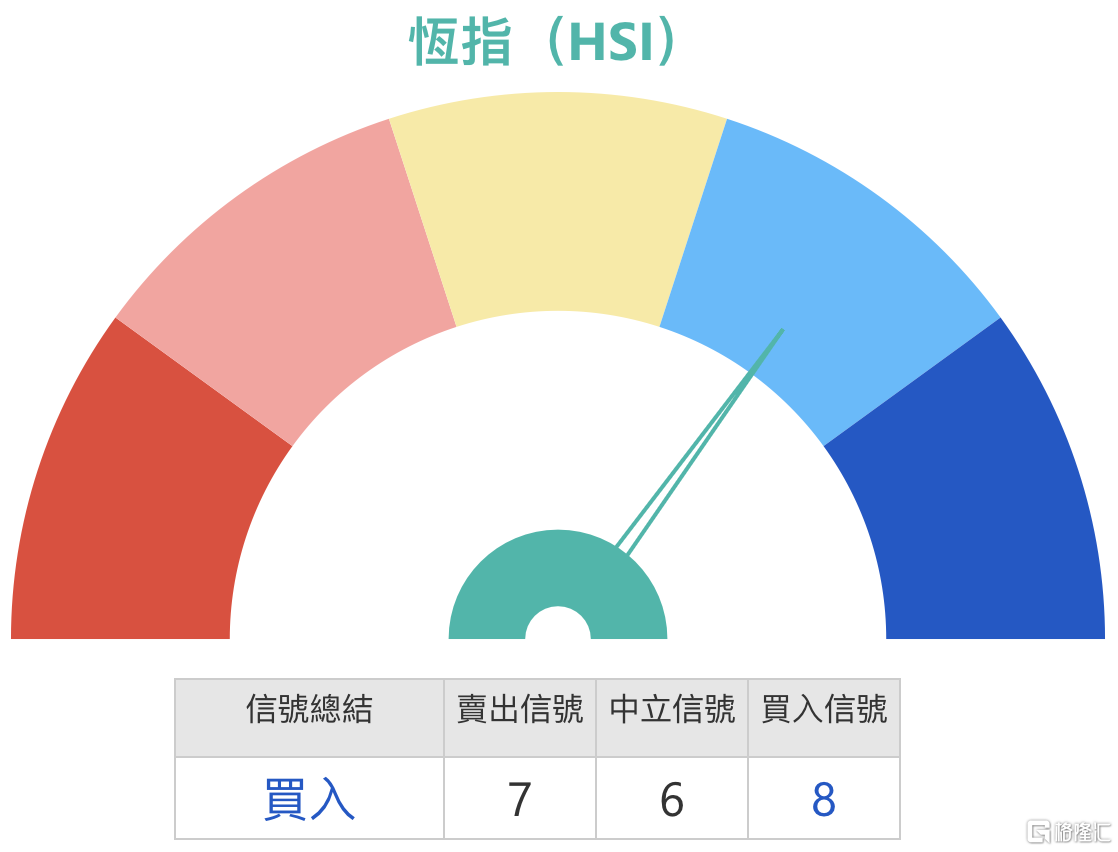
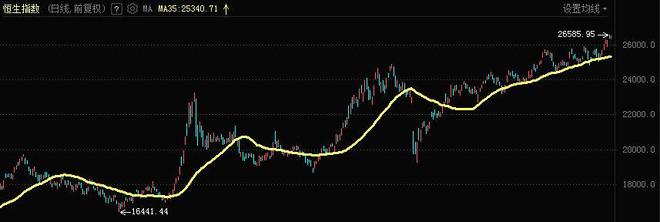
Group 1: Hang Seng Index (HSI) - Investors are optimistic about the Hang Seng Index, believing that if it stays above the 10-day moving average, it could test the monthly resistance level of 26,773 [1] - The index has shown a good performance, rising to the 26,500 level and recovering past losses, with short-term technical signals indicating a "buy" [1] - Key resistance levels are identified at 26,800 and 27,600, while support levels are at 25,600 and 25,100 [1] Group 2: Alibaba (09988.HK) - Alibaba's stock price has surged, with a high of 174 HKD, nearing the upper Bollinger Band at 175 HKD, but technical signals suggest a "sell" due to potential adjustments [8] - Resistance levels for Alibaba are at 179.6 HKD and 196 HKD, with support levels at 150 HKD and 136 HKD [8] - Products with a buyback price between 145-150 HKD show competitive leverage, with some having premiums around 1.18%-1.2% and leverage between 4.6-4.9 times [8] Group 3: Xiaomi Group (01810.HK) - Xiaomi's closing price was 56.9 HKD, with technical signals indicating a "buy" [12] - Resistance levels are at 57.4 HKD and 59.2 HKD, while investors can consider options with a strike price around 61 HKD, offering leverage between 4-8 times [12] - Premiums vary significantly, with some reaching 14% and others exceeding 20%, necessitating careful product comparison [12] Group 4: Kuaishou (01024.HK) - Kuaishou's closing price was 76.8 HKD, with technical signals indicating a "sell" and a bearish outlook [19] - Support levels are at 73.2 HKD and 72.2 HKD, with suitable call options available around a strike price of 68 HKD [19] - Premiums for these options range from 18-20%, with implied volatility between 48%-53%, highlighting the need for product comparison [19] Group 5: China Mobile (00941.HK) - China Mobile's closing price was 85.7 HKD, with technical signals suggesting a "buy" [22] - Resistance levels are at 88.6 HKD and 91.9 HKD, while support levels are at 82.1 HKD and 78.9 HKD [22] Group 6: Hua Hong Semiconductor (01347.HK) - Hua Hong's stock price reached 66.4 HKD, closing at 63.2 HKD, close to the upper Bollinger Band [29] - Support levels are at 56.1 HKD and 51.7 HKD, while resistance levels are at 70.2 HKD and 78.3 HKD [29]


港股投资周报:恒生科技领涨,港股精选组合年内上涨76.35%-20250920
Guoxin Securities· 2025-09-20 07:49
- The "Hong Kong Stock Selection Portfolio" strategy aims to construct a portfolio by dual-layer screening based on fundamental and technical aspects of stocks recommended by analysts. The analyst recommendation pool is built using events such as upward earnings forecast revisions, initial analyst coverage, and unexpected research report titles. Stocks with both fundamental support and technical resonance are selected to form the portfolio. The backtesting period is from January 1, 2010, to June 30, 2025, with an annualized return of 19.11% and an excess return of 18.48% relative to the Hang Seng Index[14][15][20] - The "Stable New High Stock Screening Method" identifies stocks that have reached a 250-day high in the past 20 trading days. The screening criteria include analyst attention (at least five buy or overweight ratings in the past six months), relative stock strength (top 20% in 250-day returns), and stock price stability. Stability is assessed using metrics such as price path smoothness and the average 250-day high distance over the past 120 days and the last 5 days. The formula for calculating the 250-day high distance is: $ 250\text{-day high distance} = 1 - \frac{\text{Close}_{t}}{\text{ts\_max}(\text{Close}, 250)} $ where $\text{Close}_{t}$ is the latest closing price, and $\text{ts\_max}(\text{Close}, 250)$ is the maximum closing price over the past 250 trading days[21][23][24] - The "Stable New High Stock Screening Method" evaluation highlights its effectiveness in identifying momentum stocks, aligning with research findings that stocks near their 52-week highs tend to outperform. This method also incorporates elements from established growth stock selection frameworks like CANSLIM and insights from "Stock Market Wizards"[21][23] - The backtesting results for the "Hong Kong Stock Selection Portfolio" show annualized return metrics, including excess returns relative to the Hang Seng Index, IR values, and maximum drawdown statistics across multiple years. For the full sample period, the annualized return is 19.11%, excess return is 18.48%, IR is 1.22, and maximum drawdown is 23.73%[20] - The performance of the "Stable New High Stock Screening Method" is reflected in the selection of stocks across sectors such as cyclicals, healthcare, technology, and manufacturing. For example, stocks like 中创智领 (0.0% 250-day high distance, 206.3% 250-day return) and 赤子城科技 (0.0% 250-day high distance, 433.3% 250-day return) demonstrate the method's ability to identify high-performing stocks[23][29]
港股市场前景看好,政策与资金双重助力
Xin Lang Cai Jing· 2025-09-20 02:10
Group 1 - The Hong Kong stock market is showing unique investment value due to a combination of factors, particularly driven by policy support and capital inflows [1] - The Chinese government's proactive fiscal policy and moderately loose monetary policy provide a stable environment for economic growth, benefiting the Hong Kong stock market [1] - Recent policy measures announced by the Chief Executive of Hong Kong aim to attract more companies to list in Hong Kong, enhancing market vitality and providing investors with diverse investment options [1] Group 2 - There is a significant inflow of capital into the Hong Kong stock market, with southbound funds exceeding 1 trillion HKD this year, indicating increased demand from mainland investors [1][2] - The attractiveness of Hong Kong stocks has increased for foreign investors due to the U.S. entering a rate-cutting cycle, making it a primary channel for allocating quality Chinese assets [1] - The valuation of the Hong Kong stock market remains significantly lower than other major markets, providing potential investment opportunities, especially in the technology sector [2] Group 3 - The industry structure of the Hong Kong stock market is undergoing optimization, with a shift from a finance-dominated market to a more diversified one, particularly in non-essential consumer goods and information technology [3] - The rise of new economic forces allows investors to access emerging companies through the Hong Kong stock market, effectively diversifying market risks and reducing portfolio volatility [3] - The current environment in the Hong Kong stock market is favorable for various types of investors, whether they seek steady long-term growth or aim to capitalize on short-term fluctuations [3]
景顺长城恒生港股通50ETF于9月18日正式发行
Zheng Quan Ri Bao Wang· 2025-09-18 04:02
Core Viewpoint - The Hong Kong stock market has shown significant rebound since September, attracting more investors, leading to the launch of the Invesco Great Wall Hang Seng Stock Connect 50 ETF on September 18, which aims to help investors efficiently capture market opportunities [1]. Group 1: ETF Product Overview - The Invesco Great Wall Hang Seng Stock Connect 50 ETF tracks the Hang Seng Stock Connect 50 Index, which selects 50 highly liquid leading companies listed in Hong Kong, covering both new economy and traditional sectors [1]. - The index represents 52% of the market's circulating market value and 56% of net profits, making it a key representation of core assets in the Hong Kong stock market [1]. - The top four industries in the index are consumer, finance, technology, and pharmaceuticals, which together account for 85.82% of the index's weight, effectively covering popular assets in the Hong Kong market [1]. Group 2: Company Strategy and Product Line - Invesco Great Wall Fund has been expanding its ETF product line, creating a diverse "Hong Kong Stock Family" that includes various ETFs focusing on technology, new consumption, biotechnology, and multi-strategy dividend ETFs [2]. - The launch of the Invesco Great Wall Hang Seng Stock Connect 50 ETF further enhances the company's offerings in Hong Kong index products, completing an important piece of its product puzzle [2].
恒指突破27000点关口,恒生中国企业ETF(159960)强势翻红
Sou Hu Cai Jing· 2025-09-18 02:39
Group 1 - The Hang Seng Index (HSI) surpassed the 27,000-point mark, reaching its highest level since July 2021, indicating a strong market performance [1] - The Hang Seng China Enterprises ETF (159960) rose by 0.2%, with notable increases in constituent stocks such as Semiconductor Manufacturing International Corporation (6.06%), Baidu Group (4.43%), Meituan (3.99%), Pop Mart (3.29%), and China Life (2.29%) [1] - The Federal Reserve announced a 25 basis point reduction in the federal funds rate target range to 4.00% to 4.25%, with expectations of an additional cumulative cut of 50 basis points within the year [1] Group 2 - According to China Merchants Securities, the Hong Kong stock market is primarily driven by liquidity, with expectations for a new round of increases due to ample internal and external liquidity [1] - Factors contributing to the easing of liquidity constraints in September include the Fed's rate cut, improved funding conditions in the Hong Kong market, continuous inflow of southbound funds, and the resolution of profit concerns following interim reports [1] - The long-term outlook suggests a potential demand recovery point as the supply-demand balance improves, with expectations for a bottom reversal in corporate earnings [1] Group 3 - The Hang Seng China Enterprises Index (HSCE) tracks the performance of Chinese mainland enterprises listed in Hong Kong, with the top ten weighted stocks accounting for 55.76% of the index [2] - The top ten constituents of the HSCE include Alibaba, Tencent, Xiaomi, China Construction Bank, Meituan, China Mobile, Industrial and Commercial Bank of China, BYD, Ping An Insurance, and China National Offshore Oil Corporation [2] - Continuous attention is recommended for the Hang Seng China Enterprises ETF (159960) [2]





中信证券:美联储降息或推动港股短期上涨 长期仍回归基本面
Zhong Guo Jin Rong Xin Xi Wang· 2025-09-18 02:18
Core Viewpoint - The Federal Reserve's interest rate cuts have historically had a significant short-term positive impact on the Hong Kong stock market, with distinct patterns observed based on the type of rate cut [1] Group 1: Impact of Rate Cuts - Most rate cut cycles, except for the unique situations in 2019 and 2020, have led to short-term increases in the Hong Kong stock market [1] - In accommodative rate cuts, the performance of the Hong Kong stock market has shown a phase-synchronized relationship with foreign capital flows, as seen in 2001 and 2007 [1] - The 2020 rate cut, which exceeded expectations, triggered panic and led to a short-term withdrawal of foreign capital, resulting in a decline in the Hong Kong stock market [1] Group 2: Divergence in Market Behavior - In preemptive rate cuts, the Hong Kong stock market often moves in the opposite direction of foreign capital flows, driven by the expansion of China's policy space [1] - During the 1998 Asian financial crisis, the Federal Reserve's rate cuts created a favorable environment for the Hong Kong market's financial defense [1] - The direct impact of the Federal Reserve's rate cuts in 2024 is expected to be limited, with the key driver for the Hong Kong stock market's rise being China's policy measures [1] Group 3: Future Outlook - Current observations indicate a cooling U.S. job market, but economic resilience remains, with rate cuts aimed at addressing potential risks [1] - Short-term growth sectors such as technology, consumer discretionary, and pharmaceuticals are likely to benefit from these conditions [1] - If China initiates synchronized easing with the U.S., it could lead to increased foreign capital inflows into the Hong Kong stock market, highlighting the core asset allocation value in the current environment [1]

ETF市场日报 | 恒生科技相关ETF集体领涨!港股核心资产布局迎新选项
Sou Hu Cai Jing· 2025-09-17 08:37
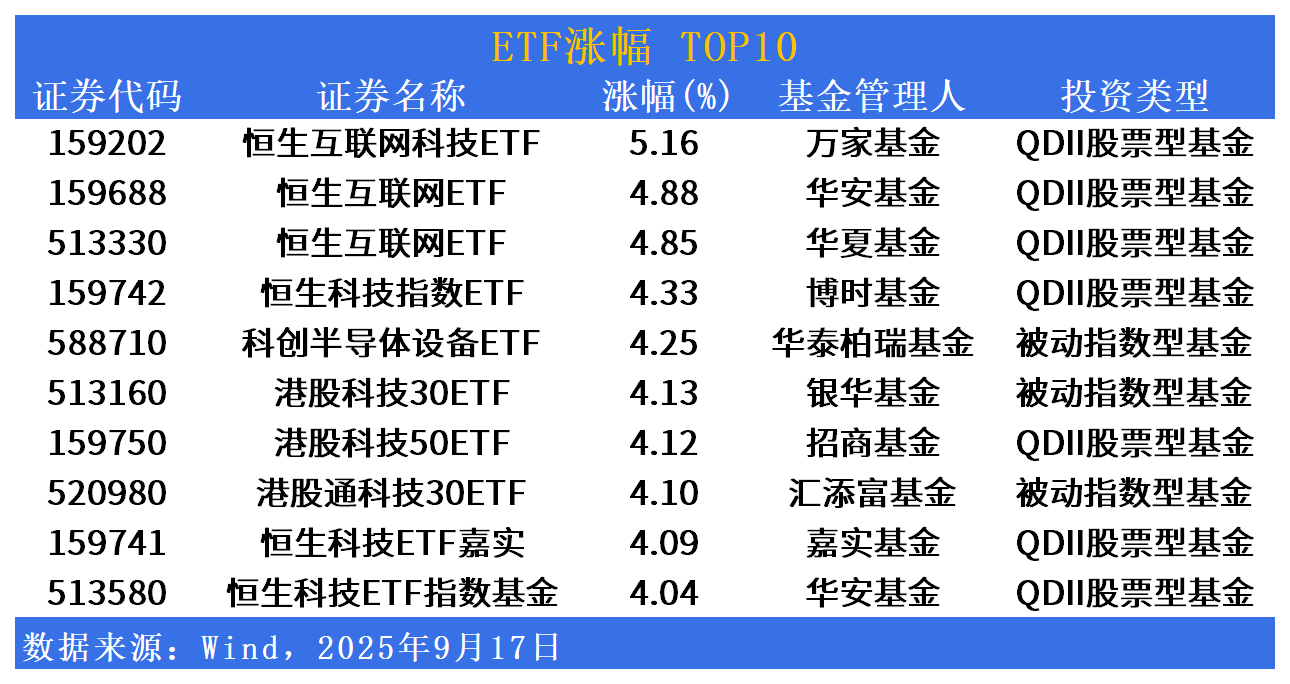
Group 1: ETF Performance - The Hang Seng Internet Technology ETF (159202) led the gains with an increase of 5.16% [1] - Other ETFs such as the Hang Seng Internet ETF (159688) and the Hang Seng Technology Index ETF (159742) also saw significant increases, with gains exceeding 4% [1] Group 2: Market Trends - The Nasdaq China Golden Dragon Index rose by 1.76%, reaching its highest level since February 2022, with notable increases in stocks like NIO (over 8%) and Baidu (over 7%) [2] - The Hong Kong stock market is expected to have a positive short-term and long-term outlook, supported by increased capital inflow and a stable upward trend in the Hang Seng Index [2] Group 3: ETF Trading Activity - The Short-term Bond ETF (511360) recorded the highest trading volume today, reaching 31.1 billion [5] - The Benchmark Government Bond ETF (511100) had the highest turnover rate at 466.96% [4][5] Group 4: New ETF Offerings - New ETFs being launched include the Invesco Hang Seng 50 ETF (159109) and the Huatai-PineBridge Hong Kong Stock Connect Consumer ETF (159285), which track major indices in the Hong Kong market [6][7][8] - The Guolian An A500 Dividend ETF (560570) is set to launch, focusing on low-volatility dividend stocks suitable for conservative investors [9]
机构每日谈 | 华泰证券:港股无需“恐高”
Mei Ri Jing Ji Xin Wen· 2025-09-15 08:57
Core Viewpoint - The Hong Kong stock market has seen a significant rise since early April, with the Hang Seng Index surpassing 25,000 and 26,000 points, marking a cumulative increase of over 30% and reaching a four-year high [1] Group 1: Market Dynamics - The Hang Seng Index is no longer the same as in the past, with the weight of new economy companies in the MSCI China Index rising from under 30% to 70% over the past decade [3] - The proportion of financial and real estate sectors in the Hang Seng Index has decreased from 47.6% and 10.1% in 2016 to 32.0% and 3.8% respectively, while the new economy sectors have increased from around 20% to 58.6% [3] - The overall turnover rate of the Hong Kong stock market remains at 60%-70%, lower than that of A-shares and US stocks, but the liquidity discount faced by valuations may have significantly decreased [3] Group 2: Investor Structure - The influx of over a trillion yuan in southbound funds has altered the investor structure in the Hong Kong market, with southbound funds now accounting for nearly 40% of trading in Hong Kong Stock Connect stocks [3] - The increase in funds benefiting from low financing costs in China is expected to elevate the valuation levels in the Hong Kong market [3] Group 3: Valuation Comparisons - The AH premium has decreased from 134 to 119 since May, currently at its lowest level in five years, indicating that Hong Kong stocks are not overvalued compared to A-shares [4] - The potential for the AH premium to narrow further exists, influenced by the trends of RMB appreciation and USD depreciation [4] - Hong Kong stocks remain attractive to overseas investors, benefiting from global liquidity and foreign capital inflow, with their valuation positioned in the mid-range compared to other global assets [5]

千亿资金涌入!这个主题基金“卖爆”!
天天基金网· 2025-09-15 08:38
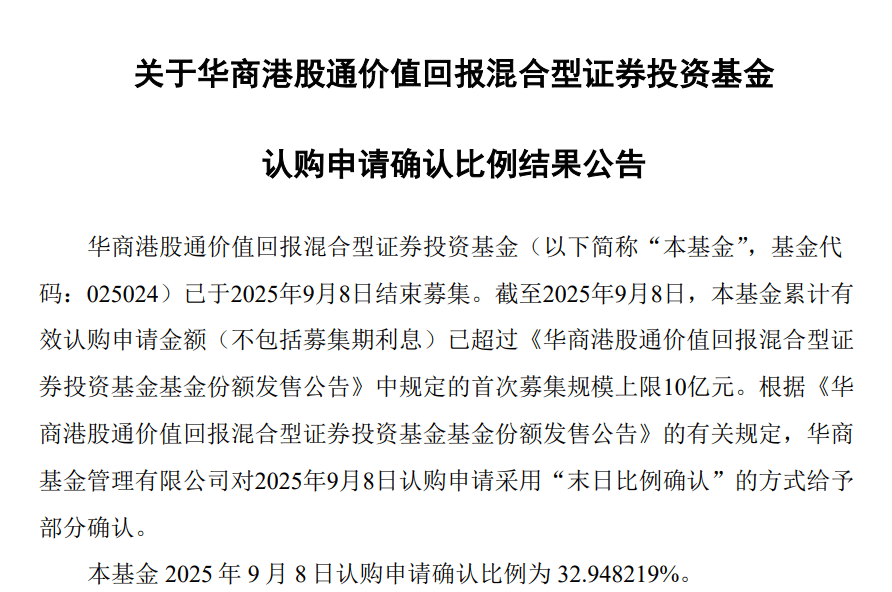
Core Viewpoint - The article highlights a significant influx of capital into the Hong Kong stock market, particularly through ETFs and newly launched thematic funds, driven by favorable monetary policy expectations from the Federal Reserve [3][10]. Group 1: Capital Inflow into Hong Kong Market - Since August, over 100 billion yuan has flowed into Hong Kong thematic ETFs, indicating strong investor interest [5]. - The net subscription amount for Hong Kong thematic ETFs exceeded 100 billion yuan by September 12, with technology, innovative pharmaceuticals, and financial sectors being the most favored [5][10]. - Specific ETFs such as the Fuguo Hong Kong Internet ETF and the Huatai-PineBridge Southbound Hang Seng Technology Index ETF saw net subscriptions of over 150 billion yuan and 66.86 billion yuan, respectively [5]. Group 2: New Fund Launches - The newly launched Huashang Hong Kong Value Return Mixed Fund sold out in one day, with subscription applications exceeding the 1 billion yuan cap [6]. - The fund received over 30 billion yuan in subscription applications on its first day, with a confirmation ratio of 32.95% [6]. Group 3: Institutional Participation - Recent Hong Kong thematic ETFs have attracted significant institutional investment, with several private equity funds among the top ten shareholders in the Huazhang Hang Seng Biotechnology ETF [8]. Group 4: Increased Equity Fund Allocation - Active equity funds have raised their allocation to Hong Kong stocks to 20%, marking a historical high, with over 15 new thematic funds reported in September [10]. - The expectation of a shift in the Federal Reserve's monetary policy, particularly a potential interest rate cut, is seen as a key driver for increased liquidity and valuation improvements in the Hong Kong market [10]. Group 5: Investment Opportunities - The current market presents systemic discount recovery opportunities, particularly in sectors like AI chips, innovative pharmaceuticals, and international companies [11]. - Potential adjustments in dividend tax policies may further enhance the attractiveness of dividend stocks in the Hong Kong market [11].
千亿元涌入ETF!主题基金“卖爆”!
Sou Hu Cai Jing· 2025-09-15 08:16
Group 1 - Significant capital inflow into Hong Kong stock market through ETFs, with over 100 billion yuan invested since August [1][3] - The newly launched Hong Kong-themed funds are also gaining popularity, exemplified by the rapid fundraising success of the Huashang Hong Kong Stock Connect Value Return Mixed Fund, which raised over 3 billion yuan in a single day [3][8] Group 2 - The net subscription amount for Hong Kong-themed ETFs has exceeded 100 billion yuan, with notable interest in technology, innovative pharmaceuticals, and financial sectors [3][7] - Specific ETFs such as the Fuguo Hong Kong Stock Connect Internet ETF and the Huatai-PineBridge Southern Eastern Hang Seng Technology Index ETF have seen net subscriptions of over 15 billion yuan and 6.686 billion yuan respectively [3][7] Group 3 - Active equity funds have been increasing their allocation to Hong Kong stocks, reaching a historical high of 20% by the end of Q2 this year [7] - The expectation of a shift in the Federal Reserve's monetary policy, particularly the likelihood of interest rate cuts, is seen as a key driver for the increased investment in Hong Kong stocks [7][8] Group 4 - The Hong Kong stock market is perceived to have systemic discount recovery opportunities, with sectors like AI chips, innovative pharmaceuticals, and international companies being highlighted as attractive investment targets [8]