AI算力

Search documents
2026年年度策略:供需重塑与资源再定价 | 投研报告
Zhong Guo Neng Yuan Wang· 2026-01-04 02:49
Group 1: Copper - The supply side of copper is facing long-term capital expenditure shortages, with new project realization being difficult, leading to a potential zero or negative growth in global copper mine supply by 2026 [1][2] - On the demand side, the expansion of AI computing power is amplifying copper demand through the power system, and accelerated investment in the US power grid is causing a continuous supply-demand mismatch [1][2] - A conservative estimate indicates a global copper supply-demand gap of approximately 830,000 tons by 2026, necessitating a price increase to suppress demand and maintain balance, with prices expected to significantly rise, potentially exceeding $13,000 per ton [1][2] Group 2: Aluminum - The aluminum sector is expected to benefit from a continued cost reduction dividend by 2026, with supply constraints due to the production capacity ceiling in China and power restrictions [2] - Low inventory levels combined with diverse demand are likely to exceed expectations, with a positive outlook for the profitability of electrolytic aluminum [2] Group 3: Gold - The gold market is driven by a combination of cyclical and structural bull market factors, with overseas interest rate cuts continuing to drive cyclical ETF investment demand [2] - Concerns over the high deficit rate in the US are expected to sustain central bank gold purchases [2] Group 4: Silver - The silver price is anticipated to trend upward in the medium term, supported by stable overall supply and demand driven by industrial growth and investment demand fluctuations [2] - Key sectors such as photovoltaics and electronics are core supports for silver demand, with global silver inventories continuing to decline [2] Group 5: Lithium - The peak of capital expenditure in the lithium sector has passed, with a clear downward trend in capacity growth [3] - High investment in global energy storage is expected to sustain improvements in lithium supply and demand, with prices likely to rise beyond expectations [3] Group 6: Cobalt - The export quota for cobalt from the Democratic Republic of Congo has been implemented, leading to a global tight supply situation [4] - The tight raw material situation is expected to persist, resulting in continued upward pressure on cobalt prices [4] Group 7: Rare Earths - Supply reforms and export competition are expected to resonate, with rising processing fees for imported heavy rare earths indicating a significant reduction in buyers within the industry [4] - The export market for magnetic materials is thriving, and the supply-demand dynamics in rare earths are expected to remain positive [4] Group 8: Tin - The global tin supply is frequently disrupted, with actions in Indonesia to eliminate illegal mining potentially offsetting production increases from Myanmar [4] - Low global tin ingot inventories suggest a widening supply-demand gap, with the tin-to-copper ratio expected to rise [4] Group 9: Tungsten - Tungsten prices are expected to continue reaching new highs due to supply reductions and global strategic stockpiling [4] - Strengthening economic recovery expectations and rising PMI are likely to enhance consumer demand, leading to sustained supply shortages and price increases [4] Group 10: Molybdenum - Molybdenum inventories remain low, with prices trending upward due to high demand in the steel sector and ongoing low inventories [4] - The impact of imported ore since October 2025 is expected to continue depleting stocks, leading to a return to an upward price trend [4] Group 11: Uranium - The uranium market is expected to maintain a supply-demand gap, with short-term recovery in primary supply driven by mine restarts, while long-term supply capabilities face continuous decline [5][6] - Demand for nuclear power is steadily increasing due to energy security and the transition to clean energy, further supporting the uranium market [5][6] Group 12: Steel - The steel industry is characterized by defensive attributes, with potential arbitrage opportunities arising from raw material supply easing and self-discipline in steelmaking [6] - The focus of demand has shifted from domestic real estate to export manufacturing, with diverse administrative measures expected to enhance supply-side policies by 2026 [6]
通信行业点评报告:2026年通信投资机会梳理:算力为核,卫星为翼-20260104
Soochow Securities· 2026-01-04 02:04
证券研究报告·行业点评报告·通信 通信行业点评报告 2026 年通信投资机会梳理:算力为核,卫星 为翼 2026 年 01 月 04 日 证券分析师 欧子兴 执业证书:S0600525110002 ouzx@dwzq.com.cn -9% 2% 13% 24% 35% 46% 57% 68% 79% 90% 101% 2025/1/3 2025/5/3 2025/8/31 2025/12/29 通信 沪深300 相关研究 《 AI 算力方案多点开花,继续看好 光互联方向》 2025-11-27 《AI 算力跟踪深度(四):怎么看算力 的天花板和成长性?》 增持(维持) [Table_Tag] [Table_Summary] 投资要点 2025-10-16 东吴证券研究所 1 / 3 请务必阅读正文之后的免责声明部分 行业走势 ◼ 光互联核心受益海外算力与国内算力需求共振。展望 2026 年,海外算 力链将保持景气度向上。北美 CSP 对资本开支保持高投入预期,数据中 心建设热情高涨,以英伟达 GPU 和谷歌 TPU 为代表的算力芯片都在快 速上量,更下一代产品也将在 2026 年开始商用,与之配套的光互联全 ...
起步800亿,谁在“港股GPU第一股”身上赚的最多?
阿尔法工场研究院· 2026-01-04 00:06
Core Viewpoint - The successful IPO of Biren Technology marks a significant milestone in the domestic GPU sector, with substantial returns for early investors and a promising outlook for future growth in the AI computing market [2][9]. Investment Performance - Five key investors in Biren Technology have achieved paper returns exceeding 1 billion RMB, showcasing the lucrative potential of investments in domestic GPU companies [5][9]. - The IPO raised a total of 55.83 billion HKD, making it the largest fundraising project since the implementation of the Hong Kong Stock Exchange's 18C rules, indicating strong institutional confidence in the domestic GPU market [9]. Company Background and Financing - Biren Technology has completed 10 rounds of financing since its establishment in 2019, raising over 5 billion RMB, with a diverse range of investors including venture capital, state-owned platforms, and large financial institutions [6][9]. - The company has attracted significant investment from both early-stage and institutional investors, demonstrating a long-term commitment to supporting its growth through various stages of development [6][7]. Investor Returns - Notable returns include Qiming Venture Partners, which invested in the Pre-A round and held 3.89% of the company post-IPO, with a market value of approximately 2.883 billion RMB [7]. - Country Garden Venture Capital's investment of about 350 million RMB resulted in a return of approximately 1.74 billion RMB, reflecting a nearly 6x return on investment [7]. - Other investors like Yunji Capital and Gree Group also reported significant returns, with Gree achieving a return multiple exceeding 10x [8][9]. Technological Advancements - Biren Technology launched its first general-purpose GPU chip, BR100, in 2023, achieving peak performance at the PFLOPS level, and has developed a complete ecosystem with its software platform BIRENSUPA [13][15]. - The company has positioned itself as a leader in the domestic GPU market, focusing on comprehensive solutions rather than just individual chip performance, which enhances its competitive edge [15]. Future Prospects - Biren Technology plans to pursue an A-share listing in the future, indicating its ambition for further growth and expansion in the capital markets [14][16]. - The ongoing trend of domestic GPU companies entering the public market suggests a competitive landscape that will increasingly focus on financial performance and valuation metrics [16].


中概股开年大涨,百度上涨15%,释放什么信号?节后A股也会大涨?
Sou Hu Cai Jing· 2026-01-03 17:00
Core Viewpoint - The U.S. stock market experienced a dramatic divergence on the first trading day of 2026, with the Dow Jones index rising by 0.66% while the Nasdaq index fell by 0.03%. However, the Nasdaq China Golden Dragon Index surged by 4.38%, marking its largest increase in nearly eight months, driven by significant gains in Chinese tech stocks like Baidu, which rose by 15.03% [1][2]. Group 1: Market Performance - The surge in Chinese tech stocks was not an isolated event, as Alibaba rose over 6%, and NetEase and Bilibili saw increases of over 7%. Even lesser-known stocks like Haohong Technology experienced a staggering rise of 72.41% [2]. - The trading volume in Chinese concept stocks increased significantly, with a 45% rise in transaction amounts and tech-related Chinese stocks seeing a volume 1.8 times higher than the previous day, indicating institutional investment rather than mere retail speculation [2]. Group 2: Key Drivers - Three main factors are driving this market behavior: 1. Policy incentives are being released, with the 2026 "14th Five-Year Plan" emphasizing artificial intelligence and semiconductors as key areas. AI hardware is now included in the "old-for-new" subsidy policy, and the overseas listing process has become more transparent, reassuring international investors [4]. 2. The hard power of companies is becoming a strong foundation, exemplified by Baidu's stock surge following its AI chip subsidiary Kunlun's application for a Hong Kong listing and securing a significant order from China Mobile [4]. 3. A strategic shift in global capital flows is occurring, with rising expectations for U.S. Federal Reserve interest rate cuts leading to a weaker dollar and increased investment in high-growth assets. In 2025, net inflows into ETFs investing in Chinese assets reached $83.1 billion, with over $5 billion invested in Chinese tech stocks on January 3 alone [4]. Group 3: Sector Trends - The semiconductor sector is also experiencing a significant rally, with the Philadelphia Semiconductor Index rising by 4.01% and major companies like Micron Technology and ASML seeing gains of over 10% and 5%, respectively. This indicates a consensus on the importance of AI computing power in the tech landscape [6]. - The offshore RMB exchange rate has surpassed 6.97, reaching its highest point since May 2023, reflecting a fundamental shift in overseas investors' attitudes towards Chinese assets [6]. - The preference for large-cap stocks like Baidu and Alibaba over smaller stocks indicates a shift from speculative trading to value investing, as institutional investors seek companies that are shaping the future [9]. Group 4: Broader Market Implications - The surge in Chinese tech stocks has also positively impacted the Hong Kong market, with the Hang Seng Index rising by 2.76% and the Hang Seng Tech Index soaring by 4%. The A-share market has shown strong performance as well, with the Shanghai Composite Index achieving an unusual "11 consecutive days of gains" [10]. - Despite the enthusiasm for AI chips and semiconductors, some consumer tech stocks like Tesla and Netflix are showing signs of weakness, highlighting the selective nature of capital allocation in this market environment [10].

市场估值或达1000亿港元,已提交上市申请!
Sou Hu Cai Jing· 2026-01-03 15:39
Core Viewpoint - Baidu's subsidiary Kunlun Chip has submitted a listing application to the Hong Kong Stock Exchange, aiming for a separate public listing while remaining a Baidu subsidiary. The details regarding the split, global offering scale, and Baidu's share reduction in Kunlun Chip are yet to be finalized [2][4]. Group 1: Listing and Corporate Structure - Kunlun Chip submitted its listing application on January 1, with the aim to enhance operational and financial transparency [2][4]. - Baidu currently holds a 59.45% stake in Kunlun Chip, making it the largest shareholder [4]. - The company underwent a name change and increased its registered capital from approximately 21.28 million RMB to 400 million RMB [4]. Group 2: Business Performance and Market Position - Kunlun Chip was initially a project within Baidu, established in 2012, and achieved independent financing in April 2021 with an initial valuation of around 13 billion RMB [4]. - The latest financing round is expected to be completed by July 2025, with investors including BYD and CITIC Capital [4]. - In November 2025, Kunlun Chip's revenue surpassed 1 billion RMB, exceeding competitors like Moore Threads and Cambricon [6]. Group 3: Product Development and Future Plans - Baidu announced the launch of new Kunlun Chip products, including the M100 and M300, designed for large-scale inference and multimodal model training, set to be released in 2026 and 2027 respectively [5]. - A five-year roadmap was revealed, with plans for the Tianchi super nodes and Kunlun N series products to be launched between 2028 and 2030 [5].
芯片赛道大消息!百度分拆昆仑芯上市
Zheng Quan Shi Bao· 2026-01-03 11:40
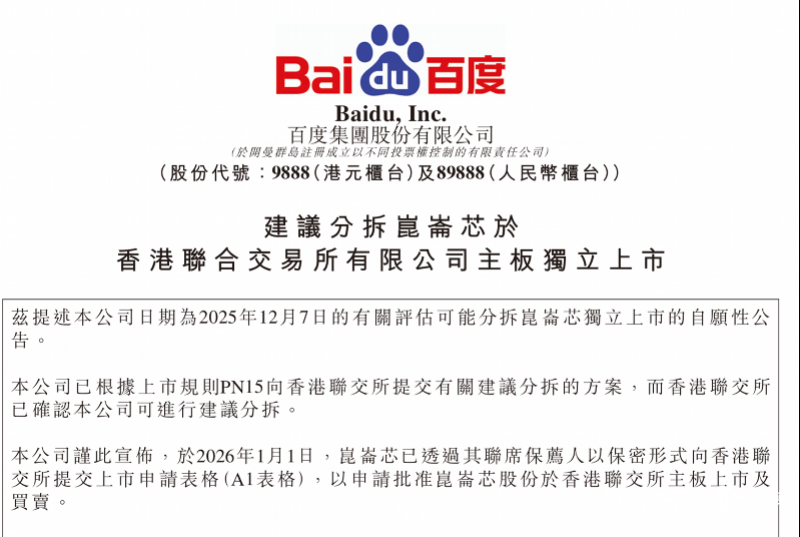
三是赋能双方长期发展:当前昆仑芯的业务规模已具备独立上市条件,分拆将为其带来多方面助力,同 时也能反哺百度保留集团。一方面,分拆可提升昆仑芯在客户、供应商及潜在战略合作伙伴中的形象, 增强其业务谈判能力,百度可通过持股分享昆仑芯的增长红利;另一方面,昆仑芯可在未来直接、独立 地进入股权及债务资本市场融资,帮助百度保留集团更高效地配置财务资源;此外,分拆能将双方管理 层的职责、问责与其各自的运营及财务表现深度挂钩,强化管理层专注度与企业治理水平。 公告显示,分拆后百度在昆仑芯的持股比例可能下降,其对昆仑芯的控制权虽保持但具体影响需视最终 持股变动而定。 昆仑芯密集融资 公开资料显示,昆仑芯前身为百度智能芯片及架构部,2021年4月独立运营,是国内少数经历互联网大 规模核心算法考验的云端AI芯片企业,专注通用AI计算芯片及相关集成软硬件系统,致力于成为"全球 领先的智能计算公司"。 1月2日,百度集团(9888.HK)发布公告,宣布其非全资附属公司昆仑芯(北京)科技股份有限公司 (以下简称"昆仑芯")已于2026年1月1日通过联席保荐人以保密形式向香港联合交易所提交上市申请表 格,申请在港交所主板独立上市及买卖。 ...
两大龙头获关注!券商最新“金股”组合出炉
Zhong Guo Zheng Quan Bao - Zhong Zheng Wang· 2026-01-03 09:58
炒股就看金麒麟分析师研报,权威,专业,及时,全面,助您挖掘潜力主题机会! 券商新一年度首月"金股"组合日前陆续出炉。 Wind数据显示,截至2026年1月3日中国证券报记者发稿时,已有151只标的入围券商2026年1月"金 股"组合,港股标的数量占比超三成。中际旭创、腾讯控股分别成为最受关注的A股、港股标的。电 子、机械设备、汽车等行业"金股"分布较为密集。 对于1月市场前景,业内机构认为,A股进入关键数据验证期,波动可能加大,风格倾向阶段性再平 衡,配置上看好具备战略稀缺性的上游资源品板块、部分内需板块以及产业趋势明确、业绩能见度高的 细分领域龙头;港股未来有望继续震荡上行,配置上可关注科技成长及高股息占优的"哑铃"策略。 逾150只"金股"获看好 从多家券商发布的2026年1月"金股"组合看,中际旭创投资价值仍获看好,截至2026年1月3日中国证券 报记者发稿时,其获得光大证券、华泰证券、中国银河、开源证券、国联民生5家券商推荐。2025年12 月25日,中际旭创盘中股价创历史新高,虽然年末小幅回落,但当月涨幅仍超18%,2025年全年涨幅近 400%。 开源证券认为,中际旭创作为全球光模块龙头企业,领先 ...


节后关键周:市场面临方向选择
Sou Hu Cai Jing· 2026-01-03 07:56
Market Overview - Global stock markets showed significant divergence this week, with U.S. markets pressured by profit-taking in technology stocks, leading to a 1.52% decline in the Nasdaq and a 1.03% drop in the S&P 500, primarily due to short-term adjustments in high-valuation sectors [1] - In contrast, European markets strengthened, with France's CAC40, Germany's DAX, and the UK's FTSE 100 all recording gains, driven by improving regional economic recovery expectations [1] - The Asia-Pacific market exhibited a mixed pattern, with strong performances from South Korea, Taiwan, and India, while Japan's Nikkei 225 index saw a slight decline [1] Domestic Market Performance - The A-share and Hong Kong stock markets displayed an independent trend of "strong Hong Kong, stable A-share," with the A-share market showing a fluctuating trend and significant index divergence [1] - The Shanghai Composite Index rose slightly by 0.13%, while the ChiNext Index and North Star 50 Index fell by 1.25% and 1.55%, respectively, becoming the main drag on the market [1] - In terms of style, small-cap and large-cap stocks showed notable divergence, with the Wind Micro-cap Index up by 0.16%, while the CSI 300 and Shenzhen Component Index fell by 0.59% and 0.58% respectively [1] Trading Activity - The average daily trading volume reached 1.97 trillion yuan, an increase of 205.3 billion yuan week-on-week, indicating strong trading momentum [2] - Resource and high-end manufacturing sectors emerged as clear leaders, with the Shenwan Oil and Petrochemical sector surging by 3.92% and the defense and military industry rising by 3.05%, driven by geopolitical tensions and resource supply constraints [2] - The Hong Kong market performed strongly, with the Hang Seng Index up by 2.01% and the Hang Seng Technology Index soaring by 4.31%, supported by robust momentum [2] Sector Performance - Semiconductor and defense sectors acted as dual drivers in Hong Kong, with the Wind Hong Kong semiconductor materials and equipment sector skyrocketing by 28.81% and the aerospace and defense sector increasing by 9.70% [2] - The strong performance in these sectors was underpinned by three main supports: favorable mergers and acquisitions, increased AI computing demand, and improved capital flow, with net inflows from southbound funds amounting to 2.573 billion HKD [2] Future Outlook - The A-share market is expected to maintain a fluctuating consolidation pattern amid a tug-of-war between policy support and fundamental verification, with clear supporting factors such as the continued rollout of policy details and a rebound in holiday consumption data [3] - However, limiting factors include the relatively limited valuation recovery space for major indices and the potential constraints posed by upcoming macroeconomic data and persistently low foreign capital activity [3][4] Investment Strategy - Investors are advised to adopt a prudent mindset, focusing on structural opportunities, particularly in "hard technology" sectors like semiconductors and commercial aerospace, as well as "stable consumption" areas such as home appliances and new energy vehicles [5] - It is also recommended to explore reasonably valued quality growth stocks from a bottom-up perspective, while maintaining positions at a reasonable level to avoid high-flying speculative stocks [6] - For the Hong Kong market, the rebound trend in the technology sector is expected to continue, but caution is warranted regarding potential profit-taking pressures following rapid gains [7]
港股2026年首个交易日大涨,背后有多重原因
Xin Lang Cai Jing· 2026-01-02 10:25
综合多家市场机构观点来看,港股2026年首个交易日大涨有多重原因:一是1月2日,离岸人民币兑美元 汇率盘中升破6.97,创下2023年5月以来的新高水平,进一步鼓励资金流入港股;二是"港股GPU第一 股"壁仞科技上市大涨,这种"首日盘中翻倍"的赚钱效应提振了市场对硬科技、半导体和AI板块的投资 情绪;三是港股龙头个股有利好消息,如华虹半导体向华虹集团等4名交易对方购买其合计持有的华力 微97.4988%股权,以及百度拟分拆昆仑芯并独立上市,再次印证了芯片、AI算力赛道的市场前景和资 本认可度。(上证报) 来源:滚动播报 ...
“开门红”!港股2026年首个交易日大涨
Di Yi Cai Jing Zi Xun· 2026-01-02 09:20
Core Viewpoint - The Hong Kong stock market experienced a significant rally on its first trading day of 2026, with major indices showing substantial gains, driven by multiple factors including currency strength and positive market sentiment towards technology stocks [2][4]. Group 1: Market Performance - The Hang Seng Index rose by 2.76% to close at 26,338.47 points, gaining over 700 points during the day [2]. - The Hang Seng China Enterprises Index increased by 2.86% to 9,168.99 points, while the Hang Seng Tech Index surged by 4% to 5,736.44 points [2]. - Insurance stocks saw strong performance, with Yunfeng Financial rising nearly 8% and China Reinsurance up nearly 6% [4]. Group 2: Sector Highlights - Resource stocks experienced a collective surge, with Asia Pacific Resources rising over 22% and China Silver Group increasing by over 10% [4]. - In the technology sector, Baidu Group-SW rose nearly 10%, and Kingdee International saw an increase of over 7% [4]. - The debut of Wallen Technology, dubbed the "first GPU stock in Hong Kong," saw its share price double on the first day, boosting investor sentiment towards hard tech, semiconductors, and AI sectors [4]. Group 3: Positive Catalysts - The offshore RMB/USD exchange rate broke above 6.97, reaching its highest level since May 2023, encouraging capital inflow into Hong Kong stocks [4]. - Positive news for leading Hong Kong stocks included Huahong Semiconductor's acquisition of a significant stake in Huali Microelectronics and Baidu's plan to spin off Kunlun Core for independent listing, reinforcing market confidence in the chip and AI computing sectors [4]. Group 4: Individual Stock Movements - Despite the overall market rally, some individual stocks faced sharp declines, such as lottery concept stock Runge Interactive, which dropped over 30% and fell below 1 HKD per share, becoming a "penny stock" [5].