算力

Search documents
焦点复盘沪指冲高回落跌0.3%,高位抱团人气股遭遇批量瓦解,光刻机概念领涨芯片股
Sou Hu Cai Jing· 2025-09-19 10:05
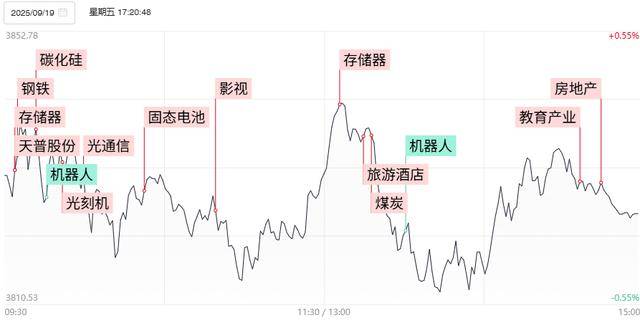
Market Overview - A total of 50 stocks hit the daily limit, while 23 stocks faced a limit down, resulting in a sealing rate of 68% [1] - The market experienced a downward trend with all three major indices closing lower; the Shanghai Composite Index fell by 0.30%, the Shenzhen Component Index by 0.04%, and the ChiNext Index by 0.16% [1] - Trading volume significantly decreased, with the total turnover in the Shanghai and Shenzhen markets at 2.32 trillion yuan, down by 811.3 billion yuan from the previous trading day [1] Stock Performance - Tianpu Co. achieved a remarkable 13 consecutive limit-ups, while Taimusi and Hangdian Co. recorded 5 and 4 consecutive limit-ups, respectively [1][3] - The highest stock advancement rate for consecutive limit-ups dropped to 26.31%, indicating a cooling trend in speculative trading [3] - The number of stocks hitting the limit down increased significantly, with over 20 stocks facing this situation, particularly affecting low-priced stocks [9] Sector Analysis - The energy metals, tourism, and photolithography sectors showed strong performance, while robotics and industrial mother machine sectors faced declines [1] - The semiconductor equipment sector is projected to see a capital expenditure surge to over $50 billion by 2028, marking a 94% increase compared to 2024 [5] - The lithium battery industry is expected to benefit from advancements in solid-state batteries and other technologies, with key players like Ganfeng Lithium hitting limit-ups [6][19] Tourism Sector - Ctrip's report indicated a 45% year-on-year increase in cross-province travel orders for the upcoming National Day holiday [15] - The tourism sector has been a leading performer in the consumer market, with stocks like Yunnan Tourism achieving a 3-day consecutive limit-up [8][16] Technology and Innovation - The demand for storage chips is driving a price surge across the industry, with companies like Jiangbolong and Demingli reaching new historical highs [5] - The light communication sector is gaining attention, with predictions of rapid growth in OCS shipments from around 10,000 units in 2023 to over 50,000 units by 2029 [17] Military and Defense - The recent air force exhibition showcased advanced military aircraft, contributing to interest in defense-related stocks [22]

美联储降息下布局中国资产正当时 机构建议关注四大方向
2 1 Shi Ji Jing Ji Bao Dao· 2025-09-19 06:17
Core Viewpoint - The Federal Reserve has initiated a new rate-cutting cycle by lowering the federal funds rate by 25 basis points to a target range of 4.00%-4.25%, which is expected to create new opportunities for Chinese assets in the medium to long term [1] Group 1: Market Reactions and Implications - The rate cut has triggered a global market response, with a consensus among fund companies that A-shares and Hong Kong stocks are expected to perform well despite short-term volatility [1][6] - The market exhibited a "good news priced in" reaction following the rate cut announcement, with fluctuations in the dollar index, U.S. Treasury yields, and stock indices [3] - Historical data suggests that A-shares and Hong Kong stocks typically perform well in the months following a Federal Reserve rate cut [7] Group 2: Investment Opportunities - Fund companies are optimistic about the long-term outlook for Chinese assets, citing improved liquidity conditions and potential for foreign capital inflow into A-shares and Hong Kong stocks [6][8] - Key investment directions identified include technology growth stocks, the Hong Kong market, consumer sectors, and gold assets, with a focus on sectors sensitive to interest rates and benefiting from global liquidity improvements [9]
算力竞速与国产突围:从沐曦样本看“中国芯”的黄金机遇
Cai Fu Zai Xian· 2025-09-19 05:52
Core Insights - The construction of the China Unicom Sanjiangyuan Green Power Intelligent Computing Center has showcased multiple domestic AI chips, indicating a significant advancement in domestic computing power and the ongoing support for high-end integrated circuits and AI technologies by the government [1] - The AI computing power demand has surged since the launch of ChatGPT, with major cloud computing companies in North America significantly increasing their capital expenditures, reflecting a robust competition for AI data center capabilities [2][3] - China's AI computing power market is thriving, with major players like Tencent and Alibaba leading the investment in AI data centers, and the market is expected to see substantial growth in the coming years [4] Industry Trends - The rapid development of AI models has led to a paradox where more efficient models increase the overall demand for computing power, rather than decrease it, as they enable broader applications across various industries [3] - The domestic AI chip market is expected to see a significant increase in self-sufficiency, with projections indicating that the self-sufficiency rate of AIGPU in China could rise from 34% in 2024 to 82% by 2027 [5] - The Chinese AI chip industry is experiencing a "golden era," with companies like Huawei and Muxi leading advancements in high-performance computing solutions [5][6] Company Highlights - Muxi Co., Ltd. has established itself as a leading player in the domestic GPU market, with a strong focus on self-research and development, achieving significant sales and revenue growth [6][7] - The company has successfully delivered over 25,000 GPU units and has seen its revenue grow from 426,400 yuan in 2022 to 743,071,600 yuan in 2024, indicating a compound annual growth rate exceeding 4000% [6] - Muxi's strategy of investing heavily in R&D to create competitive barriers aligns with the supportive policies of the Science and Technology Innovation Board, fostering a conducive environment for high-tech enterprises [7][8] Market Outlook - The global GPU market is projected to grow from $77.39 billion in 2024 to $472.45 billion by 2030, with a compound annual growth rate of 35.19%, indicating a robust demand for AI computing solutions [9] - The Chinese AI chip market is expected to capture a larger share due to improvements in capabilities and supply, alongside a favorable policy environment that supports innovation and market entry for domestic firms [9]
吉视传媒2025年9月19日跌停分析
Xin Lang Cai Jing· 2025-09-19 02:14
Core Viewpoint - Jishi Media (SH601929) experienced a significant drop, hitting the limit down price of 4.52 yuan, with a decline of 9.96%, resulting in a total market capitalization of 15.774 billion yuan and a total trading volume of 1.241 billion yuan [1][2]. Group 1: Company Financial Performance - The company reported a loss of 466 million yuan in 2024 and a loss of 232 million yuan in the first half of 2025, indicating a continuous deterioration in its financial performance [2]. - Operating cash flow turned negative, with a year-on-year decline of 114.63%, reflecting severe financial strain [2]. Group 2: Market Environment and Sentiment - Jishi Media has distanced itself from trending market concepts such as computing power and "state-owned cloud," which limits its ability to attract investment through popular themes [2]. - Despite introducing a new "annual strong" concept, the overall competitive advantage remains weak, leading to a lack of market confidence [2]. Group 3: Capital Flow and Investor Sentiment - The stock was included in the "Dragon and Tiger List" on September 17, with net selling by foreign investors contributing to downward pressure on the stock price [2]. - The margin trading balance decreased by 16.56%, indicating reduced investor enthusiasm for both buying and short-selling the stock, further weakening market confidence [2]. Group 4: ESG Rating Impact - The company's ESG rating has dropped to BBB, suggesting a decline in its performance in environmental, social, and governance aspects, which may negatively affect long-term investor confidence and lead to stock sell-offs [2].

助力企业上市 苏州有实招
Su Zhou Ri Bao· 2025-09-19 00:59
Group 1: Company Developments - The company signed a 1.184 billion yuan contract for computing power services, further expanding its presence in the computing power sector [1] - The company established a subsidiary, Ruiying Zhikuan, to create an 8000P computing resource pool in collaboration with Suzhou State-owned Assets [1] - The computing power business is expected to become a core driver of the company's growth [1] Group 2: Strategic Partnerships - Ruiying Zhikuan successfully integrated its computing resources with the public computing service platform under the Suzhou Big Data Group, enhancing service efficiency and quality [2] - The partnership with Suzhou Computing Technology Co. provided technical support and resolved operational challenges in the computing service sector [2] - The collaboration is expected to inject new momentum into Ruiying Zhikuan's business growth and create more opportunities for the parent company, Maixinlin [2] Group 3: Market Environment and Support - Suzhou has prioritized enterprise listing as a key driver for high-quality economic development, integrating listing cultivation into various industry policies [4] - As of August this year, Suzhou added 11 new listed companies, with a total of 276 listed companies, ranking fifth nationwide [5] - The market capitalization of A-share listed companies in Suzhou increased from 17,243.49 billion yuan to 23,841.90 billion yuan, a growth of 38.3% from January 1 to September 10 [5]

9月19日早餐 | 华为新算力集群发布;马斯克辟谣机器人大单
Xuan Gu Bao· 2025-09-19 00:16
Market Overview - The three major US stock indices and small-cap indices reached new highs for the first time in nearly four years, with the S&P 500 rising by 0.48%, the Dow Jones by 0.27%, and the Nasdaq by 0.94% [1] - Chip stocks rebounded over 3%, with Nvidia increasing by 3.5% and Intel soaring over 20%, marking its largest gain since 1987 [1] - FedEx reported strong Q1 earnings, leading to a post-market surge of over 7% [1] - Chinese concept stocks fell, with the Chinese concept index dropping nearly 2% [1] Currency and Commodities - The US dollar index rebounded over two days, moving away from a three-year low, while the offshore RMB fell by 200 points, breaching the 7.11 mark [2] - Oil prices dropped over 1% amid Trump's preference for low oil prices [3] - Gold prices fell for two consecutive days, with futures down over 1% to a one-week low [3] Technology and Innovation - Nvidia announced a $5 billion investment in Intel, with both companies planning to co-develop chips [7] - Panasonic Energy committed to producing all-solid-state batteries, aiming for sample shipments by the fiscal year 2026 [8] - Huawei's Xu Zhijun announced the launch of the Atlas 950 super node, which is expected to surpass Nvidia's offerings in terms of computing power [19] Automotive and Energy - The Chinese Ministry of Commerce is advancing an anti-dumping investigation into EU pork products [9] - The National Data Bureau supports pilot zones for data factor integration in more fields [10] - The AI application cooperation center between China and ASEAN countries has been initiated [12] Semiconductor and Storage - According to market research, SK Hynix is expected to maintain its position as the largest supplier in the early production phase of HBM4 [6] - Micron has notified channels of a 20%-30% price increase for storage products, while Samsung has informed major clients of a 15%-30% price increase for DRAM products [20] New Stock Offerings - New stock offerings include Ruili Kemi with a subscription price of 42.28 yuan per share and Yunhan Chip City at 27 yuan per share, both representing significant players in their respective fields [23] Company Announcements - Yonghui Supermarket appointed Wang Shoucheng as CEO [24] - Lihexing is preparing for a fundraising project focused on semiconductor equipment [24] - Shiyun Circuit's new PCB product is expected to be produced by mid-2026, potentially supplying Tesla [24]



从超节点到集群 华为亮出AI算力全家桶
2 1 Shi Ji Jing Ji Bao Dao· 2025-09-18 23:46
Group 1 - Huawei unveiled its AI computing capabilities at the Huawei Connect Conference, showcasing a comprehensive AI computing architecture that includes new Ascend chips, supernodes, and a new interconnect architecture called Lingqu [1][2] - The company emphasized that computing power is crucial for artificial intelligence and is a key component for China's AI development, aiming to create a "supernode + cluster" computing solution to meet the growing demand for computing power [1][3] - The Ascend chip series will see rapid iterations, with the Ascend 950 series set to launch in Q1 2026, followed by the Ascend 960 in 2027 and the Ascend 970 in 2028, with a goal of doubling computing power annually [2][3] Group 2 - Huawei's Kunpeng ecosystem is rapidly evolving, with the Kunpeng 950 expected to launch in Q4 2026 and the Kunpeng 960 in Q1 2028, positioning itself against Intel and AMD [3][4] - The company has developed a complete AI hardware and software system, moving beyond single-card solutions to clusters and supernodes, which are essential for AI infrastructure [4][5] - Huawei introduced the Atlas 950 SuperPoD and Atlas 960 SuperPoD supernodes, which support 8192 and 15488 Ascend cards respectively, claiming to be the world's strongest computing supernodes [5][6] Group 3 - Huawei has launched the world's first general-purpose computing supernode, TaiShan 950 SuperPoD, which aims to replace various large and small machines, showcasing its innovation in interconnect technology with the Lingqu protocol [6][7] - The company is focusing on creating a sustainable computing industry based on available chip manufacturing processes, emphasizing the need for system-level computing rather than just single-processor solutions [7][8] - Huawei's approach to AI computing is characterized by systematic innovation and a focus on building a robust computing ecosystem, aiming to provide new computing options globally [3][6]
因城施策破解千城一面
Jing Ji Ri Bao· 2025-09-18 22:04
Core Viewpoint - China's urbanization is transitioning from a rapid growth phase to a stable development phase, emphasizing the need for diverse urban development strategies to enhance city vitality and align with high-quality development trends [1] Group 1: Urban Development Strategies - The recent policy document from the Central Committee of the Communist Party of China and the State Council highlights the importance of tailored urban policies that consider local conditions and development needs [1] - The phenomenon of homogenized urban planning and industrial layout is criticized, with a call for cities to avoid blindly following trends in industries like artificial intelligence and new energy vehicles [1] - The principle of "suitable" over "best" is emphasized, advocating for differentiated policies that match local characteristics to avoid resource dispersion and unhealthy competition [1] Group 2: Innovation and Long-term Planning - Cities should leverage their resource endowments and foundational conditions to foster innovation ecosystems and stimulate entrepreneurial activity [2] - Examples of successful regional development include the transformation of disadvantages into advantages, such as the development of cold-resistant vegetables in arid areas and the establishment of advanced manufacturing clusters in cities like Changchun [2] - Long-term strategic planning is essential for urban industrial development, as demonstrated by the 15-year strategic plan for Xiamen, which aims for sustainable growth [2] Group 3: Enhancing Quality of Life - Urban development must prioritize meeting the basic needs of residents, particularly in the service sector, which includes health, education, and elder care [3] - The growth of the service industry is crucial for enhancing residents' sense of well-being and safety, while also creating job opportunities and stimulating domestic demand [3] - A collaborative approach is necessary for urban development, promoting coordinated growth among cities of varying sizes to achieve a modern, resilient, and intelligent urban environment [3]
徐直军详解华为最强“算力核弹”
Guan Cha Zhe Wang· 2025-09-18 13:24
Core Insights - Huawei unexpectedly revealed its future chip roadmap during the Huawei Connect 2025 event, showcasing several new chips including the Ascend 950, 960, and 970 series for AI computing, as well as the Kunpeng 950 and 960 processors for general computing [1][3][10] Group 1: Chip Developments - The Ascend 950 series chips will support low-precision data formats and achieve computing power of 1P and 2P, enhancing training efficiency and inference throughput [3][10] - The Ascend 960 is planned to double the performance of the Ascend 950 and will support Huawei's self-developed HiF4 data format, set to launch in Q4 2027 [7] - The Ascend 970 will further enhance specifications compared to the Ascend 960, with plans for release in Q4 2028 [7] Group 2: Supernode and Cluster Innovations - Huawei introduced the Atlas 950 supernode, which will consist of 8192 Ascend 950DT chips, achieving FP8 computing power of 8E FLOPS and FP4 computing power of 16E FLOPS, set to launch in Q4 2026 [11][13] - The Atlas 960 supernode, planned for Q4 2027, will be based on 15488 Ascend 960 chips, with FP8 computing power reaching 30E FLOPS and FP4 computing power reaching 60E FLOPS [13] - The Atlas 950 SuperCluster will consist of 64 Atlas 950 supernodes, achieving FP8 computing power of 524 EFLOPS, making it the world's strongest computing cluster [18] Group 3: Software and Ecosystem Development - Huawei aims to develop a robust software ecosystem to complement its hardware, with the CANN deep learning framework and MindSpore framework serving as alternatives to NVIDIA's CUDA [21][22] - The company plans to open-source its CANN compiler and virtual instruction set interface by the end of 2025, along with the Mind series application tools [22][24] - Huawei's strategy emphasizes hardware evolution through existing chip technology while fostering an open-source ecosystem to address challenges posed by U.S. sanctions [24]

腾讯给国产算力又添了一把火
Hua Er Jie Jian Wen· 2025-09-18 11:33
Core Insights - The rapid adoption of AI large models is driving exponential growth in global computing power demand, positioning companies that provide effective computing solutions as key players in the market [2] - Tencent's cloud division has made significant strides in adapting to mainstream domestic chips and optimizing software and hardware integration, reinforcing its long-term strategy in AI infrastructure [2][4] - Tencent is prioritizing the development of its own AI models and enhancing its vast business operations over aggressively competing for market share in the AI sector [2][4] Group 1: AI Infrastructure and Growth - Tencent Cloud's revenue from To B services is projected to achieve double-digit growth, reaching 55.5 billion yuan by Q2 2025, with its overseas customer base doubling in the past year [4] - The demand for AI-related services, including GPU leasing and API token usage, has accelerated Tencent Cloud's revenue growth in Q2 this year [5] - Tencent's capital expenditure for AI-related business development reached 83.16 billion yuan as of Q2 this year, indicating substantial investment in AI infrastructure [5] Group 2: AI Product Development and Strategy - Tencent Cloud has established a comprehensive product matrix around large models, including foundational infrastructure, self-developed models, and intelligent application platforms [8] - The company is focusing on enhancing user experience and expanding application scenarios for its AI products, such as Yuanbao, which has seen a significant increase in daily user inquiries [10][11] - Tencent's AI applications are becoming integral to its core business growth, driving performance in sectors like gaming and advertising [11][12] Group 3: Market Position and Valuation - Tencent's stock price has recently reached a nearly four-year high, with market capitalization approaching 6 trillion HKD, reflecting positive investor sentiment towards its AI strategy [3][12] - The integration of AI capabilities into Tencent's offerings is seen as a critical factor for market re-evaluation of technology companies, with AI becoming a key indicator of value [12]