大模型

Search documents
2025年中国手机银行APP监测报告
艾瑞咨询· 2026-03-05 00:08
Market Overview - The mobile banking app industry in China is transitioning to a mature stage, with user behavior becoming more efficient as the user base stabilizes. The focus is shifting from prolonged browsing to high-frequency, short-duration, and purpose-driven usage, necessitating refined operations [1][7][9]. Technology Trends - AI and ecosystem integration are driving a transformation in service delivery. AI and large models are becoming core infrastructures, enhancing business operations and interactions, while native adaptations and smart risk control improve user experience and security [2][11]. Policy Environment - Regulatory frameworks are tightening, emphasizing compliance and innovation. The "Five Major Articles" guide innovation directions, while new rules on data security and existing user base management establish compliance as a prerequisite for development [3][14]. Competitive Landscape - The competitive landscape is increasingly defined by ecological and regional capabilities. State-owned banks leverage embedded ecosystems for a competitive edge, while joint-stock banks survive through professional differentiation. Regional banks grow through local market penetration, and private banks are becoming relatively marginalized [4][16]. User Engagement and Demographics - The core user demographic for mobile banking apps consists predominantly of males (56.7%), with 63.3% under 40 years old and 66.5% being married. The user base is heavily concentrated in new first-tier and lower-tier cities, with a significant portion of users belonging to the middle-income group [6][45][48]. User Behavior Insights - From March 2023 to December 2025, the frequency of app usage is expected to slightly decline, while the effective usage duration will stabilize after a decrease. This indicates a shift from passive browsing to more efficient, functional usage, highlighting the need for banks to enhance service value and user experience [9][11]. Monthly Active Users (MAU) Rankings - The top mobile banking apps by average MAU in 2025 include Agricultural Bank of China (249 million), Industrial and Commercial Bank of China (194 million), and China Construction Bank (108 million). The rankings reflect a strong presence of state-owned banks in the top tier [5][18][21]. Case Studies of Leading Banks - Agricultural Bank of China aims to enhance user experience through its mobile banking version 11.0, focusing on intelligent service matching and comprehensive security [30]. - Industrial and Commercial Bank of China emphasizes smart financial services with its app version 1.0, offering features like wealth management and consumer loans [33]. - Postal Savings Bank of China targets a more companion-like service approach with its app version 11.0, enhancing user engagement [35]. - China Merchants Bank leads among joint-stock banks with a focus on wealth management and digital loan processing in its app version 14.0 [37]. - Ping An Bank's app version 8.0 emphasizes AI-driven service enhancements and personalized insights [39]. - Beijing Bank's app version 10.0 aims to provide a comprehensive financial ecosystem for users [41]. Future Outlook - The mobile banking app market is expected to continue evolving, with a focus on integrating advanced technologies and enhancing user engagement through tailored services, particularly for the core demographic of young and middle-aged users [11][14][48].








【重磅深度】2026年智驾平权之车企智驾方案梳理
东吴汽车黄细里团队· 2026-03-04 15:36
Investment Recommendations - The current investment suggestion for the smart automotive sector is to maintain a strong outlook on the L4 RoboX theme for 2026, favoring B-end software over C-end hardware [2][6] - Preferred H-shares include Xpeng Motors, Horizon Robotics, Pony.ai, WeRide, Cao Cao Mobility, and Black Sesame Intelligence; A-shares include Qianli Technology, Desay SV, and Jingwei Hirain [2][6] Downstream Application Dimensions - Robotaxi perspective includes: 1. Integrated model: Tesla and Xpeng Motors 2. Technology providers + operational sharing model: Horizon, Baidu, Pony.ai, WeRide, and Qianli Technology 3. Transformation of ride-hailing/taxi services: Didi, Cao Cao Mobility, Ruqi Mobility, public transport, and Jinjiang Online [2][6] - Robovan perspective includes Desay SV and Jiushi Intelligent/New Stone Technology [2][6] - Other autonomous vehicle perspectives include mining trucks (e.g., HiDi Intelligent Driving), ports (e.g., Jingwei Hirain), sanitation vehicles (e.g., Yingfeng Environment), and buses (e.g., WeRide) [2][6] Upstream Supply Chain Dimensions - B-end autonomous vehicle OEMs include BAIC BluePark, GAC Group, Jiangling Motors, and Tongli Co. - Key upstream suppliers include: 1. Testing services (China Automotive Research and China Automotive Industry Corporation) 2. Chips (Horizon Robotics and Black Sesame Intelligence) 3. Domain controllers (Desay SV, Jingwei Hirain, Joyson Electronics, Huayang Group, and Coboda) 4. Sensors (Sunny Optical Technology, Hesai, and Suteng Juchuang) 5. Steer-by-wire chassis (Bertel and Nexperia) 6. Lighting (Xingyu Co.) 7. Glass (Fuyao Glass) [2][6] Mainstream Automakers' Autonomous Driving Strategies - A detailed comparison of major domestic automakers' autonomous driving strategies shows various approaches, including self-research and external supply partnerships, with notable collaborations with companies like Huawei, Momenta, and Horizon [4][5][20][21][30][32][39][40] - Chery's strategy includes a mixed model of multiple external algorithm suppliers and self-research platforms, with significant investments in partnerships [28][29] - Geely's integration of its autonomous driving team into Qianli Technology aims to streamline operations and enhance technological capabilities [20][22][23] BYD's Autonomous Driving Development - BYD's "Tianshen Eye" system has evolved to version 5.0, featuring advanced capabilities such as automatic emergency steering and braking, with a focus on enhancing user safety and efficiency [15][16] - The company emphasizes a dual approach of self-research and external collaboration, maintaining a significant investment in autonomous driving technology [10][14][47] Xiaomi's Strategic Investment in Autonomous Driving - Xiaomi has adopted a phased approach to its autonomous driving strategy, transitioning from strategic investments to full-scale self-research and development, with a significant increase in team size and R&D investment [47][48]




阿里紧急开会,回应千问 P10 负责人离职
程序员的那些事· 2026-03-04 14:54
Core Viewpoint - The sudden resignation of Lin Junyang, the head of the Qwen large model technology team at Alibaba, has caused significant upheaval in the AI industry, with various discussions and reactions emerging on social media platforms [1][2][4]. Group 1 - Lin Junyang announced his resignation on March 4, leading to a flurry of discussions on Weibo, with multiple trending topics related to his departure [1]. - Following an internal meeting on March 3, disagreements arose, prompting Lin to leave the meeting and later submit his resignation [2]. - Alibaba's CEO, Wu Yongming, held an emergency All Hands meeting to address the situation with Qwen employees, confirming Lin's unexpected departure [4]. Group 2 - Lin Junyang expressed in a social media post that he needed to take a break and reassured his team that they should continue their work as planned [7]. - The Qwen team has experienced multiple resignations, with core members also announcing their departures on social media, indicating that they have other opportunities available [12]. - The separation of model production from the app development has been criticized as a peculiar strategy by Alibaba, especially as the Qwen app is now competing directly with other products [10].

AI科技新技术新变化
2026-03-04 14:17
Summary of Key Points from Conference Call Records Industry Overview - The conference call focused on "AI Technology New Changes," highlighting the rapid emergence of new technologies and changes in the AI sector, particularly in the context of supply and demand for computing power and key technological routes in the computing industry [2][4]. Key Insights and Arguments 1. **Supply and Demand Dynamics**: The industry has shifted from oversupply to a state of demand exceeding supply, particularly in optical modules and fiber optic cables, with prices rising significantly from 20 yuan to 70 yuan [1][9]. 2. **NVIDIA's Strategic Moves**: NVIDIA plans to produce four CPU models in 2026, integrating optical engines and switching chips to address congestion in AI clusters, with TSMC holding a monopolistic position in supply [1][4][7]. 3. **Investment in Supply Chain**: NVIDIA's investments of $2 billion each in Lumotive and Coherent aim to secure critical supply chain components, reflecting a tight supply of silicon photonics technology and isolators [7][15]. 4. **Market Sentiment Shift**: The market is expected to transition from a focus on thematic drivers to performance metrics around mid-March 2026, indicating a shift in investor sentiment [2]. 5. **AI Medical and Brain-Computer Interfaces**: The AI medical sector and brain-computer interfaces are entering a phase of intensive clinical trials, with companies like Jingtai Holdings achieving profitability [1][28]. Quantifiable Changes in Applications and Models 1. **OpenCL Popularity Surge**: OpenCL has surpassed 250K stars on GitHub, indicating a rapid increase in interest and demand for AI models and applications [3]. 2. **Domestic vs. International Demand**: China's "stealing base numbers" has surpassed the U.S., suggesting a growing ecosystem and commercialization opportunities domestically, while international demand for large models remains high due to insufficient computing power abroad [3]. Technological Developments in CPUs and Optical Interconnects 1. **CPU Development Focus**: The focus on CPU technology has intensified, with NVIDIA and TSMC advancing CPU-related chips to reduce power consumption and increase bandwidth [4]. 2. **Optical Interconnect Trends**: Traditional optical modules are expected to continue growing, while new technologies may integrate optical solutions into silicon, significantly enhancing bandwidth capabilities [4][5]. Price Changes and Market Dynamics 1. **Price Increases in Optical Components**: The optical module market has seen unprecedented price increases, with fiber optic cable prices rising sharply due to heightened demand from AI applications in North America and geopolitical factors [8][9]. 2. **Storage Price Fluctuations**: Storage prices have shown volatility, with DDR4 and DDR5 experiencing significant price changes, indicating potential inflationary pressures in consumer electronics [8][9]. Investment Opportunities and Recommendations 1. **AI Industry Outlook**: The AI industry is viewed positively, with a focus on "AI + computing power scarcity + application pain points," suggesting a transition towards performance-driven investments [10]. 2. **Key Investment Targets**: Companies such as Zhiyuan, Runze Technology, and others in the AI and data sectors are highlighted as potential investment opportunities due to their strong market positions and growth prospects [10]. Additional Insights 1. **Emerging Trends in 3D Printing**: The demand for 3D printed components in Apple's supply chain is expected to rise significantly by 2027, with companies like Dazhu and Huashu benefiting from this trend [21][30]. 2. **Commercial Space Industry Catalysts**: The commercial space sector is anticipated to see significant growth driven by various catalysts, including new company listings and advancements in reusable rocket technology [19]. This summary encapsulates the critical insights and developments discussed during the conference call, providing a comprehensive overview of the current state and future outlook of the AI technology and related industries.

2026年智驾平权之车企智驾方案梳理-20260304
Soochow Securities· 2026-03-04 12:51
Core Insights - The report emphasizes the growing importance of L4 RoboX as a key investment theme in the smart automotive sector by 2026, suggesting a preference for B-end software companies over C-end hardware companies [4] - It identifies specific investment opportunities in both H-shares and A-shares, highlighting companies like Xpeng Motors, Horizon Robotics, and Momenta as preferred choices in the H-share market, while recommending Qianli Technology and Desay SV as top picks in the A-share market [4] - The report outlines various downstream application scenarios, including Robotaxi and Robovan perspectives, and suggests relevant companies for each segment [4] Group 1: Smart Driving Strategies of Major Automakers - The report provides a detailed comparison of smart driving strategies among major domestic automakers, indicating a mix of self-developed and externally supplied technologies [2][3] - It highlights that companies like BYD and Chery are adopting a hybrid model, combining self-research with partnerships with external algorithm suppliers to mitigate risks and control costs [22][23] - The report notes that automakers such as Great Wall and Changan are also pursuing a dual approach of self-research and external collaboration, with specific emphasis on their organizational structures and technology strategies [26][30] Group 2: BYD's Smart Driving Developments - BYD's "全民智驾" strategy aims to shift from standard configurations to a pay-per-use model for smart driving features, reflecting a response to market demand and consumer sensitivity to pricing [7] - The company has established a comprehensive self-research team, integrating various departments to enhance efficiency and innovation in smart driving technology [11] - The latest iteration of BYD's smart driving system, 天神之眼5.0, introduces advanced features such as automatic emergency steering and enhanced obstacle avoidance capabilities [12] Group 3: Geely's Smart Driving Integration - Geely has completed the integration of its smart driving teams under 千里智驾, focusing on consolidating resources and optimizing technology platforms [17] - The company has introduced a tiered smart driving solution, offering various configurations and features across different vehicle models, maintaining a flexible approach to technology deployment [19] - Geely's strategic focus includes leveraging partnerships with algorithm suppliers to enhance its smart driving capabilities while ensuring a robust internal development framework [18] Group 4: Chery's Smart Driving Innovations - Chery has launched the "猎鹰智驾" series, which includes multiple versions of smart driving technology aimed at achieving full scene coverage and enhancing user experience [22] - The automaker has established a dedicated smart driving center to streamline its research and development efforts, integrating various technological components [21] - Chery's strategy involves collaborating with multiple external suppliers while maintaining a strong self-research capability to ensure flexibility and innovation [23] Group 5: Great Wall's Smart Driving Strategy - Great Wall has developed a multi-tiered smart driving platform, with varying levels of computational power and features tailored to different market segments [26][29] - The company is actively exploring partnerships with external algorithm suppliers to enhance its smart driving offerings, while also focusing on internal development [27] - Great Wall's approach includes a clear differentiation between low, medium, and high computational power platforms to cater to diverse consumer needs [26] Group 6: Other Automakers' Strategies - SAIC Group is primarily relying on external suppliers for its smart driving solutions, while also establishing internal research capabilities to enhance product offerings [34][35] - GAC Group is pursuing a dual strategy of self-research and collaboration with partners like Huawei and Momenta to develop advanced smart driving technologies [37] - Leap Motor is focusing on an end-to-end model for its smart driving system, aiming to provide comprehensive features at competitive price points [39]
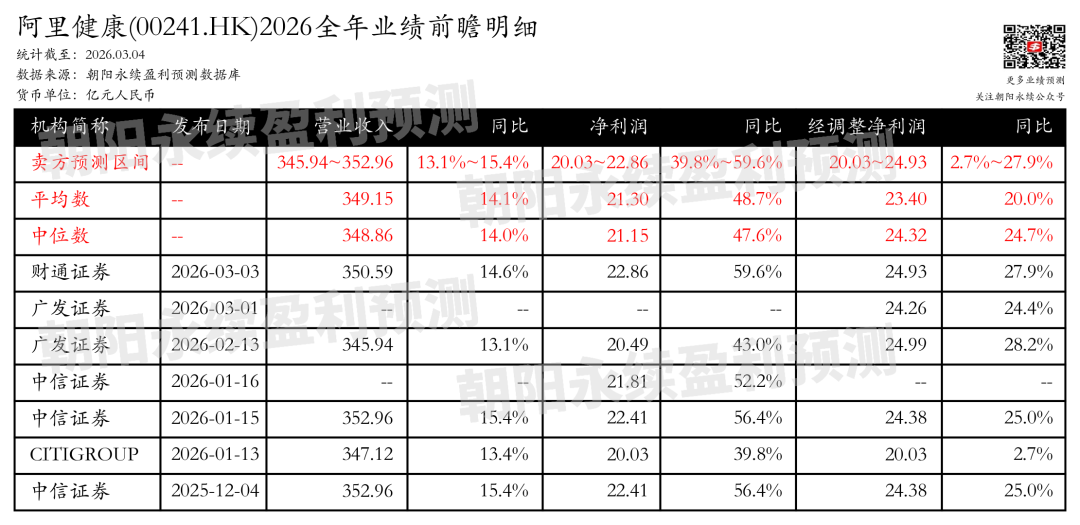
阿里健康:医药电商增长强劲,预测全年营业收入345.94~352.96亿元,同比增长13.1%~15.4%
Xin Lang Cai Jing· 2026-03-04 12:28
Group 1 - The core viewpoint of the article indicates that Alibaba Health is expected to achieve significant revenue and profit growth in the upcoming fiscal year, with projected revenue between 34.594 billion to 35.296 billion yuan, representing a year-on-year increase of 13.1% to 15.4% [1][7] - The forecasted net profit is estimated to be between 2.003 billion to 2.286 billion yuan, showing a year-on-year growth of 39.8% to 59.6% [1][3] - Adjusted net profit is projected to range from 2.003 billion to 2.493 billion yuan, with a year-on-year increase of 2.7% to 27.9% [1][3] Group 2 - Alibaba Health is recognized as a leading player in the pharmaceutical e-commerce sector, leveraging Alibaba's digital technology and extensive traffic to dominate the online B2C healthcare retail market [4][9] - The company has a diverse business model that includes self-operated pharmaceuticals, e-commerce platforms, healthcare, and digital services, with over 300 million annual active consumers and a 24% year-on-year increase in SKUs to 97 million [4][5] - The application of large models in the pharmaceutical e-commerce scene is enhancing operational efficiency across various segments, contributing to GMV growth [6][9] Group 3 - The integration of AI and specialized services is expected to improve transaction efficiency and customer retention, with the Ant Financial app reaching over 15 million monthly active users and the Qianwen app surpassing 200 million monthly active users [6][10] - The potential to connect the "consultation—purchase—service appointment—fulfillment" chain is anticipated to further enhance user engagement and transaction efficiency [10]

2026年智驾平权之车企智驾方案梳理
Soochow Securities· 2026-03-04 12:24
Investment Rating - The report maintains a positive outlook on the smart automotive sector, particularly emphasizing the L4 RoboX theme for 2026 [4] Core Insights - The report suggests a preference for B-end software companies over C-end hardware companies, recommending specific stocks in both H-shares and A-shares [4] - It highlights various downstream application perspectives, including Robotaxi and Robovan, and identifies key players and their business models [4] - The report also discusses upstream supply chain opportunities, including core suppliers and manufacturing partners [4] Summary by Sections Mainstream Automotive Companies' Smart Driving Technology Solutions - The report provides a comprehensive overview of the smart driving strategies of major automotive companies, detailing their partnerships and technology approaches [5][6][7][15][22][24][30][33] - Companies like BYD, Geely, Chery, and Great Wall are noted for their mixed strategies of self-research and external collaboration, with specific technology and supplier partnerships outlined [7][15][22][24][30][33] BYD's Smart Driving Strategy - BYD has shifted its smart driving approach from standard configuration to a pay-per-use model, emphasizing self-research while maintaining partnerships with algorithm companies [7][8] - The company has launched the "Tianshen Eye 5.0" system, which features advanced capabilities such as emergency steering and obstacle avoidance [12][13] Geely's Smart Driving Team Integration - Geely has completed the integration of its smart driving team under the "Qianli Zhijia" brand, focusing on enhancing its autonomous driving capabilities [15][17][19] - The company has established a structured approach to its smart driving solutions, offering multiple versions with varying hardware and software capabilities [19] Chery's Smart Driving Development - Chery has introduced the "Falcon Smart Driving" strategy, which includes multiple versions of its smart driving system, aiming for comprehensive coverage across various scenarios [22][23] - The company has also consolidated its smart driving R&D teams to enhance efficiency and innovation [22][23] Great Wall's Smart Driving Solutions - Great Wall has adopted a dual approach of self-research and external collaboration, with a focus on enhancing its computing power and algorithm capabilities [26][29] - The company has developed a tiered computing platform to support various levels of autonomous driving features [26][29] Changan's Smart Driving Framework - Changan has implemented a strategy that combines procurement from Huawei with its own smart driving research, aiming for a comprehensive autonomous driving solution [32][33] Other Companies' Strategies - The report also covers the smart driving strategies of other companies such as SAIC, GAC, and Leap Motor, highlighting their partnerships and technological advancements [33][36][38]
美团启动2026年春季校园招聘,首度推出食杂零售管培生计划
Guang Zhou Ri Bao· 2026-03-04 11:18
Group 1 - The core focus of Meituan's recruitment strategy is to attract and cultivate key talents in technology and management through various specialized programs [2][3][4] - Meituan's "Beidou Plan" aims to recruit top-tier campus technology talents throughout the year, emphasizing cutting-edge fields such as large model applications and autonomous driving [2] - The company has established a systematic training mechanism for campus recruits, with over 70% of them achieving their first promotion within the first year [5][7] Group 2 - Meituan's 2026 spring campus recruitment is set to hire 6,000 graduates and offer over 3,000 internship positions for 2027 graduates, covering a wide range of roles across multiple cities globally [6] - The newly launched "Retail Management Trainee Program" is designed to develop high-potential retail management talents through immersive training and clear career progression [3] - The "Overseas Business Campus Recruitment Plan" has also been initiated to reserve international talents for Meituan's global operations [4]

大模型的第一性原理:(三)信息论篇
机器之心· 2026-03-04 09:15
Group 1 - The article introduces the concept of Semantic Information Theory, which adapts Shannon's information theory to explain the underlying principles of large models by shifting the focus from BIT to TOKEN [2][22]. - Shannon's information theory established a mathematical framework for reliable communication in noisy digital systems, which is foundational for understanding modern digital communication [2][4]. - The three main conclusions of Shannon's theory include the source coding theorem, the noise channel coding theorem, and the separation theorem, which collectively provide a comprehensive understanding of communication systems [7][14][15]. Group 2 - The article discusses the Rate-Distortion function, which characterizes lossy compression performance, and emphasizes the importance of mutual information in this context [24][25]. - Directed Information is introduced as a measure to describe the statistical correlation between inputs and outputs in communication systems, particularly in feedback scenarios [27][33]. - The concept of Directed Information Density is also presented, which extends the idea of directed information to a random variable context, providing a framework for analyzing information flow in large models [36][39]. Group 3 - The article posits that large models can be viewed as stateful, feedback channels, where the flow of semantic information can be quantified using directed information [42][44]. - It outlines the training phase's performance metrics, including the directed rate-distortion function, which defines the relationship between input and output in terms of human preferences [45][49]. - The inference phase is characterized by the semantic information flow, which measures the information transfer from input to output tokens, highlighting the model's predictive capabilities [50][56]. Group 4 - The article concludes that the core concept of the AI era is TOKEN, which connects experience and reasoning, similar to how BIT defined the information age [67][68]. - It emphasizes the need for new research and development frameworks centered around this concept to advance towards Artificial General Intelligence (AGI) and Artificial Super Intelligence (ASI) [68].

美团启动2026年春季校招:大模型等AI技术人才招聘成焦点 首招“食杂零售管培生”
Mei Ri Jing Ji Xin Wen· 2026-03-04 08:03
Group 1 - The core announcement is that Meituan has officially launched its 2026 spring campus recruitment, aiming to hire 6,000 graduates from the 2026 class and over 3,000 internship positions for the 2027 class [2] - The recruitment will cover various roles including technology, product, business analysis, and operations across multiple cities globally such as Beijing, Shanghai, Shenzhen, Chengdu, Guangzhou, Hong Kong, and Dubai [2] - Meituan's "Beidou Plan" will continuously recruit top campus technology talents throughout the year, focusing on cutting-edge technology areas such as large model foundations, large model applications, autonomous driving, drones, and intelligent decision-making [2] Group 2 - A new "Retail Management Trainee Program" has been introduced to cultivate high-potential retail management talents [2]