港股投资

Search documents
万亿资金年内南下港股!千亿规模ETF大厂今日热推香港大盘30ETF(认购520563)首发
Zheng Quan Shi Bao Wang· 2025-09-15 01:21
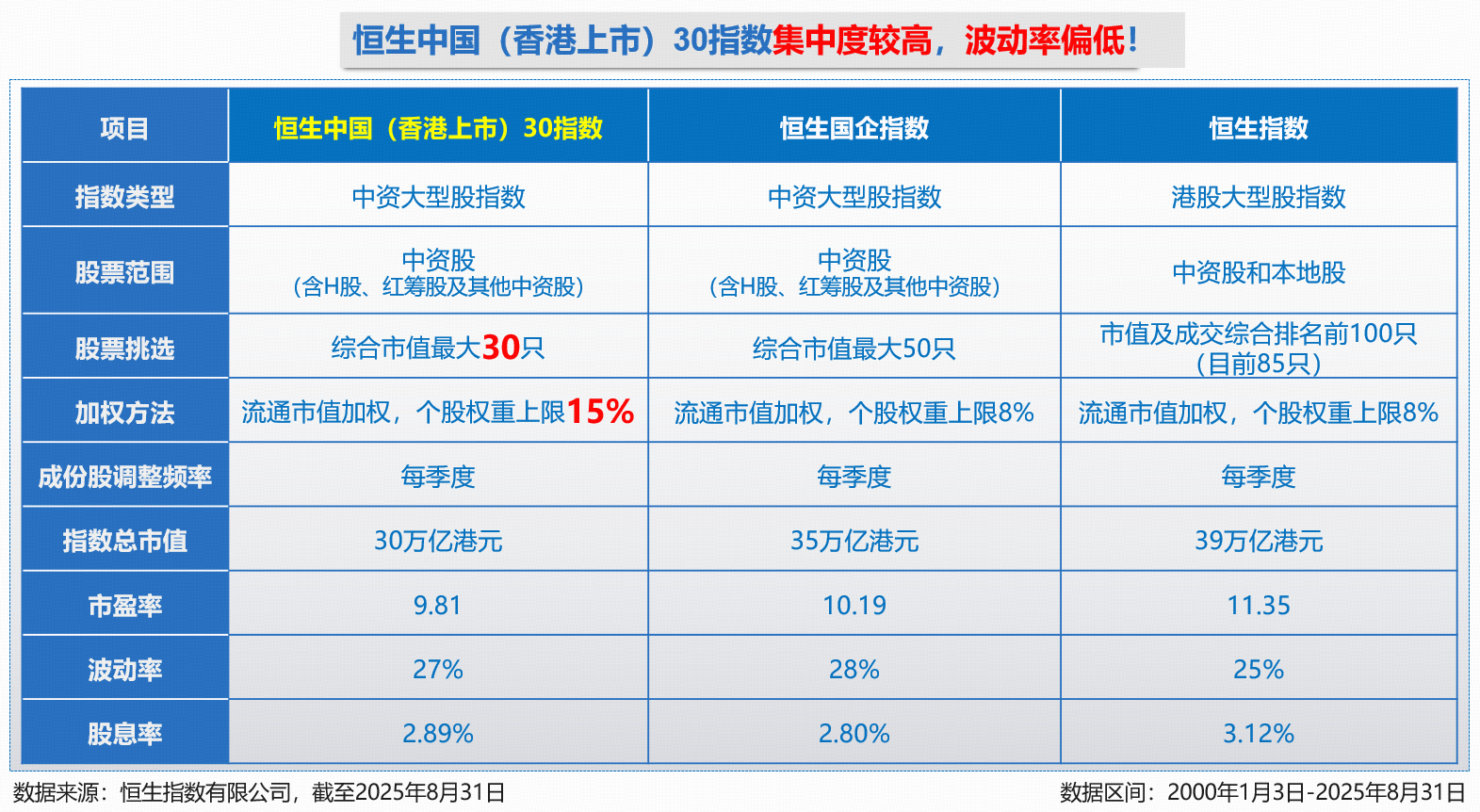
Group 1 - The core viewpoint of the articles highlights the increasing inflow of southbound funds into Hong Kong stocks, making them a focal point for global capital allocation towards Chinese assets. As of September 12, 2025, the net inflow of southbound funds has reached 1,072.886 billion HKD, contributing to a year-to-date increase of 31.55% in the Hang Seng Index and 28.46% in the Hang Seng China Enterprises Index [1][2] - The launch of the first Hong Kong large-cap 30 ETF by Huabao Fund aims to provide investors with an innovative tool to capture investment opportunities in "core Chinese assets" within the Hong Kong market. This ETF tracks the Hang Seng China (Hong Kong-listed) 30 Index, which consists of the 30 largest companies listed in Hong Kong [1][2] Group 2 - The Hang Seng China (Hong Kong-listed) 30 Index is characterized by higher concentration and lower volatility compared to the Hang Seng China Enterprises Index. It includes the largest 30 mainland companies listed in Hong Kong, with a maximum weight of 15% for individual stocks and a combined weight of no more than 60% for the top five stocks [2][4] - The index has shown significant excess returns since its base date of January 3, 2000, with a cumulative increase of 368.50% compared to 353.60% for the Hang Seng China Enterprises Index and 47.85% for the Hang Seng Index, resulting in excess returns of 14.90% and 320.66% respectively [8] Group 3 - The top ten constituents of the Hang Seng China (Hong Kong-listed) 30 Index account for 74% of the index's total weight, significantly higher than the 56% for the Hang Seng China Enterprises Index. This index includes a mix of new economy growth leaders and high-dividend value stocks, reflecting a "technology + dividend" strategy [5][7] - As of August 2025, the price-to-earnings ratio of the Hang Seng China (Hong Kong-listed) 30 Index is 9.8, with a historical percentile of 71%, indicating a more favorable valuation compared to the Hang Seng China Enterprises Index, which has a price-to-earnings ratio of 10.2 and a historical percentile of 86% [11]

港股热潮正当时,科技、红利一手抓!全市场首只香港大盘30ETF(认购520563)今日荣耀首发!
Xin Lang Ji Jin· 2025-09-15 00:39
Group 1 - The core viewpoint of the articles highlights the increasing inflow of southbound funds into Hong Kong stocks, making them a focal point for global capital allocation towards Chinese assets. As of September 12, 2025, the net inflow of southbound funds reached 1,072.886 billion HKD, contributing to a year-to-date increase of 31.55% in the Hang Seng Index and 28.46% in the Hang Seng China Enterprises Index [1][2] - The launch of the first Hong Kong large-cap 30 ETF by Huabao Fund aims to provide investors with an innovative tool to capture investment opportunities in "core Chinese assets" within the Hong Kong market. This ETF tracks the Hang Seng China (Hong Kong-listed) 30 Index, which consists of the 30 largest companies listed in Hong Kong [1][2] - The investment logic for Hong Kong stocks has shifted from "offshore marketization" to "onshore marketization," with a more diversified investment style and an expansion of profit models, which supports the sustainability of the Hong Kong stock market [2] Group 2 - The Hang Seng China (Hong Kong-listed) 30 Index exhibits higher concentration and lower volatility compared to the Hang Seng China Enterprises Index and the Hang Seng Index. The top ten constituent stocks account for 74% of the index, significantly higher than the 56% for the Hang Seng China Enterprises Index [3][4] - The index has shown significant excess returns since its base date of January 3, 2000, with a cumulative increase of 368.50% by August 31, 2025, outperforming the Hang Seng China Enterprises Index and the Hang Seng Index by 14.90% and 320.66%, respectively [5] - As of the end of August 2025, the Hang Seng China (Hong Kong-listed) 30 Index has a price-to-earnings ratio of 9.8, which is more favorable compared to the Hang Seng China Enterprises Index's 10.2, indicating a better valuation advantage [7] Group 3 - Huabao Fund has established itself as a leading player in the ETF market, with a total asset management scale of 121.98 billion CNY as of September 11, 2025, and five ETFs exceeding 10 billion CNY in size, making it one of the companies with the most large-scale industry-themed ETFs [9][10] - The fund has developed a diverse range of ETFs focusing on high-tech strategic emerging industries, including medical, financial technology, and internet sectors, contributing to a robust "hard technology" ETF product matrix [10][11] - Huabao Fund has also focused on creating a "high dividend ETF family," which includes various high-dividend ETFs, catering to long-term capital allocation strategies [10]
建信基金2025秋季投资策略会:“星火科创”破局科技新时代,多元配置赋能投资获得感
Zheng Quan Shi Bao Wang· 2025-09-12 09:04
Core Insights - The "Trust in Power" 2025 Autumn Investment Strategy Conference held by Jianxin Fund focused on current market trends and future outlooks, emphasizing the company's commitment to serving the real economy and promoting inclusive finance [1][7] Group 1: Macroeconomic Analysis - Short-term market influences include funding conditions and overseas policies, while medium-term expectations are improved by positive policy signals from "anti-involution" initiatives [2] - Long-term growth opportunities are anticipated in high-growth industries driven by the "14th Five-Year Plan" and rapid advancements in "Artificial Intelligence+" [2] Group 2: Sector Insights - The Science and Technology Innovation Board (STAR Market) has 589 listed companies with a total market capitalization exceeding 10 trillion yuan, indicating strong competitiveness and innovation potential in various sectors [2] - The Chinese innovative pharmaceutical industry is expected to perform well in the medium to long term, particularly in oncology, weight loss drugs, and autoimmune disease treatments [3] Group 3: Investment Strategies - Gold is viewed as a favorable asset due to a weak dollar trend and economic uncertainties, with central bank purchases significantly influencing gold prices [4] - In the fixed income market, there are risks in real estate and export sectors, while credit bonds may offer better yield opportunities under a continued loose monetary policy [5] Group 4: Company Vision and Development - Jianxin Fund aims to be a trusted wealth management expert and a leader in the asset management industry, with a diverse product system covering various asset types to meet diverse investment needs [6] - The company emphasizes a commitment to high-quality development and investor education, aligning with broader industry initiatives to enhance service capabilities [7]
港股开盘 | 恒生指数高开1.74% 科网股领涨 阿里巴巴(09988)涨近6%
智通财经网· 2025-09-12 01:41
Market Overview - The Hang Seng Index opened up by 1.74%, with the Hang Seng Tech Index rising by 1.97%. Notable gains were seen in tech stocks, with Alibaba increasing by nearly 6%, Baidu by nearly 4%, and JD Group by over 3%. Evergrande Property resumed trading with a rise of over 38% [1] Investment Outlook - According to China International Capital Corporation (CICC), the Hong Kong stock market's standout feature this year is structural performance over index performance, with continuous rotation of main themes. Investors should focus on structural advantages in the Hong Kong market, driven by profit trends, while also considering themes reflecting U.S.-China relations [1] - Citigroup raised its year-end target for the Hang Seng Index by 7% to 26,800 points, with expectations for further increases to 27,500 points and 28,800 points in the first half and by year-end of next year, respectively [1] Liquidity and Economic Factors - Open Source Securities indicated that the opportunity for Hong Kong stocks to catch up with A-shares may be approaching, as A-shares enter a valuation digestion phase post-uptrend. The liquidity perspective is bolstered by dovish signals from Powell at the Jackson Hole meeting, suggesting a potential easing cycle in monetary policy. This, combined with a significant downward revision of non-farm employment data (a reduction of 911,000 jobs for the year ending March 2025), strengthens market expectations for Federal Reserve rate cuts [1] AI and Technology Sector - From an investment and profitability perspective, funds are seeking "outlets" in AI hardware and applications, positioning the Hong Kong internet sector as a potential beneficiary. Alibaba is increasing its investment in self-developed AI chips, enhancing its influence in core computing power. Oracle's post-market guidance for AI cloud business exceeded expectations, with a remaining performance obligation of $455 billion for Q1 of fiscal year 2026, reflecting a 359% year-on-year increase, indicating strong global demand for AI and cloud services [2] - Bank of China International noted that under the current environment of accelerated domestic substitution and rapid development of the AI industry cycle, technology stocks are likely to benefit from the revaluation of RMB assets. Despite a macroeconomic "weak recovery" landscape, large-cap tech companies still have room for growth, with absolute advantages in prosperity remaining evident [2] Strategic Investment Recommendations - Analysts suggest maintaining a cautiously optimistic strategic outlook on Hong Kong stocks. With improvements in supply-demand dynamics, the Chinese economic cycle is expected to reach a turning point, with capital expenditures and R&D in the tech industry gradually translating into corporate profits [3] - Key investment opportunities in Hong Kong stocks include sectors with high earnings growth but low to mid-level valuations, such as consumer discretionary, daily necessities, and utilities. Additionally, sectors benefiting from policy support, such as the AI industry chain and consumption, should be monitored [3]

上半年机构增持路径披露!工银瑞信多只港股通ETF获机构力捧
Xin Lang Ji Jin· 2025-09-11 09:00
Group 1 - The core viewpoint of the articles highlights the significant increase in institutional investment in Hong Kong-themed ETFs, particularly in technology and innovative pharmaceutical sectors, driven by favorable market conditions and valuation advantages [1][2][3][4] - As of June 30, 2025, institutional holdings in onshore ETFs reached 1.78 trillion units, with a notable increase of 231.76 billion units since the beginning of the year [1] - The Hong Kong stock market has seen a strong rebound, with the Hang Seng Index rising by 20% and the technology sector outperforming with a 28.38% increase in the first half of 2025 [2] Group 2 - The total institutional holdings in Hong Kong-themed ETFs increased by 62.24 billion units to 291.79 billion units, marking a growth of 27.12% [3] - The ICBC Credit Suisse Hong Kong Stock Connect Technology 30 ETF and the ICBC Credit Suisse Hong Kong Stock Connect Innovative Pharmaceutical ETF have seen substantial institutional inflows, indicating strong recognition of their investment value [1][4] - The ICBC Credit Suisse Hong Kong Stock Connect Technology 30 ETF has achieved a year-to-date return of 26.42%, significantly outperforming the Hang Seng Technology Index's return of 18.68% [4][10] Group 3 - The ICBC Credit Suisse Hong Kong Stock Connect series of ETFs has strategically focused on sectors such as technology, dividends, innovative pharmaceuticals, and automobiles, with a total increase of 14.4 billion units in institutional holdings in the first half of 2025 [4] - The management fee rates of ICBC Credit Suisse ETFs are among the lowest for similar index-tracking products, enhancing their attractiveness to long-term investors [5] - The company has established a comprehensive index family covering various categories, providing investors with a "one-stop index investment toolbox" [7] Group 4 - The company has built a competitive advantage in the ETF sector through a robust research and investment management system, ensuring product liquidity and continuous strategy innovation [6][7] - The future outlook for the Hong Kong market remains positive, with expectations of continued valuation recovery and profit growth, supported by the company's precise product layout and research capabilities [7]
港股存在景气度机会,关注港股科技ETF(513020)、创新药ETF(517110)
Sou Hu Cai Jing· 2025-09-11 01:21
Core Viewpoint - The Hong Kong stock market has shown notable performance recently, with specific ETFs experiencing gains, but the overall outlook suggests that a rebound may not be imminent due to structural differences with the A-share market [1][2]. Market Performance - The Hong Kong stock market, particularly the National Enterprises ETF (159519), Dividend ETF (159331), and Technology ETF (513020), saw increases of 1.95%, 1.37%, and 0.64% respectively [1]. - Since July, the Hong Kong market has underperformed compared to the A-share market, raising questions about potential catch-up growth [1]. Earnings Expectations - There is an expectation of downward revisions in earnings for Hong Kong stocks, contrasting with the A-share market, which is experiencing a positive shift in profit forecasts [1]. - In the first half of the year, Hong Kong's net profit growth was +4.2% year-on-year, but this is a decline from the projected +9.2% for 2024, while A-shares reported a +2.8% increase, recovering from a -3.0% forecast for 2024 [1]. Valuation Insights - The AH premium remains low, having slightly rebounded after reaching 125%, which indicates that Hong Kong's dividend-paying assets are losing their attractiveness compared to A-shares due to a 20% dividend tax for investors using the Hong Kong Stock Connect [1]. - According to Zheshang Securities, the current appeal of Hong Kong stocks is not strong given the low AH premium [1]. Liquidity and Market Drivers - Market expectations of a Federal Reserve interest rate cut may provide some support for Hong Kong stocks, but historical data suggests that such cuts do not guarantee market uptrends [2]. - The fundamental factors are expected to dominate market movements, with structural opportunities identified in sectors like technology hardware and pharmaceuticals [2]. Investment Recommendations - Investors are advised to focus on specific ETFs such as the Technology ETF (513020) and the Innovative Drug ETF (517110) to capture structural opportunities in the Hong Kong market [2].
港股市场资金涌入,机构加仓表现显著
Xin Lang Cai Jing· 2025-09-10 17:45
Group 1 - The A-share market has shown strong performance since July, significantly outperforming the Hong Kong stock market, which has been experiencing high-level fluctuations [1] - As of September 9, southbound capital has achieved a net inflow for eight consecutive trading days, with a cumulative net purchase exceeding 1 trillion Hong Kong dollars this year, reaching 10,389.94 billion Hong Kong dollars, setting a new annual record [1] - There is a noticeable divergence in ETF fund flows, with broad-based A-share ETFs experiencing a net outflow of 203.8 billion yuan since July, while industry and thematic ETFs recorded a net inflow of 114.2 billion yuan [1] Group 2 - The attractiveness of Hong Kong thematic ETFs has surpassed that of A-share related ETFs, with the Hong Kong Internet ETF (159792) seeing a significant increase in shares from 31.734 billion to 83.002 billion, a growth of 512.68 million shares [2] - Active equity funds have continuously increased their positions in Hong Kong stocks for six consecutive quarters, with the latest allocation reaching a historical high of 20.0% [2] - The market's liquidity support and potential valuation uplift for quality assets are influenced by the Federal Reserve's monetary policy shift, particularly following signals of interest rate cuts from Chairman Powell [2] Group 3 - The 富国蓝筹精选股票 (QDII) fund has performed exceptionally well, ranking first in its category over the past five years, focusing on Hong Kong and US stocks while maintaining a low A-share holding [3] - The 富国沪港深业绩驱动混合 fund has also gained market attention, ranking first in its category over the past five years, emphasizing a combination of quality growth and high-dividend stocks [3] - The market is expected to continue exhibiting bullish characteristics, with a trend of capital inflow into the Hong Kong stock market likely to persist [3] Group 4 - The 富国中国中小盘混合 (QDII) fund manager anticipates a volatile upward trend in the market for the second half of the year, influenced by US-China trade relations and stabilization of the Chinese economy [4] - Despite external risks, the market liquidity remains ample, and Hong Kong stock valuations are considered reasonably low, presenting investment opportunities in quality stocks [4]
明星基金经理“以老带新”!刘格菘最新调仓曝光
券商中国· 2025-09-10 15:05
Core Viewpoint - Liu Gesong has stepped down from managing the GF Multi-Dimensional Emerging Stock Fund, which will now be independently managed by Zhou Zhishuo, marking a rapid transition in management style at GF Fund [1][2][4]. Group 1: Management Changes - Liu Gesong and Tang Xiaobin initially co-managed the GF Multi-Dimensional Emerging Stock Fund, with Zhou Zhishuo being appointed as a co-manager in August. Following Tang's departure, Liu has also resigned, making this Zhou's first independently managed fund [2][4]. - The trend of experienced managers mentoring younger ones, referred to as "old leads new," has been prevalent at GF Fund, with Liu Gesong previously mentoring new managers like Wu Yuanyi and Chen Yunzong [4][5]. Group 2: Fund Performance and Strategy - The GF Multi-Dimensional Emerging Stock Fund had an approximate scale of 1.855 billion yuan as of the end of Q2 2025 [4]. - Liu Gesong continues to manage five other funds, with a total asset scale exceeding 30 billion yuan. His investment strategy has diversified, focusing more on new economy sectors, including internet and new consumption [7][8]. - Liu's recent portfolio adjustments include a significant increase in holdings of Hong Kong-listed stocks, which now account for 43% of the fund's total assets, reflecting a shift in investment strategy [8][10]. Group 3: Market Outlook - Liu Gesong has expressed optimism about the potential of Hong Kong stocks, particularly those with unique characteristics, due to improving domestic economic conditions and global market dynamics [10]. - The macroeconomic outlook suggests that the potential for interest rate cuts by the Federal Reserve may enhance the attractiveness of RMB assets, leading to increased risk appetite for both A-shares and Hong Kong stocks [10].
万亿资金“抢筹”,港股牛市归来?如何切入更合适~
Xin Lang Cai Jing· 2025-09-10 14:43
Core Viewpoint - The A-share market has outperformed the Hong Kong stock market since July, but recent days have seen a broad rally in Hong Kong stocks, with some individual stocks reaching new highs for the year [3][4]. Group 1: Market Performance - Since July, A-shares have consistently outperformed Hong Kong stocks, which have shown high-level fluctuations [3]. - Recent trading days have seen a resurgence in Hong Kong stocks, with broad gains and some stocks hitting annual highs [3]. Group 2: Fund Flows - Despite the underperformance of Hong Kong stocks, capital flows have remained strong, with southbound funds net buying Hong Kong stocks for eight consecutive trading days, totaling over 1 trillion HKD for the year [4]. - From July onwards, A-share broad-based ETFs have seen a net outflow of 203.8 billion CNY, while industry and thematic ETFs have seen a net inflow of 114.2 billion CNY, and Hong Kong-related ETFs have attracted 143.1 billion CNY [4]. Group 3: Investment Strategies - The shift in capital flows indicates a trend of institutional investors reducing their A-share ETF holdings while increasing their positions in Hong Kong ETFs, reflecting a "reduce A, increase Hong Kong" strategy [4]. - The Hong Kong Internet ETF has seen significant growth, with its shares increasing from 317.34 billion to 830.02 billion since the beginning of the year, a rise of 512.68 billion [4][5]. Group 4: Economic Influences - A key driver for the increased investment in Hong Kong stocks is the shift in U.S. Federal Reserve monetary policy, with expectations of interest rate cuts following signals from the Jackson Hole meeting and disappointing non-farm payroll data [6]. - This shift is expected to enhance liquidity in the Hong Kong market and improve the valuation levels of quality assets in sectors like technology and pharmaceuticals [6]. Group 5: Fund Performance - The 富国蓝筹精选股票 (QDII) fund has focused on Hong Kong and U.S. stocks, maintaining a low A-share allocation, and has adopted a barbell strategy of quality growth stocks and high-dividend stocks [10]. - The fund has seen a significant increase in its growth stock allocation since last year, particularly in sectors like innovative pharmaceuticals and new consumption [10].

港股创新药ETF、港股创新药50ETF年内涨超110%,港股通互联网ETF、港股通创新药ETF 、恒生科技ETF强势吸金
Ge Long Hui· 2025-09-10 08:16
Group 1 - The Hang Seng Index has risen over 30% this year, while the Hang Seng Tech Index has increased by more than 32% [1] - Hong Kong stocks are leading global markets, with significant capital inflow, totaling 1,038.994 billion yuan, with over 100 billion yuan invested in Alibaba, Meituan, and other major companies [2] - Alibaba's stock price has reached a new high, supported by the launch of the "Gao De Street Ranking" and a 1 billion yuan subsidy program to boost offline consumption [3] Group 2 - A total of 189.2 billion yuan has flowed into ETFs tracking Hong Kong stocks this year, with significant inflows into various sector-specific ETFs [4] - Ten ETFs have seen over 100% growth this year, particularly those focused on innovative pharmaceuticals and biotechnology [6] - The current market shows a strong performance in both Hong Kong and A-shares, with several ETFs doubling in value [5] Group 3 - Market activity is robust, but the Hang Seng Index is experiencing consolidation at high levels, with limited room for further valuation expansion in the short term [7] - The recovery in earnings expectations is supported by new economy sectors such as technology and healthcare, which now account for 70% of the MSCI China Index [8]