
降准

Search documents
5月份LPR下调10个基点 年内仍有下行空间
Zheng Quan Ri Bao· 2025-05-20 16:14
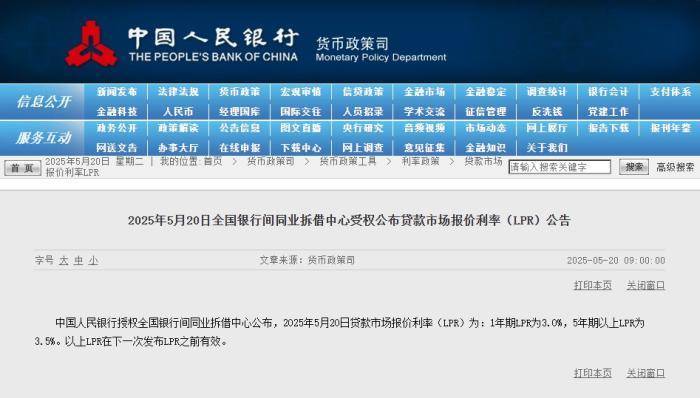
Core Viewpoint - The Loan Prime Rate (LPR) has been lowered for the first time this year, with the one-year LPR at 3% and the five-year LPR at 3.5%, both down by 10 basis points from previous values [1][2]. Group 1: LPR Adjustment and Market Expectations - The LPR reduction aligns with market expectations, following a 0.1 percentage point decrease in the policy rate announced by the central bank [1][2]. - Analysts predict further interest rate cuts in the second half of the year, indicating potential for additional LPR declines [1]. Group 2: Impact on Financing Costs - The reduction in the LPR is expected to significantly lower financing costs for both enterprises and residents, stimulating internal financing demand [2]. - Improvements in banks' funding costs, due to previous deposit rate cuts and liquidity management, have facilitated the LPR decrease [2]. Group 3: Deposit Rate Adjustments - A new round of deposit rate cuts has commenced, with state-owned banks reducing various deposit rates, which is anticipated to stabilize banks' net interest margins [3]. - The overall deposit rate is expected to decrease by approximately 0.11 to 0.13 percentage points, offsetting the impact of lower loan rates on banks' asset yields [3]. Group 4: Housing Market Implications - The reduction in the five-year LPR is directly linked to lower mortgage costs, with potential adjustments in housing loan rates in major cities like Beijing [4]. - The adjustment is expected to alleviate repayment pressures for existing homeowners as mortgage rates are re-evaluated [4][6]. Group 5: Support for Housing Demand - The recent decrease in housing provident fund loan rates, alongside the LPR cut, is projected to save residents over 20 billion yuan annually in interest payments, supporting housing demand [5]. - Overall, these financial policy adjustments are seen as beneficial for stabilizing the real estate market and meeting housing needs [6].
国泰海通|固收:大行融出在降准生效后反而回落
国泰海通证券研究· 2025-05-20 14:20
Funding Market - The large banks' lending scale rapidly increased in the first half of last week but declined after the reserve requirement ratio cut took effect [1] - The overall funding market cooled down in the past week, with net borrowing amounts turning negative for major borrowers and net lending amounts rising for major lenders [1] - The total repo balance in the interbank market increased, while the leverage ratio in the interbank bond market remained stable [1] Primary Market - The issuance heat in the primary market showed divergence, with one 10-year government bond, two 10-year policy bank bonds, and one 10-year other policy financial bond issued in the past week [1] - The bid-to-cover ratio for government bonds and policy bank bonds decreased, while it increased for other policy financial bonds [1] - The price spread between primary and secondary markets narrowed for government and policy bank bonds, while it widened for other policy financial bonds [1] Secondary Market - The overall heat in the secondary market improved, with an increase in the turnover rate of ultra-long bonds and stronger buying interest for short-term bonds [2] - The total borrowing volume of bonds increased, and the proportion of active bonds rose [2] - Major buyers increased net purchases of short and medium-term bonds while reducing net purchases of long and ultra-long bonds [2] Wealth Management and Fund Scale - Since May, the growth of wealth management scale has been weaker than historical averages, with a cumulative increase of 164.4 billion yuan as of May 18 [3] - The fund scale (net asset value) increased by 83.2 billion yuan in May, with equity and bond funds increasing by 56.1 billion yuan and 25.3 billion yuan respectively [3] - The issuance of new bond funds saw a significant rise compared to the previous week [3]


5月LPR下调,同日六大行及招行宣布调降存款利率
Cai Jing Wang· 2025-05-20 10:20
Core Points - The People's Bank of China (PBOC) has lowered the Loan Prime Rate (LPR) for the first time in 2023, with the one-year LPR set at 3.0% and the five-year LPR at 3.5%, both down by 10 basis points [1][2][3] - Major banks have also reduced their deposit rates, with rates for terms of three years and below decreased by 15 basis points, and rates for three years and above reduced by 25 basis points [1][5][6] - The adjustments in LPR and deposit rates are aimed at reducing the cost of liabilities for banks and providing more room for lending to the real economy [1][6][7] Group 1: LPR Adjustment - The LPR was adjusted downwards by 10 basis points, marking the first reduction of the year and the first since October of the previous year [2][3] - The reduction follows a decrease in the seven-day reverse repurchase rate, which serves as a new pricing anchor for the LPR [2][3][7] Group 2: Deposit Rate Changes - Six major banks, including the "Big Six" and China Merchants Bank, collectively announced a reduction in deposit rates, with the largest cuts seen in longer-term deposits [5][6][7] - The new rates for one-year deposits have fallen below 1%, while rates for three-year and above deposits are now below 1.5% [8][9] Group 3: Impact on Banking Sector - The reduction in deposit rates is expected to help stabilize net interest margins for banks, which have already been under pressure due to declining loan yields [6][7][9] - The banking sector is likely to focus more on reducing non-interest costs in the future, as credit costs have already decreased significantly [8][9]
首套房贷利率进入“2”时代 楼市期待政策利好
2 1 Shi Ji Jing Ji Bao Dao· 2025-05-20 05:07
Core Viewpoint - The People's Bank of China has lowered the Loan Prime Rate (LPR) for both 1-year and 5-year terms, which will lead to a decrease in mortgage rates, particularly for first-time homebuyers, marking a significant shift in the housing market [1][2]. Group 1: Interest Rate Changes - The 1-year LPR has been adjusted from 3.10% to 3.00%, and the 5-year LPR from 3.60% to 3.50%, resulting in a 10 basis point reduction for both [1]. - The average mortgage rate for first-time homebuyers is expected to drop to approximately 2.95%, with some cities potentially seeing rates as low as 2.90% [2]. Group 2: Impact on Housing Market - The reduction in mortgage rates is anticipated to lower housing costs, thereby stimulating demand for home purchases [3]. - The average weighted mortgage rate for new commercial personal housing loans in Q1 2025 was reported at 3.11%, with first-time homebuyer rates around 3.06% [2]. Group 3: Economic Context and Future Outlook - The recent interest rate cuts are part of a broader strategy to support the economy, particularly in light of weak external conditions and a challenging employment landscape [5]. - Analysts suggest that the current monetary policy will continue to trend towards greater easing, indicating a sustained period of lower interest rates [8]. - There is an expectation for additional supportive policies for the real estate market, including financial measures linked to housing sales and urban renewal initiatives [9].
LPR迎年内首降,如何影响房贷?
Sou Hu Cai Jing· 2025-05-20 05:00
Core Viewpoint - The Loan Prime Rate (LPR) has been lowered for the first time in 2025, with the one-year LPR at 3.00% and the five-year LPR at 3.50%, both down by 10 basis points from previous levels [1][3]. Group 1: Impact on Financing Costs - The reduction in LPR is expected to lower financing costs for both enterprises and residents. For instance, a 10 basis point decrease in LPR would reduce the monthly payment by approximately 54 yuan and the total repayment amount by around 20,000 yuan for a 1 million yuan mortgage over 30 years [3]. - The recent reduction in public housing loan rates by 0.25 percentage points may create a favorable environment for further adjustments in commercial housing loan rates, thereby reducing the overall cost for homebuyers [3]. Group 2: Market Expectations and Reactions - The market had anticipated this adjustment, following the central bank's announcement of comprehensive "interest rate cuts" measures, including a 10 basis point reduction in the 7-day reverse repurchase rate and a 0.5 percentage point reduction in the reserve requirement ratio [4]. - Major banks, including Industrial and Commercial Bank of China and Agricultural Bank of China, collectively lowered deposit rates across various products, with the one-year fixed deposit rate reduced by 15 basis points to 0.95% [4]. Group 3: Future Outlook - Analysts suggest that if policy rates and deposit rates continue to decline, there remains potential for further reductions in LPR, with future adjustments needing to balance multiple economic objectives [6].
流动性周报:降准后的资金紧怎么看?-20250519
China Post Securities· 2025-05-19 13:49
Report Summary 1. Report Industry Investment Rating No industry investment rating is provided in the report. 2. Core Viewpoints - Maintain the conclusion that "funding may be looser than expected." Although short - term fluctuations occur in the current funding situation, the optimistic expectation for liquidity should not change, and there is still room for the funding price to decline [2]. - The bank's liability growth has returned to normal, and the objective environment for funding regulation has changed. The so - called "central bank's attitude" speculated by institutions is unreliable, and the central bank's attitude has also changed [3]. - After the RRR cut, the easing effect had been overdrawn before the actual implementation. The comprehensive impact of released funds and the overdrawn effect on the actual implementation day may not lead to an obvious change in the lent funds [3]. - The impact of government bond payments and the maturity of repurchase agreements exists, but the replacement of high - cost funds with cheaper RRR - cut funds still has an easing effect [3]. - There will be support from excess structural tools in the future, including a confirmed increase of 1.1 trillion in various re - loans and the possible re - activation of PSL, which has shrunk by 1.3 trillion since 2024 [4]. 3. Summary by Directory 1. How to View the Tightening of Funds after the RRR Cut - **Previous Views on the Bond Market and Funds**: Microscopically, the bond market is recovering; macroscopically, there are still opportunities in the bond market. The key to the subsequent bond market trend is whether the funding price center can break through 1.4%. There is a possibility that the funding will be looser than expected [10]. - **Current Situation of Funds after the RRR Cut**: The RRR cut was implemented on May 15th, and the funding tightened marginally. The funding price center dropped to around 1.5% after the RRR cut was announced in early May, but did not decline further after May 15th [11]. - **Reasons for Not Being Pessimistic about the Funding**: - **Change in the Bank's Liability Environment**: The bank's liability growth has returned to normal, and the so - called "central bank's attitude" speculated by institutions is unreliable. Even if the central bank continues to regulate, the funding center will be lower than before [14]. - **Overdrawn Easing Effect**: Before the actual implementation of the RRR cut, the easing effect had been overdrawn. The actual scale of the RRR cut may be affected by the change in the deposit base, and the lent funds may not change significantly on the implementation day [16]. - **Impact of Other Factors**: The large - scale government bond payments in the short term will consume excess reserves, and the maturity of repurchase agreements also needs to be considered. However, the replacement of high - cost funds with cheaper RRR - cut funds still has an easing effect [17]. - **Support from Structural Tools**: There will be support from excess structural tools in the future, including a confirmed increase of 1.1 trillion in various re - loans and the possible re - activation of PSL, which has shrunk by 1.3 trillion since 2024 [20]. - **Conclusion**: It is not advisable to be pessimistic about the funding. In most cases, the funding price will decline in the two weeks after the RRR cut. The bank's liability has returned to normal, and the central bank's attitude has also returned to stable and loose [22].
宏观金融数据日报-20250519
Guo Mao Qi Huo· 2025-05-19 08:14
Group 1: Market Data - DROO1 closed at 1.63 with a 21.93bp increase, DR007 at 1.64 with an 11.29bp increase, GC001 at 1.51 with a 13.50bp increase, and GC007 at 1.56 with a 2.00bp increase [4] - SHBOR 3M closed at 1.65 with a 0.90bp decrease, LPR 5 - year at 3.60 with no change [4] - 1 - year, 5 - year, and 10 - year Chinese government bonds closed at 1.45, 1.55, and 1.68 respectively, with increases of 1.94bp, 1.14bp, and 0.71bp; 10 - year US Treasury bonds closed at 4.43 with a 2.00bp decrease [4] - Last week, the central bank conducted 486 billion yuan of reverse repurchase operations, with 836.1 billion yuan of reverse repurchase and 125 billion yuan of MLF maturing, resulting in a net withdrawal of 475.1 billion yuan [4] - This week, 486 billion yuan of reverse repurchase will mature, with 4.3 billion, 18 billion, 9.2 billion, 6.45 billion, and 10.65 billion yuan maturing from Monday to next Friday [5] Group 2: Stock Index Quotes - The CSI 300 closed at 3889 with a 0.46% decrease, the SSE 50 at 2717 with a 0.86% decrease, the CSI 500 at 5716 with a 0.01% increase, and the CSI 1000 at 6068 with a 0.18% increase [6] - IF, IH, IC, and IM contracts also showed corresponding price changes and volume and position changes [6] - Last week, the CSI 300 rose 1.12% to 3889.1, the SSE 50 rose 1.22% to 2716.7, the CSI 500 fell 0.1% to 5715.8, and the CSI 1000 fell 0.23% to 6068.1 [6] - In the Shenwan primary industry index, non - bank finance (2.5%), automobile (2.4%), transportation (2.1%), basic chemicals (1.8%), and comprehensive (1.7%) led the gains last week, while computer (-1.3%), national defense and military industry (-1.2%), media (-0.8%), electronics (-0.7%), and social services (-0.5%) led the losses [6] Group 3: Economic Data and Market Analysis - In April, the domestic inflation level remained low, with CPI down 0.1% year - on - year, core CPI up 0.5% year - on - year, and PPI down 2.7% year - on - year with a 0.2 - percentage - point increase in the decline [7] - Financial data was weaker than seasonal. In April, new social financing was 1.16 trillion yuan, weaker than market expectations; the year - on - year growth rate of social financing stock was 8.7%, up 0.3 percentage points from the previous month [7] - In April, new RMB loans in the financial caliber were 280 billion yuan, 450 billion yuan less than the same period last year, and government bonds continued to provide support; the year - on - year growth rate of M1 was 1.5%, down 0.1 percentage points from the previous month [7] - Due to the under - performance of social financing and inflation data in April, the fundamental driving force for the stock index is still weak. After the first - stage Sino - US tariff negotiation, the stock index has recovered the technical gap, and the need for Central Huijin to support the market has weakened. It is recommended to reduce long positions and be vigilant against adjustment risks [7] Group 4: Futures Premium and Discount - The IF, IH, IC, and IM contracts showed different premium and discount rates for different contract periods [8]
什么是降准?(财经科普)
Ren Min Ri Bao· 2025-05-18 22:02
Group 1 - The People's Bank of China announced a 0.5 percentage point reduction in the reserve requirement ratio for financial institutions, effective from May 15, which is expected to provide approximately 1 trillion yuan in long-term liquidity to the market [1] - The reserve requirement ratio indicates the proportion of deposits that financial institutions must hold as reserves with the central bank, impacting their ability to lend [1] - The targeted reserve requirement reduction policy aims to encourage specific financial institutions to increase credit lending to key sectors such as agriculture and small enterprises, thereby supporting their development [1] Group 2 - The reduction in reserve requirements allows banks to have more funds available for loans, which can stimulate production and improve the availability of high-quality goods and services for consumers [2]
如何看待降准落地后资金面的边际收敛?
Xinda Securities· 2025-05-18 06:45
Report Industry Investment Rating - No information provided regarding the industry investment rating. Core Viewpoints - Despite the 0.5% reserve requirement ratio cut on Thursday, the funding situation tightened marginally due to factors such as MLF maturity and increased government bond payments. The fluctuations in the funding situation on these two days are considered temporary shocks [2][3]. - Although the excess reserve ratio remains low, the continuous increase in the central bank's net lending to banks from March to April has led to a marginal loosening of funds, which may indicate that the central bank is regulating the funding situation through implicit support for banks. The central bank may not intend to let the funding rate decline significantly in the short - term, and the target central DR007 rate may still be above 1.5% [3]. - It is expected that the central funding rate next week will not rise significantly, and the central DR007 rate is likely to remain between 1.5% - 1.6% [4]. Summary by Directory I. Money Market 1.1 This Week's Funding Review - The central bank's reverse repurchase had a net withdrawal of 350.1 billion yuan this week, with 125 billion yuan of MLF maturing on Thursday and a 0.5% reserve requirement ratio cut implemented on the same day. The funding rate declined significantly in the first half of the week, with R001 dropping to the range of 1.4% - 1.45%. However, after the reserve requirement ratio cut on Thursday, the funding tightened marginally. On Friday, the central bank made a small - scale net injection, and the DR007 rose to 1.64% [2][7]. - The volume of pledged repurchase first increased and then decreased, with the average daily trading volume rising by 0.33 trillion yuan to 7.14 trillion yuan. The overall scale of pledged repurchase also showed the same trend. The net lending of large - scale banks, joint - stock banks, and city commercial banks decreased on Friday. The new - caliber funding gap index decreased to - 486.5 billion on Wednesday and rebounded to - 102.8 billion on Friday, still lower than last Friday's - 15 [3][16]. - The funding rate turned loose as expected this week, with the overnight rate dropping to around 1.4%. However, after the reserve requirement ratio cut on Thursday, the funding tightened marginally. The main reason for the funding fluctuations may be the net payment of 685.8 billion yuan for government bonds and the net withdrawal of 475.1 billion yuan from reverse repurchase and MLF this week, which are roughly equivalent to the scale of the reserve requirement ratio cut [3][18]. - The excess reserve ratio in April decreased by 0.1 percentage points to 0.9% compared to March, lower than expected. The main reason is the significant decrease in the central bank's claims on other depository corporations. Other factors include the higher - than - expected increase in fiscal deposits, the slower - than - expected cash return, the increase in the central bank's claims on other financial corporations, and the decrease in the central bank's claims on the government [20]. 1.2 Next Week's Funding Outlook - The scale of government bond net payments will decrease from 685.8 billion yuan this week to 437.9 billion yuan next week. The scale of reverse repurchase maturity is 486 billion yuan, and May 22nd is the tax payment deadline. Considering the central bank's attitude of maintaining stability, the probability of a significant increase in the central funding rate next week is limited, and the central DR007 rate is likely to remain between 1.5% - 1.6% [4][39]. - The scale of 10Y coupon - bearing treasury bonds and 50Y special treasury bonds issued in May is higher than expected. The assumption of net treasury bond financing in May is raised to 940 billion yuan, and the assumption of net local government bond financing in May remains at 670 billion yuan. It is estimated that the scale of government bond issuance in May is about 2.42 trillion yuan, and the net financing is about 1.61 trillion yuan [3][4]. II. Inter - bank Certificates of Deposit - The 1 - year Shibor rate decreased by 4.0BP to 1.67%. The 1 - year secondary rate of AAA - rated inter - bank certificates of deposit increased by 1.5BP to 1.675% [40]. - The issuance scale of inter - bank certificates of deposit decreased while the maturity scale increased, resulting in a net repayment of 799 million yuan. The net financing scales of state - owned banks, joint - stock banks, city commercial banks, and rural commercial banks are 90 million yuan, - 848 million yuan, - 63 million yuan, and - 7 million yuan respectively. The issuance proportion of 1 - year certificates of deposit decreased by 14 percentage points to 23%, and the issuance proportion of 3 - month certificates of deposit is the highest at 57%. The maturity scale of certificates of deposit next week is about 74.6 billion yuan, an increase of 15.22 billion yuan compared to this week [4][42]. - The issuance success rates of certificates of deposit of various banks decreased slightly compared to last week but remained close to the average level in recent years. The issuance spread of 1 - year certificates of deposit between city commercial banks and joint - stock banks widened. The demand for certificates of deposit from money market funds and funds weakened, while the willingness of wealth management products and other products to increase their holdings of certificates of deposit increased. The supply - demand relative strength index of certificates of deposit continued to rise, increasing by 3.7 percentage points to 47.7% compared to last week [4][55]. III. Bill Market - The bill rate first decreased and then increased this week. The 3 - month and 6 - month rates of state - owned and joint - stock banks increased by 5BP to 1.14% and 1.13% respectively [62]. IV. Bond Trading Sentiment Tracking - The bond market adjusted this week, and the credit spread narrowed. The willingness of large - scale banks to reduce their bond holdings decreased, mainly for perpetual bonds and policy - bank bonds. The willingness of trading - type institutions to slightly reduce their bond holdings increased, while the willingness of allocation - type institutions such as rural commercial banks, insurance companies, and wealth management products to increase their bond holdings generally increased [65].
降准正式落地 将对楼市产生积极影响
Zheng Quan Ri Bao Wang· 2025-05-16 13:04
Core Viewpoint - The People's Bank of China (PBOC) has officially implemented a 0.5 percentage point reduction in the reserve requirement ratio (RRR) for financial institutions, effective May 15, 2025, which is expected to provide approximately 1 trillion yuan in long-term liquidity to the market, positively impacting the real estate sector and overall market confidence [1][2]. Group 1: Impact on Real Estate Market - The RRR cut is anticipated to significantly boost market confidence and alleviate pressure on homebuyers, thereby promoting housing demand [1]. - The reduction will enhance banks' lending capacity, particularly for personal mortgage loans and real estate development loans, which are key areas for commercial banks this year [1][2]. - The real estate market has already shown positive changes, with a 3% decline in new commercial housing sales area in Q1, a reduction that is 9.9 percentage points less than the previous year's total decline [2]. Group 2: Financial Support and Policy Measures - In Q1, the funding situation for real estate companies improved, with domestic loans amounting to 444.1 billion yuan, a decrease that is 3.8 percentage points less than the January-February period [2]. - The total balance of real estate loans increased by over 750 billion yuan in Q1, with new personal housing loans reaching the largest quarterly increase since 2022 [2]. - Continuous policy support is deemed essential to stabilize the real estate market and enhance consumer confidence, as indicated by the ongoing emphasis on maintaining a stable real estate market [2][3]. Group 3: Future Expectations - Beyond the RRR cut, additional funding support policies are expected to be implemented to further stimulate housing demand and alleviate corporate financial pressures [3].